China's Top 10 Provincial Economies: A Major Reshuffle Underway
 07/27 2026
 559
559
Source: Shenlan Finance
Data is far more honest than people's words.
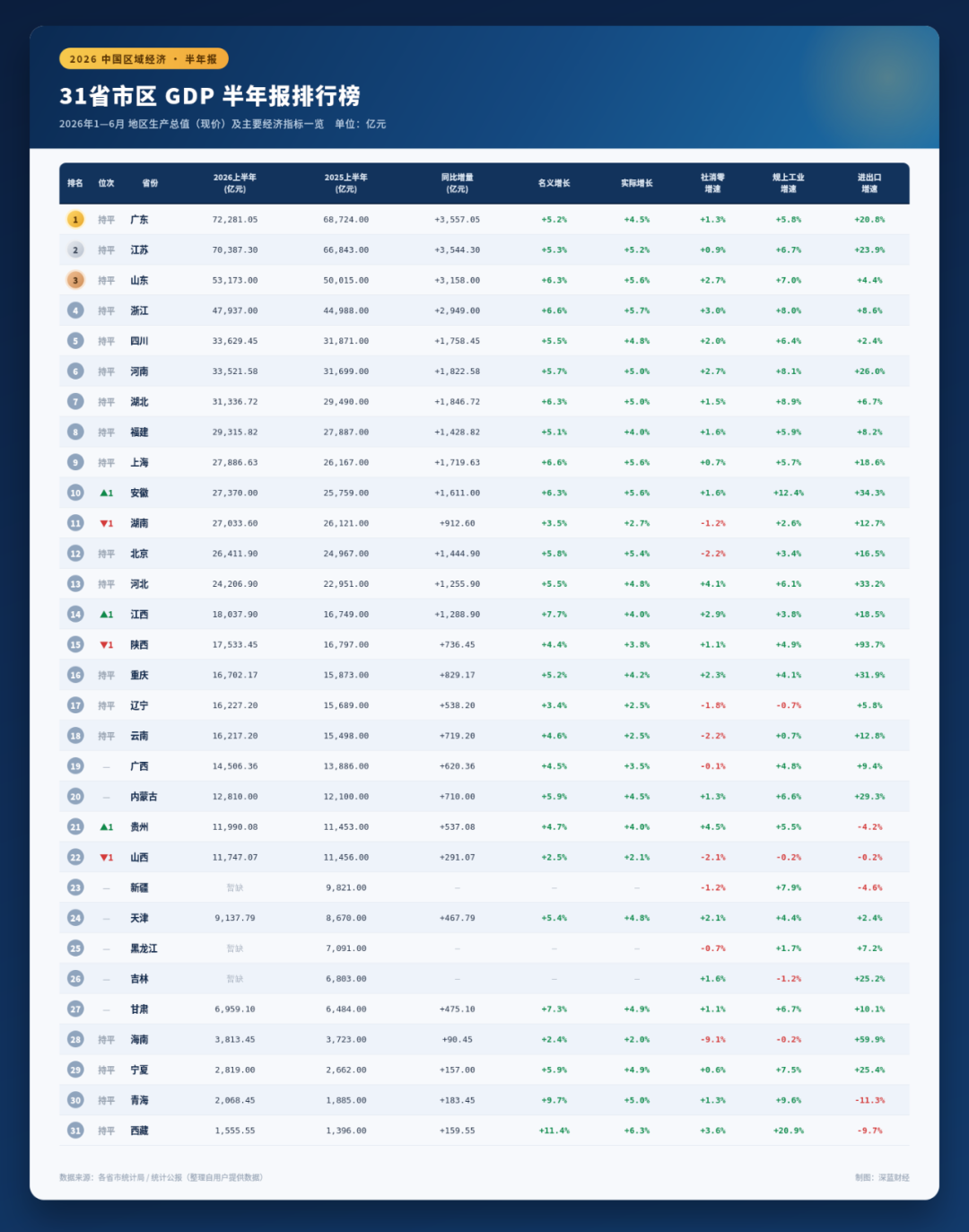
As of today (the 25th), 28 provinces across China have released their first semi-annual reports for the '15th Five-Year Plan' period. The biggest news isn't that Guangdong and Jiangsu continue to battle it out at the top, but that Anhui has finally overtaken Hunan, making a historic entry into the national top 10.
This reshuffle in provincial economies is more than just a change in numbers—it represents a complete shift in industrial logic. The semi-annual reports clearly reveal who is winning the transition to new growth drivers and who is still struggling in old sectors.
1. Guangdong-Jiangsu Rivalry: Defending the 'Base' and Pursuing 'Incremental Growth'
Guangdong and Jiangsu have long dominated the top two spots, with economies large enough to rival many developed nations.
In the first year of the '15th Five-Year Plan' period, Guangdong, the 'economic leader,' released three impressive indicators for the first half of the year: a 4.5% growth rate, the highest for the same period in three years; its economic output surpassing 7 trillion yuan for the first time in six months; and its nominal GDP increment reclaiming the top spot among the top 10.
Behind these numbers, Guangdong's success lies in its stable 'base' and powerful 'new engines.'
Foreign trade remains Guangdong's cornerstone. In the first half of the year, its imports and exports reached 5.49 trillion yuan, up 20.8%. Notably, this marks the first time Guangdong's foreign trade has surpassed 5 trillion yuan in the same period, with June's trade volume exceeding 1 trillion yuan for the first time in history. Its significance needs no further explanation.
Nationally, while Guangdong's foreign trade growth rate isn't the highest among the top 10, it accounts for 21.6% of the national total and contributes 25.6% of the national increment in foreign trade, ranking first in share, increment, and contribution.
AI is the main driver behind Guangdong's foreign trade dominance. Guangdong alone accounts for one-fourth of China's AI core industry scale, making it a clear beneficiary of the AI boom.
Shenzhen's AI-related product imports and exports exceeded 1 trillion yuan, growing by over 50%; Guangzhou boasts the largest 12-inch wafer cluster in South China, with a complete computing power industry ecosystem; and Dongguan accounts for half of the global AI glasses shipments.
In the first half of the year, Guangdong's computing hardware exports saw significant growth, with integrated circuit exports reaching 266.7 billion yuan, up 61.4%, and computer and component exports reaching 246.12 billion yuan, up 14.6%—clearly, AI is profoundly reshaping Guangdong's industrial landscape.
While Guangdong maintains its lead in GDP, Jiangsu is closing in fast.
In recent years, the annual GDP gap between Jiangsu and Guangdong has narrowed from 745.1 billion yuan in 2023 to 349.5 billion yuan in 2025. In the first half of this year, the GDP gap between the two provinces remained tight at just under 200 billion yuan. Last year, the gap was 188.1 billion yuan for the same period, and this year it was 189.375 billion yuan, with a fluctuation of just over 1 billion yuan.
This momentum comes from Jiangsu's solid manufacturing base, particularly in equipment manufacturing. The province now has 14 national advanced manufacturing clusters, covering all 13 prefecture-level cities.
Built on this strong manufacturing foundation, Jiangsu's equipment manufacturing added value grew by 9.1% year-on-year in the first half, contributing 76.5% to the growth of all industrial enterprises above a designated size. Specifically, the computer, communication, and other electronic equipment manufacturing sector grew by 15.9%; the instrumentation manufacturing sector by 12.7%; and the railway, ship, aerospace, and other transportation equipment manufacturing sector by 11.0%.
With this momentum, Jiangsu remains a strong contender for the title of 'China's largest provincial economy by GDP.'
2. Anhui-Hunan Swap: New Track Ascendancy and Old Growth Pains
The most significant positional change among the top 10 provinces in the first half came at the 10th spot. Anhui, with 2,737 billion yuan, overtook Hunan's 2,703.357 billion yuan, entering the national top 10.
This marks Anhui's second consecutive advancement after surpassing Beijing in 2022, rising from 12th to 11th place. However, this latest overtaking of Hunan to enter the top 10 has been long in the making.
In the first quarter of this year, Hunan's GDP growth rate was just 3.0%, ranking second-to-last nationally and bottom among the top 10 provinces. Meanwhile, Anhui's growth rate reached 5.8%, narrowing the GDP gap between the two provinces to around 14 billion yuan. Now, with the semi-annual reports out, the rankings have been thoroughly reshuffled.
The core driver behind Anhui's ascent is industry—more precisely, new quality productive forces.
Anhui's industrial added value for enterprises above a designated size grew by 12.4% in the first half, far ahead of other top 10 provinces, with Hubei ranking second at 8.9%. Specifically, Anhui's computer, communication, and other electronic equipment manufacturing sector surged by 61.6%, while its automotive manufacturing sector grew by 29%.
As the top automotive-producing province, Anhui led the nation in both automotive production and exports in the first half. The province produced 1.6867 million vehicles, exporting 1.006 million units, generating 104.36 billion yuan in value.
Not just in automotive—CXMT, BOE, NIO... These early 'bold venture investments' have now grown into towering trees. From memory chips to new display technologies, from new energy vehicles to artificial intelligence, Anhui has formed two trillion-yuan industrial clusters in next-generation information technology and equipment manufacturing.
Now, the province has turned industrial trends into solid economic data. In the first half, Anhui's foreign trade growth rate reached 34.3%, leading the top 10 provinces. After a decade of effort, Anhui has shed its 'low-profile' image and become a hotbed for tech startups.
In contrast, Hunan's GDP growth rate was just 2.7% in the first half, still bottom among the top 10 provinces, with its social consumer goods retail growth at -1.2%, the only negative growth in the group.
Hunan's challenges, as directly stated in views reposted by the Hunan Provincial Bureau of Statistics, are clear: Why the slowdown? It's not due to 'illness' but 'shifting gears'—'the old is declining, and the new hasn't fully taken over yet.'
On one hand, Hunan's traditional Advantage industries like construction machinery, rail transit, and tobacco are undergoing deep adjustments. On the other, while emerging industries like next-generation information technology and intelligent weighing and metrology are growing rapidly, their scale remains relatively small, with limited driving effect.
Turning around an elephant takes time. However, Hunan is accelerating its steps to foster new growth within its existing industrial foundations. Leading enterprises in construction machinery, rail transit, and other sectors are actively stepping out of their comfort zones to find second growth curves.
Sany Heavy Industry is comprehensively advancing its electrification transformation, with large batches of electric heavy trucks going overseas, securing the largest single export order for similar domestic products. Zoomlion is using decades of accumulated process and scenario data from excavator manufacturing to develop humanoid robots, drawing high attention at international industrial exhibitions. CRRC Zhuzhou Institute is applying mature high-speed rail electric control technologies to offshore wind power equipment, remaining in the domestic first tier...
It can be said that while Hunan's economic 'base' remains intact, its industrial transformation still requires time for phased adjustment.
3. Latest Signals: Long-Term Logic Drives the Reshuffle
Looking ahead, the ranking changes among the top 10 provinces become clearer. In recent years, besides Anhui, Sichuan and Hubei have also made significant progress. Looking to the future, these two central and western provinces hold even greater potential.
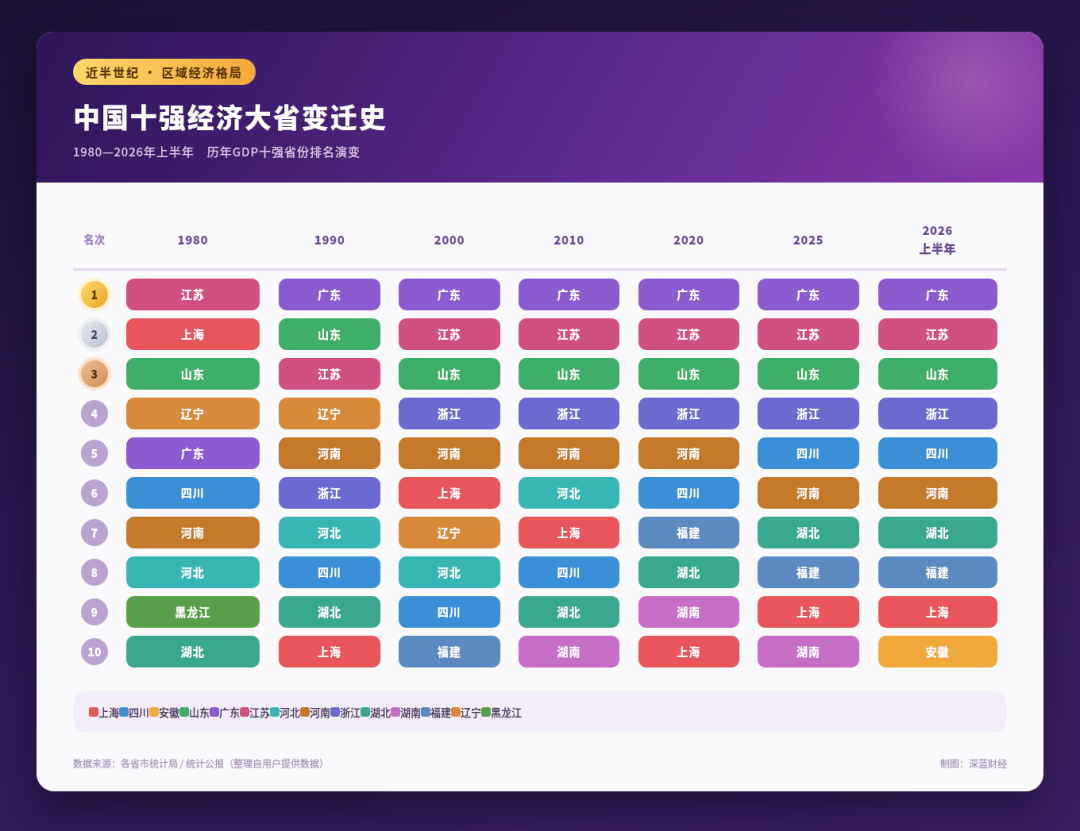
Sichuan's economic output has already risen to 5th place nationally. Throughout the '14th Five-Year Plan' period, the province maintained an average annual growth rate of 5.7%, surpassing two trillion-yuan thresholds in economic output to exceed 6 trillion yuan, solidifying its position as the top economy in western China. However, future long-term opportunities suggest Sichuan may soon see another leap forward.
Why? As global geopolitics shift and industrial iteration accelerates, the world is turning its attention to energy security and AI computing power—areas where Sichuan holds strong cards.
In the first half, the province's green and low-carbon advantage industries grew by 9.9%, with the power battery and vanadium-titanium industries growing by 36.7% and 17.8%, respectively. Lithium battery production increased by 62.7%, hydroelectric generator sets by 31.2%, hydrogen production doubled, and solar power generation grew by 44.7%—all 'production capacities' highly needed for future industries.
This is just the beginning. As 'computing power follows electricity' becomes the new logic of the AI era, Sichuan naturally serves as a computing power base. Going forward, Sichuan's opportunities will follow long-term logic—green energy advantages may not monetize quickly, and computing power relocation westward will take time. But investments are already voting with their feet:
In the first half, Sichuan's green and low-carbon advantage industry investments grew by 14%, with crystalline silicon photovoltaic industry investments up 17.5% and power battery industry investments surging by 71%. These investments are likely to translate into future economic growth potential.
Hubei, meanwhile, has staged a 'V-shaped recovery' in recent years. After a decline in 2020 due to the pandemic, it rebounded strongly thanks to its 'optics, chips, displays, terminals, and networks' industrial cluster. Looking ahead, Hubei remains a 'long-term potential stock.'
Because the hotter AI gets, the more expensive computing power becomes; and the more expensive computing power is, the more valuable 'light' becomes. In the first half of this year, Hubei's computer, communication, and other electronic equipment manufacturing added value surged by 63.8%, directly reflecting this logic.
Now, Hubei holds the world's largest optoelectronic communication R&D and production base—Wuhan 'Optics Valley.' From a single fiber to a bundle of brilliant light, from a handful of small enterprises to 16,000 optoelectronic information companies in Optics Valley... The world is 'chasing light,' and Hubei stands right in it.
Wuhan alone supports half of China's optoelectronic industry. From optical chips to modules, from storage to transmission, Hubei's industrial chain leaves almost no gaps. This isn't explainable by short-term trends—as AI moves from concept to infrastructure, 'light' becomes the steel and concrete of next-generation infrastructure, and Hubei will inevitably be an unavoidable name in this chain.
Looking ahead to the '15th Five-Year Plan' period, industrial iteration will never stop, and neither will the reshuffling of provincial economies. For provinces like Sichuan and Hubei, future growth will follow long-term logic. And long-term logic is never about winning or losing in a single city or season—it's about the fundamentals over five or ten years.
Rankings are temporary; industries are long-term. The first-half data proves one thing: In today's China, there are no 'perennial runners-up' or 'immutable top 10.' Whoever continuously invests in new tracks will seize the initiative in the next reshuffle.
The old growth model is receding, and new industrial logic is emerging—this major reshuffling has only just begun.
*Disclaimer: The views expressed in this article are solely those of the author. Market risks exist; invest cautiously. Under no circumstances shall the information or opinions herein constitute investment advice to any individual.
Shenlan Finance New Media Cluster, originating from the Shenlan Finance Journalist Community with a 16-year history, is a well-known domestic finance new media outlet. Its accounts focus on China's most valuable companies, cutting-edge industry developments, and emerging regional economies, providing valuable content for investors, corporate executives, and the middle class. Welcome to follow.
-
![]()
Used Cars Step into the Limelight Alongside New Cars: What Does This Trend Indicate?
-
![]()
After 20 Million Vehicles, How Can Chery Conquer the 'Brand Value' Challenge?
-
![]()
Xiaomi Pengcheng Set to Unveil Two New Models at Launch Event!
-
![]()
Can Beijing Hyundai Make a Comeback?
-
![]()
Still Thrivings: Top Fuel-Powered Cars with Over 10,000 Sales in June
-
![]()
Surprise! 17 Fuel-Powered Vehicles Surpass 10,000 Units in Sales for June
-
![]()
Mercedes-Benz Halts Production of Electric CLA L in China Less Than a Year After Launch
-
![]()
China's Top 10 Provincial Economies: A Major Reshuffle Underway