Shocking! 60 Car Models Fail to Reach Double-Digit Sales in Six Months
 07/27 2026
 368
368
Introduction
In the automotive market, less than 10% of car models dominate the majority of industry sales and revenue. Fewer than one in ten products can consistently generate commercial benefits for automakers.
"Only 40 models have monthly sales exceeding 10,000 units, yet 60 models have sold fewer than 10 units in half a year. It's shocking," remarked an industry insider recently after the release of first-half sales figures.
After all, with numerous new car launches in the first half of the year, one would anticipate more successful models and fewer underperformers. The fact that the number of successful models with monthly sales exceeding 10,000 units is outnumbered by underperformers is indeed startling.
According to statistics, 701 new car models (including new models, facelifts, and additional variants) were launched domestically in the first half of the year, with a total of 768 models recording terminal sales. The overall supply of models is abundant, covering various segments and price points. However, among the vast array of models, very few have managed to establish a strong market presence and sustain high sales volumes.
Data indicates that only 40 models achieved average monthly sales exceeding 10,000 units in the first half of the year, accounting for just 5.2% of the 768 models. In other words, less than 10% of car models in the market account for the majority of industry sales and revenue, with fewer than one in ten products truly capable of sustainably generating commercial benefits for automakers.
In stark contrast to the scarcity of successful models, the market is inundated with underperformers. In the first half of this year, a staggering 60 models in China recorded cumulative sales in the single digits, effectively detaching themselves from the mainstream consumer market and becoming marginalized products.
01 Arms Race Amid Industry Anxiety
The overall decline in auto market sales in the first half of 2026 is concerning, a situation last seen in 2018.
However, the downturn in the auto market has not slowed down the pace of new car launches. Reports indicate that 701 new car models were launched domestically in the first half of the year, covering various categories such as passenger vehicles, small trucks, and vans.
Specifically, no new models were launched in January, with 44, 167, 208, 142, and 140 new models launched from February to June, respectively. On average, 3.8 new models were introduced to the market daily in the first half of the year. Excluding January, the daily average surged to 4.7 models from February to June, with multiple new products arriving almost every day.
Even in the second half of the year, the trend of intensive new car launches continues. For instance, on July 16th alone, seven new models were unveiled, even trending on social media with the hashtag #July16thAutoLaunchFrenzy.
Behind the frenzy of new car launches lies the anxiety of operating in a saturated market.
As we all know, in today's era of "unprecedented changes in a century," apart from technological advancements and shifts in energy forms, the pace and intensity of the auto market's competitive race are also accelerating. The disruption of old patterns and the establishment of new ecosystems can happen suddenly. For industry players, ensuring product updates and maintaining a market presence is paramount. As someone once lamented, "The saddest thing is not that no one buys your car, but that no one remembers your brand."
At the same time, in the industry's ingrained mindset, the strategy of "launching more models to gain a competitive edge" is a common approach to capturing market share. Many automakers hope to enrich their product portfolios and participate in this arms race to capture consumer attention and market share.
However, this approach has proven ineffective in 2026. As mentioned earlier, with nearly four new models launched daily and only 40 successful models with monthly sales exceeding 10,000 units, accounting for less than 6% of the 768 models with recorded sales, over 90% of new offerings end up as industry underperformers.
Clearly, the influx of a vast number of new models has not revitalized the market but instead intensified internal competition within the industry. Coupled with the overall market contraction, the auto market's downturn has further deepened.
As a result, we've seen cumulative retail sales of narrow passenger vehicles in China reach 8.701 million units in the first half of the year, down 20.2% year-on-year. Monthly data is equally lackluster, with retail sales of narrow passenger vehicles reaching 1.602 million units in June, down 23.2% year-on-year, and the downward pressure on the market continuing to mount.
Even the new energy vehicle (NEV) market, which once drove industry growth, has ended its rapid growth phase and seen a significant decline. Specifically, retail sales of NEVs reached 4.704 million units in the first half of the year, down 14% year-on-year. The traditional fuel vehicle market continues to languish, with sales steadily shrinking.
With the overall market pie shrinking but automakers increasing their new product launches, the imbalance between supply and demand has intensified competition in the industry to a fiercer level. Subsequently, a large number of homogeneous, core-technology-lacking, and differentiation-deficient models are trapped in a quagmire of high inventory and sluggish terminal sales. This explains why only 40 models have monthly sales exceeding 10,000 units, while 60 models have sold in the single digits in the first half of the year.
02 Most New Cars Are Destined to Be Underperformers
Despite the flurry of new car launches, very few products have managed to break through.
According to incomplete statistics, at least 40 new passenger vehicle models were launched in the first half of this year, with market performance showing a clear three-tier stratification. Among them, models with monthly sales exceeding 5,000 units account for 35%, those with sales between 2,000 and 5,000 units account for 30%, and weak models with monthly sales below 2,000 units also account for 35%. What's even more noteworthy is that about one-third of the new models experienced a month-on-month decline in sales during their initial launch period, with the market's tolerance for new products dropping to an all-time low.
From the June sales rankings, it's evident that market influence is largely wielded by established best-selling models. Currently, almost all models in the top 30 sales rankings are successful products that already existed in 2025. In contrast, only one new model launched this year, the Leapmotor A10, has made it onto the list, becoming a best-selling new car in the first half of the year.
The majority of models that have managed to stabilize sales and maintain a market presence have achieved this through product facelifts and secondary breakthroughs.
For instance, the Xiaomi SU7 saw a sales boost after its facelift, becoming the top seller in the mid-to-large sedan segment. BYD's implementation of flash charging technology across its lineup drove a sales recovery for models like the Fangchengbao Titan 7. The new Wenjie M9 and new Li Auto L9 quickly regained their positions in the top tier of large SUVs after their facelifts.
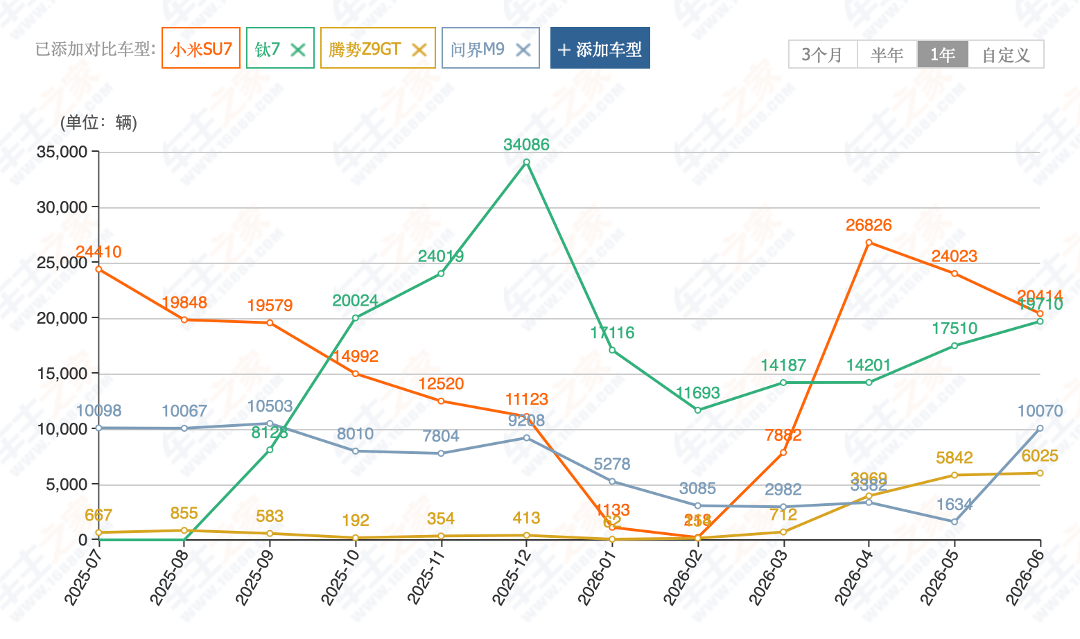
The Denza Z9GT is a prime example of a facelift leading to a turnaround. Previously, it consistently sold in the hundreds per month. The new version, by adding an entry-level variant and upgrading the chassis and range configurations, improved product cost-effectiveness, reversing the sales decline and becoming the brand's core volume model.
However, high-quality facelifts are rare. The majority of facelifts in the market are lightweight adjustments, merely optimizing details like exterior colors and wheel designs, lacking upgrades in core product competitiveness. For example, a certain boxy model only made styling adjustments in its new variant, with no improvement in sales after launch, selling only around 500 units in June, unable to escape the sluggish sales trap.
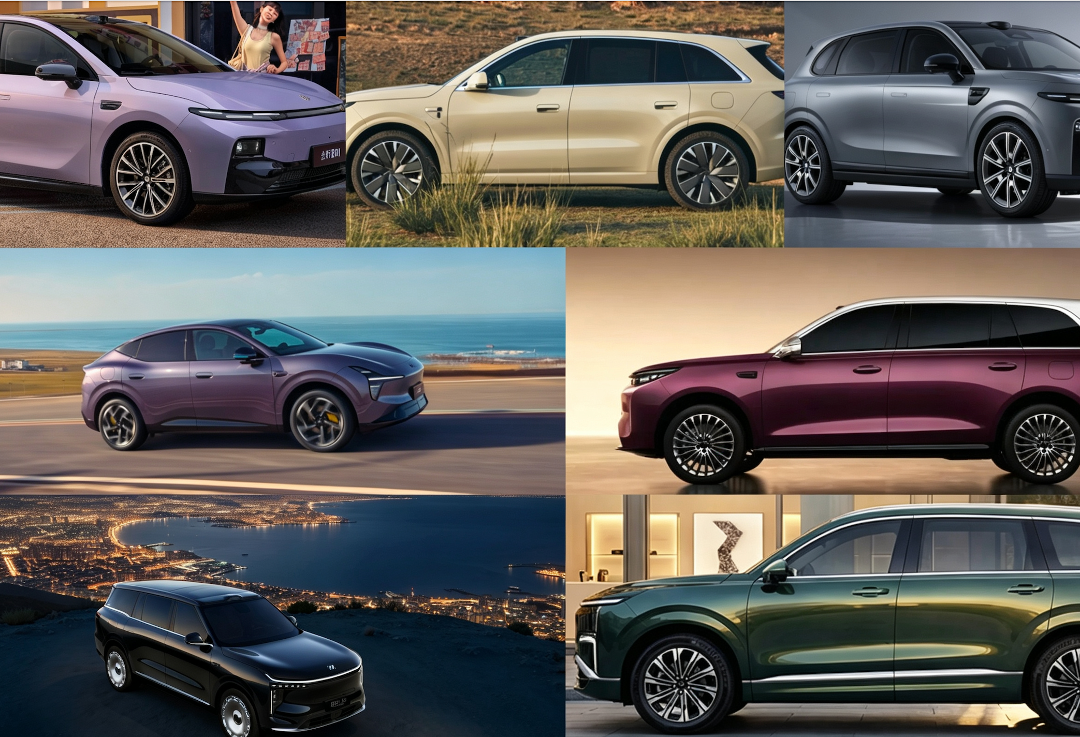
Among them, the highly anticipated "Battle of Full-Size 9-Series SUVs" in the first half of the year vividly illustrates the brutality of industry competition.
Seven new 6-seater full-size SUVs cover the price range from 150,000 to 600,000 yuan. The NIO ES9 and Leapmotor D19 achieved monthly sales exceeding 8,000 units within two to three months of launch, while the BYD Datang EV received over 100,000 pre-orders, showing promising potential. However, models like the WEY V9X and SAIC Volkswagen ID.ERA 9X have seen lackluster sales, with limited capacity in the niche market to accommodate multiple homogeneous high-end models.
Meanwhile, a large number of new models, with hundreds of millions of yuan invested in R&D and development periods exceeding two years, have seen their popularity fade within three months of launch, quickly becoming "cannon fodder." Previously, an auto executive publicly criticized industry chaos, stating that the current intensity of competition in the auto market has surpassed fierce and is trending toward pathological levels.
Of course, newly launched models are still in the production ramp-up phase, with their sales potential not yet fully unleashed, and some models may still break through. However, based on existing data, the extensive development model of "launching more models to gain a competitive edge" seems to have lost its effectiveness.
Therefore, for automakers, moving away from the current state of high-intensity, disorderly internal competition and instead focusing on a premium strategy, concentrating resources to create highly competitive successful models, may be the key to survival in today's saturated market.
Editor-in-Chief: Shi Jie Editor: He Zengrong

THE END
-
![]()
Used Cars Step into the Limelight Alongside New Cars: What Does This Trend Indicate?
-
![]()
After 20 Million Vehicles, How Can Chery Conquer the 'Brand Value' Challenge?
-
![]()
Xiaomi Pengcheng Set to Unveil Two New Models at Launch Event!
-
![]()
Can Beijing Hyundai Make a Comeback?
-
![]()
Still Thrivings: Top Fuel-Powered Cars with Over 10,000 Sales in June
-
![]()
Surprise! 17 Fuel-Powered Vehicles Surpass 10,000 Units in Sales for June
-
![]()
Mercedes-Benz Halts Production of Electric CLA L in China Less Than a Year After Launch
-
![]()
China's Top 10 Provincial Economies: A Major Reshuffle Underway