Summer Blockbuster Season Captures 3% Market Share: Panoramic Cameras Remain Outside Mainstream Imaging Trends
 08/13 2026
 515
515
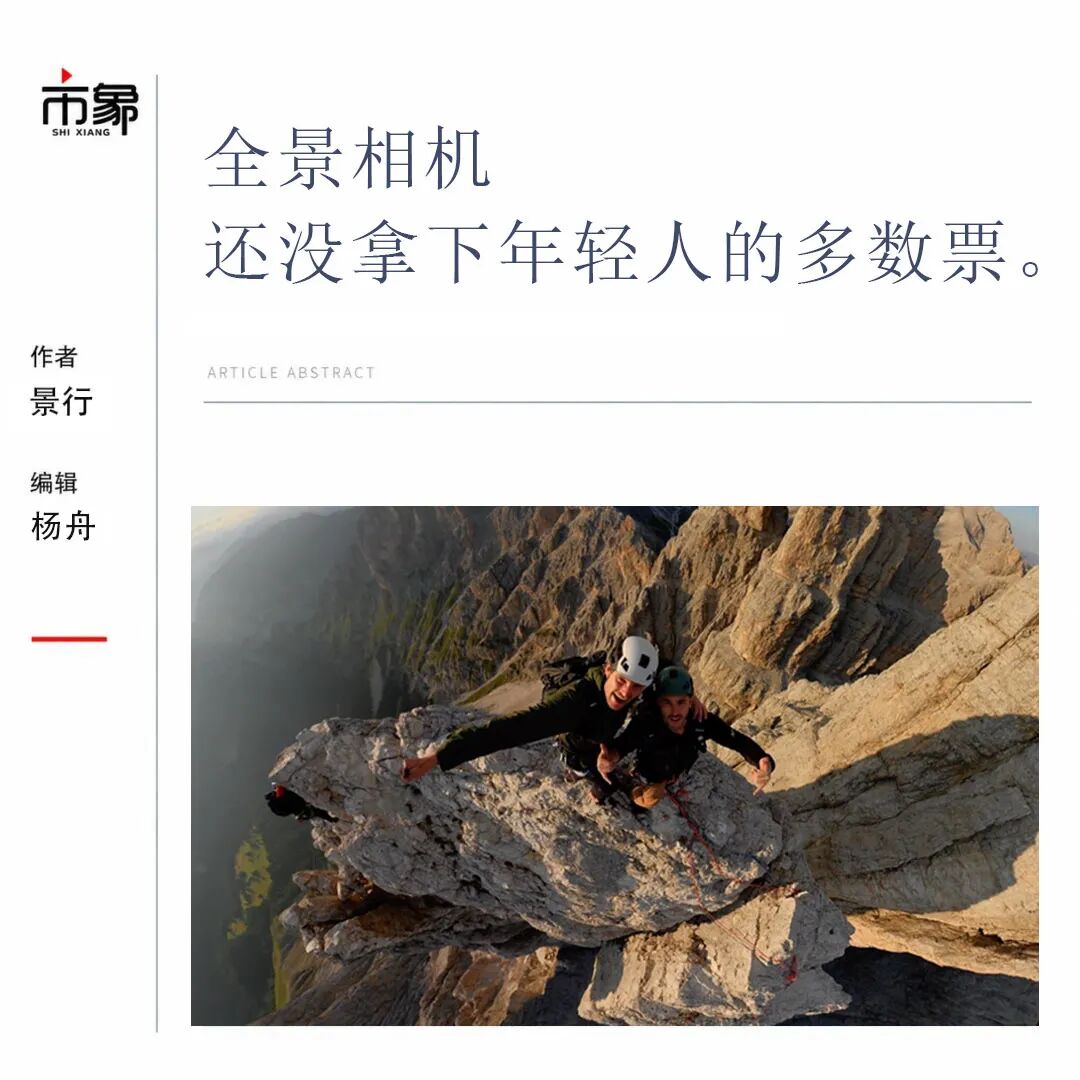
Amid the thrills of this summer, action cameras are enjoying a surge in popularity. From July to mid-August, the summer travel season has propelled the handheld smart imaging market from a period of growth cultivation to peak performance.
The entire handheld imaging sector is experiencing a notable upswing this year. According to IDC data, global shipments of handheld smart cameras reached 4.14 million units in the first quarter of 2026, marking a 33% increase year-on-year.
IDC predicts that the market will exceed 40 million units by 2030, boasting a five-year compound annual growth rate (CAGR) of nearly 18%. This growth stands out against the backdrop of a sluggish consumer electronics market, signaling a promising future for the sector.
However, beneath the surface excitement, a critical question arises: Where are consumers truly investing their money?
Data from LuoTu Tech for the summer travel season reveals that, in the 2026 summer online market for handheld imaging devices, the market share by product type was as follows: handheld gimbal cameras (Pocket) accounted for 61%, traditional action cameras (Action) for 27%, wearables for 9%, and panoramic cameras for a mere 3%.
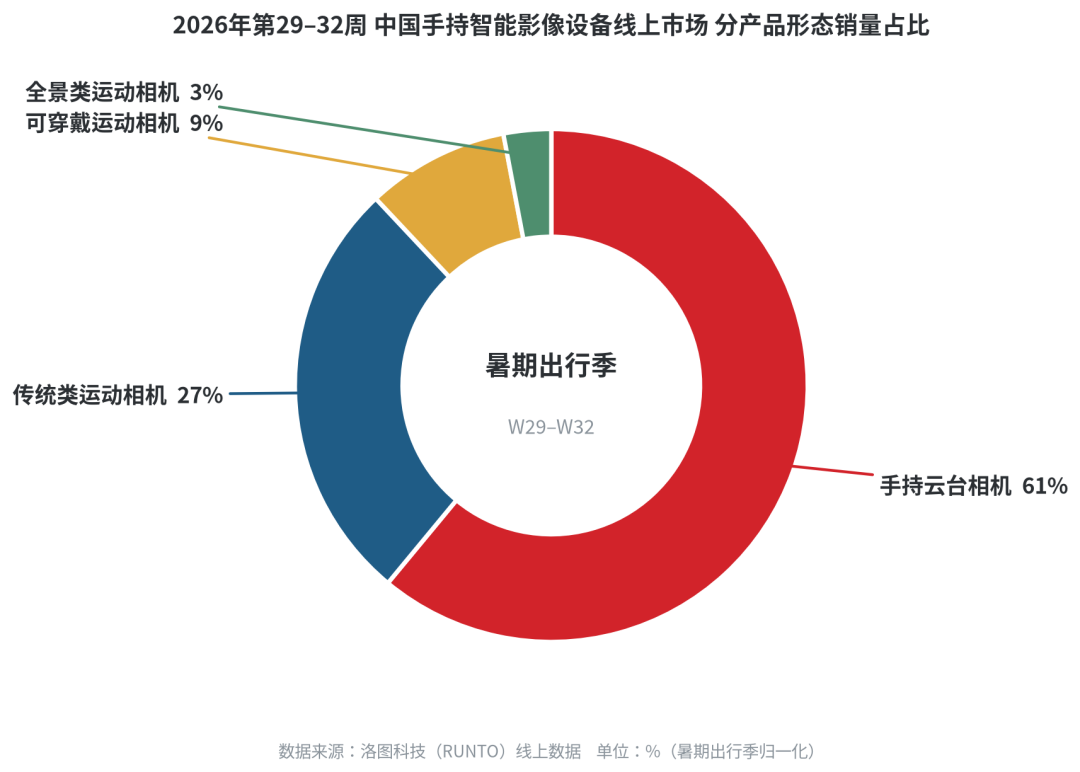
In essence, handheld gimbal and action cameras continue to be the primary drivers of the sector, with more consumers opting to spend their money on these mainstream products rather than panoramic cameras. 
88% vs. 3%: High Growth, Yet Low Market Share
From a sector popularity perspective, panoramic cameras are not lagging. Whether it's leading brands launching new products in August or the summer travel boom fueling imaging consumption, panoramic cameras are enjoying significant attention.

However, this does not mean that panoramic cameras have successfully entered the mainstream imaging market. Looking back at LuoTu Tech's long-term tracking data, panoramic cameras have consistently held less than 5% of the handheld imaging market, with online sales share at just 3% even during the peak summer season.
This creates a unique paradox: high sales growth but low market share.
The underlying logic is that when a category experiences consistent growth that outpaces the market while its share remains stagnant or even declines, it indicates market recognition of product performance, an increase in the absolute size of the category, and an expansion of the vertical user base.
However, the lack of share growth suggests that the industry's growth is primarily driven by other products. The impact of action and gimbal cameras, which operate on a much larger base, contributes more significantly to overall growth.
The conclusion is clear: panoramic cameras are not penetrating the mainstream; instead, they are carving out their own vertical niche.
Over the past few years, panoramic camera manufacturers have pushed the boundaries with innovations ranging from high frame rates to advanced stabilization algorithms, maintaining high levels of R&D investment, marketing hype, and rapid iteration speeds. Yet, they have been unable to break through market share bottlenecks during peak seasons.
This issue is not about whether the products are perfect but rather that the potential user base limits the expansion of this niche category. Growth only indicates whether the vertical niche is fully tapped; market share reveals the actual size of the niche.
From a brand perspective, DJI dominated the online market this summer with an 80.5% share, primarily through its gimbal and action cameras, demonstrating a strong alignment between brand concentration and category concentration.
The question remains: Why have panoramic cameras been confined to the niche market? 
The Foundation of Handheld Imaging: Daily Demand
The true potential of handheld imaging is not solely determined by technological advancements but by the frequency of usage scenarios. This is why Pocket and Action cameras dominate.
The strength of the Pocket handheld gimbal lies in its simplicity: pull it out of your pocket, rotate the screen, power on in one second, seamlessly switch between horizontal and vertical shots with no complex operations, and maintain stable image quality without worrying about shaky hands. It encapsulates professional capabilities in minimalist operation, making the user barrier to shooting nearly zero.
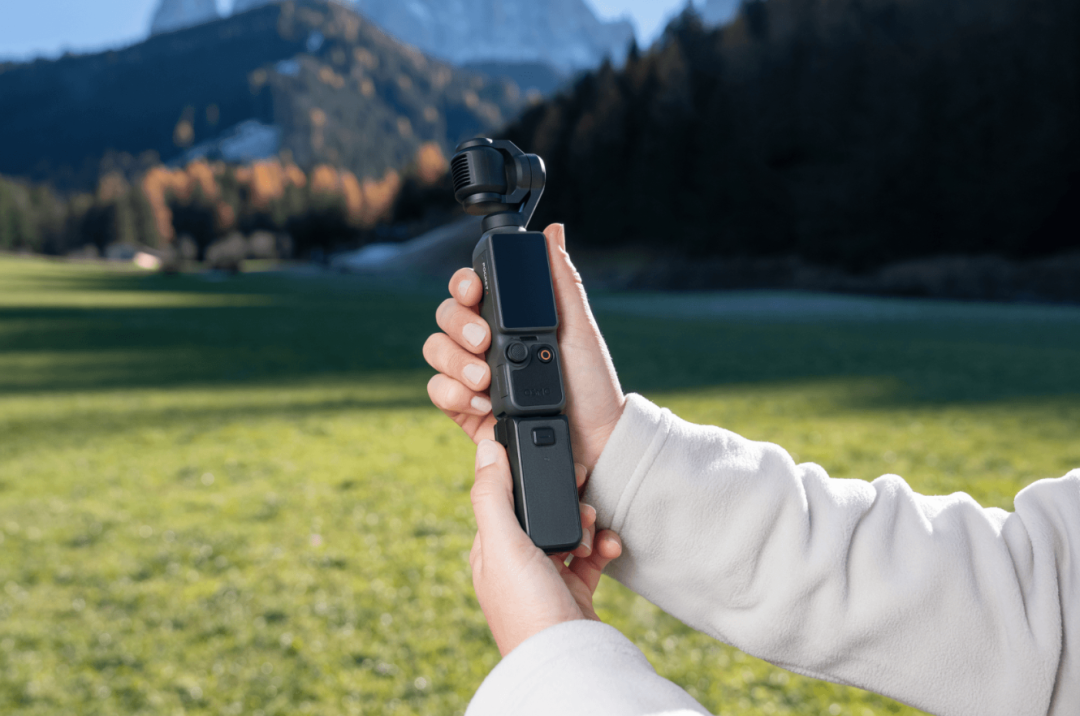
It caters to scenarios with common features—clear subjects, fixed perspectives, and users seeking stable, visually appealing results.
Examples include capturing outfits while shopping, documenting street views while traveling, recording a concert stage, or photographing pets or children at home on weekends. Users don't need to create special scenarios; they can shoot immediately.
Action cameras operate similarly, with core strengths in waterproofing, shock resistance, dustproofing, and low-temperature tolerance. These features enable fixed-position first-person shooting without intervention, minimizing usage costs in specialized scenarios.
Action cameras address another high-frequency scenario: stable first-person recording in complex motion environments.
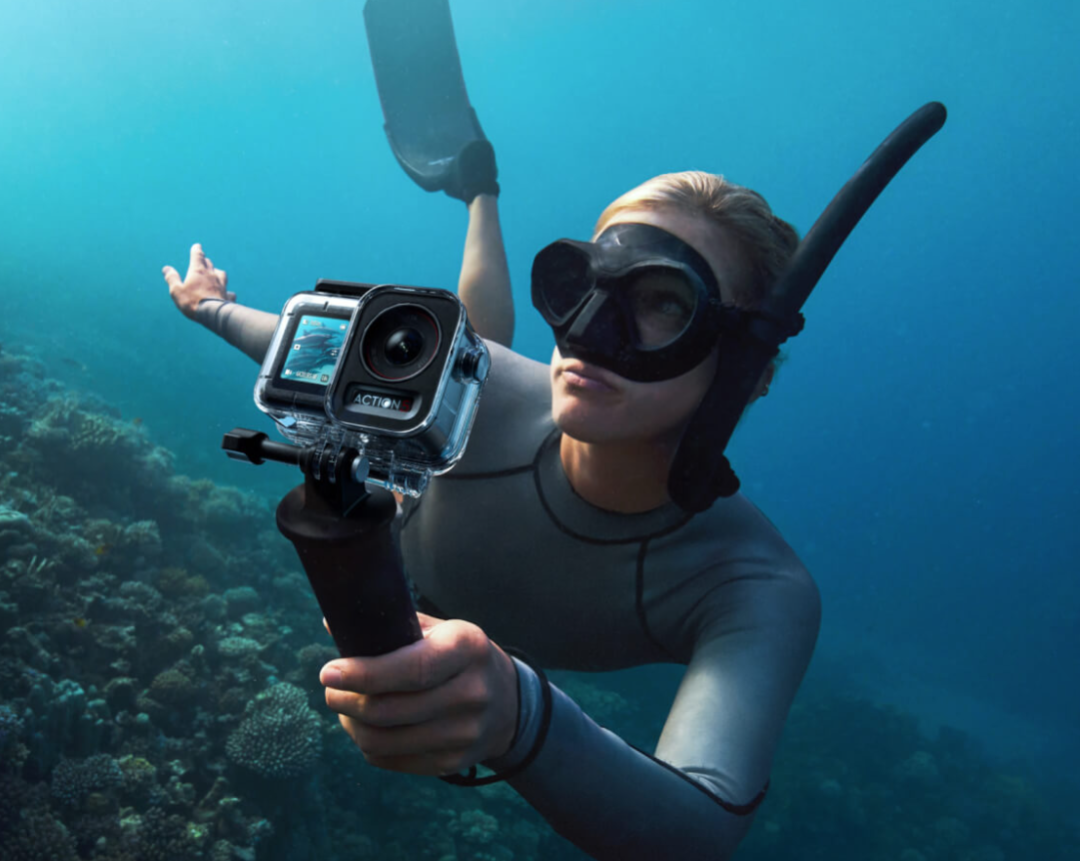
Examples include skiing, surfing, skydiving, and cycling. These scenarios don't require creative composition but demand simple, durable equipment that can withstand bumps, water, and drops while recording at the press of a button, producing stable footage when mounted on helmets or handlebars.
While their usage scenarios differ, both types of cameras share a key trait: users know exactly when they need them.
This is the most crucial difference between mainstream and niche products. Mainstream products may not have the flashiest features but often have more frequent, repeatable, and self-explanatory usage scenarios.

The Barrier for Panoramic Cameras: Post-Capture Challenges
Panoramic cameras excel in first-person extreme sports recording and creative special effects shorts, emphasizing shoot-first, frame-later, 360° capture, and invisible selfie stick effects to achieve immersive perspectives unattainable with conventional devices.

However, for most consumers, such scenarios are rare. Extreme sports already have strict participation requirements, and creative videos are unsuitable for everyday user creation.
This limits the penetration of panoramic cameras. Despite being the most engineering-complex of the three categories, complexity does not guarantee consumer buy-in.
Most ordinary users don't need to capture full spherical footage; they just want to photograph what's in front of them.
This explains why creative content often sparks social media buzz but fails to convert viewers into buyers.
Panoramic cameras prioritize raising creative ceilings, offering more possibilities for works. However, most ordinary users don't need 360° capture + post-framing; they want to shoot immediately, with good results, and share on social media.
Another barrier to consumer adoption lies after recording stops, when the true challenges of panoramic cameras emerge.
The first challenge is time.
Pocket and Action cameras deliver finished content immediately. Footage is ready to share. Panoramic cameras, however, subvert this logic: capture everything first, then import footage, select angles, choose keyframes, adjust perspectives and motion paths, and finally export and edit planar footage.
The advantage of not needing to compose during shooting does not mean users avoid decisions; it delays composition to post-production.
This means a longer creative path. For professionals, it offers greater freedom, but for those seeking immediate results, delayed output dampens sharing enthusiasm.
The second challenge is storage and computing power.
Dual sensors and spherical recording requirements mean panoramic cameras generate far more data and require higher pixel redundancy for output than single-lens cameras.

To rotate perspectives freely in post-production while retaining clear local images, panoramic cameras often shoot at 7K or 8K resolution. Exporting a small portion of planar video requires accepting multi-gigabyte file sizes.
This demands higher-spec storage cards and larger computing spaces on phones or computers for editing.
An ordinary phone can smoothly edit 4K planar video from a Pocket but may lag with equivalent-duration panoramic footage. Users don't get stuck on the camera but during editing—the final mile to finished content.
The third challenge is structural trade-offs in image quality.
At the same price point, with similar sensors and total pixel counts, ordinary single-lens cameras concentrate pixels on one perspective, while panoramic cameras spread coverage across the entire sphere.
For single-angle shots, panoramic cameras must cover a larger area, diluting limited pixels and optical capabilities across a wider field of view. When users output footage, effective resolution is inherently lower than comparable planar devices.
Manufacturers can optimize stitching algorithms and multi-frame synthesis, but physical limits remain. Consumers perceive that panoramic cameras underperform single-lens models in image quality at the same price.
Finally, there's the decision-making cost.
This is both the charm and pain point of panoramic cameras: no need to compose during shooting, 360° capture. But the trade-off is redoing composition during editing, with no reduction in total decisions—only delay.
Potential workload may even increase.
Faced with footage containing infinite editing possibilities, every frame requires user decisions. For users accustomed to shoot-and-share, this forcibly splits shooting from sharing, inserting a mandatory manual step.
These four challenges explain the paradox of panoramic cameras: high popularity, weak repurchase rates, and slow word-of-mouth diffusion. For young users, most don't need to capture more footage but to shoot more effortlessly.
Panoramic cameras are most likely destined not to become the next mainstream handheld imaging track but to evolve into a capability within mainstream products.
When panoramic stitching algorithms, AI framing, and invisible selfie sticks mature enough, become compact enough, and cost little enough, panoramic cameras may integrate into the next generation of mainstream products.
In this industry evolution, panoramic cameras will play a niche role, not a mass-market one. They have unique value—first-person extreme sports, creative multi-angle storytelling, VR content capture—but for mass consumption, Pocket and Action cameras already dominate daily device roles.
-
![]()
China Mobile Reports 538 Billion Yuan in Revenue for First Half of the Year, with 5G Subscribers Surpassing 687 Million
-
![]()
Domestic Wi-Fi Chips Usher in Prime Era
-
![]()
HONOR Unveils Robot Phone, Yet AI-Driven Smartphones Still Await Market Breakthrough
-
![]()
Jiemei Technology Splurges 915 Million Yuan, Making a Bold Move into Optical Ultra-Precision Equipment
-
![]()
Intensifying Investment in Advanced Coating Equipment: Landun Optoelectronics Aims to Secure Majority Stake in Lanchuang Technology
-
![]()
Honor’s Ambition Demands More Than a Gimbal-Equipped Phone
-
![]()
IIHS Latest Fatality Report: Small Cars and Muscle Cars Are the 'Deadliest,' While Large Pickups Pose the Greatest Threat to Others
-
![]()
Can Leapmotor Sustain Its Leadership with a Low-Price Strategy?