Ali Qianwen's Public Beta Launch: A 380 Billion Yuan AI Venture
 11/21 2025
 678
678

By Haishan
Source: Bowang Finance
The AI sector has witnessed the rise of DeepSeek, the sudden surge in popularity of Manus, and now the much-anticipated Ali Qianwen. Has AI technology truly reached a new pinnacle? Recently, the public beta version of the Ali Qianwen app was unveiled, making a full-fledged entry into the AI-to-C (consumer) market and igniting market enthusiasm. Meanwhile, Kuake has also fully integrated the Qianwen dialogue assistant.
01
Ali Qianwen: A Pleasant Surprise?
Let's first delve into why Ali embarked on developing this application.
According to The Paper, the product manager of the Ali Qianwen project offered a detailed explanation in an interview with the tech media outlet 'LatePost.' The timing for venturing into the consumer market is now ripe. On one hand, the model maturity of Qwen3-Max has attained a globally leading level in terms of overall performance and efficacy.
On the other hand, the maturity of the entire Agent ecosystem, whether within the third-party ecosystem or Ali Group's internal ecosystem, has reached a stage where models can be more universally employed to address a broader array of problems.
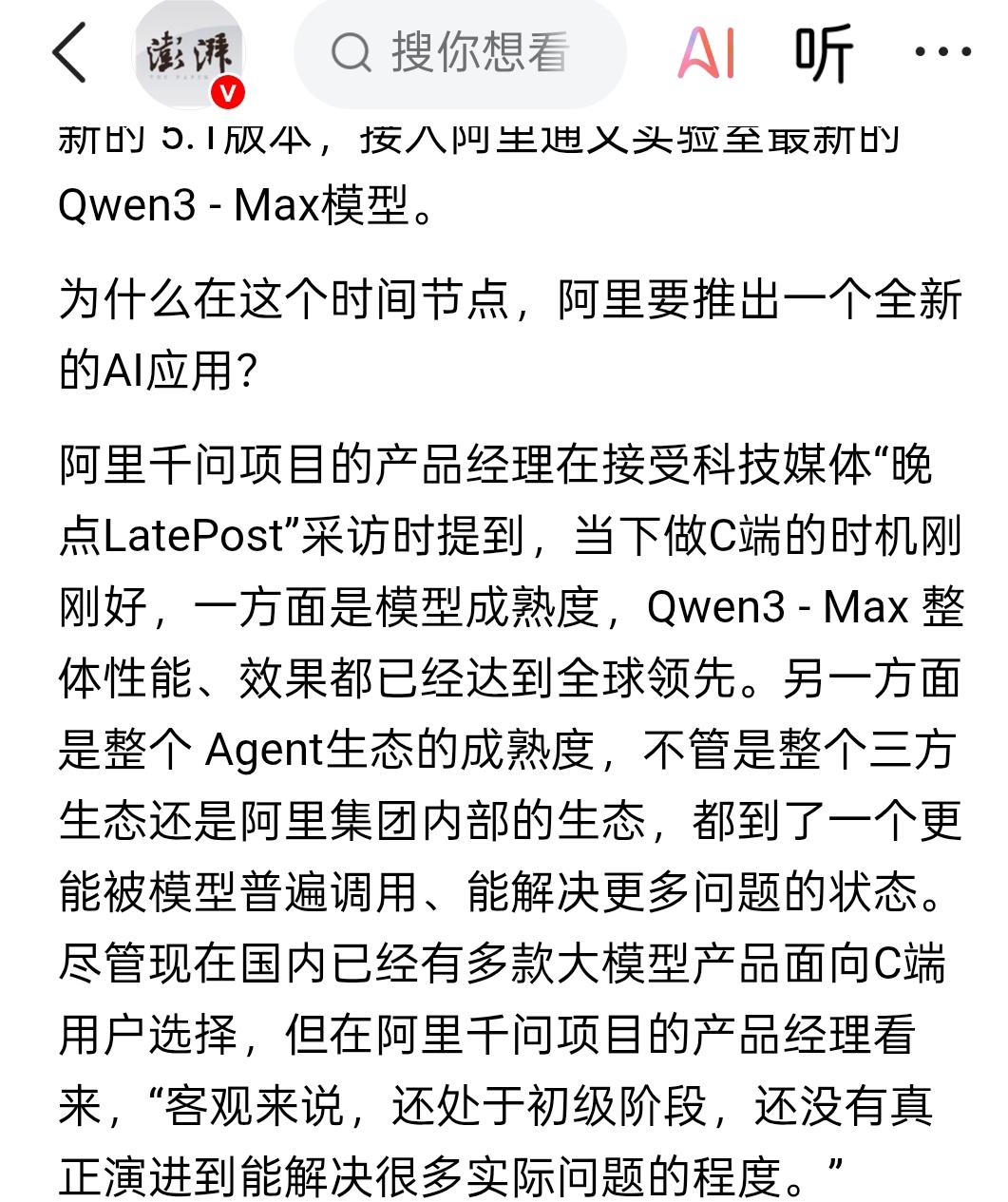
Objectively speaking, some argue that it is still in its nascent stages and has not truly evolved to the point of effectively resolving numerous practical issues. Looking back, whether it's large models or other AI applications, domestic companies are relentlessly striving to make strides in solving real-world problems.
For instance, earlier this year, Manus's AI agent application, hailed as the 'first universal AI agent for humans,' caused quite a stir. Its internal beta invitation codes were swiftly resold for nearly 100,000 yuan on secondary platforms. At that time, Manus's core selling point was its 'full-process autonomous execution.' However, actual user experiences revealed flaws: when faced with complex tasks (such as multi-step SEO optimization), the output reports were criticized as 'mechanical frameworks' lacking in-depth analysis of industry trends. The high level of hype led to a disparity between early user expectations and actual capabilities, with some scenarios still necessitating manual correction of output results. Additionally, the complex interface design and steep learning curve for operation procedures deterred some users.
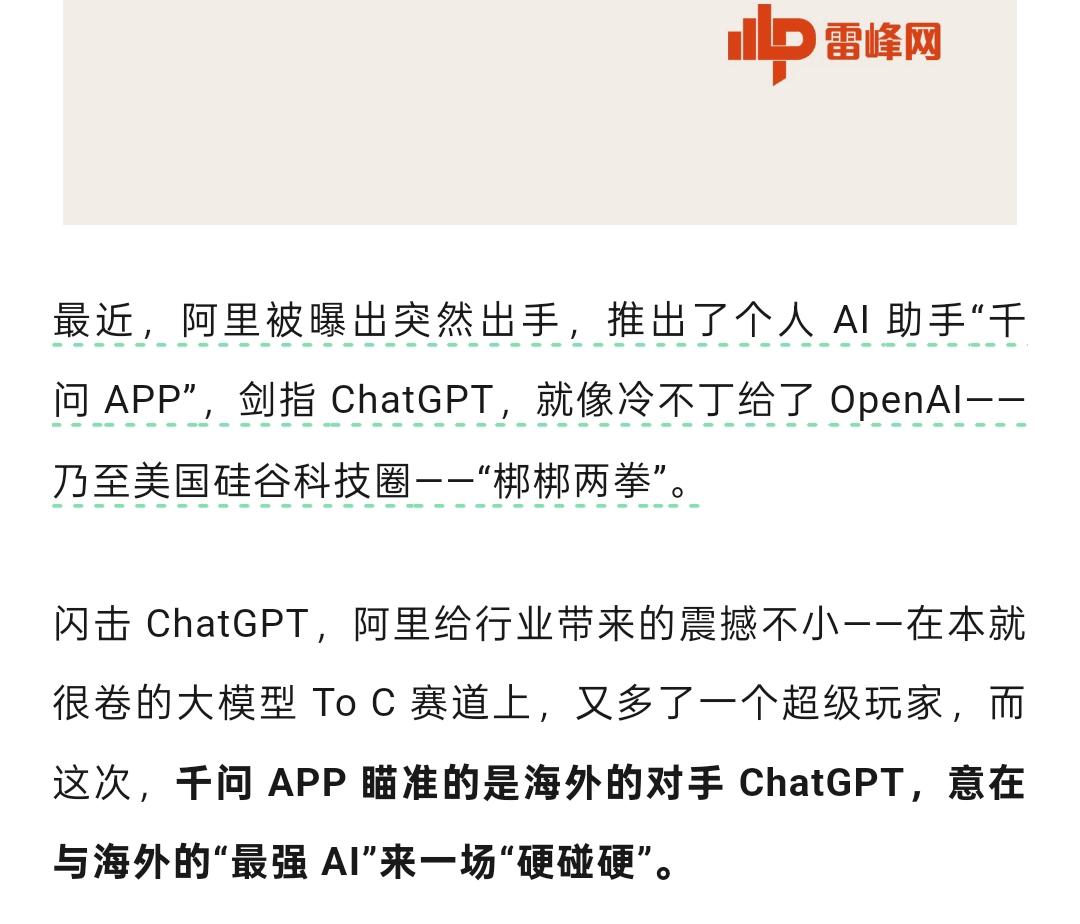
As an application launched by a major corporation, Ali Qianwen has received markedly different evaluations compared to the aforementioned company. In their view, Ali excels at problem-solving. According to Lei Feng Network, the Qianwen app is setting its sights on overseas competitors like ChatGPT, aiming for a head-to-head showdown with the 'strongest AI' overseas.
Data from Qimai reveals that on November 12th, the estimated downloads of the Qianwen app were 12,700, and by November 16th, this number had soared to approximately 34,800, currently still ranking high on the App Store's free chart. Through the Qianwen app, it can be observed that its interface layout is broadly similar to other native AI applications, featuring an interactive area at the bottom where users can input demands via both voice and text, as well as upload various materials such as images, documents, and recordings. Similar to other models, Qianwen also offers core functions commonly found in similar products, such as AI image generation, intelligent writing, photo-based problem explanation, and translation.
02
A More Far-sighted AI Strategy
From an industry perspective, many users hope that AI applications will adhere to a logic of 'autonomous execution of complex tasks → delivery of complete results.' The core of this closed-loop capability lies in a multi-agent architecture and cloud-based asynchronous connection processing, which differs somewhat from early AI large models. Most AI language models generate Q&A through searching, organizing, learning, reasoning, and generating. In contrast, complex applications can elevate simple Q&A dialogues to the next level after dialogue, achieving a new pinnacle of human-machine collaboration.
At the technical level, the entire industry seems to be at a stage where everyone possesses similar capabilities. However, returning to the public beta version of the Qianwen app, it can be considered another crucial stride in Ali's AI strategy after the company officially announced a 380 billion yuan investment in AI infrastructure earlier this year.
Public reports indicate that Ali plans to integrate full-scenario services such as maps, food delivery, ticketing, office work, learning, shopping, and health into the platform, enhancing its 'problem-solving capabilities' and clearly anchoring the two core goals of 'comprehensiveness' and 'ease of use.'
In terms of benchmarking against competitors, ChatGPT is currently the benchmark for a 'comprehensive and easy-to-use' AI application on a global scale. Ali's straightforward display of confidence in benchmarking against international first-class enterprises seems to aim at creating a 'comprehensive AI gateway' for China in the domestic market.
Domestically, there are players like Baidu, Tencent, ByteDance, Huawei, and DeepSeek. With numerous players participating, domestic large models have captured a significant market share through open-source, free strategies, and performance comparable to international mainstream models. However, there is severe homogenization among top AI applications, and the industry is still mired in early-stage chaos and a cutthroat competition for funding. The ultimate winner remains to be determined.
Nevertheless, Ali Qianwen does possess certain advantages at its own level.
For example, the latest 'China GenAI Market Insight: Panoramic Research on Enterprise-Level Large Model Adoption, 2025' released by international market research firm Frost & Sullivan shows that in the first half of 2025, the total daily average consumption of large models in China's enterprise-level market was 10.2 trillion Tokens, with Ali Tongyi accounting for 17.7%, ranking first. The performance and coverage of Ali's foundational models may, to some extent, bring value.
03
Accelerating the Commercialization of the AI Industry
Zooming out, this event holds significant implications.
Previously, QuestMobile's latest report indicated that in August 2025, native AI apps, in-app AI, and AI assistants from smartphone manufacturers continued to grow steadily, with user bases reaching 645 million and 529 million, respectively. In contrast, the PC side underperformed, with both web-based and client-based AI applications experiencing an 8.8% month-on-month decline in user numbers.
This implies that in the AI era, smartphone apps remain an irreplaceable core user gateway, while wearable devices like smart glasses and watches have yet to make a significant impact. This is precisely the core logic behind some major companies' recent focus on launching new mobile-end products. Only by swiftly capturing users and locking in market share advantages can they establish a solid foundation and seize the initiative in the fiercely competitive AI landscape.
Whether AI application products are targeted at consumers (C-end) or businesses (B-end), opinions on innovation vary among individuals. The public is more concerned with the underlying logic and core technologies, especially when it comes to a Chinese company. Most people have become accustomed to comparing such 'groundbreaking' technologies with previous or foreign enterprises. Without careful consideration, the first team to 'take the plunge' may face either widespread criticism or adulation.
Objectively speaking, Ali Qianwen's promotional effect on the entire AI industry cannot be overlooked, especially in terms of scenario implementation and ecological integration. More importantly, as various companies innovate in AI applications or other fields, it will ultimately benefit the further development of AI Agents (intelligent entities capable of perceiving the environment, making decisions, and executing tasks).
This viewpoint is not unfounded. The coming years are expected to be the inaugural year of Agent commercialization. Survey data from Deloitte indicates that by 2025, 25% of enterprises using generative AI will deploy AI Agents, and this figure is expected to grow to 50% by 2027. IDC similarly predicts that by 2028, at least 15% of daily work decisions will be autonomously made by Agentic AI, and 33% of enterprise software applications will incorporate Agentic AI.
Against this backdrop, many tech giants, including NVIDIA, Baidu, OpenAI, ByteDance, and Honor, have already launched various application entities based on their own technologies. For instance, Zhao Ming, the former CEO of Honor, claimed at the launch of the Honor Magic7 series that they had created the world's first operating system equipped with intelligent agents and derived the YOYO intelligent agent, even ordering 2,000 cups of coffee for the audience on site.
This implies that amidst the development of various AI software applications, intelligent agents have significant potential for growth and explosion. The execution effectiveness of Manus further demonstrates that higher-level AI Agents are not limited to generative AI dialogues and responses. They can mobilize end-to-end resources to fully comprehend various forms of human information, such as images, voice, and text, and form autonomous decisions in complex situations. Under an Agent collaboration framework, they can also collaborate with other intelligent agents (multimodal agents). For example, Manus's current practice of directly assisting people in stock and real estate investments reflects this to some extent.
This precisely confirms that the accelerated commercialization of AI technology may prove effective, especially in the paradigm shift from 'suggestion generation' to 'task execution.' For instance, in finance, healthcare, and manufacturing, intelligent agents can assist humans in many low-frequency work tasks (such as report generation and contract review), freeing up human resources for creative endeavors. There are also rich application scenarios in other fields like cultural tourism, education, and healthcare.
The boundaries of the artificial intelligence industry continue to be pushed. From the innovation and optimization of DeepSeek's underlying algorithms and training models to the launch of Ali Qianwen, it indicates that there is no one-size-fits-all definition for AI innovation. Industry progress is made through exploration.
-
![]()
Can a Small Car Priced at 63,900 Yuan Help Leapmotor Achieve Its Goal of 60% Overseas Sales?
-
![]()
Behind Two Renewed Agreements: Joint Venture Automakers Choose Long-Term Presence in China's New Energy Sector
-
![]()
Will Zunjie’s Launch of Two L3-Ready MPVs Spell the End of the ‘Price Markup Era’ for Alphard and Its Peers?
-
![]()
17 Strategies, 1.8 Billion Parcels, 12.5 Billion Yuan: Huizhou, Guangdong, Paves the Way for Autonomous Vehicle and Drone Delivery
-
![]()
Manus to Regain Independence, Former Shareholders Including Tencent to Repurchase Shares from Meta for $2 Billion
-
![]()
Starting at 99,900 yuan, the Updated Seal 06 Hits the Market. How Should Family Buyers Decide?
-
![]()
In-Depth Analysis of Volkswagen CARIZON’s Proprietary Intelligent Driving Technology
-
![]()
Can a car priced at 80,000 yuan really have LiDAR? Features once exclusive to 300,000-yuan models now available at rock-bottom prices