AI’s All-Encompassing ‘Invasion’ of Every Aspect of E-commerce
 02/25 2026
 460
460
The AI red envelope battle during the Spring Festival epitomizes how internet giants are leveraging the most straightforward subsidy approach in the online realm to tackle a common challenge faced by AI applications: having advanced technology but lacking practical scenarios and user retention.
Subsidies are temporary. The real determinant of success is whether AI can remain unobtrusively and reliably integrated into users' daily needs after the Spring Festival fervor subsides.
Notably, Alibaba's Qianwen initiative, with its "3 billion yuan treat," transcends mere cash handouts by directly creating a closed loop of "AI + consumption." This signifies a shift in competition from traffic volume to service depth and ecosystem strength.
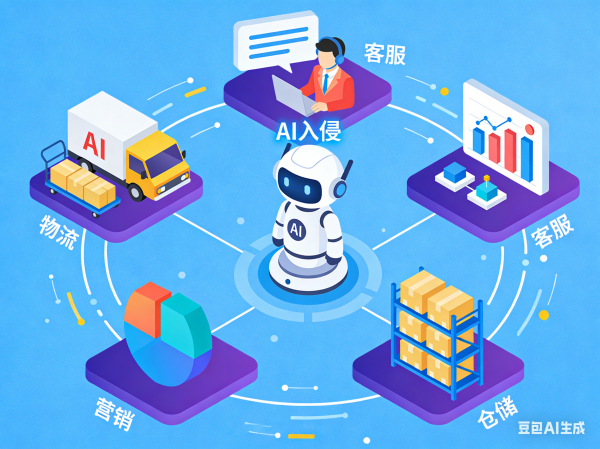
The year 2025, now in the rearview mirror, witnessed e-commerce, empowered by AI, seemingly ushering in an era of "smart shopping."
Subtle yet profound changes are afoot: when searching for a product, AI begins calculating its price trend for the coming year and even proactively reminds us to "claim a refund for the price difference" when the item goes on sale; late-night orders are automatically routed to the nearest warehouse for the fastest delivery, arriving by morning; even the live-streamed shopping videos we encounter may originate from industrial clusters in our hometown, directly connecting us to source factories.
Whether ordinary consumers keep abreast of e-commerce industry news or not, these subtle yet far-reaching changes are deeply integrating into daily shopping routines, quietly revolutionizing every facet of e-commerce.
This represents a comprehensive upgrade driven by supply chain optimization, traffic logic refinement, service mindset enhancement, and AI technology integration.
We seem to have stepped into an era where e-commerce appears "all-knowing and all-powerful," yet it remains ambiguous whether it truly serves consumers' genuine needs or the platforms' growth imperatives.
Internal Reform, External Breakthroughs
In 2025, pure price competition became a relic of the past. Traditional e-commerce platforms shifted from mere price wars to holistic contests of service, efficiency, and cost-effectiveness. To gain a competitive edge, the notorious food delivery wars spurred some changes in industry service trends.
Technologically, during its 17th Double 11, Taotian Group hosted the "first AI-fully-implemented Double 11," featuring AI shopping guides capable of understanding complex semantics and deep-seated needs, AI semantic tagging for 2 billion products (improving search relevance by 20% and recommendation click-through rates by 10%), and tools like the "Business Assistant" for merchants, reducing whole-store data analysis from 64 minutes to just 3 minutes.
That year's Double 11 also marked a pivotal moment as Alibaba, JD.com, and Meituan fully embraced instant retail, signaling a competitive focus shift toward "half-hour delivery" for local life and high-frequency consumption scenarios.
Initially, both Taobao Flash Sale and JD Second Delivery achieved promising results in their Double 11 debuts.
For instance, at Taotian's Double 11 press conference, executives repeatedly underscored the synergistic significance of Taobao Flash Sale for the event, with keywords like "trillion in new growth," "traffic surge," and "enhanced user engagement" frequently mentioned.
During Double 11, Taobao Flash Sale witnessed over 863 non-food brands achieving more than 100% transaction growth compared to pre-promotion periods, significantly contributing to new user acquisition for the main platform. JD Second Delivery's mobile phone accessory category saw a 200% year-on-year transaction growth, with digital accessories and photography equipment growing by 100%. More crucially, 60% of users purchasing 3C products via "Second Delivery" were new to buying 3C items on JD.
JD even pulled off a "major coup." In October 2025, JD partnered with GAC Group and CATL to launch the "national good car," Aion UT Super, exclusively sold on JD during Double 11, with the battery rental version priced as low as 49,900 yuan. JD explicitly stated it would not directly engage in manufacturing but focus on user insights and sales channels, simultaneously recruiting "delivery centers" to establish a full-service ecosystem for car transactions.
In global market penetration, Taotian's Double 11 in 2025 marked the first simultaneous launch in 20 countries and regions, with 1 billion yuan in overseas marketing subsidies aimed at helping 100,000 merchants double their overseas transactions. Its core strategy was a lightweight "sell globally with one click" solution, where merchants only needed to sign up for automatic product synchronization to overseas sites, with the platform handling returns. Since its launch, the program has attracted over 1 million merchants, with signed merchants' GMV growing three times faster than the overall overseas market.
In short, what have traditional e-commerce platforms been up to in 2025?
Internally, they harness AI to reconstruct efficiency; for fulfillment, they integrate online and offline through instant retail; for the ecosystem, they explore growth boundaries through cross-industry collaborations; externally, they accelerate globalization with lightweight models; for consumers, they deeply understand and respond to emotional and value-driven needs.
Reconstruction Has Just Begun
AI's most profound impact on e-commerce is upgrading from traditional keyword-based and short-term user behavior matching to an attempt to understand users' deep-seated intentions and interests.
For example, in the past, if a user purchased a stroller, product recommendations would likely remain confined to strollers; in the AI era, the system infers the presence of a baby needing a stroller at home and recommends cross-category parenting products, shifting the logic of traffic distribution from a "positional battle" for keywords to a deep battle for "mindset understanding" of users.
The starting point of consumption shifts from a rigid search box to more natural dialogue and scenario descriptions. When users mention a travel destination, AI can provide scenario-based solutions, greatly assisting shopping decisions and enhancing convenience.
More importantly, AI is gradually leveling the playing field for merchant operations.
Tasks previously requiring professional teams, such as design, customer service, and data analysis, can now be quickly accomplished through AI tools, delivering "85-point" professional-quality output and providing small and medium-sized merchants with operational capabilities once exclusive to big brands. With the aid of a "prefabricated operational standard," these merchants save costs and redirect energy toward developing new products or enhancing pre- and post-sales services.
For platform competition, the traditional battle for e-commerce traffic entrances may evolve into a contest for users' shopping assistants/managers, fostering new tracks. For instance, AI assistants with cross-platform price comparison, automatic price protection, and ticket booking functions are gradually breaking down barriers erected by traditional e-commerce platforms.
This implies that future e-commerce competition will center not on traffic scale but on AI models' ability to understand and meet users' complex needs. Precisely defining and providing "solutions" for a specific category of complex needs could spawn new tracks and industry giants.
These transformations ultimately converge in every consumer click and delivery, shaping the distinct "two sides" of the 2025 experience:
On the positive side, various e-commerce forms offer consumers ultimate convenience, precise supply, and enriched meaning, such as supporting rural revitalization or contributing to environmental protection behind products;
The other side is more nuanced: while enjoying AI-powered algorithmic recommendations, consumers may easily fall into information bubbles, face more subtle big data "price discrimination" and impulsive consumption inducement, and concede some privacy. After all, the cost of personalized services is deeper analysis and use of personal data by platforms, in turn requiring consumers to possess higher information discrimination abilities.
Not all users appreciate being "labeled," and those who dislike this experience may feel even stronger discomfort in the AI era. Over time, this could narrow consumption horizons and even solidify consumption notions, making it difficult for users to discover new brands and products.
In the past, "labeling" users has triggered unfair trading practices leveraging information asymmetry, including but not limited to big data "price discrimination." This should be guarded against more vigilantly in the future.
-
![]()
Xiaomi's MiMo Stages a Two-Year Comeback to Top Global Inference Volume Rankings
-
Tech Titans' Offline Tussle for Desktop Dominance: The Office Agent Showdown
-
![]()
Full-Spec Power and BOSE Subwoofer: The REDMI K100 Pro Max Performance Review
-
![]()
Yuewen’s Unending Innovation: Navigating Content Industry Shifts
-
![]()
Huawei, Li Auto, XPENG, Xiaomi: After Scrutinizing Seven Papers, What Are 'World Models' and 'VLA' Really Competing For?
-
![]()
Proposed to Raise 955 Million Yuan through Private Placement! Huicheng Vacuum Boosts Localization of Ultra-Precision Optical Coating Equipment
-
![]()
Cash Flow Soars 13-Fold! What Major Strategic Move is Wuhan Five Square Optoelectronics Planning?
-
![]()
Leaked Design of vivo X500: Reverts to Circular Camera Module in Top-Left Corner, Pays Homage to Classic X90 Aesthetic