OPPO Announces Price Hike Next Week: From Entry-Level to Mid-Range, No Model Spared. Is the Era of Sub-1000 Yuan Smartphones Over?
 03/11 2026
 741
741
In this wave of price hikes, there are no winners.
Some readers previously claimed that Leitech's articles on smartphone price hikes were like the 'boy who cried wolf'—lots of noise but no action. Well, now the wolf has truly arrived.
A while back, a vivo employee revealed that prices for all vivo smartphones would increase by 10%–15%, stating, 'Competitors will follow suit.' That prediction proved accurate. On March 10, OPPO officially announced on its e-commerce platform that it would strategically adjust prices for certain products starting March 16—in simpler terms, prices are going up.
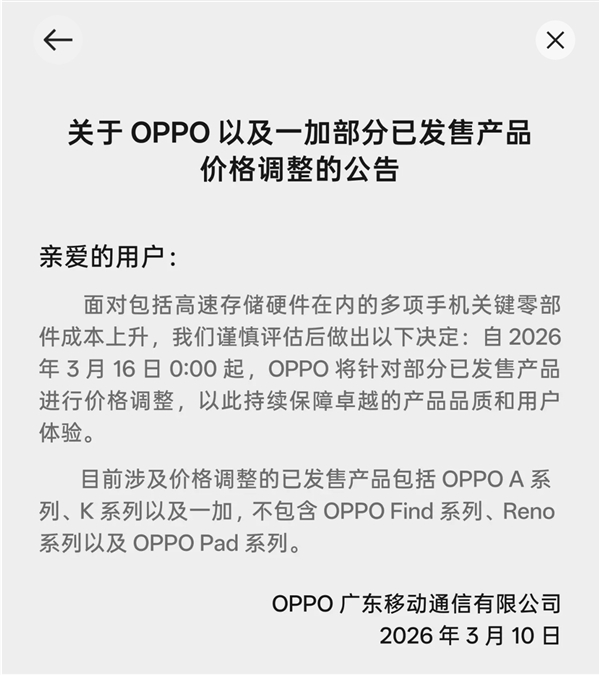
Image source: OPPO
As two of the most closely tied domestic smartphone brands, if OPPO has announced a price hike, vivo is unlikely to be far behind. After this announcement, many netizens expressed disbelief: 'We thought you were just trying to trick us into upgrading, but you're serious?'
To be honest, this price increase isn't about smartphone companies trying to squeeze more profit from you—they simply can't hold out anymore. As of March this year, memory prices have surged by over 150% year-on-year. For many domestic smartphones that operate on thin margins, rising costs have completely erased profits. Without price hikes, they'd be selling at a loss.
Entry-Level and Mid-Range Models Hit Hard
This isn't just damage control for smartphone manufacturers—OPPO's announcement makes it clear they're trying to limit price increases. The models affected in this round are primarily from the A series, K series, and all OnePlus devices. The A and K series represent OPPO's mid-range and entry-level models, while the premium Reno and Find series have not yet seen price adjustments.
Currently, the pressure is concentrated on the 1,000–2,000 yuan price range, where thin profit margins make these products highly sensitive to component costs. This has forced OPPO to raise prices. According to insider information from Weibo influencers, the increase should be around 10%–20%, with overall price hikes likely capped at 200–300 yuan. After accounting for national subsidies, the actual increase may be even smaller.
OnePlus, however, is raising prices across its entire lineup. Currently, OnePlus offers the flagship Digital series, Ace series, and Turbo series. With fewer models and a focus on cost-effectiveness, OnePlus is more significantly impacted. If price increases are similar to OPPO's, the OnePlus 15's starting price could rise to around 4,500 yuan. After subsidies, this would roughly align with its original launch price.
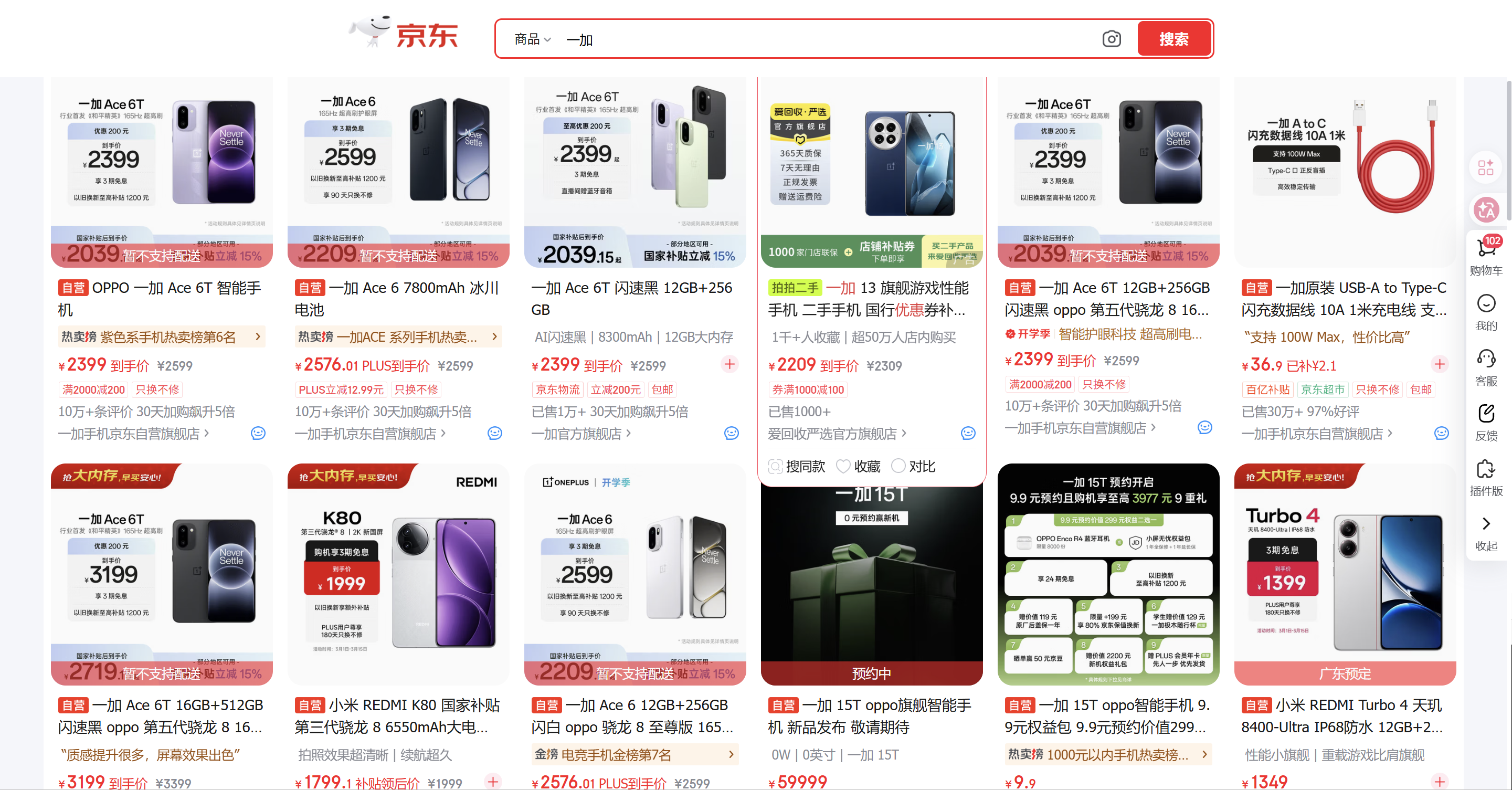
Image source: Leitech
In my view, this price hike will hit OnePlus harder, but its previously low pricing means even after increases, its cost-effectiveness remains competitive. Take the OnePlus Ace 6T, currently priced at 2,039 yuan with subsidies. After a proportional increase, it would likely land between 2,200–2,300 yuan. While pricier, its Snapdragon 8 Gen 5, 1.5K 165Hz display, and gaming chip still make it a strong choice.
Of course, if other brands follow suit, cost-effectiveness across the market may not change significantly. Notably, the OnePlus Ace 6T is currently sold out on JD.com's self-operated store, with only flagship models like the OnePlus 15 in stock. Given the upcoming OnePlus 15T launch, I suspect OnePlus is redirecting limited memory resources to flagship models.
For now, the biggest impact of soaring memory costs may not be absolute price hikes but outright shortages of sub-1,000 yuan and high-cost-effectiveness models. Within reasonable price increase ranges, if product prices can no longer cover costs, selling through existing inventory without restocking becomes the only option.
Industry insiders have already noted that many manufacturers are temporarily abandoning entry-level models to focus on mid-range and premium devices. The OnePlus Ace 6T shortage may just be the beginning—several popular cost-effective models could soon face similar risks.
Mid-Range Models Under Pressure, Glory Days Gone
However, smartphone manufacturers face another headache: how will mid-range models compete with flagship devices after price hikes? Take OPPO's best-selling K13 Turbo Pro, currently priced at 1,899 yuan. After a hike, it could exceed 2,200 yuan—a price range with many alternatives, including the aforementioned OnePlus Ace 6T.
Post-hike, the OnePlus Ace 6T would directly compete with OPPO's 2025 flagship, the Find X8s, which features a Dimensity 9400+ chipset, superior imaging, and a better display. Priced around 2,800 yuan after discounts, users might overlook a 600–700 yuan difference, but what if it narrows to 300–400 yuan? That becomes a tough call.

Image source: Leitech
Trust me, similar scenarios will play out frequently in the coming months. With premium and flagship models holding prices steady, the mid-range market will gradually shrink. On one hand, these models can't compete with discounted previous-gen flagships; on the other, their price-sensitive audience may simply opt out of purchasing.
Vivo faces a similar situation, though perhaps less severely than OPPO. If vivo raises prices across its lineup, the competitive dynamics between its models won't change drastically. In fact, if premium and flagship models see larger hikes, some budget-conscious users might shift to mid-range options.
However, as inventories deplete and memory prices climb further, I believe no brand will escape this price hike unscathed. Even Huawei and Apple may only maintain prices this year while reducing or eliminating discounts and promotions.
Moreover, the impact of this price hike wave could be greater than anticipated. In the short term, users' upgrade will (willingness to upgrade) will decline, extending replacement cycles. Long term, the mid-range market could collapse, with manufacturers pivoting to premium and flagship segments while offering only a few mid-range and entry-level models to reduce R&D costs.
It seems the era of a vibrant mid-range smartphone market may truly be ending.
Smartphone Upgrade Strategies Amid Price Hikes
With smartphone prices set to surge, it's time to strategize. If you own a flagship device from last year or this year, delaying your upgrade is wise. Memory prices will likely remain high through September and October, pushing up next-gen flagship prices. Average users shouldn't foot the bill for memory cost increases.
From a user experience perspective, flagship devices remain competitive for two to three years. The 2026 flagships won't offer dramatically better daily performance than 2024 models, especially given rising raw material costs, which will limit upgrades in standard variants. If you bought a Pro model last year, you can probably skip this generation entirely.
For 'Ultra' model users with disposable income, go ahead and upgrade. Current leaks suggest prices for these high-end models will remain stable. Their lower sales volumes account for cost distribution during pricing, and memory costs represent a smaller portion of their total expenses, leaving enough profit margin to absorb price increases.

Image source: Leitech
In my view, mid-range and premium model users face the toughest decisions—they're most affected by this crisis. This market segment demands strong performance and imaging but operates on limited budgets. If your current phone meets your needs, don't upgrade. Even aggressively speaking, there's no need to replace a phone under two years old.
If you must upgrade, consider used devices. Platforms like Paipai and Zhuanzhuan offer certified, high-quality used phones with unbeatable cost-effectiveness for the next six months. On Paipai, a 90%+ new Find X8 starts at 2,089 yuan, offering a better experience than the price-hiked K13 Turbo Pro.
We used to say, 'Why buy used when new phones are so cheap?' Not anymore. With new phone prices skyrocketing, used devices are the smarter choice. After scouring secondhand platforms, these models stand out (using Paipai as an example):
Xiaomi 15 Pro: Priced steadily around 2,400 yuan, it offers better imaging than the Xiaomi 17 but slightly weaker gaming performance. The Xiaomi 15 series is Xiaomi's most acclaimed in two years. If current models see across-the-board hikes, the 15 Pro's value will only grow—unless you specifically need a compact flagship (Xiaomi 15), the Pro offers far better cost-effectiveness.
OnePlus 13: Priced around 2,200 yuan, the OnePlus 13 lacks 'Pro' branding but matches flagship specs with a large primary sensor, periscope zoom, and a 2K high-refresh-rate display. It offers a better experience than the Find X8 for just ~100 yuan more.
Redmi K80 Pro: Priced around 1,800 yuan, it packs a Snapdragon 8 Elite, 2K display, large primary sensor with zoom, ultrasonic fingerprint scanning, and 120W wired + 50W wireless fast charging. Its cost-effectiveness is unmatched, though its design may be considered average.
All three models are readily available in the used market at competitive prices, ideal for budget-conscious upgraders. Since most are last year's flagships, you can still find new units on Taobao for 10%–20% more. If warranty is a priority, that's worth considering.
Honestly, March may offer the lowest smartphone prices for the next six months. Once current models see hikes, used phone prices will follow suit. If you need to upgrade, act soon—these prices won't last.
-
![]()
Proposed to Raise 955 Million Yuan through Private Placement! Huicheng Vacuum Boosts Localization of Ultra-Precision Optical Coating Equipment
-
![]()
Cash Flow Soars 13-Fold! What Major Strategic Move is Wuhan Five Square Optoelectronics Planning?
-
![]()
Leaked Design of vivo X500: Reverts to Circular Camera Module in Top-Left Corner, Pays Homage to Classic X90 Aesthetic
-
![]()
DeepSeek Shows Signs of Foraying into Code Agents, Launches WeChat Official Account Focused on Harness
-
![]()
Auto Companies Deny Claims That ‘Cooperation with Huawei Is Non-Essential’, as Huawei Transforms into a ‘Public Platform’
-
![]()
Starship to Independently 'Return to the Launch Tower': SpaceX's Ambitions Extend Beyond Rocket Building to Dominating Space Transportation
-
![]()
Starship Set to Independently 'Return to the Launch Tower': SpaceX is Revolutionizing Space Transportation, Not Just Building Rockets
-
![]()
Anthropic and OpenAI Face Off Against Deepseek