AI Transforms Education: Hailiang Science and Technology Persists in the Principle of 'Slow is Fast'
 04/27 2026
 699
699
By Ji De
Edited by Ziye
In the spring of 2026, a biology classroom at Zhejiang Hailiang Experimental High School was empty at the front.
Teacher Xu Qiang had retreated to the back of the room, stare at (his eyes fixed on) a tablet in his hand. The screen displayed the progress of each group's challenges—he had designed the protein synthesis process into a game called 'Curing Little Q.' Students, organized into 'medical teams,' were flipping through materials to find passwords, deducing amino acid sequences, and recording diagnostic reports. Xu only stepped in with a question when a group got stuck.
When the bell rang, one team leader, still absorbed in the screen, remarked, 'So this is how ribosomes work.'
This scene was just one of many unfolding across the campus.
Stepping out of the classroom, the 'Star Magic Cube' smart class signage operated silently in the hallway—attendance, schedules, and substitute approvals, 18 campus scenarios linked by a single screen. In the faculty office, the AI Classroom Advisor had dissected the just-concluded lesson into 'what worked well' and 'what needed improvement.' That evening, parent Ms. Li saw a candid shot of her child conducting an experiment on the 'Hi-Home-School' app and commented, 'Who knew cell division could be so romantic?'
Classroom, hallway, office, home—AI was no longer just a screen on the wall but a 'nervous system' permeating every corner of the campus. The orchestrator behind it all: a company named Hailiang Science and Technology.
From entering the market in 2021 to being named a Zhejiang unicorn by 2026, it became the nation's first education technology unicorn dedicated to empowering schools. In just a few years, its services covered 210 districts and counties, reaching over ten million users, with annual revenue surpassing 1 billion last year.
But more noteworthy than its scale was its market approach.
While peers competed for orders from elite schools in first- and second-tier cities, piling on computing power and selling hardware, Hailiang Science and Technology did two 'unconventional' things.
First, it focused on county-level markets and 'the bottom 30% of schools in China.' Second, it avoided being a generalist player that 'finds applications after developing technology.' Instead, it leaned on its parent company's 30-year history in education, going all-in on scenarios and diving deep into classroom reform.
How did this seemingly 'thankless' decision make it one of the few unicorns to achieve Scale based closed-loop (large-scale closed-loop success) in the education AI sector five years later?
1. Tackling the 'Hardest Thing': How AI Restructures the Classroom?
'If we're going to do it, let's tackle the hardest part. If we're going to reform, let's reform the 99% of 'chalk-and-talk' teaching.'
Sitting in his office, Chen Junwei, Chairman of Hailiang Science and Technology, recalled the starting point of last year's decision. Education informatization had entered the 2.0 era, with policy tailwinds blowing strong, but the reality inside schools left a bitter taste in his mouth.
Chen had toured Hailiang's schools and then ventured into county regions. The scene was strikingly consistent: teachers drenched in sweat lecturing for 45 minutes while students dozed off. Even with integrated machines installed and homework-grading software in use, the underlying logic of the classroom remained industrial-era 'standardized indoctrination.'
'A student spends over 80% of their time in the classroom. If the classroom doesn't change, all technological investments are just icing on the cake.' He gave his team a firm directive: Focus on the classroom—that's the 'linchpin' of school transformation.
But how? The classroom is the most complex 'micro battlefield' in education: It involves the entire process from pre-class preview to in-class interaction and post-class evaluation, as well as multi-role interactions among teachers of various subjects and dozens of students with distinct personalities.
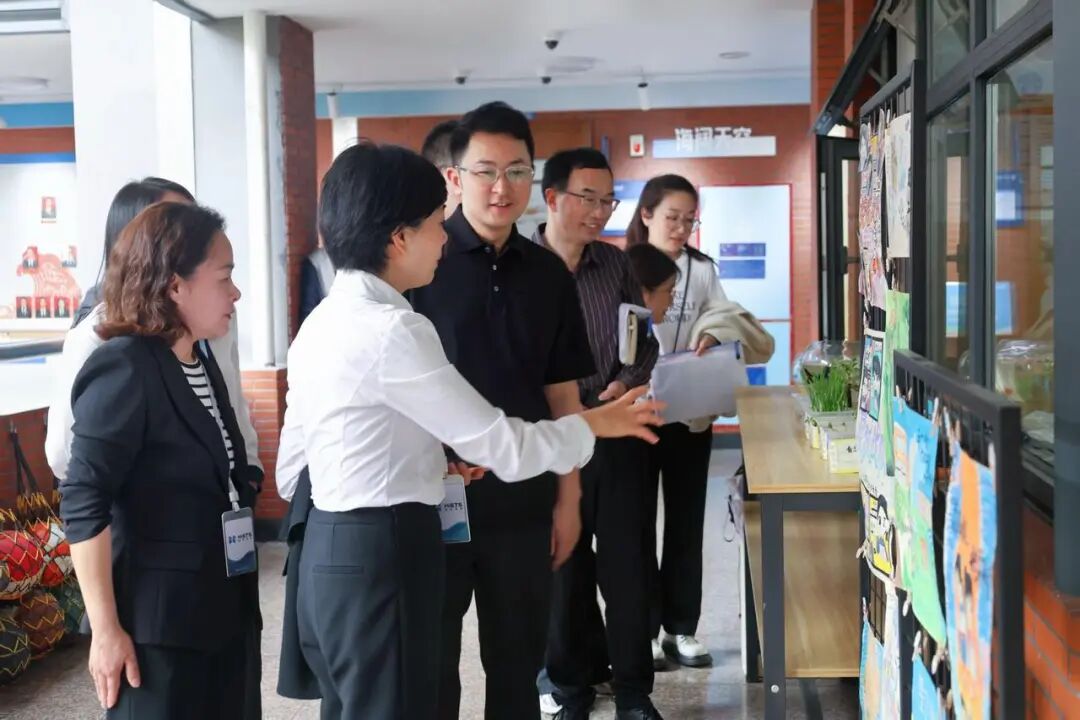
Chen Junwei conducting school research
Chen convened principals, management teams, and technicians for discussions. The reaction was unanimous: 'Great idea, but it's too hard.'
But 'difficulty' was precisely the moat in his eyes. 'The hardest things are often the simplest because fewer people do them. If you keep pouring resources in, the barriers only get higher.'
How to reform? Chen had long developed a mature methodology called 'Best Practices,' dating back to 2019.
When they first ventured into education technology, they dissected a prestigious school. The secret to its performance management: Teachers of different subjects didn't compete for time because the performance model allocated the 'total cake' of future class results to homeroom teachers and subject teachers alike, forcing collaboration.
Hailiang Science and Technology spent considerable time refining these experiences into a digital tool called 'Haiban Hui,' then co-created it with their own principals and teachers, focusing on 'borderline students'—those hovering 10 points above or below the key university admission threshold—as the core focus for performance evaluation. It was a hit upon launch.
This 'born in schools, raised in schools' R&D logic remains in use today: First, identify best practices in scenarios, use technology to create tools, then co-create with principals and teachers, pilot in select classes, and rapidly scale after seeing results.
This deep understanding of scenarios ultimately gave birth to Hailiang Science and Technology's latest AI classroom transformation solution—the 'AI Innovative Thinking Classroom.'
Since 2025, the 'AI Innovative Thinking Classroom' has been operating routinely in over 100 schools.
Interestingly, after Chen personally took charge of the curriculum reform team, he chose to start with schools weak in academic performance but with significant room for improvement.
At Hailiang Art High School, AI transformation addressed the pain point of art students' weakness in academic subjects. The classroom was transformed into a growth game with full participation: Students elected their own team leaders. Under the 'Star Power' point system, speaking up, serving, and winning awards could all be exchanged for points, redeemable for milk tea, outing privileges, or even unlocking group hotpot.
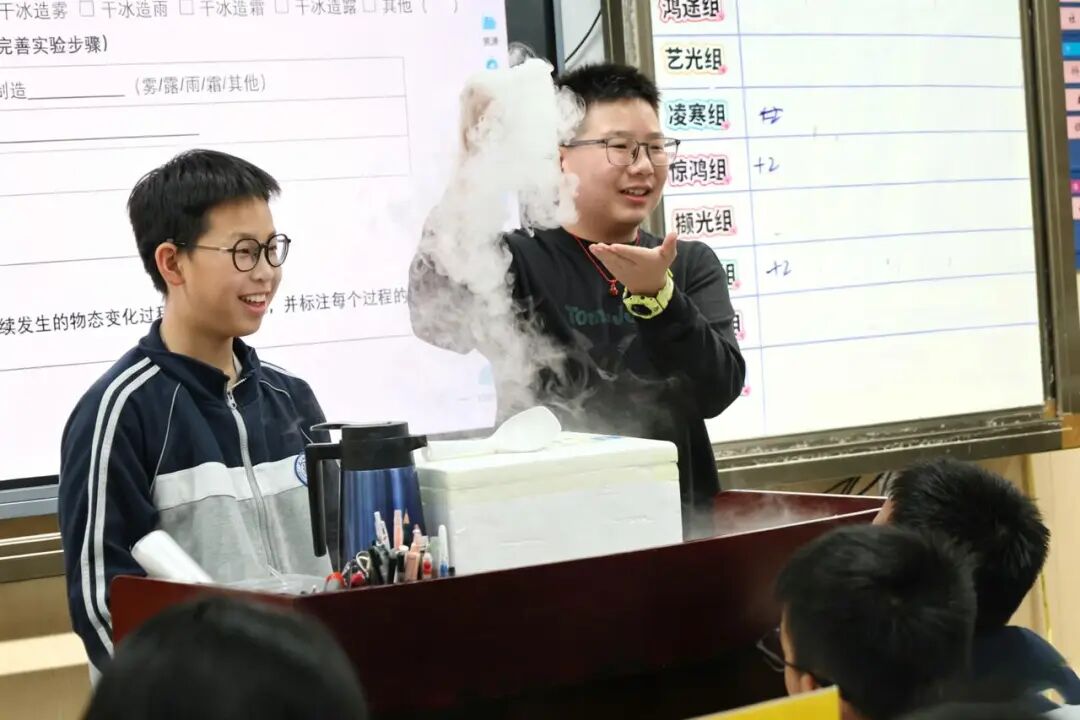
Students acting as 'little teachers' explaining on stage
At Hailiang Junior High School, the protagonists at the podium became rotating 'little teachers.' Teachers no longer fretted about 'how to explain clearly' but stood at the back, probing and guiding. The core of this model was the 'Three-Teacher Classroom'—returning learning autonomy to students, with teachers designing guidance and AI assistants providing precise feedback.
These varied classroom models were all built on an integrated hardware-software smart teaching terminal, establishing a full-process support system for 'data collection—intelligent analysis—precise feedback.'
Its operational logic spanned three key phases: pre-class, in-class, and post-class.
Pre-class, the system pushed preview resources, and students completed guided worksheets to generate learning data, shifting lesson preparation from 'relying on experience' to 'relying on data.' In-class, smart terminals captured participation and answer quality in real time. Post-class, personalized tutoring paths were generated based on error data. Thus, a closed loop of 'teaching—evaluation—optimization' was formed.
Data showed that in schools where it operated routinely, teachers' average lecture time dropped from 'chalk-and-talk' to around 15 minutes, with significant improvements in student classroom participation and teacher-student relationships. Academically, 70% of students improved, while 30% held steady.
But Chen emphasized that score improvements were just the surface. The AI Innovative Thinking Classroom addressed deeper issues—focusing on human growth rather than purely pursuing grades.
In his view, this model simultaneously resolved three core variables in student development: time (learning duration tailored to the student), personalization (addressing each student's unique issues), and emotional engagement (intrinsic motivation—whether the student wants to learn). These three elements were nearly impossible to align simultaneously in traditional classrooms.
More importantly, it pointed to the future. Chen's judgment: The purpose of education is to cultivate individuals for the future. In the AI era, students need four core competencies: human-machine collaboration, higher-order critical thinking, empathy, and self-awareness.
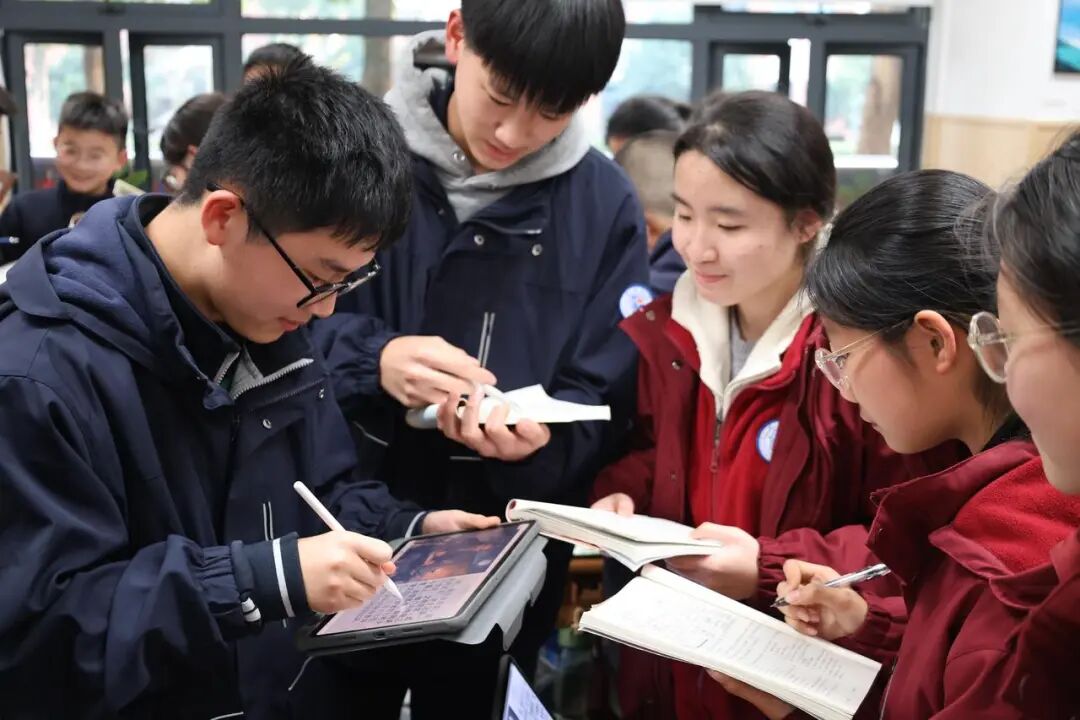
Student groups discussing together on Star Learning Companion tablets
The design of the AI Innovative Thinking Classroom comprehensively considered these issues. Collaborative learning cultivated empathy; autonomous learning and AI Q&A exploration addressed human-machine collaboration; open-ended discussions reinforced critical thinking training.
The AI Innovative Thinking Classroom was just one facet of Hailiang Science and Technology.
In Chen's view, 'Our approach to personalized education can be summed up in two phrases: 'We excel where others exist, and we create where others don't.''
'We excel where others exist' means understanding scenarios better and adapting more effectively to schools than peers.
Beyond classroom teaching, Hailiang Science and Technology also launched a series of products for scenarios like smart student development, smart teacher training, smart governance, and smart campuses. For example, 'Star Future' addressed the pain point of 'form without substance' in five-dimensional evaluations, while 'Star Oasis' provided a systematic mental health intervention process.
But these weren't the core differentiators.
Many companies talked about 'personalized teaching,' but most actually practiced 'precision teaching'—pushing content based on students' knowledge mastery and ability. Hailiang Science and Technology differed by considering teaching scenarios throughout the pre-class, in-class, and post-class process, delivering precision teaching more attuned to schools' actual rhythms.
'We create where others don't' meant developing more intelligent supporting tools.
A Typical Case (typical example) was their self-developed 'AI Classroom Advisor.' After a teacher finished a class, the system automatically generated a complete classroom analysis report—precisely dissecting what worked well and what needed improvement, from teaching objectives and content delivery to teacher-student interaction. Teachers no longer had to rely on vague memories for reflection; they received evidence-based insights immediately after class.
This capability continued to deepen. They were simultaneously advancing the 'AI Student Classroom Advisor,' which evaluated students' question quality, expression skills, and thinking depth during 'little teacher' explanations or group discussions, helping students track their growth. These products had no market equivalents; the needs emerged organically from classroom reforms.
The classroom puzzle had an answer. But the next question followed: Who needed this solution most?
2. Why County Schools Are the Best Practice Ground?
With a refined 'weapon' in hand, Chen aimed at the most 'barren' battlefield—China's county-level schools and the bottom 30% of institutions.
This choice was half emotional, half rational.
Emotionally, Chen, hailing from a rural background, deeply understood the pain of county-level education—structural shortages of quality teachers, outdated teaching philosophies, ongoing student drain, and insufficient high-quality resources. User-friendly AI tools could, to some extent, bridge this gap.
Rationally, he saw counties as a 'blue ocean' ignored by giants.
He summarized the practical advantages of county schools: high decision-making efficiency, Strong willingness to change (extremely strong willingness to change), and no reliance on past success models, making them willing to give it their all.
So while most education technology companies focused on first- and second-tier cities, Hailiang Science and Technology dove into lower-tier markets.
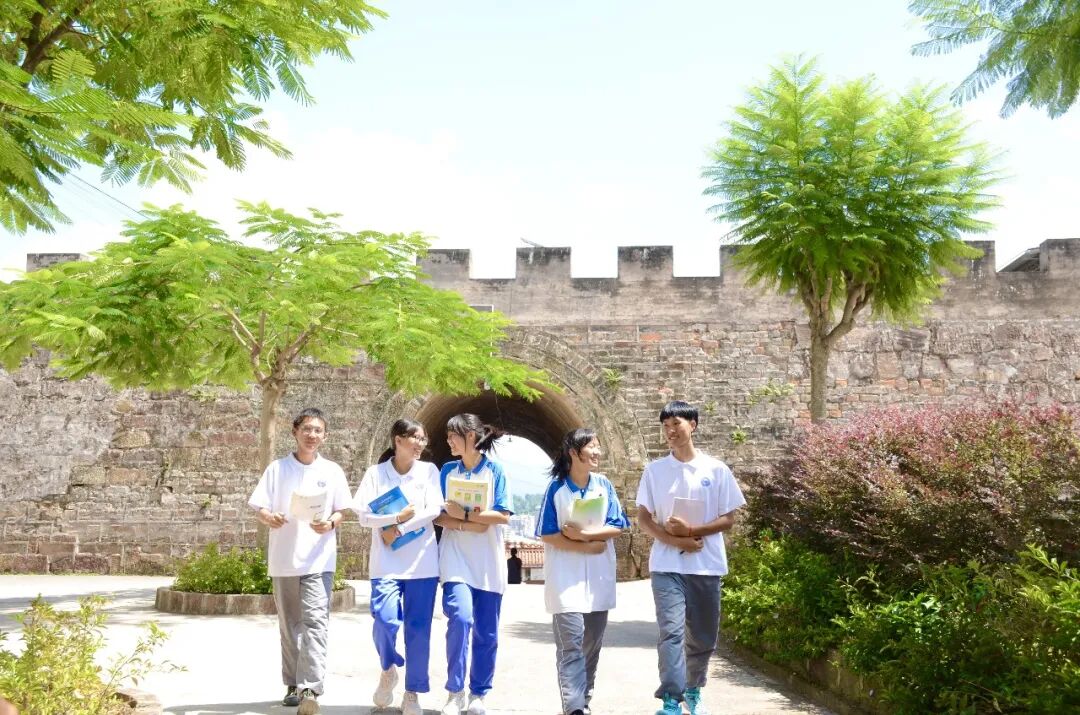
Jingdong No.1 High School, Jingdong Yi Autonomous County, Yunnan Province
But having a battlefield wasn't enough. Getting B-end schools to buy in and enabling scalable replication of the solution were the real tests.
Hailiang Science and Technology followed a unique G-B-C path: winning G-end and B-end favor and trust through professional services and tangible results, then establishing a student-centered resource allocation system to catalyze and meet C-end students' diversified educational needs.
But this path demanded extreme 'dialogue capability' and 'delivery capability' from the vendor. Hailiang Science and Technology succeeded because it worked to fill market supply gaps.
Schools didn't just need isolated AI software; they needed a suite of services delivering Deterministic results (guaranteed outcomes) from diagnosis to consultation and implementation.
With 30 years of school operation experience, Hailiang Science and Technology could provide a full range of services, from problem diagnosis and top-level consulting to team deployment, teacher training, and student growth support, now covering 30 provinces and over 200 districts/counties, backed by a vast on-the-ground service team.
More critically, Hailiang Science and Technology dared to Promise quantitative indicators (commit to quantifiable metrics).
Chen insisted on proactively agreeing with local governments on measurable outcome indicators, such as improvements in academic performance or teaching efficiency. These commitments forced the team to prioritize results during implementation. Once results emerged, trust solidified, leading to repeat and additional purchases.
These outcome-committed products and services precisely addressed the largest supply gap in smart education.
Meanwhile, Hailiang Science and Technology remained open, integrating top-performing third-party products into its ecosystem, provided they aligned with its system and shared data infrastructure.
In Jingdong Yi Autonomous County, Yunnan, when Hailiang Science and Technology took over Jingdong No.1 High School in 2021, nearly all students scoring above 500 on the county's high school entrance exam had left. Through consulting services, classroom reforms, and tiered teaching, three years later, the school saw over 177 students reach the undergraduate admission threshold, with a large-scale return of high-quality students.
At Ansai Senior High School, Yan'an, Shaanxi, in Hailiang's first year, the number of students admitted to first-tier universities jumped from 45 to over 100, with dual-first-class admissions surpassing the school's total from the previous five years. By 2025, 250 students met special admission control thresholds, and 911 reached undergraduate thresholds—all achieved in just three years.
Similar stories repeated at Luxi No.1 High School, Yunnan; Mengyin Liancheng Middle School, Shandong; and Wushan No.2 High School, Chongqing.
Chen mentioned that local governments had sent 129 stamped letters of appreciation, with renewal rates stable above 80%. 'Our team roots itself wherever it goes, turning it into a model. Once models emerge, neighboring districts visit, and clients voluntarily recommend us. From a single point, we radiate outward, creating a 'slow is fast' virtuous cycle.'
The challenge of scalable replication was thus resolved. Their team discovered in practice: 90% of core issues in K-12 schools nationwide were shared. They adopted a 'standard base + modular customization' strategy—each new region's unique needs were refined into independent modules. After covering enough counties, they could address most scenarios.
'We chose the right battlefield,' Chen sighed. 'Counties are the best stronghold for building barriers.'
3. Vertical Large Models + Scenario-Based Consumption: Hailiang Science and Technology's Second Growth Curve
Classroom transformation addressed 'how to learn.' But Chen looked further: What do students truly need?
The core contradiction in Chinese education today is the 'conflict between education scalability and personalized cultivation.'
The new college entrance exam reform placed career planning as early as freshman year, and the 'Outline for Building an Education Powerhouse (2024-2035)' explicitly mandated 'career enlightenment education (career enlightenment education)' in primary and secondary schools.
The policy direction was clear: The education system was shifting from 'monolithic' to 'diversified,' from 'uniform' to 'differentiated.' This meant students' academic planning must be personalized, and schools' operational models must be specialized.
Demand exploded, but supply lagged. Career planning products for parents and students fell into two categories: generic large models offering vague advice after a few questions, or traditional institutional (institutional) human consulting, heavily reliant on experts, expensive, and difficult to scale.
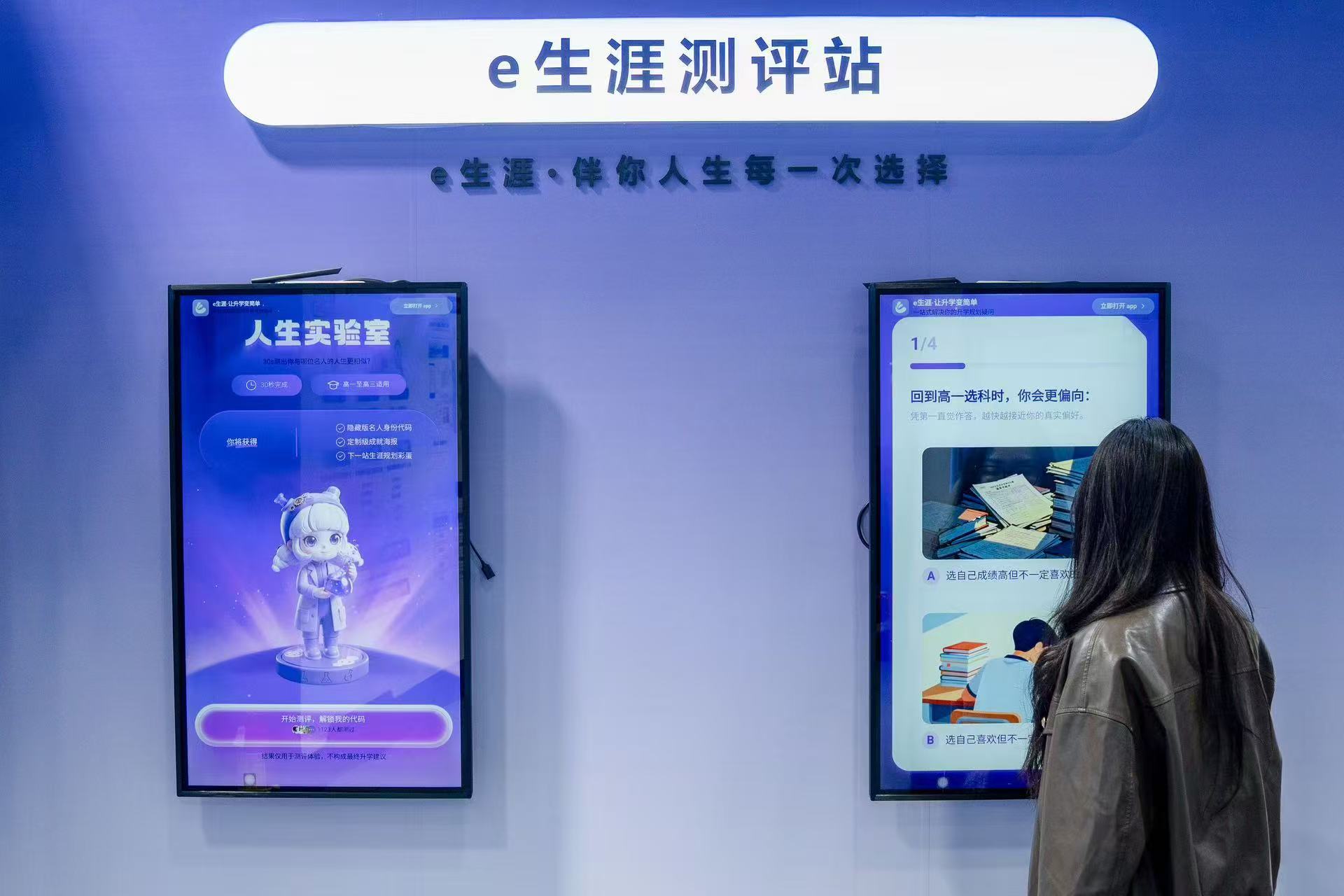
Hailiang Science and Technology Services identified this gap and created a career digital intelligence platform based on a vertical large model - 'eCareer'.
The core difference starts with the knowledge base. General large models are fed with 'web crawler corpora', while 'eCareer' is fed with real student data. Hailiang Science and Technology Services has accumulated growth trajectories of hundreds of thousands of students from Hailiang Education, refining a complete academic progression roadmap covering primary, junior high, and senior high schools. Combined with authoritative data interfaces from examination authorities and university admissions offices, as well as calibration by a team of professional planners, the generated advice is traceable and explainable - unlike general large models that may provide different answers to the same question twice.
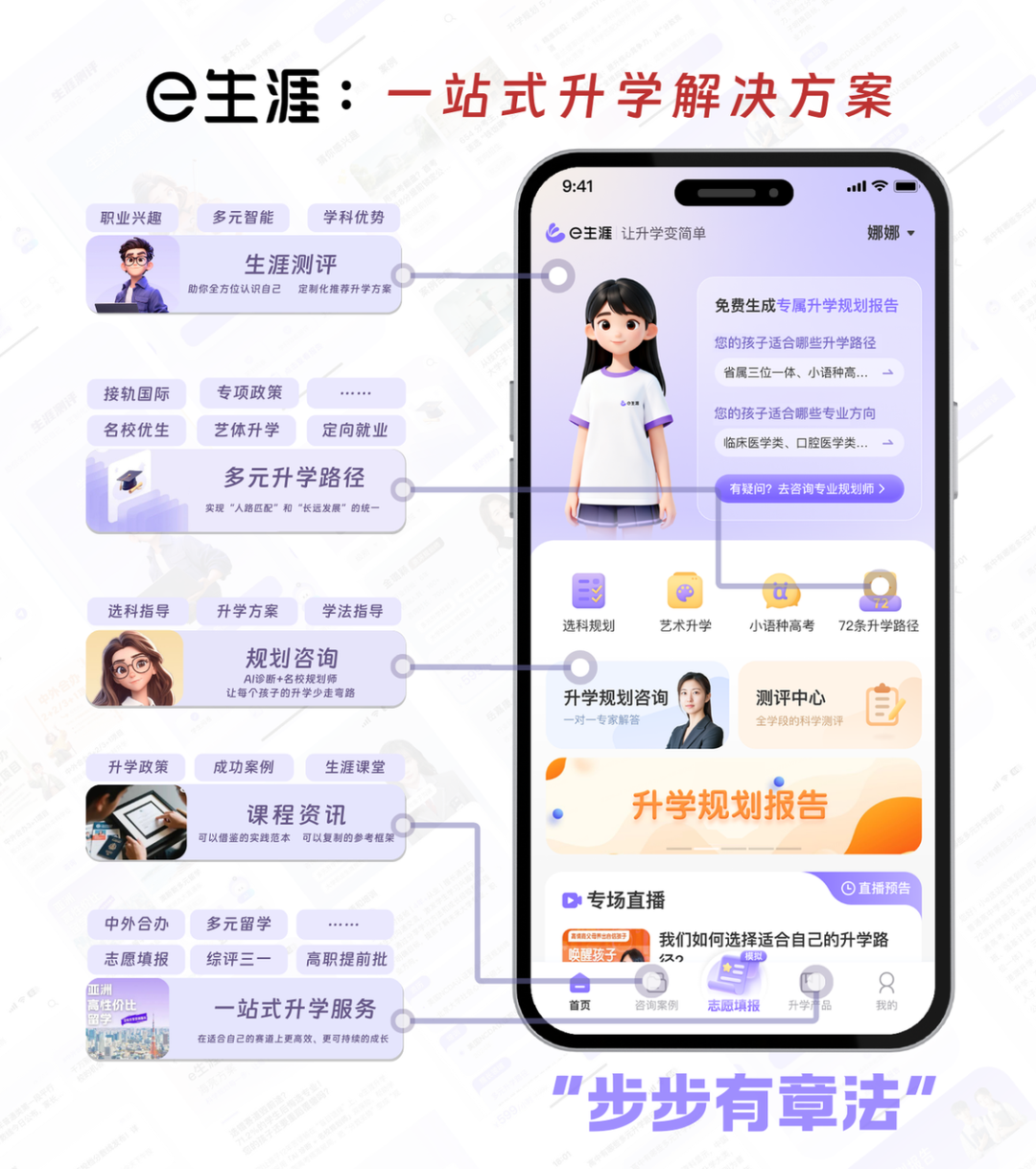
'eCareer' APP
The interaction methods are also evolving.
Currently, the 'eCareer' APP is transitioning from 'unidirectional report output' to multi-round dialogue iteration. Chen Junwei admitted that while the previous version had a decent conversion rate, it was essentially a tool from the 'information age' - the system provided conclusions, and users passively received them. His ideal vision is for parents and students to engage in multi-round dialogues with the large model, gradually understanding themselves and forming consensus through conversation, ultimately naturally deriving suitable pathways. The team plans to launch a new version based on conversational deep interaction by the end of the year.
However, the true competitive edge of 'eCareer' lies not in dialogue but in delivery.
The large model provides suggestions, while 'eCareer' offers a closed-loop of 'planning-resources-implementation'. After planning, the platform directly matches corresponding personalized growth services - science and technology innovation, arts and sports, humanities, international programs... Some are self-operated, while most are rigorously selected third-party ecosystems.
'We're not selling a query tool but a solution that helps children find suitable pathways and actually navigate them successfully,' Chen Junwei said.
In fact, when combined, the entire career technology sector resembles a hybrid model. The AI capability layer is akin to vertical large models providing intelligent decision support, even linking to consumption closed-loops, similar to 'QianWen' and 'Taobao'. The resource and service layer more closely resembles JD.com - featuring both self-operated high-quality services and an open third-party ecosystem with strict quality control on the supply side.
Currently, 'eCareer' has piloted the APP in about 70 schools, converting 100,000 registered users, conducting in-depth assessments for approximately 60,000 individuals, with order conversions far exceeding expectations.
Behind this product, Chen Junwei operates on a deeper logic: career planning must be approached 'horizontally and vertically'.
Horizontally, it connects inside and outside of school. Inside school, it matches students with courses and resources based on data models; outside school, it connects students and parents with social education services across various specialized directions.
Vertically, it follows students' growth - from academic planning to major selection, career development, and ultimately extending to lifelong learning.
This is a roadmap that begins in secondary school and lasts a lifetime. Horizontally, it breaks down resource barriers; vertically, it penetrates through time cycles.
At this point, the synergistic effects between the entire career technology sector and smart education also emerge.
Viewing the two business lines together, a clear business model has taken shape: with 30 years of school-running experience as the foundation, smart education serves the B-end to build trust, while career technology serves the C-end to connect educational consumption. A growth flywheel of 'B-end deep cultivation + C-end natural growth' is taking shape.
Comprehensively, on the G&B end, Hailiang Science and Technology Services builds government trust and school reputation through classroom transformation and regional service platforms; on the C end, leveraging the trust accumulated from the G&B end, it precisely matches needs with vertical large models, satisfies students' diversified needs through services, and thus achieves commercial realization; meanwhile, the data assets accumulated on the C end will in turn enhance the personalization capabilities of the smart education platform.
This model is nearly unique in China's educational technology sector.
Current players in the sector roughly fall into two categories. One type is hardware vendors selling all-in-one machines and smart classroom solutions, targeting educational informatization infrastructure budgets. The other type is general large model vendors using AI capabilities for content generation and Q&A tools, targeting teaching assistance scenarios.
Hailiang Science and Technology Services occupies a rather unique position. It doesn't belong to either category but overlaps with the core areas of both.
Compared to hardware vendors, it has scenario depth and proprietary schools to create data closed-loops, coupled with in-depth services, resulting in far higher product usage rates than the 'install and forget' procurement model; compared to general large model vendors, it has a foundation of school-running data, avoids providing ambiguous advice, and offers a full chain of 'decision-making-resources-delivery', forming entry barriers that competitors cannot replicate in the short term.
The imaginative space corresponding to this position far exceeds the valuation logic of a mere software or service company.
According to estimates in the Xinchuang Consulting's '2025 Digital Intelligence Education Xinchuang Research Report', China's educational digitalization market size will reach approximately RMB 646.4 billion in 2025 and is expected to surpass RMB 900 billion by 2030. Meanwhile, Ministry of Education data shows that as of the end of 2024, there were 15,000 regular senior high schools, 52,000 junior high schools, and 136,000 primary schools nationwide, with 189 million primary and secondary school students.
What Hailiang Science and Technology Services targets is the vast yet overlooked foundation of this enormous market - the bottom 30% of schools. With deep pain points and scarce supply, once a scalable path is established, every percentage point increase in penetration will release exponentially growing revenue.
The flywheel has just started spinning.
This is a 'slow business'. It requires deep cultivation, trust, and time to validate effects. But once barriers are erected, slowness becomes the most formidable moat.
Looking back, what Chen Junwei has led Hailiang Science and Technology Services to explore over these years is actually the same thing: finding the truly important questions in areas where the industry collectively lacks awareness, then relentlessly iterating and refining.
While the industry chases computing power, he chooses to dive into classroom scenarios because 'without classroom transformation, all technological investments are merely icing on the cake'; while the industry competes for orders from prestigious schools, he chooses to focus on county-level areas because 'the bottom 30% of Chinese schools are the foundation of educational equity'; while the industry creates 'score-improvement tools', he chooses to build 'life pathways' because 'what students truly need is not a few extra points but finding directions that suit them'.
Three counterintuitive choices, three early positioning moves. Chen Junwei never chases trends but repeatedly asks the same question: 'What does education truly lack?' Those who have run schools have an intuition for this question.
And commercial returns often hide behind the truly important questions that most people avoid. In the education sector, commercial value and social value are never opposed. Products that genuinely solve social pain points inherently possess the strongest commercial barriers.
Having come this far, Chen Junwei finally dares to say he has transformed the hardest things into the simplest, also believing that the AI era offers exceptional opportunities: 'By using AI as a new driving force, we have the chance to mass-replicate and upgrade best practices while establishing even higher barriers.'
-
![]()
Proposed to Raise 955 Million Yuan through Private Placement! Huicheng Vacuum Boosts Localization of Ultra-Precision Optical Coating Equipment
-
![]()
Cash Flow Soars 13-Fold! What Major Strategic Move is Wuhan Five Square Optoelectronics Planning?
-
![]()
Leaked Design of vivo X500: Reverts to Circular Camera Module in Top-Left Corner, Pays Homage to Classic X90 Aesthetic
-
![]()
DeepSeek Shows Signs of Foraying into Code Agents, Launches WeChat Official Account Focused on Harness
-
![]()
Auto Companies Deny Claims That ‘Cooperation with Huawei Is Non-Essential’, as Huawei Transforms into a ‘Public Platform’
-
![]()
Starship to Independently 'Return to the Launch Tower': SpaceX's Ambitions Extend Beyond Rocket Building to Dominating Space Transportation
-
![]()
Starship Set to Independently 'Return to the Launch Tower': SpaceX is Revolutionizing Space Transportation, Not Just Building Rockets
-
![]()
Anthropic and OpenAI Face Off Against Deepseek