Or to Construct a 'Satellite Super Factory': Aerospace Unicorn Firm Secures 30-Acre Industrial Site in Beijing for 29.245187 Million Yuan!
 07/20 2026
 365
365
Embodied Intelligence I Humanoid Robots I Financing for Embodied Intelligence I Robots 
Embodied Intelligence News: According to an official announcement from the Development and Construction Bureau of the Beijing Economic-Technological Development Area, Galaxy Space, China's premier commercial aerospace unicorn, has successfully acquired a 30-acre Class I industrial plot in the Yinghai area of Yizhuang New City. The total transaction price for the plot was a mere 29.245187 million yuan. This land will serve as the foundation for a satellite super factory project, integrating satellite mass production lines and the company's headquarters.
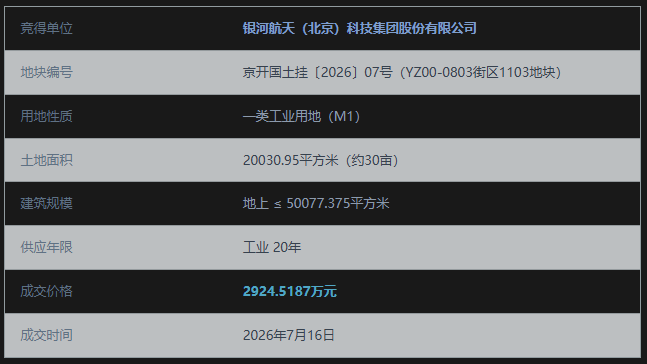
Data Source: Announcement on the Results of Listing and Transfer of State-owned Construction Land Use Rights by the Development and Construction Bureau of the Beijing Economic-Technological Development Area (July 16, 2026). The initial listing price for this plot was 29.245187 million yuan, and it was ultimately sold at this starting price.
Considering land prices alone, the cost of this industrial plot, which is adjacent to residential land, is significantly lower than that of surrounding commercial residential land. This low land acquisition threshold reflects Beijing's strategic move to bolster its capacity for batch manufacturing of low-Earth-orbit satellites and to enhance its 'Southern Rockets, Northern Satellites' aerospace industrial layout. It will also directly propel the domestic commercial aerospace sector to transition from a single-satellite custom development model to an era of mass production.
01 Where Does Galaxy Space's Industrial Confidence Stem From for an Annual Production Capacity of 500 Satellites?
As a leading domestic commercial aerospace enterprise established in 2019, Galaxy Space has already completed the technical and production line verification for satellite mass manufacturing. The existing data supports the production capacity goals of this new super factory. To date, the company has successfully launched 25 self-developed low-Earth-orbit broadband communication satellites. Its existing smart factory in Nantong has achieved pulsed automated production, maintaining a stable annual manufacturing capacity of 100 to 150 satellites. Leveraging modular and digital production lines, the overall satellite development cycle has been shortened by 80% compared to traditional aerospace development models, with the fastest production rhythm achieving the completion of two satellites in just 5 days.
The newly planned factory in Yinghai aims to produce 500 satellites annually. Upon completion, it will become China's leading low-Earth-orbit satellite manufacturing base in terms of production capacity. The planned construction includes nearly 50,000 square meters of production and R&D space, meeting the precise manufacturing needs for the full process of large-scale flat-panel satellite assembly, testing, and final inspection.
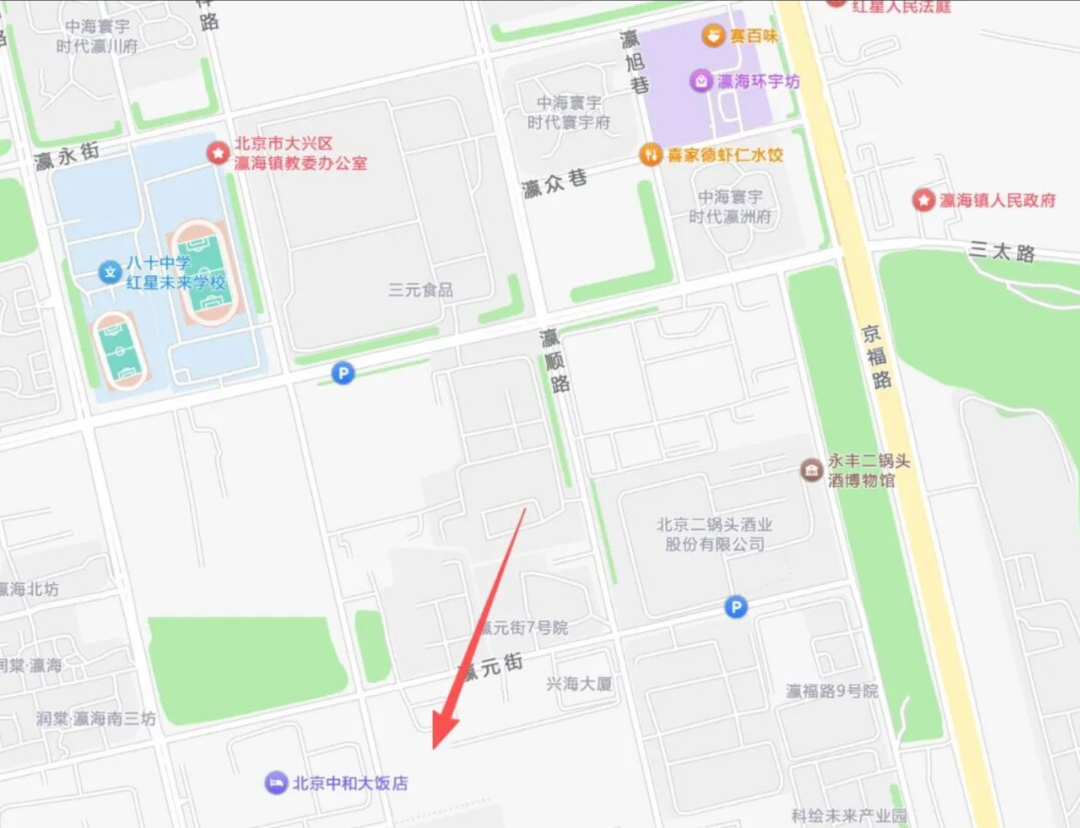
Simultaneously, the company's headquarters park will also be established, centralizing R&D, mass production, and operational functions in Yinghai. The self-developed communication core components produced by the Hefei Load Center will be directly supplied to the local production line in Beijing in the future, creating a complete closed loop from core standalone components to the delivery of fully assembled satellites. This will completely eliminate the cycle losses caused by the off-site allocation of core satellite manufacturing components in the past.
The plot adopts the characteristic land supply model of the economic development area: 'lease before sale, with sale upon reaching production targets.' The initial 5-year lease period significantly reduces the company's upfront one-time land acquisition capital investment, allowing it to allocate more cash flow towards the procurement of production line equipment and the recruitment of high-end R&D talent. After meeting the lease assessment criteria, the land transfer procedures will be completed. The total lease and transfer period is controlled within the statutory 20-year limit for industrial land. Through production output assessments, the government ensures the quality of project implementation, avoids land idleness and inefficient development, and achieves a dual balance between enterprise development and intensive land use. The land use attribute is Class I industrial land, with environmental protection and safety control standards suitable for satellite precision assembly, ensuring no high-pollution emissions and harmonious coexistence with surrounding residential and commercial areas.
02 What Qualitative Changes Will the Yinghai Super Factory Bring to Beijing's Commercial Aerospace Industry?
For a long time, Beijing's 'Southern Rockets, Northern Satellites' industrial layout has had obvious shortcomings. The southern Yizhuang and Daxing areas are home to 70% of the country's private rocket enterprises, with a complete chain of rocket R&D, assembly, and testing. However, the capacity for large-scale satellite manufacturing has long been dispersed outside the region, leading to a mismatch in the development of the satellite and rocket industries. The establishment of Galaxy Space's Yinghai factory precisely fills the gap in satellite batch manufacturing in the southern industrial belt, forming a complete industrial chain of 'rocket manufacturing + satellite mass production' that is coordinated between the north and south and within the same area. The An Ding Rocket Base will focus on carrier equipment, while Yinghai will focus on satellite mass production. The proximity of the two will enable rapid completion of satellite-rocket matching and coordination, significantly shortening the cycle from satellite delivery to launch docking.
For the regional economy and local residents, the changes brought about by the implementation of aerospace smart manufacturing are equally apparent. Satellite manufacturing is a highly technology-intensive industry. After the factory is completed, it will create a large number of jobs for aerospace engineers, precision assembly technicians, and digital production line operation and maintenance personnel. Yizhuang Industrial Investment, as a shareholder of Galaxy Space, will also provide corresponding industrial support resources, attracting upstream and downstream supporting SMEs to gather in Yinghai. As the aerospace industry landmark takes shape, the area's commercial, transportation, and living facilities will be upgraded simultaneously. Ordinary residents will have access to high-end aerospace industry employment opportunities right at their doorstep, continuously boosting the industrial popularity of the area.
From the perspective of national industrial competition, the construction of domestic low-Earth-orbit satellite internet constellations has entered an accelerated phase. The industry has long been constrained by insufficient mass production capacity and high single-satellite manufacturing costs. The establishment of a local production line with an annual capacity of 500 satellites can rely on large-scale production to reduce R&D and manufacturing costs, providing a stable hardware supply for the large-scale networking of domestic satellite internet. This will break free from the industry's past limitations of relying on small-batch custom production and enable domestic commercial aerospace to take the initiative in terms of production capacity in the global low-Earth-orbit constellation race.
03 Behind the Low-Priced Industrial Land Lies a Long-Term Layout of Precise Industrial Policy Support
Many people may wonder why, in the same Yinghai area, the transfer price of residential land can easily reach billions of yuan, while this 30-acre industrial plot was sold for less than 30 million yuan. The huge price difference is not merely due to differences in land nature but represents the city's proactive choice to cede development space for high-end manufacturing. Embodied Intelligence News believes that Beijing's transfer of low-priced industrial land to support leading commercial aerospace enterprises is essentially using land element concessions to exchange for long-term benefits from the trillion-yuan aerospace information industry. The short-term concession in land transfer revenue is exchanged for multiple long-term values such as future industrial chain taxation, high-end employment, and technological innovation.
Unlike traditional manufacturing industry investment attraction, the economic development area's flexible land supply mechanism of 'lease before sale' is a policy tool tailored to the characteristics of the commercial aerospace industry, which involves long-cycle investments and slow initial returns. Traditional one-time land transfers would occupy billions of yuan in working capital for enterprises, which is difficult for start-up aerospace enterprises to bear. The installment lease model lowers the entry threshold while setting production achievement assessment constraints to screen high-quality projects that truly possess mass production capabilities and can drive industrial chain development, preventing land hoarding and idleness and achieving risk-sharing between the government and enterprises.
Another often-overlooked underlying logic is that the establishment of this super factory marks Beijing's commercial aerospace sector officially entering a new stage of 'satellite-rocket integration' development. In the past, rocket and satellite enterprises were located in different areas, resulting in high supply chain coordination costs. Now, Yinghai simultaneously hosts rocket support and satellite mass production, enabling local completion of satellite-rocket matching and joint testing, significantly improving industrial chain coordination efficiency. Nationwide, there are few cities that can simultaneously gather large-scale rocket and satellite manufacturing capacities. Relying on multiple advantages in policy, land, and industrial clusters, Beijing is constructing a unique competitive barrier for the entire commercial aerospace chain in China.
From the perspective of long-term industry development, the establishment of Galaxy Space's Yinghai factory also sets a regional implementation model for domestic private aerospace enterprises. Leading enterprises relying on local policies to complete large-scale capacity expansion will drive the synchronous development of thousands of upstream and downstream supporting private enterprises. From aerospace lightweight materials and intelligent assembly equipment to satellite-ground communication terminals, SMEs in various niche sectors can obtain stable orders relying on the super factory, ultimately forming a virtuous cycle of industrial clusters. This will make commercial aerospace not just a track for a few enterprises but a new growth pole driving the upgrading of the real economy.
Previous Recommendations
Disclaimer: This article is compiled, translated, and edited based on public media content and is for readers' reference only. The views and content herein do not provide any guidance and do not constitute any project recommendations or commitments to readers! If this article inadvertently infringes upon your rights, please contact us, and we will handle it promptly.
Image Source: Internet
This article does not serve as investment advice.
-
![]()
6 Park Companies Shine at WAIC: How Hong Kong Science Park Bridges AI from Research to Industry
-
![]()
Wang Wenjing’s Third Act: Can Yonyou Reinvent Itself in the AI Era?
-
![]()
Performance Coupe Entry Threshold Reduced to 170,000 Yuan: Assessing the 2027 Exeed ES's Prospects
-
![]()
Battery "Crisis" for 4 Million New Energy Commercial Vehicles
-
【Focus】Fluorinated Photosensitive Polyimide (FPSPI): A High-End Subdivision of PSPI with Great Potential in High-Tech Industries
-
![]()
Some New Thoughts on ModelBest
-
![]()
After Three Attempts to List on the Hong Kong Stock Exchange, Has Yonyou Finally Broken Free from Its Painful Transition?
-
![]()
Qianwen Powers Apple’s AI: Alibaba Secures Its ‘Doubao Moment’ with iPhone Integration