Tencent Maintains Matrix Approach, Alibaba Merges Entry Points: Tech Titans Initiate AI Agent Consolidation
 07/24 2026
 368
368

After six months of intense AI agent competition, major tech firms are now streamlining their product, computing power, and commercialization resources.
Author|Yixiu
Editor|Xiaobai
Illustrations|AI Generated
Produced by|Qiangdiao Next
This week, Tencent issued an internal memo: Businesses and select teams from the QClaw product center will transition to Cloud Product Division VI, aligning with WorkBuddy under the same division. QClaw will maintain its operations.
A day later, media outlets reported that Alibaba is planning to introduce "Qianwen Office," integrating three key products—QoderWork, Wukong, and MuleRun—under the leadership of DingTalk's new CEO, Chen Yusen. Alibaba had not issued a response as of the press deadline.
This move signifies a broader industry trend: Following a wave of office agent launches earlier this year, tech giants are now entering a phase of consolidation.
According to Analysys' latest report, in June 2026, 17 mainstream desktop AI-native office agents collectively garnered over 60 million visits. WorkBuddy led the pack with 20.97 million visits, outpacing the combined totals of the second and third-ranked agents. TRAE IDE (domestic version) and QoderWork also secured positions in the top tier.
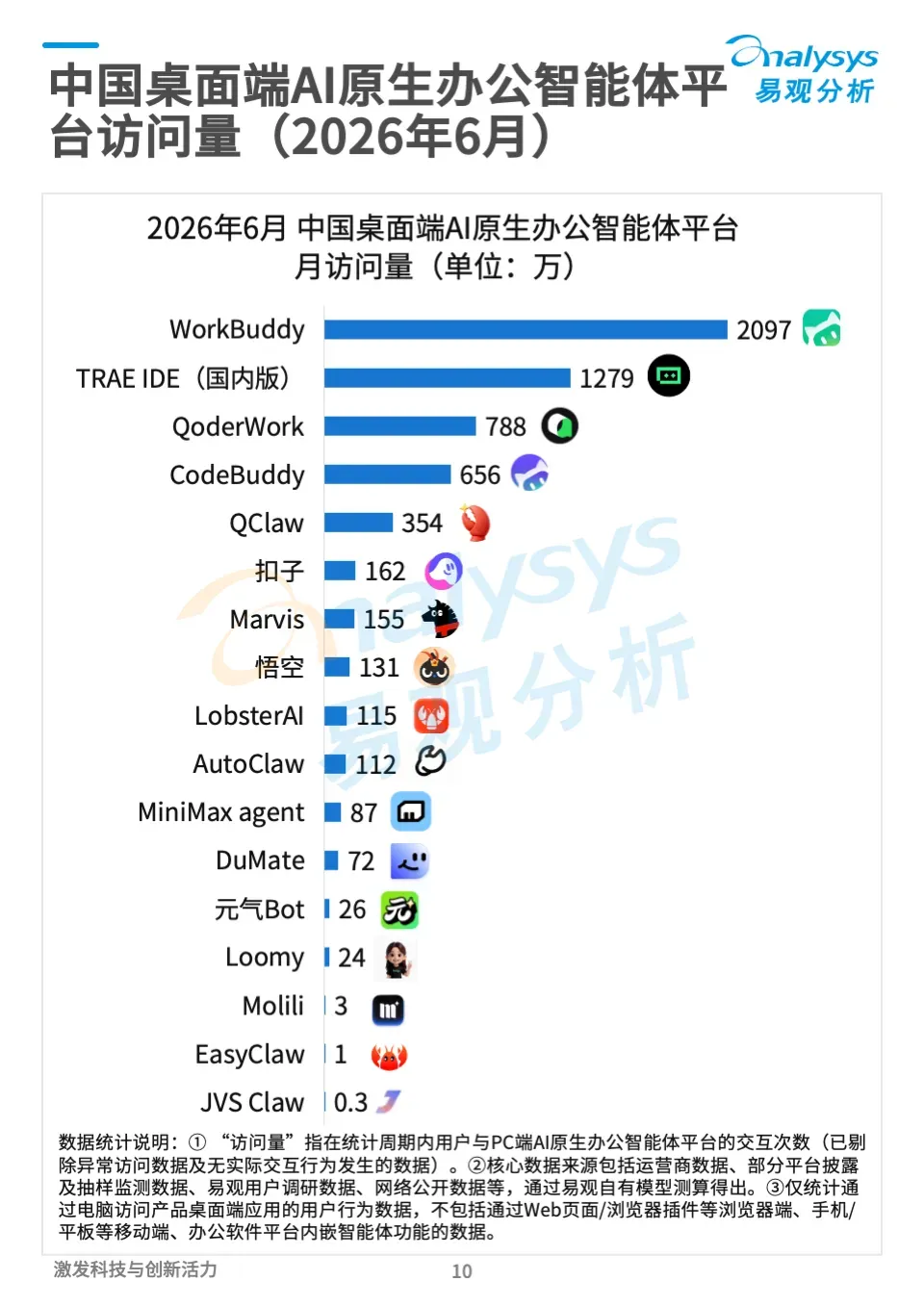
The traffic gaps have widened. Consequently, major companies are now focusing on consolidating scattered projects, teams, and computing resources. The competition among agents is transitioning from product launches to organizational and commercialization stages.
01. Traffic Dictates the Main Strategy
WorkBuddy's remarkable growth is the primary catalyst for Tencent's decision to consolidate QClaw at this juncture.
Previous data from Analysys indicated that WorkBuddy's monthly PC visits reached 8.85 million in March this year. By June, this figure had skyrocketed to 20.97 million, marking a nearly 2.4-fold increase in just three months.
It's important to note that monthly visits measure the frequency of visits, not unique monthly active users. In its Q1 earnings report, Tencent stated that WorkBuddy was China's most widely used productivity AI agent service based on daily active accounts, without revealing absolute user numbers.
Alibaba lacks directly comparable data. Analysys places QoderWork in the top tier. Media reports citing Alibaba sources claim that QoderWork boasts the largest user base and best market reputation among the three products, while Wukong has long been a semi-finished product, and MuleRun primarily targeted overseas markets.
These metrics influence corporate resource allocation but do not yet determine a final winner. Visits merely indicate user willingness to try; retention, paid conversions, and enterprise renewals are the true indicators of success.
02. Tencent Consolidates Backends, Delays Entry Point Reduction
Tencent's current adjustments are relatively modest. While organizational affiliations have changed, both products continue to operate.
QClaw, built on the OpenClaw open-source ecosystem, emphasizes local operation, WeChat remote recall, and device data security. It functions more like a persistent personal assistant.
WorkBuddy, on the other hand, focuses on task delivery. After users authorize files and tools, it can generate documents, spreadsheets, PPTs, and analytical results. The enterprise version also integrates organizational permissions, team management, and Tencent's office ecosystem.
The two products overlap in capabilities but differ in entry points. QClaw operates through local devices and WeChat, while WorkBuddy resembles a desktop workstation and enterprise productivity tool.
In May, Tencent Cloud established Cloud Product Division VI, led by Tencent Cloud CTO Wang Huixing, responsible for capability building and commercialization of agents like CodeBuddy and WorkBuddy. Over two months later, QClaw-related businesses and some teams were transferred to this division.
This move provides an organizational foundation for reusing model access, skills, security capabilities, cloud resources, billing, and enterprise sales. Tencent does not yet need to choose between the two entry points. Instead, it first consolidates backends and then assesses whether stable demand exists across different scenarios.
This matrix strategy aligns with Tencent's historical product approach: maintaining multiple frontend entry points while concentrating backend resources. As long as user scenarios differ, multiple brands are not necessarily burdensome. The real need is to reduce redundant R&D and internal friction.
03. Alibaba Aims for an Integrated Office Ecosystem
Alibaba's adjustments are more substantial. It plans to integrate three products into a single entry point using QoderWork as the foundation. This move aligns with organizational changes following Wu Zhao's departure and Alibaba's previous AI-related restructuring.
The three Alibaba products differ significantly: QoderWork operates locally, accessing authorized folders, browsing the web, and generating Word, Excel, PPT, and PDF files, serving as a desktop gateway and local execution tool.
Wukong connects to documents, schedules, and approvals within DingTalk, leveraging enterprise identities, permissions, collaboration networks, and business data. MuleRun focuses on cloud-based long tasks and continuous operation.
Alibaba aims to unify three previously scattered organizational and product capabilities: QoderWork handles local execution, Wukong and DingTalk provide organizational and data support, and MuleRun adds cloud operation capabilities. A unified brand reduces user confusion, while a single leader minimizes internal resource competition.
The challenge lies within the product. Three account systems, permission frameworks, task logs, skills, and computing quotas must be integrated, requiring a redesigned pricing model. Security boundaries differ for local operation, cloud execution, and enterprise governance.
More critically, DingTalk is central. Media reports claim DingTalk generated over 4 billion yuan in revenue in 2025, accumulating a vast client base in manufacturing, government, education, and SME markets. Qianwen Office's value would be limited unless it integrates with these clients, permissions, and workflows.
04. ByteDance Maintains Multiple Entry Points for Now
Another representative case is ByteDance. In Analysys' report, TRAE IDE (domestic version) entered the top tier, but ByteDance's office agents span multiple product lines.
The foundation is the Doubao large model. The middle layer is Kouzi, responsible for agent construction, skills, and workflow development. The upper layers include Kouzi and TRAE Work.
Kouzi has expanded from a low-code development platform into an AI team collaboration tool, covering office work, programming, video creation, and file processing. TRAE Work extends from programming scenarios to general office tasks, offering Work and Code modes for handling documents, spreadsheets, research, and coding.
Their boundaries are converging. Both can read files, invoke tools, and deliver results directly, differing only in starting points and core user bases.
ByteDance has not publicly announced plans to merge these entry points. Sources say internal discussions are underway about deep integration between Doubao Office and Feishu. Feishu possesses enterprise clients, collaboration networks, and organizational data; Doubao provides consumer-facing access and model capabilities; Kouzi and TRAE handle agent development and task execution.
ByteDance's higher tolerance for experimentation allows it to temporarily maintain multiple product lines, connected via models and development ecosystems. However, as product lines multiply, issues like overlapping entry points, fragmented branding, and redundant investment become harder to ignore.
While ByteDance has not merged all products like Alibaba, it has begun prioritizing entry points. Kouzi and TRAE continue developing and executing agents, while Feishu Daily leverages organizational relationships, enterprise knowledge, and permission systems to compete for enterprise-grade agent residency.
05. Post-Competition: Time to Assess Costs
Earlier this year, OpenClaw spurred domestic vendors to launch office agents en masse. Parallel team operations suited early-stage trial-and-error but led to redundant investments. Model, computing, R&D, branding, and sales resources were scattered across similar products.
Now that traffic has stratified, companies have a basis for consolidating resources.
Tencent has begun charging: WorkBuddy's personal version costs 99–999 yuan monthly, while the enterprise SaaS version costs 198 yuan/user/month. Wukong's personal memberships are priced at 39 and 99 yuan. Office agents have moved from free customer acquisition to paid testing.
However, published prices do not equate to a viable business model. Tencent has not separately disclosed WorkBuddy's revenue or paying users, nor has Alibaba revealed comparable figures for its three products. While Analysys' visit data indicates market enthusiasm, it does not reflect commercialization success.
Tencent and Alibaba's current adjustments primarily address internal efficiency. Tencent aims to have multiple entry points share a single backend, while Alibaba seeks to unify desktop, DingTalk, and cloud capabilities under one entry point. ByteDance retains multiple product lines but must reevaluate the relationship between its office agents and Feishu.
Next, the true tests are whether users incorporate agents into daily workflows, whether enterprises renew subscriptions, and whether task revenue covers computing costs.
- END -
-
![]()
Focus | CCCC’s Takeover of Greentown Comes to Fruition: Why Did the 11-Year ‘Control Without Authority’ Era End?
-
![]()
Final Verdict: The 2026 China Auto Forum Shines with Unique Characteristics at a Pivotal Moment
-
![]()
Tencent Maintains Matrix Approach, Alibaba Merges Entry Points: Tech Titans Initiate AI Agent Consolidation
-
![]()
Geely Secures Portion of Ford’s Spanish Production Capacity
-
![]()
Tesla Stalls This Second
-
![]()
Elon Musk's 'Money-Burning' Spree: All Car Sales Profits Poured into AI
-
![]()
Why Did Tesla’s Profits Drop and Cash Flow Go Negative?
-
![]()
AI Titans Are All in the Red: Time for Intelligent Driving Car Buyers to Reassess?