Tesla Stalls This Second
 07/24 2026
 466
466
Capital markets are "losing patience" with Tesla.
Recently, Musk has encountered another "sweet dilemma."
On one hand, Tesla is achieving record-high sales and revenue; on the other, profits and gross margins are declining, marking an awkward phase of "revenue growth without profit growth." After the financial report was released, shareholders angrily stated, "If the stock price doesn’t drop by 10% today, how can you justify it?"
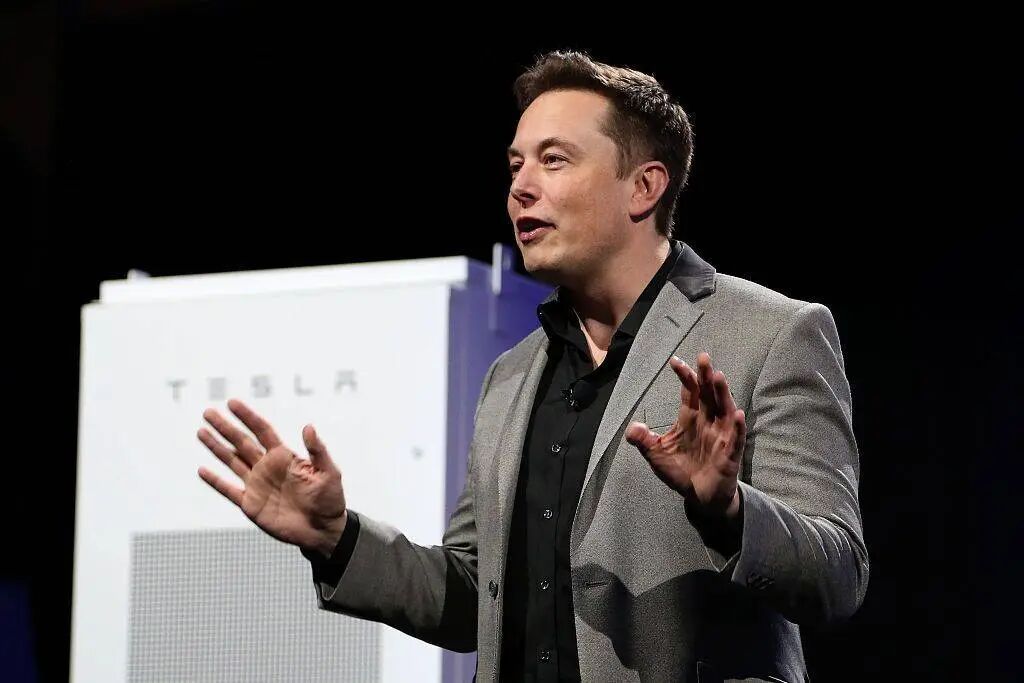
However, the capital markets fulfilled half of this shareholder's "grievances." The stock price dropped, but not by 10%. After the release of this record-breaking financial report, Tesla's after-hours stock price fell by 4%.
This is because the rate of decline in Tesla's automotive profits has outpaced the growth rate of AI revenue.
Two Sharp Declines
Wall Street has expressed dissatisfaction with Tesla's financial results for the second quarter of 2026. The report appears somewhat contradictory, with some data rising while more shows a decline.
Financial results show that Tesla's revenue for the quarter reached $28.236 billion, exceeding market expectations of $25.71 billion, representing a 26% year-over-year increase; automotive sector revenue was $20.516 billion, up 23% year-over-year.
These figures would normally be cause for congratulations, as revenue exceeded market expectations. However, Musk couldn't smile because profit indicators weakened significantly across the board, with operating profit plunging by 57% year-over-year and an operating profit margin of just 1.4%. Additionally, Tesla's automotive gross margin fell from 21.1% in the first quarter to 16.8% in the second quarter.
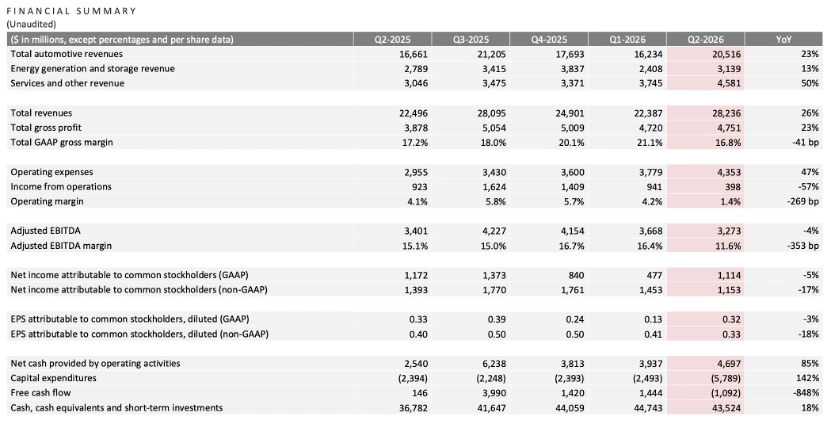
These two "sharp declines" were almost unbearable for capital markets. Wall Street cast a vote of disapproval against the model of revenue growth without profit growth, and the after-hours stock price fell accordingly after the financial report was released.
Tesla provided explanations for the decline in profitability and gross margin. The drop in operating profit was mainly influenced by factors such as lower average selling prices of vehicles, reduced regulatory credit revenue, increased warranty expenses in the energy business, and ongoing growth in AI R&D, stock-based compensation, and administrative expenses.
Furthermore, Tesla offered reassurance to Wall Street. As vehicle deliveries increase, service business profitability improves, FSD subscription revenue grows, and per-unit manufacturing costs decline, these factors will provide some support for profitability.
The automotive business remains Tesla's foundation, contributing 72.7% of the company's revenue. In terms of delivery data, Tesla produced over 451,000 pure electric vehicles globally in the second quarter, a year-over-year increase of about 10%. Deliveries reached 480,100 units, up approximately 25% year-over-year. The Model Y remained at the top of global sales rankings across all categories, with comprehensive recovery in global market demand.
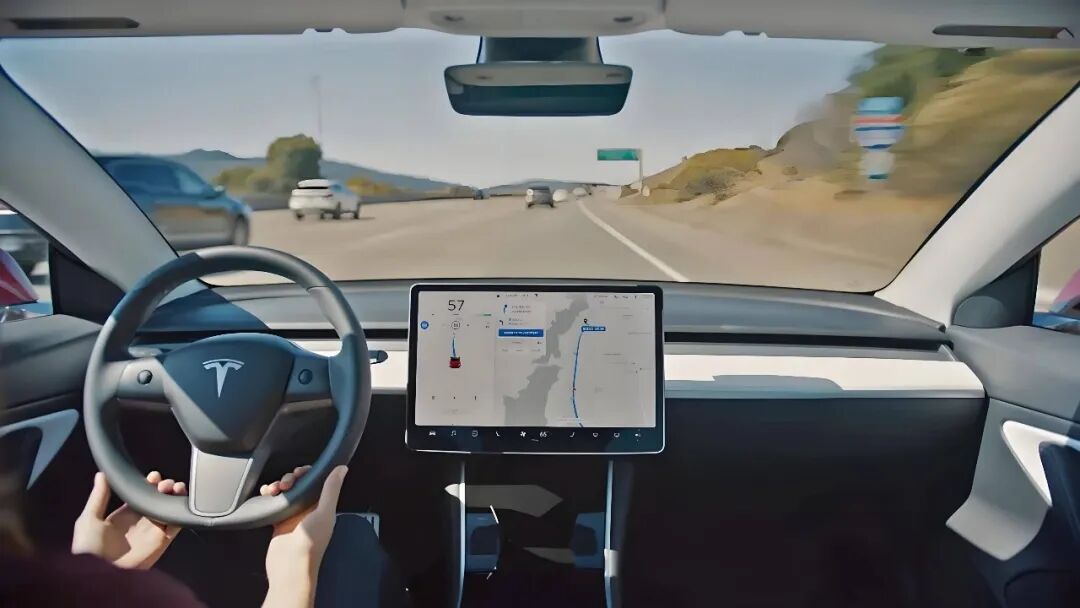
Musk said during the earnings call, "Many people come to our stores saying they want to buy FSD and include a vehicle with it." Data shows that the FSD option rate for new cars in North America is 55%, with 1.48 million global paying users, a 56% year-over-year increase.
With 1.48 million users and FSD capabilities priced at $99 per month, Tesla could generate approximately $775 million in annual revenue from this source, which is already on the scale of Tesla's second-largest revenue stream.
A decent increase and a seemingly favorable situation. So, where does the issue of declining automotive gross margins lie?
The direct reason is the reduction in vehicle selling prices and a significant shrinkage in carbon credit revenue, which fell by 66.7% year-over-year, significantly weakening its pulling effect on automotive gross margins. The automotive gross margin, excluding credits, fell to 16.3%.
Another core reason is Tesla's continued investment in artificial intelligence and autonomous driving R&D, compounded by increased stock-based compensation expenses, leading to a 47% year-over-year increase in operating expenses. Currently, $1 billion of the reported net profit is unrealized gains from SpaceX equity; after excluding this non-recurring gain, the net profit from core businesses such as automotive, energy storage, and services is only around $100 million.
Tesla's management stated that the company is currently in a period of large-scale investment and is willing to sacrifice short-term profits for long-term technological and production capacity expansion. However, overall, the reassurance provided by Musk will take time for the markets to digest.
As for whether Wall Street will accept this reassurance, Musk lacks complete confidence.
Painting a Big Picture for Wall Street
The reason Wall Street is hesitant to fully embrace reassurance is that Musk clearly stated that Tesla will continue to burn cash until 2029.
Currently, the market defines Tesla as a technology company combining "automotive + AI + energy storage + robotics," and Tesla has made some "comprehensive but aggressive" layout (translations kept as pinyin for specific terms unique to context) in line with this positioning (positioning).
During the earnings call, Musk mentioned that the Cybercab production line, Optimus production line, Dojo supercomputing cluster, next-generation AI hardware R&D, and site selection for the TeraFab self-built chip factory, among others, will all be announced soon. He referred to this as "the fastest industrial-scale expansion in the U.S. since World War II."
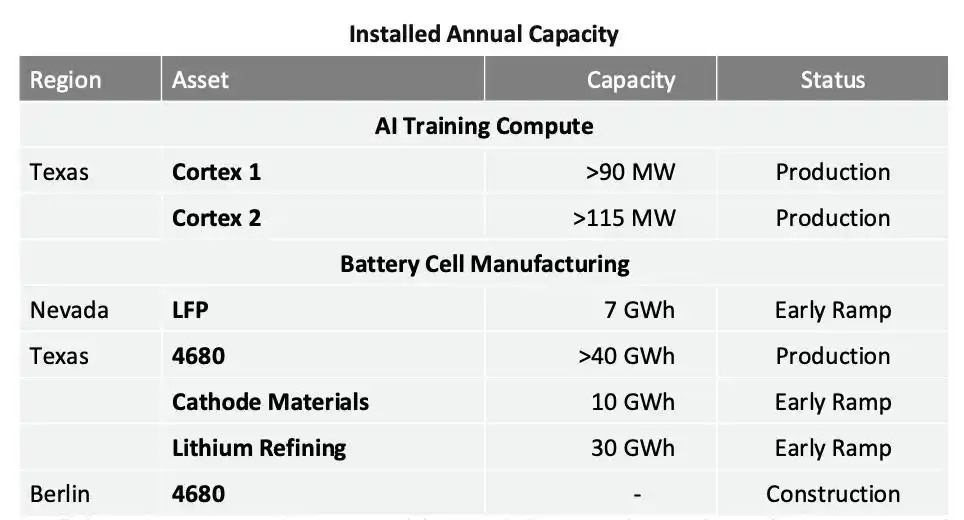
These layout (layouts) are also why capital markets are willing to assign Tesla a trillion-dollar valuation premium. However, this does not mean capital markets will indefinitely "indulge" Tesla.
They support long-term narratives but also demand Periodic performance (phased performance) and, more importantly, tangible return expectations for capital investments. Both are indispensable. Currently, all new businesses are in the pure investment, zero-return incubation stage, and Tesla lacks sufficient return expectations, with phased performance also falling short.
As a result, capital markets' trust in Tesla's multi-line investment expansion is insufficient, even giving rise to skepticism. Moreover, Tesla is currently at a stage where "it's unclear where the money is being spent." In 2026, Tesla's capital expenditures will exceed $25 billion, compared to $8.53 billion in 2025.
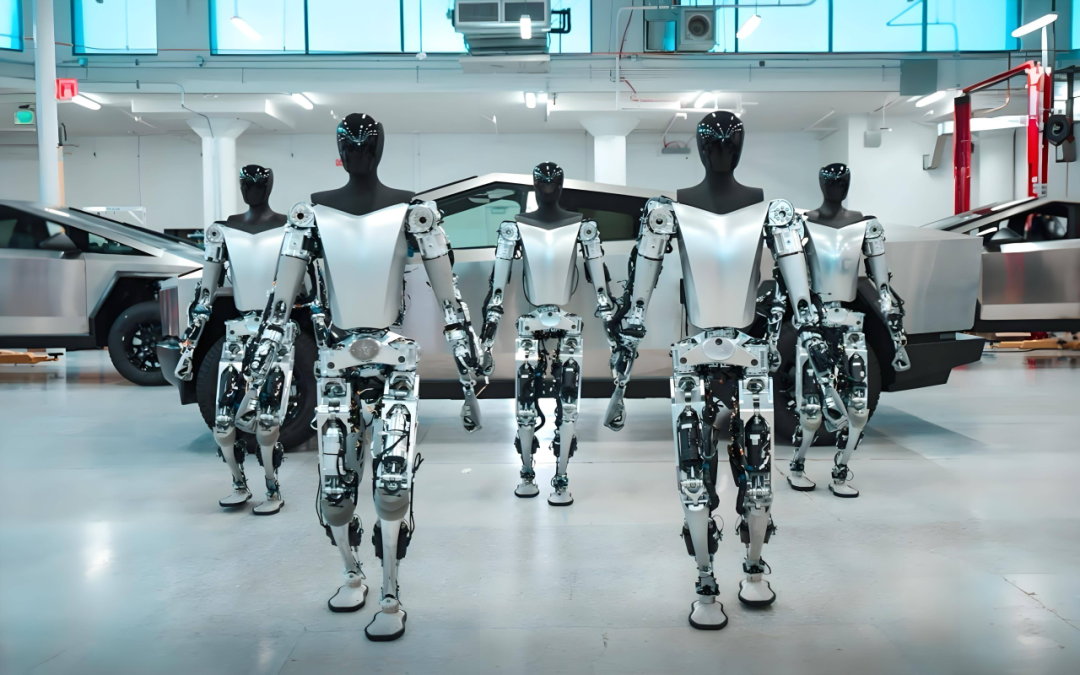
Despite massive capital investments, production issues continue to plague Optimus. Optimus has been explicitly identified by Musk as "the most difficult product to mass-produce in the company's history," with over 10,000 entirely new custom components in the entire machine. This means Tesla must face the development of new components, new systems, and assembly processes, as well as redesign, validate, and establish a supply chain.
Moreover, this is a lengthy process. Currently, production line construction has begun at the Fremont factory, replacing the original Model S/X production line. It is predicted that 100,000 units will be produced monthly in five years, but there is currently no clear guidance on mass-production scale, application scenarios, profit models, or return cycles.
Nevertheless, Musk remains confidently painting a grand vision for investors: "Optimus will be the first robot capable of completing general-purpose tasks."
However, before indulging in this grand vision, investors hope to see progress on the TeraFab mega-wafer fab. This is the core infrastructure for the large-scale mass production of AI chips and robots, consuming cash flow in the short term with commercial profitability still far off.
Besides this, Tesla's plans for mass-producing the Cybercab and expanding the Robotaxi business remain at the technical pilot stage, requiring a prolonged process.
In the financial report, Tesla updated its annual production capacity forecast for the Cybercab Texas factory to 125,000 units. However, when asked about challenges, Musk stated the "extremely high requirement" of "achieving 99.999999999% stability," which poses some obstacles to the widespread adoption of the Cybercab. Thus, he vaguely said, "Production ramp-up is underway." It is evident that ramping up production is a challenge Tesla cannot resolve in the short term.
Multiple projects require funding.
The three core technology sectors supporting Tesla's trillion-dollar valuation—FSD, Robotaxi, and Optimus—all face the issue of rapid technological implementation but slow commercial monetization. Tesla's CFO explicitly predicts that free cash flow will remain negative until 2029, with continuous cash consumption over the next three years.
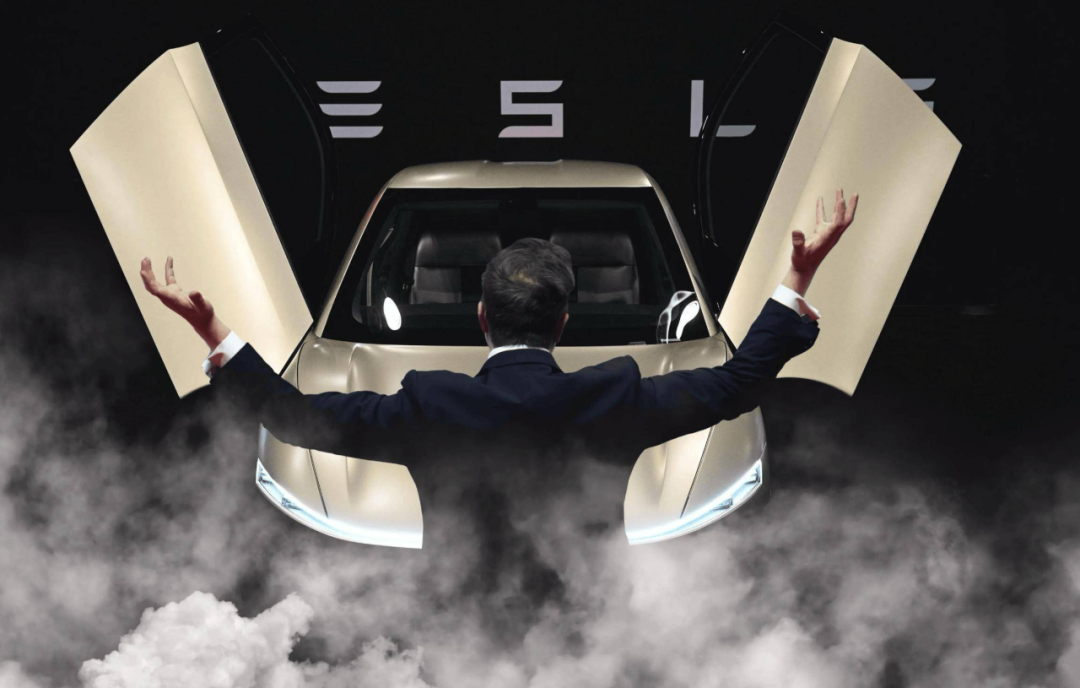
Tesla's trajectory is clear. The automotive business provides scale, data, and cash, which are then reinvested into Robotaxi, chips, and robotics, ultimately expecting software subscriptions, autonomous mobility services, and robot sales to form new profit sources. In Morgan Stanley's $417 target price, the automotive business accounts for only $47, with the remaining $370 coming from Robotaxi, Optimus, and FSD.
However, the pressure from multiple businesses and market scrutiny, like a dull knife cutting flesh, raises the question of whether the profits Tesla earns from its automotive business can cover prolonged R&D costs and the pace of investment expansion. Musk may not dare to guarantee this.
After all, market patience is already waning.
Note: Some images sourced from the internet. If there is any infringement, please contact us for removal.
-END-

-
![]()
Focus | CCCC’s Takeover of Greentown Comes to Fruition: Why Did the 11-Year ‘Control Without Authority’ Era End?
-
![]()
Final Verdict: The 2026 China Auto Forum Shines with Unique Characteristics at a Pivotal Moment
-
![]()
Tencent Maintains Matrix Approach, Alibaba Merges Entry Points: Tech Titans Initiate AI Agent Consolidation
-
![]()
Geely Secures Portion of Ford’s Spanish Production Capacity
-
![]()
Tesla Stalls This Second
-
![]()
Elon Musk's 'Money-Burning' Spree: All Car Sales Profits Poured into AI
-
![]()
Why Did Tesla’s Profits Drop and Cash Flow Go Negative?
-
![]()
AI Titans Are All in the Red: Time for Intelligent Driving Car Buyers to Reassess?