Yonyou Network: A Company Selling 'Transformation' but Struggling in Its Own Transition
 07/24 2026
 545
545
This article marks the 1058th original work by Deep Dive Atom.
"
Wang Wenjing's Third Comeback Amidst Yonyou's Challenging Journey
By Meng Fanle | Authored
Edited by Deep Dive Atom Studio
On July 15, 2026, Yonyou Network made its third attempt to list on the main board of the Hong Kong Stock Exchange, with China Merchants Securities International and CITIC Securities acting as joint sponsors. This move came after two previous applications lapsed and were swiftly resubmitted within just over a year, highlighting Yonyou's pressing need to secure financing in Hong Kong.
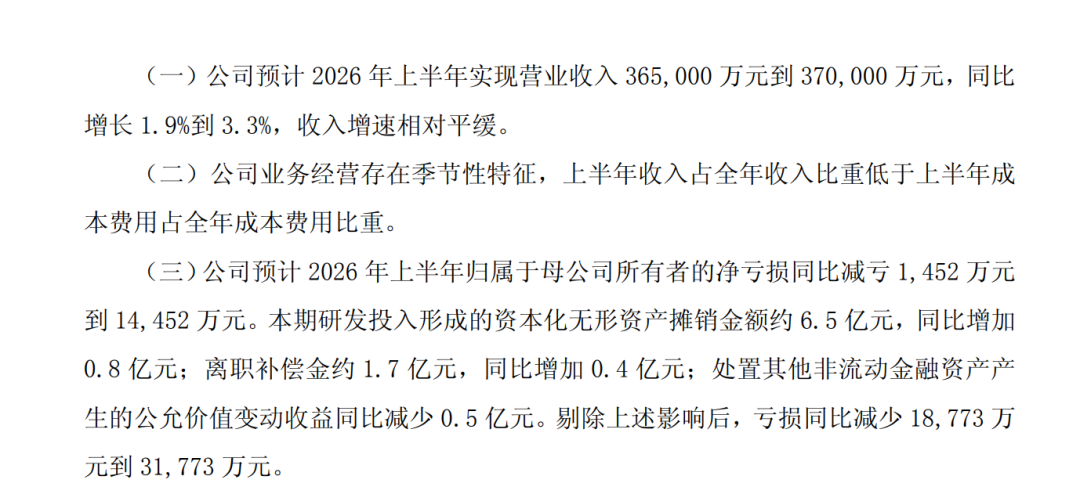
The day before submission, on the evening of July 14, Yonyou Network released its semi-annual performance forecast: revenue for the first half of the year was projected to be between RMB 3.65 billion and RMB 3.7 billion, with a net loss ranging from RMB 800 million to RMB 930 million. Founded in 1988 and once hailed as the 'Cloud Leader' with a market capitalization exceeding RMB 180 billion, this Chinese ERP giant saw its stock close at just RMB 9.31 on the day of submission, with a market cap below RMB 32 billion—a staggering decline of over 80% from its peak.
Over the past three years, Yonyou Network has reported a cumulative net profit attributable to shareholders of approximately -RMB 4.4 billion, reduced its workforce by nearly 30%, and witnessed four presidential changes in four years. While Yonyou assures its clients that 'AI will reshape your business,' its own profit statements tell a different story. A company that sells 'digital transformation' solutions to enterprises across China is finding itself increasingly entangled in its own digital transition.
The Truth Behind the Losses: More Than Just 'Growing Pains'
Yonyou often attributes its losses to 'accounting growing pains resulting from the shift to cloud subscriptions'—moving from one-time licensing to installment-based subscriptions means contracts are signed, but revenue is recognized gradually, making financial statements appear unattractive. This narrative has been consistently repeated at investor meetings for three years, yet the numbers remain uncooperative.
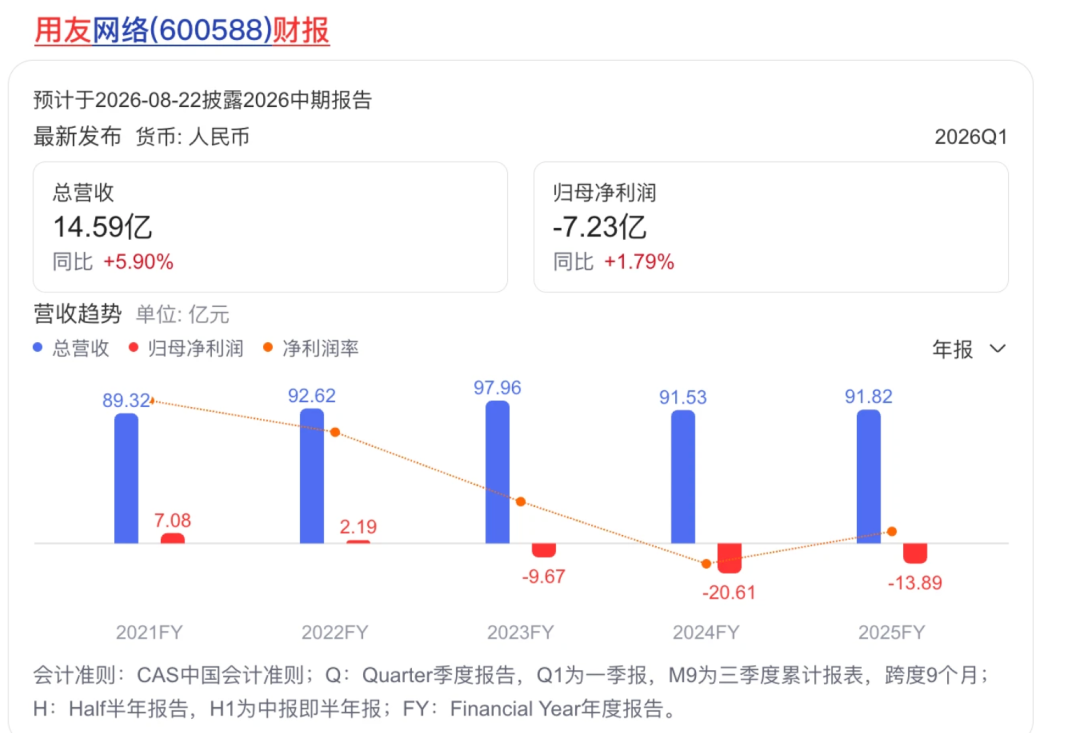
From 2023 to 2025, Yonyou's net profit attributable to shareholders was -RMB 967 million, -RMB 2.061 billion, and -RMB 1.389 billion, respectively. In the first quarter of 2026 alone, it reported a net loss of -RMB 723 million, with an expected loss of -RMB 800 million to -RMB 930 million for the first half of the year. If this were merely a timing issue, losses should narrow each quarter; instead, the loss curve remains stubbornly high. The real reasons lie hidden within the cost structure.
In 2025, Yonyou's R&D expenses reached RMB 2.286 billion. Of this, depreciation and amortization expenses related to the capitalized costs of developing and upgrading Yonyou BIP amounted to RMB 250.7 million. Due to capitalization, the amortization of this 'old debt' alone consumed RMB 650 million in profit in the first half of 2026. Yonyou is not merely investing for the future; it is paying off past accounting decisions.
Revenue figures further undermine the 'transformation pains' narrative. Total revenue in 2025 was RMB 9.182 billion, up just 0.32% year-on-year. Revenue for the first half of 2026 is projected at RMB 3.65 billion to RMB 3.7 billion, representing a year-on-year increase of 1.9% to 3.3%. For a company claiming to fully embrace cloud and AI, stagnant revenue growth is difficult to dismiss as a 'normal phase of transformation'—it suggests a deceleration of its core business.
On the liability front, as of the end of the first quarter of 2026, Yonyou's total liabilities stood at RMB 12.626 billion, up 1.96% from the start of the year; its liability ratio was 59.75%, an increase of 2.5 percentage points; and current liabilities were RMB 12.048 billion, up 7.45%. Short-term borrowings reached RMB 3.969 billion, a 10.59% increase from the start of the year.
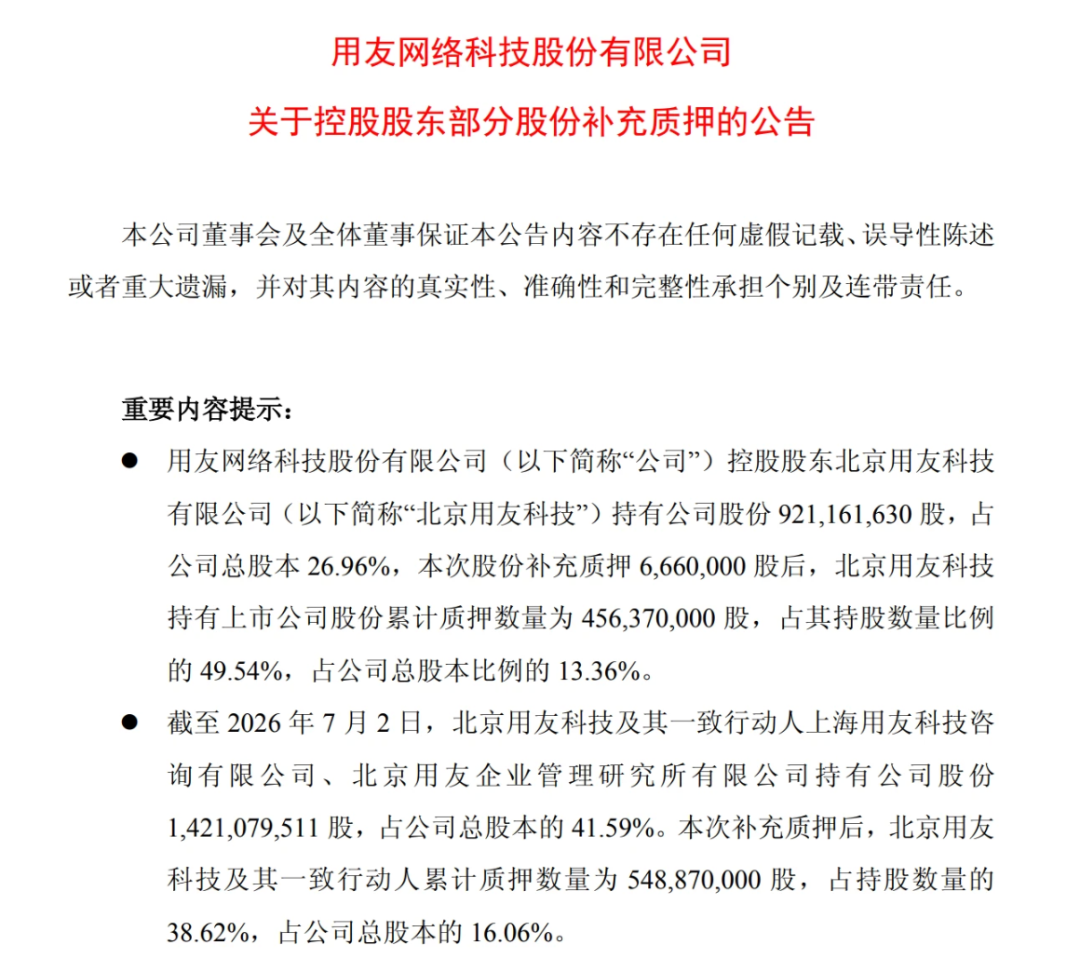
The cash flow situation is even more alarming. In the first quarter of 2026, Yonyou's net cash flow from operating activities was -RMB 1.005 billion, net cash flow from investing activities was -RMB 1.365 billion, and net cash flow from financing activities was RMB 951 million. The net decrease in cash and cash equivalents was RMB 1.422 billion, bringing the total down to RMB 1.698 billion. As of July 2, the controlling shareholder and parties acting in concert had pledged approximately 549 million shares, representing 16.06% of the total share capital. A controlling shareholder of a billion-dollar listed company relying on frequent share pledges for liquidity is a dangerous signal of financial strain.
Layoffs and Leadership Changes: Self-Preservation or Self-Destruction?
To address persistent losses during its transformation, Yonyou has resorted to layoffs.
At the end of 2023, Yonyou employed 24,949 people; by the end of 2024, this number had dropped to 21,283; by the end of 2025, it was 19,055; and by the end of the first quarter of 2026, it stood at 17,747. Over two years and three months, approximately 7,200 employees were let go, a reduction of nearly 30%. Sales and implementation operations roles were hit hardest. Severance pay reached RMB 142 million in 2024 and surged to RMB 170 million in the first half of 2026, with the cost of personnel optimization continuing to rise. Layoffs themselves have become a new source of losses.
More troubling is the manner of these layoffs. In early 2025, media reported that Huang Chenhong, the president brought in from SAP, implemented a reform to 'outsource 80% of delivery work,' requiring many delivery department employees to transfer to outsourcing firms. While layoffs can significantly reduce operational costs, amortization expenses alone reached RMB 650 million in the first half of 2026. The savings are insufficient to fill past financial holes and may first deplete delivery capabilities.
Even more dramatic than layoffs has been the leadership turmoil. Since 2019, the presidency at Yonyou has become a notorious revolving door: Wang Wenjing first stepped down in 2019, handing over to Chen Qiangbing; he returned in 2021; handed over again to Chen Qiangbing in 2024; brought in Huang Chenhong as an outsider in January 2025, who departed after less than three months; and in April 2025, Wang Wenjing once again 'came out of retirement' to serve as president. Four presidential changes in four years and three rotations in 15 months, with five senior executives leaving their management roles in June 2025—a frequency rare even in the loosely governed A-share market. Tianyancha data similarly shows frequent leadership changes at Yonyou.
Each leadership change has been accompanied by a strategic pivot: Chen Qiangbing focused on maintaining existing business, Huang Chenhong pushed for outsourcing, and Wang Wenjing bet on AI. Directions shifted every few months, leaving middle and lower management at a loss.
Ironically, compensation figures tell their own story. In 2025, Wang Wenjing received RMB 1.9855 million for the year, while Huang Chenhong, who served as president for just three months, took home RMB 1.6106 million. From 2023 to 2025, total compensation for directors, supervisors, and senior management was RMB 31.9666 million, RMB 33.4057 million, and RMB 27.1066 million, respectively. The 2025 salary decline correlates with the removal of five senior executives and stands in stark contrast to the deteriorating profit curve.
Yonyou is deeply tied to large state-owned enterprises, benefiting from policy dividends for indigenous innovation and import substitution. However, this has come at the cost of long implementation cycles, heavy customization, and slow payment collection. After laying off delivery teams, who will serve these major clients? While the core product YonBIP boasts a 99.2% renewal rate, the sustainability of this figure amid weakened delivery capabilities is questionable. Rival Kingdee focuses on SMEs with standardized offerings and achieved positive adjusted net profit in 2025. While both are transforming, Kingdee has succeeded where Yonyou remains stuck.
The AI Narrative: Genuine Innovation or IPO Packaging?
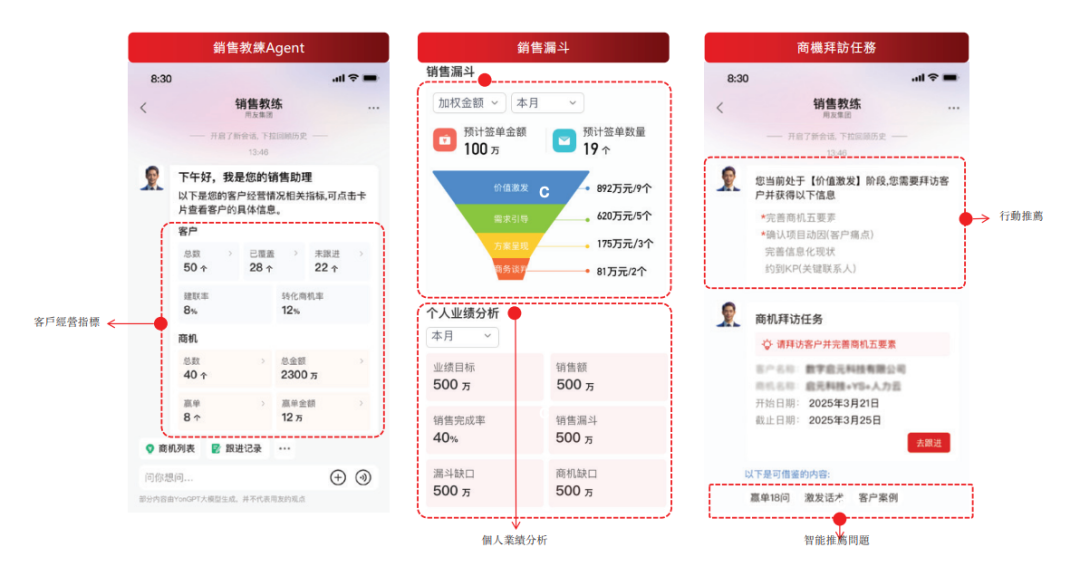
Yonyou has crafted a comprehensive AI story for the capital markets: developing the YonGPT enterprise large model and YonLOM ontology large model, compatible with general-purpose large models like DeepSeek, Tongyi Qianwen, and Doubao; layering on the YonAI intelligent platform, DataAgent data intelligence, and the intelligent agent 'Zhiyou'; covering finance, supply chain, manufacturing, and HR scenarios; and unveiling the Digital Employee 2.0 system. The matrix is complete, the concepts cutting-edge, and the presentations impressive.
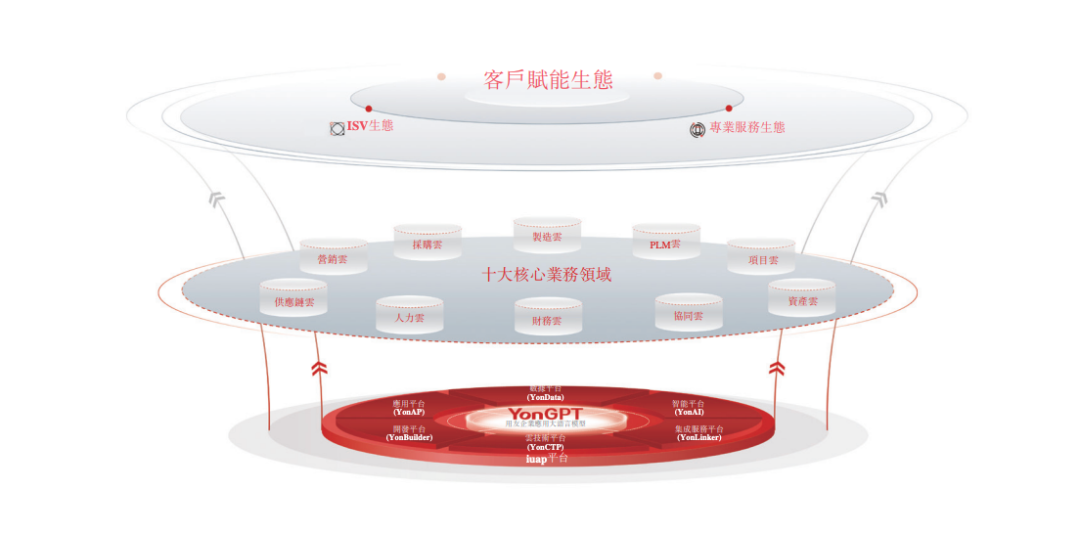
But the commercial reality is far leaner. AI projects involve data governance, system integration, and industry adaptation, with long delivery cycles and high implementation costs. Signed contract amounts do not quickly convert into revenue and gross profit. While AI-related contracts reached RMB 910 million in the first half of 2026, only RMB 137 million was recognized as revenue in the first quarter.
Crucially, nearly all current AI projects are concentrated among flagship state-owned enterprises, such as China First Heavy Industries and State Power Investment Corporation. These projects are highly customized and nearly impossible to replicate. Yonyou has yet to develop a standardized, low-cost, mass-deliverable AI product.
This creates a vicious cycle: the more AI projects are 'customized flagships,' the less scalable they become; the less scalable, the more reliant they are on high-cost delivery to a few major clients; the higher the delivery costs, the harder it is for the AI business to turn a profit. Yonyou's AI currently represents 'burning money for hope' rather than 'earning money from reality'—more akin to a 'technology showcase' constructed for the Hong Kong IPO and valuation narrative.
Meanwhile, the competitive landscape is increasingly unfriendly to traditional vendors. Old competition focused on ERP functionality and implementation experience, where Yonyou could leverage three decades of industry know-how. But AGI-era competition standards have shifted—clients now demand combinations of enterprise large models, data foundations, intelligent agents, low-code platforms, security compliance, and AI-native delivery capabilities. Standalone ERP modules have lost their edge. SAP and Microsoft have deeply embedded self-developed AI into their products, while domestic AI vendors and vertical SaaS companies are rapidly encroaching on enterprise process scenarios. Yonyou's traditional barriers are being diluted from multiple directions, and its new AI barriers have yet to materialize.
The strain in resource allocation is even more fundamental. Yonyou must maintain delivery and maintenance for traditional ERP clients while continuing to burn money on AI R&D, diverting both manpower and funds. Traditional heavy project-based delivery clashes with AI's lightweight SaaS model in organizational capabilities, and frequent leadership changes prevent organizational restructuring from taking root. Hong Kong and international investors long ago stopped buying 'revenue scale' arguments; they focus on ARR, net retention rates, free cash flow, and AI profitability inflection points—precisely Yonyou's weakest metrics.
Hong Kong and Overseas: Lifeline or Mirage?
Yonyou's three attempts to list in Hong Kong tell their own story. The first submission in June 2025 lapsed in December; an updated submission also lapsed; and a third was filed on July 15, 2026. The core reason for both lapses was failure to complete a hearing within the six-month validity period, with the CSRC focusing on inquiries about share pledges, liquidity risks, foreign investment compliance, and the rationale for persistent losses—each question striking at a soft spot.
Yonyou may package its Hong Kong listing as 'a crucial step in its globalization strategy,' but the Purpose of Fundraising clearly states: supplementing working capital and alleviating short-term debt repayment pressures. The RMB 1.7 billion in cash barely covers the RMB 4 billion shortfall in short-term debt—the true driver behind the three Hong Kong listing attempts. 'Connecting with international institutional investors' and 'telling China's enterprise AI story' are merely dignified wrappers for a financial lifeline.
Overseas business data further undermines the 'global breakthrough' narrative. From 2023 to March 31, 2026, overseas revenue accounted for just 2.2%, 2.5%, 3.4%, and 5.5% of total revenue, respectively. As of March 31, 2026, 40% of client performance relied on Chinese enterprises going abroad. Talk of a 'global second growth curve' seems overly optimistic. More critically, the overseas ERP market is already dominated by SAP, Oracle, and other giants, with local SaaS vendors rapidly rising. Yonyou lacks brand recognition and channel accumulation in this arena, making upfront burning of cash inevitable—and its cash reserves are already strained.
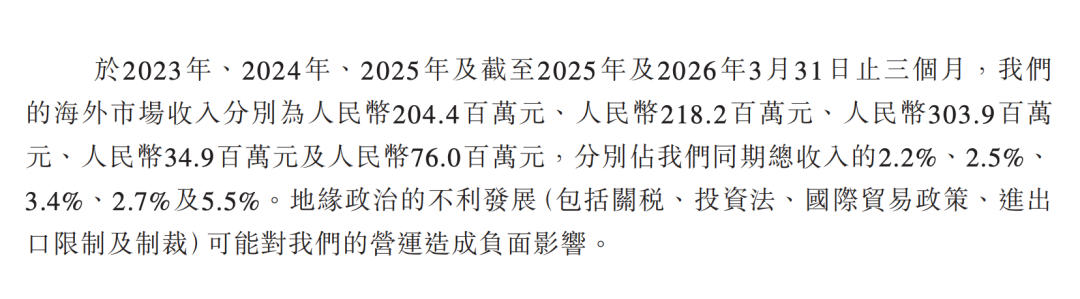
In the short term, even a successful Hong Kong listing would only alleviate immediate pressures, not reverse losses; overseas revenue at 3% cannot begin to cover domestic profit shortfalls. To turn around in the medium to long term, Yonyou needs simultaneous delivery on three fronts: Hong Kong listing, overseas scaling, and standardized AI delivery—each fraught with uncertainty.
The current predicament of Yonyou Network essentially mirrors the classic quandary faced by traditional software vendors, who find themselves ensnared between shifting technological paradigms. Their legacy businesses are dwindling, yet they still constitute the bedrock of revenue. New ventures, while on an upward trajectory, are far from robust enough to reverse the overarching downward trend. Cost savings from workforce reductions are offset by historical amortization expenses. Leadership transitions have introduced more confusion than innovation, and fundraising efforts in Hong Kong are geared more toward sustaining operations than fueling expansion. Moreover, the company's overseas business serves more as a compelling narrative for stakeholders than as a genuine driver of growth.
Whether Yonyou can extricate itself from this quagmire hinges on three critical, quantifiable factors. First, can its AI products transition from bespoke, flagship projects to standardized, scalable offerings? Second, can overseas revenue evolve from a mere 3% embellishment into a bona fide second growth curve? Third, can the company's operating cash flow decouple from its reliance on year-end payment surges? Until these questions are answered affirmatively, Yonyou may continue to market "transformation solutions" to others—but what it urgently requires is a transformation strategy of its own, one that transcends mere PowerPoint presentations and delivers tangible results.
-
![]()
From Energy Conservation and Carbon Reduction to AI Decision-Making: GECON East Intelligence and Chery Group Explore a New Green and Smart Paradigm for Automobile Manufacturing
-
![]()
WAIC 2026 Observation | AI Accelerates Towards the Core of Industries, Industrial AI Enters a Critical Phase
-
![]()
Volkswagen China Fires the First Shot in Foreign-Funded 'White Box Delivery'!
-
![]()
AI Agent Smartphones: The Next Competitive Edge Transcends Large Models
-
![]()
Over 880 Million Yuan Worth of Orders Unveiled, Bidding Launched for Shenzhen Eastern Public Transport
-
![]()
Tesla's Robotaxi Hits the Road: A Monumental Gamble with an Uncertain Future
-
![]()
Ford and Geely Forge New Joint Venture in Spain, Sidestepping Changan and JMC
-
![]()
199 RMB! Godox's First Camera Review: Subpar Photography, Transparent Viewfinder Frame is the Highlight