DingTalk, Feishu, and WeCom's Silent 'March Eastward'
 07/29 2026
 539
539
SHEN MOU

Original: Shenmou Finance and Economics (chutou0325)
'Starting from July 28, 2026, the personal free version of Teams will no longer be available in mainland China.'
An increasing number of Chinese users are seeing this pop-up notification when they open the Microsoft Teams desktop client. This message reflects Microsoft Teams' turbulent nine-year journey in the Chinese market.
In March 2017, Microsoft Teams entered the enterprise collaboration and communication market as a competitor to Slack. By 2020, amid the global COVID-19 pandemic, demand for remote work surged, and Teams' global user base skyrocketed from 20 million to 145 million, making it Microsoft's fastest-growing enterprise application in history.
In China, Teams Free gained popularity among individual users and freelancers during this remote work boom, especially appealing to cross-border professionals who frequently collaborate with overseas clients and foreign enterprise teams. On April 1, 2023, Microsoft introduced the domestic version of Microsoft Teams, operated by 21Vianet, aiming to position Teams as the 'digital hub' for Chinese enterprises.
However, after nine years in China, Microsoft Teams has struggled to gain significant traction.
QuestMobile data reveals that by 2026, the combined market coverage of DingTalk, Feishu, and WeCom—the top three collaborative office platforms in China—reached 92%, leaving Teams with a mere 8% share, heavily squeezed by local competitors.
As the global enterprise office software giant withdraws from the Chinese market, a pressing question arises: Where will local players head in this battle for dominance?
01
The Demise of Old Rules
While DingTalk, Feishu, and WeCom appear to 'divide the market,' there are significant disparities in their user bases.
QuestMobile data shows that DingTalk has surpassed 800 million cumulative users, with approximately 200 million monthly active users (MAUs), securing a 32.7% share—topping China's collaborative office market. WeCom follows with around 100 million MAUs (23.4% share), while Feishu has approximately 30 million MAUs (18.9% share). In terms of MAUs, DingTalk's user base is nearly seven times that of Feishu.
'The winner is whoever has the most users.' According to this once-dominant 'truth' in the office software industry, DingTalk should be the undisputed victor.
However, focusing solely on user scale may overlook more fundamental shifts underway.
From a revenue perspective, despite Feishu having only about 15% of DingTalk's user base, its 2025 revenue exceeded 3 billion yuan, while DingTalk's surpassed 4 billion yuan. DingTalk's subscription revenue broke 3 billion yuan, whereas Feishu's annualized subscription revenue exceeded 2.1 billion yuan—significantly narrowing the gap. This partly demonstrates that user scale does not necessarily equate to commercial value, marking the first old rule's obsolescence.
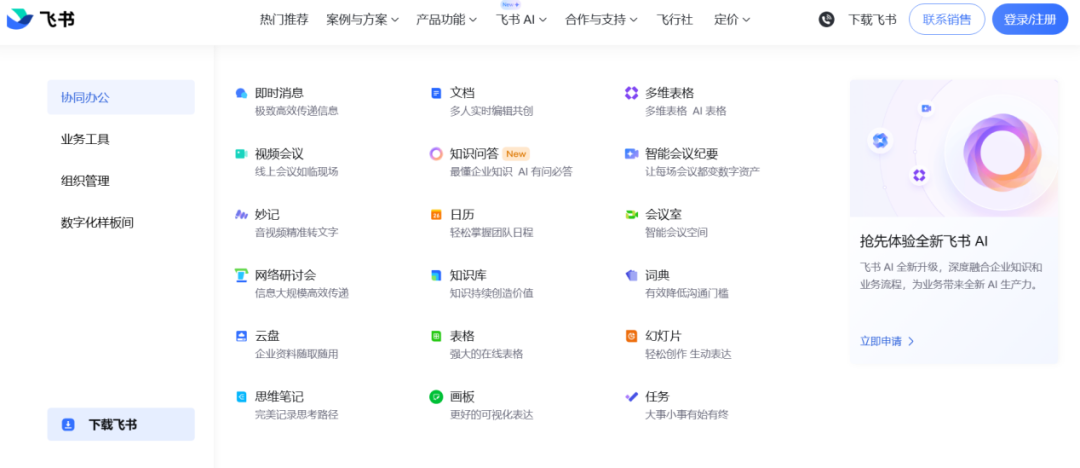
Source: Feishu Official Website
The second obsolete rule is the growth logic of 'acquire users for free, monetize later.'
Enterprise services have never been a game of traffic but a game of trust. A single enterprise client willing to pay continuously, engage deeply, and expand purchases is far more valuable than a hundred active free users.
When an office software adopts a subscription-based, pay-as-you-go model from the outset—rather than relying on free user acquisition followed by gradual conversion—its clients inherently exhibit stronger payment willingness and deeper usage.
As the incremental market dries up and inventory (existing) competition becomes the norm, the ability to extract higher value density from fewer users determines pricing power and growth initiative.
The third, more subtle, obsolete rule is the shift in competitive barriers from 'feature quantity' to 'ecosystem depth.'
Teams Free's exit from China appears to stem from Microsoft's strategic pivot to AI and Copilot, but beneath the surface, the 'tool + ecosystem' barrier proves insurmountable for outsiders.
DingTalk leverages Alibaba's ecosystem, integrating ToB commercial capabilities from Taobao, Tmall, 1688, Alipay, and Alibaba Cloud as 'skills' into its platform, serving as Alibaba's unified AI interface for enterprise work scenarios. WeCom benefits from WeChat's unique ecosystem, enabling message interoperability with over 1 billion WeChat users, connecting mini-programs and WeChat Pay, and facilitating seamless external client engagement—creating a closed-loop from internal collaboration to external services.
Feishu, backed by ByteDance's content and globalization prowess, had over 4 billion monthly active users across ByteDance's apps as of August 2025—nearly one-third of global internet users. This allows Feishu to deeply embed ByteDance's organizational experience and technical capabilities in content distribution and global operations into its product. Such ecosystems cannot be replicated through mere feature stacking.
Old rules crumble; new rules emerge. This is not a contest of user quantity but of who can extract higher value from fewer users, transcend digital-native enterprise boundaries, penetrate broader industrial markets, and build uncopyable ecological barriers.
02
AI Enters the Fray: Unique Strategies Emerge
On March 17, 2023, Microsoft led by integrating GPT-4 capabilities into Office, launching Microsoft 365 Copilot. In November 2024, its commercial version debuted, marking the AI era for Windows. Traditional office software now faces a dimensionality reduction challenge from GPT.
China's market reacted faster than expected. Feishu followed in November 2024 with AI products like 'Feishu Intelligent Partner.' In January 2025, DingTalk unveiled its AI assistant, co-created based on demands from 700,000 enterprises. In April 2025, Tencent announced its collaboration SaaS products, including WeCom, would fully integrate its Hunyuan large model. Leading players simultaneously transitioned AI from concept to product.
Today, as rules evolve, AI's entry has escalated competition to a new level. DingTalk, Feishu, and WeCom have chosen distinct paths based on their DNA.
DingTalk opted for the most challenging route: reconstructing its foundation.
In March 2026, Alibaba launched 'Wukong,' the world's first enterprise-grade AI-native work platform, directly embedded within DingTalk. That same month, DingTalk completed full CLI transformation, enabling Wukong Agent to natively operate thousands of DingTalk capabilities—bypassing simulated human clicks for 'communication as execution.'
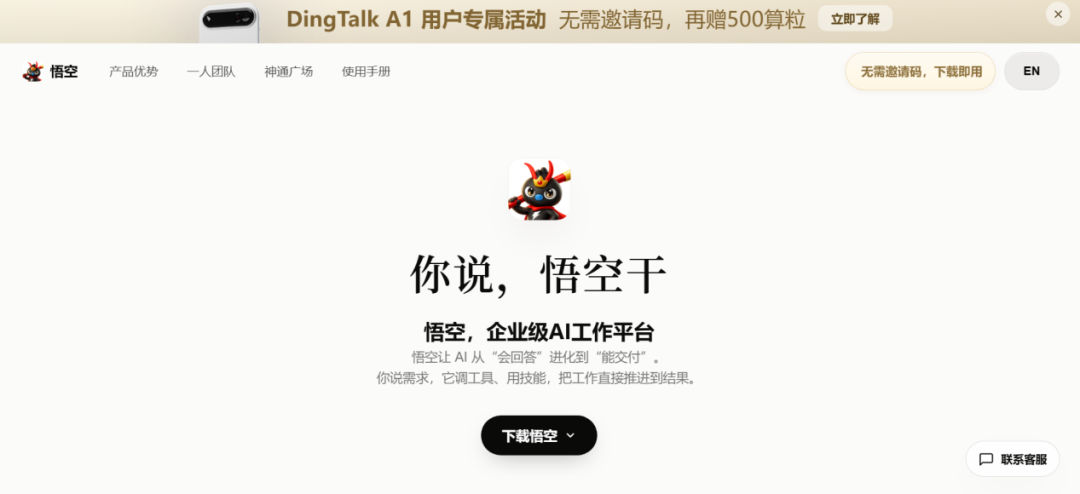
Source: Wukong Official Website
Concurrently, Alibaba developed two other Agent products: MuleRun, launched in September 2025 as a cross-platform Agent execution engine, now serves enterprise users in 43 countries and regions, with 34% of users paying over $200 monthly; and QoderWork, launched in January 2026 as a desktop-grade AI agent tool, leading all Alibaba AI tools in daily and weekly active users and Token usage.
In July 2026, Alibaba strategically consolidated QoderWork, Wukong, and MuleRun into 'Qianwen Office,' led by DingTalk's new CEO, Chen Yusen.

DingTalk CEO Chen Yusen
Source: MuleRun Official WeChat Account
From 'multi-track exploration' to 'resource consolidation,' DingTalk is aligning scattered AI capabilities. Reconstructing a platform with 800 million users for the AI era won't happen overnight, but this architectural overhaul lays the groundwork for the next decade.
In contrast, Feishu was designed from inception as a data system where AI could 'reside.'
Instead of creating a standalone Agent product, Feishu incrementally embedded AI capabilities into its existing product matrix.
This approach works because Feishu's documents, spreadsheets, knowledge bases, calendars, approvals, project management, multi-dimensional tables, and automation workflows all reside in a single system with largely structured data—precisely what AI needs. This 'heavy' design in the collaborative office era now offers a 'first-mover advantage' in the AI era.
Along existing product lines, Feishu extended AI capabilities into Feishu Daily Intelligent Partner, intelligent meeting minutes, AI functions for documents and multi-dimensional tables, Feishu CLI agent operation tools, and CodeM agent for R&D scenarios.
Since 2026, over 90% of Feishu's new clients have simultaneously purchased Feishu AI products. This indicates enterprises now pay for infrastructure enabling AI to integrate into organizational operations, not just 'AI for show.'
Notably, Doubao's deep integration with Feishu is clear. The synergy between an AI assistant with over 150 million DAUs and a collaboration platform housing enterprise core data opens vast imagination space.

Source: Feishu Official Website
WeCom's uniqueness lies in embedding AI into connections.
In June, WeCom launched 'Dayuan,' an AI Agent currently in beta testing. Unlike standalone AI chatbots, Dayuan functions as an 'AI assistant native to WeCom.' Users can summon it by swiping left anywhere in the WeCom interface; it intelligently recognizes the current screen, understanding context based on existing group chats, documents, meetings, emails, schedules, and other work data.

Source: WeCom Official WeChat Account
Leveraging WeChat's 1.432 billion MAUs, Dayuan may extend beyond internal collaboration to client engagement scenarios. If successful, WeCom could become a rare AI Agent gateway with dual access to 'work data + client connections.'
These three approaches differ in focus, and no early winner is clear. Yet they converge on one truth: whoever first integrates AI into organizational DNA gains the upper hand.
03
AI Office Competition: Beyond Parameter Stacking
In the AI office race, large model capabilities were once the focal point. However, as technology iterates, gaps between models narrow rapidly. The Stanford AI Index Report shows that by early 2026, mainstream large models scored within a 25-point margin across multiple benchmarks—nearly indistinguishable.
As large model disparities diminish, competition shifts from 'feature stacking' to 'agent deployment.' The most visible changes occur at the intersection of physical and digital worlds. With software features homogenizing and growth curves flattening, hardware is no longer optional but a key differentiator to break stalemates.
At DingTalk's 10th-anniversary celebration in August 2025, it launched DingTalk A1, its first AI hardware. This 3.8mm-thick AI recording card features a 6nm low-power AI audio chip and a 6-microphone array, supporting clear audio capture within 8 meters and 97% transcription accuracy.

Source: Baidu Baike
Within six months, DingTalk A1 became a bestseller among domestic AI hardware, topping sales charts on Tmall, Douyin, and JD.com. By June 2026, it dominated AI recording device sales across all three platforms.
When voice data from face-to-face discussions, offline meetings, and client interactions is automatically captured, transcribed, and structured—then seamlessly integrated into AI workflows—the boundaries of office software blur, extending from screens into the real world.
If hardware is the vanguard for entry points, industry penetration determines long-term survival.
By Q2 2026, Feishu's ARR surged over 100%, accelerating its 'breakout.'
More notably, its growth structure shifted. Since 2026, over 90% of Feishu's new clients have simultaneously adopted Feishu AI products, expanding its customer base from internet, new energy vehicle, and hard-tech firms to traditional retail, consumer goods, manufacturing, energy, and industrial enterprises.
In the new energy vehicle industry, 70% of the top 30 brands in terms of sales use Feishu; all six listed companies in the tea beverage industry use Feishu. In June 2026, Nanjing Iron and Steel Group officially announced that all employees would use Feishu; in July, Wanxiang Qianchao also announced that all employees would adopt Feishu. Feishu is transcending the boundaries of digital-native enterprises and entering a broader industrial hinterland.

Wanxiang Qianchao & Feishu signing ceremony on-site. Image source: Rizhao News Network
The entry point determines where the data comes from, while the depth determines where the data goes. When AI becomes the workflow itself, having a firm grasp on both offline scenarios and industrial intricacies will make it more likely to go further in this transition from 'tools' to 'infrastructure.'
The exit of Teams Free at this juncture seems more symbolic—the contraction of old forces intertwines with the expansion of local players, but the real transformation has only just begun. As AI begins to redefine 'work,' whoever can become the system that allows AI to 'settle in' will have the opportunity to define the work style of the next decade.
* Image sourced from the internet. Please contact us for removal if there is any infringement.
-
![]()
McKinsey 2026 Mobility Report: Consumers Are Redefining What Makes a 'Good Car'
-
![]()
Duan Jianjun Spearheads Premium Project as Volvo Sets Sights on Rivaling Zunjie with New Flagship Model
-
![]()
Absent from New Energy Vehicle Rural Promotion, Leapmotor Turns Its Gaze Overseas
-
![]()
Reclaiming Global Dominance! Apple’s Market Cap Surges to $5 Trillion in Cook’s Epic Finale
-
![]()
Sales Soar: Has Ora Staged a Remarkable Comeback?
-
![]()
What Kind of AI Phones Do We Actually Need?
-
![]()
DingTalk, Feishu, and WeCom's Silent 'March Eastward'
-
![]()
Is 'Data Scarcity' More Fatal Than 'Computing Power Shortage'? Is It Bringing Disaster?