Competing in the AI Work Arena: Is Qianwen Office Too Late?
 08/06 2026
 330
330

Tencent Ecosystem Dominates Half the Market
Written by / Chen Dengxin
Edited by / Li Ji
Formatted by / Annalee
The AI office sector has witnessed significant changes.
Recently, Qianwen Office, formed by merging three agents—QoderWork, MuleRun, and Wukong—officially launched its public beta, aiming to achieve greater momentum through resource integration.
This signifies a further escalation in AI office competition.
Why has betting on AI office become a consensus among major internet companies? Can Qianwen Office, which is lagging behind, still have a chance?
AI Office 'Three-Way Battle': Who Will Dominate the Future?
Competition Shifts from Shopping to Office
AI office was not initially a core focus for major companies.
In fact, AI applications targeting To C scenarios were the main attraction in early 2026. Services like Doubao, Yuanbao, and Qianwen competed fiercely during the Spring Festival, bringing 'one-sentence shopping' to the forefront.
At that time, AI applications were the main battleground for major companies.
Data from QuestMobile shows that as of March 2026, Doubao had 345 million monthly active users, with a single-quarter increase of 119 million; by the end of the second quarter, Doubao's monthly active users reached 382 million.
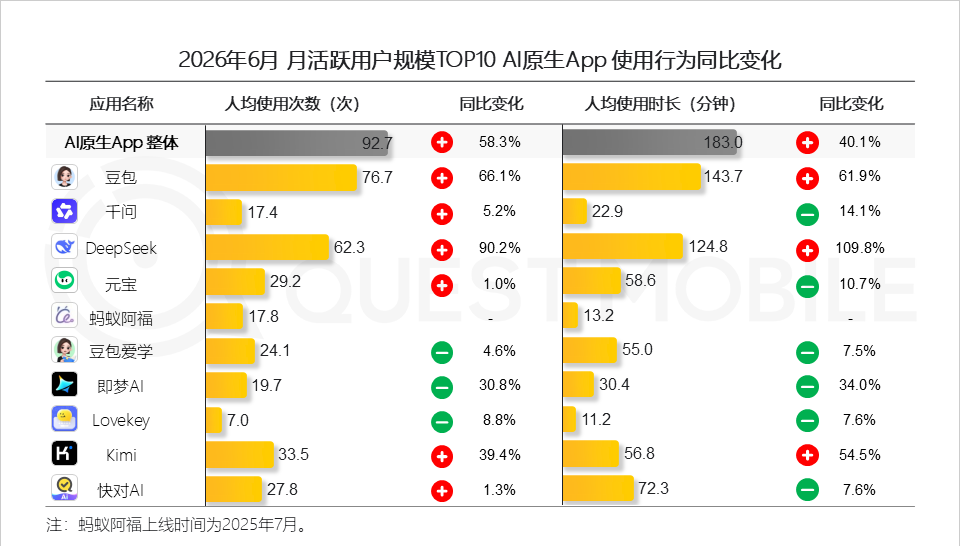
Source: QuestMobile
In other words, Doubao maintained its dominant lead after the competition.
Looking back, while 'one-sentence shopping' seemed promising and was seen as a super entry point for AI, it failed to capture consumer attention for various reasons.
The 'AI Era Consumer Perception and Consumption Decision Survey Report' shows that 64.22% of consumers are concerned about privacy and security in AI shopping, while 62.53% question the accuracy of AI decisions.
Against this backdrop, the importance of AI office has become increasingly prominent, seen as a new opportunity for a breakthrough.
In fact, overseas focus during the same period was on super agents like OpenClaw, which emphasized To B scenarios and demonstrated visible efficiency improvements in AI office, making them highly sought after and prompting global major companies to enter the field.
On one hand, there is a higher willingness to pay.
After AI enters real-world scenarios, token consumption grows exponentially. Although Chinese tokens are cost-effective, the expanding user base makes cost pressure a concern.
The issue is that C-side attitudes toward payment are nuanced, while B-side acceptance is relatively easier.
'Market Value List' states, 'For individual users, an AI product might only slightly improve work efficiency; but for enterprises, if an agent can replace repetitive tasks, shorten business processes, and reduce communication costs, its value will be directly reflected in cost savings and productivity gains.'
Microsoft 365 Copilot exemplifies this point.
In the second quarter of 2026, Microsoft 365 Copilot's paid user base surpassed 30 million, up from 20 million in the previous quarter, representing a 50% quarter-over-quarter growth.
From this perspective, AI office has been the first to establish a viable business model, becoming a fiercely contested area.
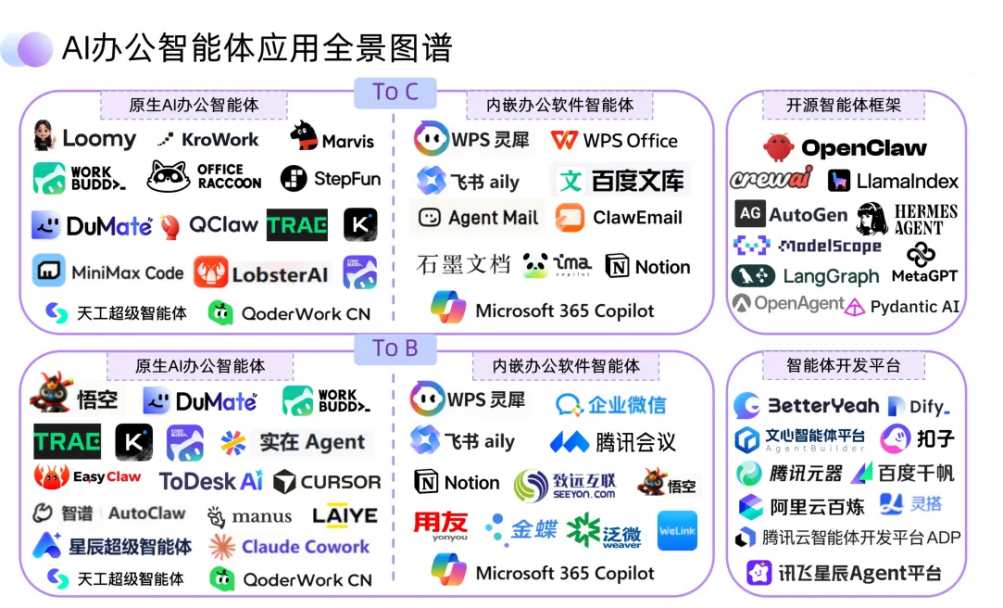
Source: iiMedia Research
On the other hand, office work is a lucrative business.
Daily office tasks are characterized by repetitive content, fixed processes, and clear objectives, making them easier to standardize and facilitating AI learning and iteration. Additionally, the vast data and knowledge accumulated in office work can feed back into large models, creating a virtuous cycle.
More critically, major companies have already established a strong presence in the collaborative office market.
DingTalk entered the enterprise scene in 2015 with innovative features like work attendance tracking, amassing over 800 million users and serving more than 26 million enterprises; WeChat Work leveraged the WeChat ecosystem and partnered with Tencent Docs and Tencent Meeting, keeping pace with DingTalk...
The Challenge of Catching Up with WorkBuddy
However, Alibaba has faced resistance in transitioning from collaborative office to AI office.
Data from iiMedia Research shows that the global AI agent market reached $37.2 billion in 2025, up 197.6% year-over-year; China's AI agent market hit 80.4 billion yuan, up 123.2% year-over-year, and is expected to reach 696.8 billion yuan by 2030, indicating explosive growth.
To compete for this attractive market, Alibaba developed three agents—QoderWork, MuleRun, and Wukong—which, despite different positioning, overlapped in AI office applications.
iiMedia Research states, 'AI office agents are evolving from standalone tools to multi-agent collaborative systems, reshaping traditional enterprise office organization and collaboration models. Relying on a master-slave scheduling architecture, a central control agent distributes tasks, while various sub-agents work in parallel across roles, automatically validating data, and streamlining business processes.'
Wukong is particularly noteworthy.
Backed by DingTalk, Wukong could directly integrate into the DingTalk ecosystem, giving it a unique advantage in AI office and raising high expectations.
The reality, however, fell short of expectations.
As an enterprise-grade AI-native work platform, Wukong's performance was underwhelming and even failed to gain internal recognition within Alibaba, which was disappointing.
'Letter Rankings' notes, 'When processing DingTalk documents, Wukong struggled to distinguish whether to append content or overwrite existing content; during document edits, images were sometimes deleted, and content turned into 'loading' status; when asked to draw flowcharts, it often produced Markdown. Given that these are not particularly complex agent tasks, it suggests a natural tension between office collaboration and general-purpose agents.'
In contrast, QoderWork stood out.
Alibaba CEO Wu Yongming previously stated, 'QoderWork ranks first among all AI tools in the group in terms of daily active users, weekly active users, and token usage.'
This led to a paradoxical situation.
Wukong, closest to the office entry point and possessing enterprise workflows, failed to gain consistent internal or external recognition to lead AI office efforts. Meanwhile, QoderWork, backed by Alibaba Cloud and the first to emerge, struggled to access valuable enterprise-grade resources for rapid expansion.
Thus, the inability to form a unified front became a reality, which is why Qianwen Office was introduced. Led by DingTalk, it aims to centrally schedule AI resources and eliminate internal conflicts.
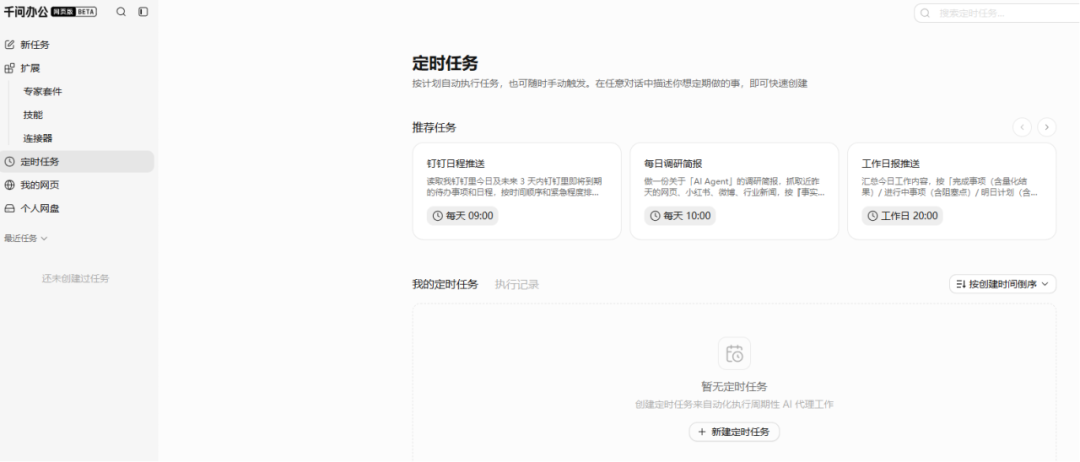
Qianwen Office integrates B-side AI resources
An internet observer told Zinc Digit, 'The article 'Inside DingTalk' exposed internal chaos at DingTalk, leading to the departure of CEO Wu Zhao. However, these issues did not arise overnight. Whether Chen Yusen, his successor, can quickly restore order remains to be seen. Qianwen Office's ability to organically integrate cloud services, entry points, and large models will also test Alibaba's B-side agent capabilities.'
The observer further noted that even if Qianwen Office resolves internal competition issues and receives strong support from Qwen3.8-Max, it cannot afford to be complacent. Lagging in the AI office race, catching up will be extremely difficult.
The 'Q2 2026 China Office Agent Platform Market Insight Report' shows that in June 2026, total visits to AI-native office agents on PCs in China exceeded 60 million. Tencent's WorkBuddy led the industry with 20.97 million monthly visits, while four Tencent-backed agents—WorkBuddy, CodeBuddy, QClaw, and Marvis—combined for 32.62 million monthly visits, accounting for half the market.
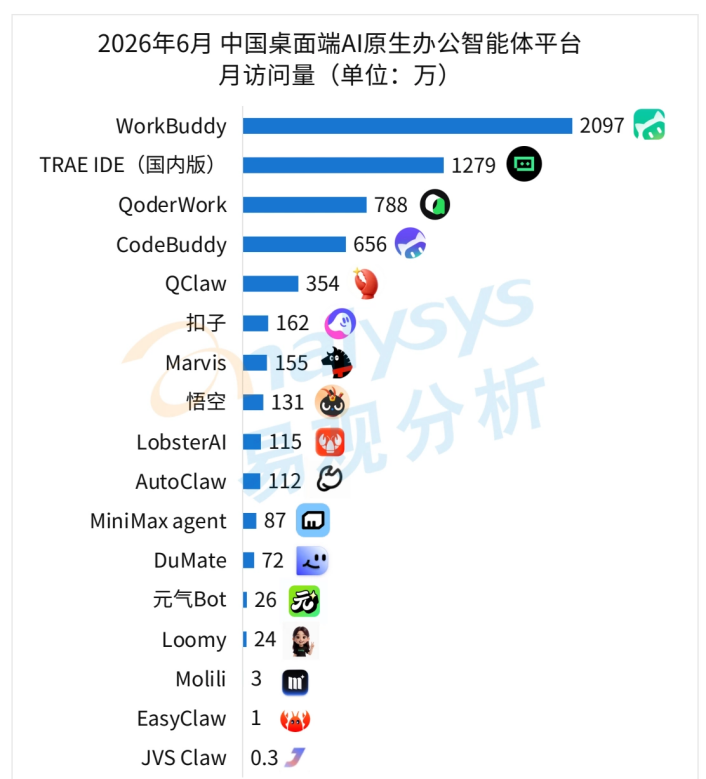
Source: Analysys
In contrast, Alibaba-backed agents totaled 9.19 million monthly visits, with QoderWork leading at 7.88 million, a noticeable gap compared to Tencent's ecosystem.
More importantly, WorkBuddy has entered a virtuous cycle: Tencent's Q1 2026 earnings report revealed that WorkBuddy's active user retention rate exceeded 60%, while paid user retention exceeded 80%.
Ma Huateng praised it openly in the earnings report, 'We believe WorkBuddy is currently China's most widely used efficiency AI agent service.'
In short, WorkBuddy has preemptively captured user attention, becoming a flagship in AI office and a formidable barrier for Qianwen Office to overcome.
In conclusion, collaborative office is becoming a thing of the past, while AI office is the present, showing signs of monopolization. Former collaborative office leaders are falling behind and even struggling for internal recognition, forcing them to abandon outdated strategies and rely on Qianwen Office to address shortcomings, attempting a comeback in the AI office 'three-way battle.'
Whether Alibaba's plans will succeed remains uncertain. What is clear is that challenging Doubao with Qianwen and WorkBuddy with Qianwen Office will be tough battles.
-
![]()
Competing in the AI Work Arena: Is Qianwen Office Too Late?
-
![]()
Dongtian Micro Accelerates Semiconductor Optical Precision Machining with Wuxi Expansion
-
![]()
A Whopping 200 Million Yuan Bet on Full-Color Waveguide: Guangna Siwei Gears Up for 2027!
-
![]()
China’s eSIM Smartphones Adopt Three Key Strategies: Pure eSIM, Single SIM Slot with Dual eSIMs, and Quad-SIM Dual Standby
-
![]()
Traditional Fuel Vehicle Market Base Dwindles: BBA Vehicles Struggle Despite 300,000 Yuan Price Cuts, Prompting Closure and Absconding of Several 4S Dealerships
-
![]()
Largan Precision Makes Another Attempt at Hong Kong Stock Exchange IPO Amid High Growth, Raising Concerns Over 'Apple Dependency' and Operational Independence
-
![]()
From "Tongyi" to "Qianwen", and on to "Qianwen Office": A Showcase of Alibaba's Astute Leadership Decision-Making
-
![]()
Is Qwen3.8 the 'Zelda' for Qianwen Office?