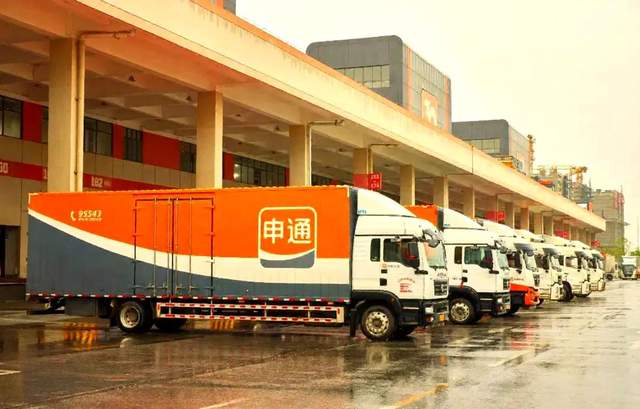
STO Express Under Scrutiny: Low Delivery Costs, but Safety Remains Paramount
 08/07 2026
 417
417
By Bishan
Source: Bowang Finance
"Delivering parcels nationwide for just 80 cents—a price point that even industry giants like JD.com and SF Express wouldn't dare to set."
A logistics salesperson shared their observations: In certain e-commerce hubs in Guangdong, STO offers prices as low as 80 cents per parcel to major e-commerce clients. This is not an exaggeration but a true reflection of the current industry dynamics. Before Guangdong introduced "anti-internal-competition" measures last year, some local e-commerce parcel prices had already fallen below 1 yuan. After authorities imposed a 40-cent price floor, average prices rose to over 1.4 yuan, with grassroots distribution fees increasing by 10 cents.
However, the price war continued unabated. Headquarters pursued scale expansion, provinces competed for rankings, and outlets relied on low prices to retain clients. In July, during Fujian Province's first provincial-level collective consultation for the express delivery industry, an STO representative acknowledged that price competition remained "intense."
The pressure from the price war did not affect all parts of the supply chain equally. According to STO, its economy-tier delivery adopts a "centralized transit, franchised outlets" model: Headquarters controls transit centers, trunk networks, information systems, and settlement rules, while pickup, delivery, and last-mile operations are handled by franchisees. In this system, a parcel's revenue is distributed layer by layer—after the sending outlet collects fees from merchants, it pays headquarters for waybills, materials, transit, and destination delivery fees. Headquarters then distributes delivery fees to the destination outlet. What remains covers rent, vehicles, loading/unloading, sorting, and staff wages for the sending outlet.
An industry insider bluntly stated: When prices hit rock bottom, franchisees can only cut corners on facilities, staff, vehicles, equipment, and management. Sorters are hired sparingly, vehicles are overloaded, and equipment maintenance is delayed. Investments in safety training, equipment upkeep, and hazard inspections—which do not yield immediate revenue—are the first to be sacrificed in cost-cutting measures.
On August 4, the deferred "bills" came due.
01
From Administrative Discussions to Formal Investigation
The State Post Bureau's announcement that day was specific: Since 2024, enterprises operating under the "STO Express" brand have repeatedly experienced workplace safety incidents, with hazards identified during inspections. STO Express Co., Ltd. failed to properly oversee safety management at affiliated companies and did not implement unified safety safeguards as required, prompting a formal investigation.
This marked the first time STO's headquarters faced a State Post Bureau investigation, making it the third major franchised express firm to be held directly accountable, following Yunda and J&T Express.
STO's safety record is evident in its prospectus: From 2023 to 2025, STO Express and its key subsidiaries received 52 administrative penalties exceeding 10,000 yuan, totaling 3.045 million yuan in fines. Among these, 27 were related to workplace safety (e.g., failing to eliminate hazards, using non-compliant safety equipment, inadequate staff training), and 19 involved postal regulations (e.g., lack of unified management, unlicensed franchise operations).
A more severe incident occurred in September 2024: A telescopic conveyor collapsed at STO's Heilongjiang sorting center, killing one employee. The State Post Bureau's Market Regulatory Department subsequently conducted administrative discussions with STO, citing issues like improper equipment installation, lax safety management, and insufficient staff training. The headquarters' unified management responsibility was explicitly mentioned.
Despite these discussions, incidents continued. This year alone, an STO transport vehicle caught fire in Yongji, Shanxi, destroying thousands of parcels; a sorting center equipment collapse caused injuries. Since 2025, six STO franchisees in Yiwu, Ningbo, Shaoxing, Huzhou, and Taizhou were penalized 15 times for failing to inspect parcels or accepting prohibited items. Zhejiang STO Ruisheng Express Co., Ltd. was cited for "inadequate unified management, lax enforcement, and substandard measures."
Over two years, "unified safety management" repeatedly appeared in regulatory notices, with penalties escalating from administrative discussions to formal investigations. STO responded swiftly: "We fully accept and comply with the decision and apologize to the public." The company's Safety Production Committee launched a special rectification campaign to overhaul systems, restructure safety departments, strengthen safety performance reviews, implement one-vote vetoes for safety failures, and integrate directly operated branches, franchisees, and suppliers into unified management. Operations remain normal as investigations continue.
02
Why Regulators Targeted Headquarters
Previously, franchisee issues typically resulted in local outlet fines and franchisee corrections, with headquarters distancing itself via claims of "independent operations." This time, regulators did not stop at the grassroots level.
Under express industry regulations, if business entities operate under the same brand, trademark, and waybill system, the headquarters must fulfill unified safety management responsibilities. Franchise agreements cannot exempt headquarters from legal obligations. In other words: "Your brand, your waybills, your business—you can't shift blame to franchisees alone."
This logic was tested in two prior cases. In March 2025, Yunda was investigated after franchisees' lax oversight of contractual clients allowed fraudulent materials into the delivery network. Reports indicated criminal gangs shipped at least 900,000 fraud-related parcels over months, causing significant victim losses. Liability fell not just on receiving outlets but also on Yunda's headquarters for inadequate unified management. In June 2026, J&T Express faced a similar investigation, with wording nearly identical to STO's case: repeated safety incidents, persistent hazards, and headquarters' failure to enforce unified safeguards.
Yunda's breach occurred at the receiving end, STO's at production, and J&T's resembled STO's—though the incidents differed, a common shift emerged: Regulators are now focusing on brand headquarters' management accountability, redrawing boundaries long tested under the franchised model.
03
Best Year Yet, but at What Cost?
STO's investigation timing is awkward: It coincides with its strongest performance in years.
The numbers are striking. In 2025, STO handled 26.139 billion parcels, up 15% year-on-year, raising its market share to 13.14% (third place). Annual revenue hit 55.586 billion yuan (+17.84%), with net profit reaching 1.369 billion yuan (+31.61%). From 2022 to 2025, revenue surged from 33.671 billion to 55.586 billion yuan, net profit from 288 million to 1.369 billion yuan, and gross margin from 4.37% to 6.41%. Growth accelerated in 2026: Q1 revenue reached 15.686 billion yuan (+30.74%), with net profit of 459 million yuan (+94.29%). The company projects H1 net profit of 950 million–1.06 billion yuan (+109.59–133.85%), nearly matching 2024's full-year profit. Per-parcel revenue also rebounded from 2.10 yuan in 2025 to 2.33 yuan in Q1 2026.
Profit recovery owes much to rational price increases under "anti-internal-competition" policies and STO's sustained investments in transit capacity and automation. Last year, it spent 362 million yuan to acquire 100% of DANIAO Logistics from Cainiao and Alibaba affiliates, establishing a dual network of "economy-tier franchised delivery + premium direct delivery" to target higher-margin markets.
Yet during this period, STO-branded firms suffered repeated safety incidents. While one cannot simply equate safety failures with profit growth, the State Post Bureau's direct questioning highlights this link: Has STO, through franchising, achieved greater volume, revenue, and faster profit growth without equipping outlets with scale-appropriate safety investments and management?
Franchisees can absorb rent, vehicles, labor, and delivery costs for headquarters but cannot indefinitely bear operational pressures and safety risks from price wars while contributing to volume growth. STO's profits have doubled; the safety debts of franchising should no longer fall solely on outlets.
04
3 Billion Yuan Plan Scrapped on the Same Day
On the same day as the investigation announcement, STO's board approved terminating a 3 billion yuan convertible bond issuance and withdrew the application.
The bonds aimed to raise up to 3 billion yuan, with 2.137 billion earmarked for "smart logistics equipment upgrades" and 863 million for "trunk transport network enhancements" (total project investment: 4.751 billion yuan). Without the investigation, the Shenzhen Stock Exchange would have reviewed the plan on August 7.
The timing underscores a contrast: STO sought funds for safety-critical equipment and networks, yet the investigation exposed deficiencies in these very areas. More pressing pressures lie ahead—safety overhauls across the network demand capital for fire safety upgrades at sorting centers, equipment maintenance, staff expansion, and training. With financing suspended, expenses cannot wait.
Franchisees face similar dilemmas. Under current delivery fees, most operate on thin margins; additional safety investments would strain them further. If compliance costs fall primarily on franchisees, operational pressures will intensify. If safety metrics remain secondary to volume and speed targets, enforcement will falter. How headquarters balances strict safety requirements with franchisees' survival—avoiding resistance or network instability—is a critical question for management.
A side note: On August 3, a day before the investigation, STO announced that Xi Chunyang, ex-husband of actual controller Chen Xiaoying, withdrew a lawsuit. In January, Xi had claimed half of ~40.5685 million STO shares registered under Chen's name (worth ~280 million yuan at the time). The lawsuit, tied to STO's founding family's history, ended in withdrawal. Though the storm has temporarily passed, STO's August will remain turbulent.
05
Safety Cannot Be Priced at 80 Cents
STO is not the first brand to face this backlash, nor will it be the last.
The franchise model once fueled China's express industry's low-cost expansion: Headquarters avoided rent, vehicle, and labor costs for each outlet while rapidly expanding through thousands of franchisees. STO built a vast network of over 5,000 independent outlets and nearly 100,000 service points using this model. The flip side: Headquarters' pricing rules, settlement methods, and KPIs cascade down, while operational pressures and safety risks sink to the grassroots level.
The industry has grown massive. In H1 2026, the top 8 firms accounted for 96.1% of parcel volume, with concentration rising. The sector has moved beyond mere volume competition. Prolonged price wars first eliminate a sorter, a round of equipment maintenance, or a safety training session at outlets. Next, they erode delivery safety and user experience. Ultimately, franchisees, couriers, and even consumers pay for headquarters' pursuit of scale.
Brands can license names, outlets can franchise, and operations can outsource—but safety responsibilities cannot be similarly fragmented. From Yunda to J&T to STO, regulators' repeated scrutiny of headquarters' unified management obligations establishes a new industry rule: Network reach must match responsibility.
Express delivery can be cheap, but safety must not be.
-
![]()
China Unveils Its First Embodied AI Development Bureau: Why Shunde Takes the Lead?
-
![]()
#Hytera HP780 #PDT Two-Way Radio #Industrial Private Network #Field Communication #Equipment for Extreme Cold Communication #Emergency Communication
-
![]()
Huawei Router Tops China’s Market, Xiaomi Claims Second Place Worldwide
-
Will Leading Content Creators All Transition into Sellers of 'AI Courses'?
-
![]()
Semi-annual Report | China's Sports Camera Market Nearly Doubles in Size in H1 2026, with DJI and Insta360 Dominating as a Dual Oligopoly; Full-Year E-commerce Sales Forecast to Exceed RMB 20 Billion
-
![]()
Automakers Embark on a Collective 'Downsizing' Path: Can Model Reduction Rescue Profits?
-
![]()
STO Express Under Scrutiny: Low Delivery Costs, but Safety Remains Paramount
-
![]()
Five Major Players Enter the Arena: The All-Out Battle for the Ultimate AI Office Super Gateway Begins