Huawei Router Tops China’s Market, Xiaomi Claims Second Place Worldwide
 08/07 2026
 452
452
Recently, the renowned research institution LoTu released data concerning home broadband routers for the first half of 2026.
According to the data, in the first half of this year, online sales of home broadband routers in China reached 5.517 million units, marking a 9.9% decline. Total sales amounted to 1.35 billion yuan, also down by 9.2%, indicating a downturn in both sales volume and value.
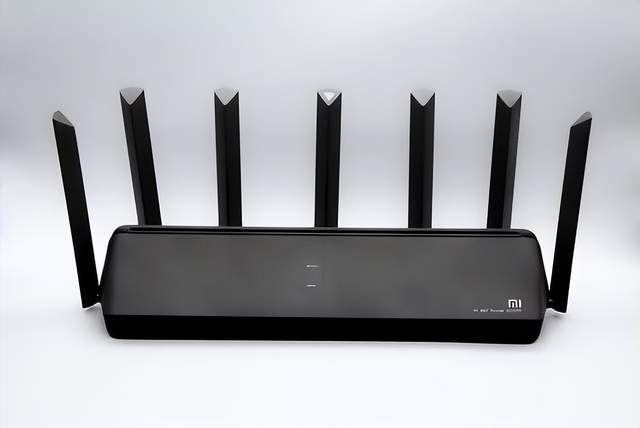
From a brand perspective, Huawei emerged as the leader. With a market share nearing 30%, it stands significantly ahead of the competition. For every three routers sold in China, one is a Huawei product, showcasing Huawei's stronghold in the communication equipment sector.
Following Huawei, Xiaomi, TP-Link, ZTE, and Tenda securely hold the top five positions. The top four manufacturers—Huawei, Xiaomi, TP-Link, and ZTE—collectively command about 85% of the market share, leaving minimal opportunities for smaller players.
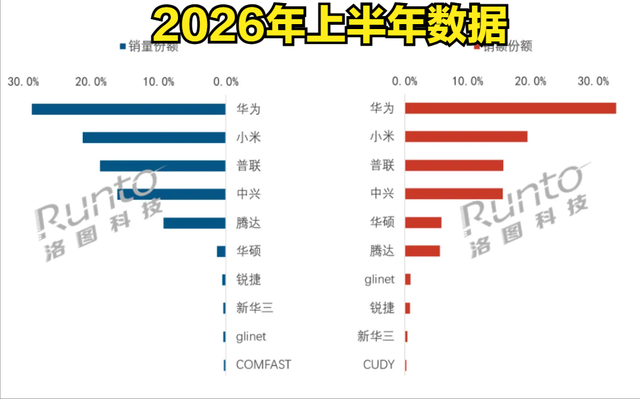
In terms of sales value, Huawei's dominance is even more pronounced, with a substantially larger share than Xiaomi and TP-Link, suggesting that Huawei's routers are positioned at a higher price point.
However, the global scenario presents a different picture, as illustrated by the specific data below.
Counterpoint released the global router data for the first quarter. Although it covers only the first quarter, it offers insights into the disparities between the global and Chinese markets.
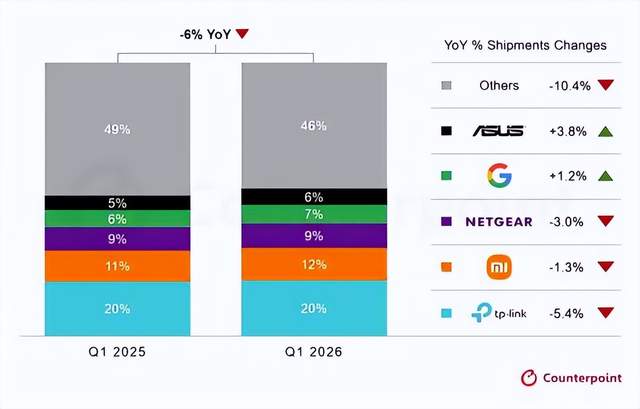
In the global market, TP-Link leads with a 20% share, followed by Xiaomi at 12%, Netgear at 9%, and then Google and ASUS.
Meanwhile, manufacturers that rank high in China, such as Huawei, ZTE, and Tenda, fail to make it into the top five globally.
What accounts for this discrepancy? The primary reason lies in the underwhelming overseas sales performance of these major brands. For instance, in the United States, Huawei and ZTE are effectively barred from the market due to bias and restrictions imposed on these two brands.
In other international markets, there is a greater inclination towards TP-Link and Xiaomi. TP-Link, as a well-established company, boasts a strong overseas presence and extensive distribution networks, resulting in high sales and a consistent 20% global market share.
As for Xiaomi, as a rising brand, it excels in the Chinese market. With its recent expansion into mobile phones and TVs overseas, it has also garnered a significant fan base abroad. Moreover, Xiaomi routers offer excellent cost-effectiveness, making them highly popular in many international markets, enabling Xiaomi to secure the second spot globally.
-
![]()
China Unveils Its First Embodied AI Development Bureau: Why Shunde Takes the Lead?
-
![]()
#Hytera HP780 #PDT Two-Way Radio #Industrial Private Network #Field Communication #Equipment for Extreme Cold Communication #Emergency Communication
-
![]()
Huawei Router Tops China’s Market, Xiaomi Claims Second Place Worldwide
-
Will Leading Content Creators All Transition into Sellers of 'AI Courses'?
-
![]()
Semi-annual Report | China's Sports Camera Market Nearly Doubles in Size in H1 2026, with DJI and Insta360 Dominating as a Dual Oligopoly; Full-Year E-commerce Sales Forecast to Exceed RMB 20 Billion
-
![]()
Automakers Embark on a Collective 'Downsizing' Path: Can Model Reduction Rescue Profits?
-
![]()
STO Express Under Scrutiny: Low Delivery Costs, but Safety Remains Paramount
-
![]()
Five Major Players Enter the Arena: The All-Out Battle for the Ultimate AI Office Super Gateway Begins