Semi-annual Report | China's Sports Camera Market Nearly Doubles in Size in H1 2026, with DJI and Insta360 Dominating as a Dual Oligopoly; Full-Year E-commerce Sales Forecast to Exceed RMB 20 Billion
 08/07 2026
 424
424
Data Release
According to data from Runto, in the first half of 2026, China's sports camera market achieved online sales of 3.119 million units and revenue of RMB 8.20 billion across all channels, with year-on-year growth exceeding 90% for both metrics. The market's growth drivers have shifted from professional outdoor shooting to everyday short video creation by the general public.
DJI and Insta360 have formed a dual oligopoly, collectively accounting for 89.4% of online sales volume and 97.9% of revenue, while low-end off-brand products continue to be phased out.
In terms of product structure, mid-to-high-end models priced between RMB 2,000-3,999 accounted for 66.6% of sales volume and 75.3% of revenue in the online market, representing the brands' primary profit centers.
I. Overall Market Overview:
Public Creation Drives China's Online Market to Exceed 3 Million Units in H1; Price Structure Shows 'Mid-to-High-End Concentration'
Based on H1 market performance, China's sports camera market exhibited a month-by-month, spiral-like upward trend in sales volume, peaking at 240,000 units in weekly sales.
Weekly Sales Volume and Pace of China's Online Sports Camera Market in H1 2026
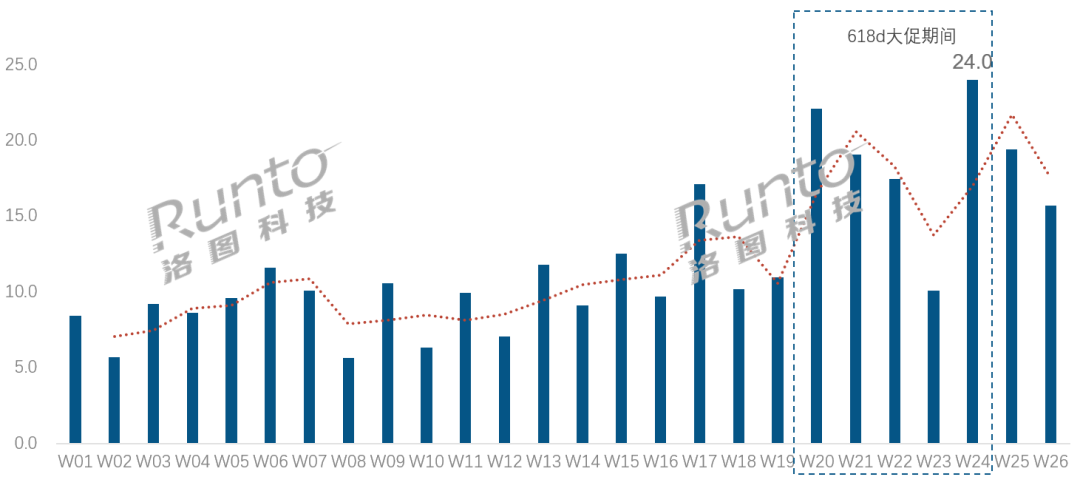
Data Source: Runto Online Data, Unit: 10,000 units
Runto believes that within the broader consumer electronics sector, sports cameras are one of the few segments maintaining rapid growth. One of the core drivers is the expansion of content creation: the democratization of short videos, outdoor lifestyles, and lightweight UGC creation, along with diversified scenarios such as camping, cycling, diving, urban travel photography, and daily self-media recording, are transforming sports cameras from professional extreme sports gear into everyday portable creation tools.
In H1 2026, the average retail price of sports cameras in China's online market was RMB 2,628. The price structure clearly shows 'mid-to-high-end concentration': mid-to-high-end models priced between RMB 2,000-3,999 accounted for 66.6% of sales volume and 75.3% of revenue.
Sales Volume and Revenue Structure by Price Segment in China's Online Sports Camera Market in H1 2026
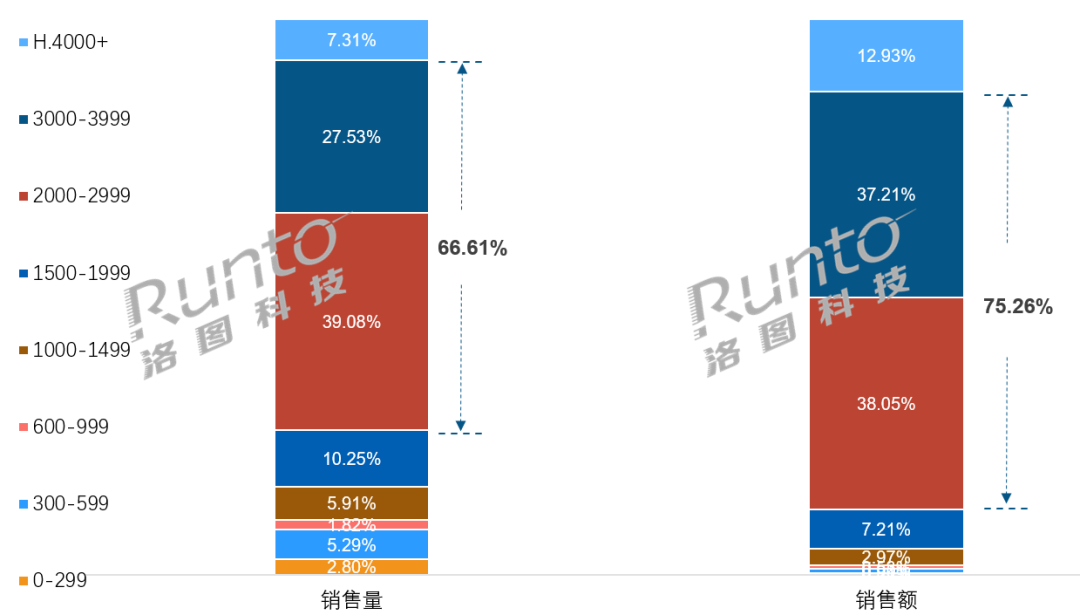
Data Source: Runto Online Data, Unit: %
Entry-level models priced below RMB 1,000 accounted for less than 10% of sales volume, with their appeal continuing to decline. In fact, Runto's user surveys indicate that the purchasing logic for sports cameras has shifted from solely pursuing hardware specifications to a focus on comprehensive experiences such as image stabilization, AI auto-editing, portability, and a complete accessory ecosystem. Low-priced models alone struggle to form significant competitiveness.
II. Competitive Landscape:
Extreme Dual Oligopoly Dominates, Leaving Little Room for Other Brands
According to Runto data, in H1 2026, DJI and Insta360 collectively accounted for 89.4% of online sales volume and 97.9% of revenue in China's sports camera market, demonstrating an extreme Matthew effect. Such market concentration has never been observed in other consumer electronics segments monitored by Runto.
DJI led with a 74.0% share of online sales volume and an 80.9% share of revenue, maintaining a significant advantage. In the specialized gimbal camera segment, the Osmo Pocket series ranked first in sales; in the wide-angle sports camera segment, the Action series led the industry, leveraging DJI's drone imaging algorithms and full-scenario accessory ecosystem.
Insta360 followed with a 15.4% share of online sales volume and a 17.0% share of revenue. Insta360's competitiveness primarily lies in the panoramic camera segment, though it launched the Luna Ultra gimbal camera in H1, formally entering DJI's stronghold and forming a dual product lineup of 'panoramic + gimbal' cameras.
Remaining brands accounted for only about 10% of online sales volume and 2% of revenue, with their survival space severely compressed. Foreign brand GoPro is being marginalized in the Chinese market, as its high-priced flagship HERO13 appeals to a narrow audience, offers cumbersome editing, and has a weak ecosystem, making it nearly uncompetitive in China's mass short video creation market. Budget brands like SJCAM, AKASO, and others rely heavily on overseas cross-border sales, lacking influence in China's online and offline channels, with their low-priced model shares continuing to shrink.
III. Three Core Industry Trends
Runto summarizes three key trends in the sports camera market based on H1 performance:
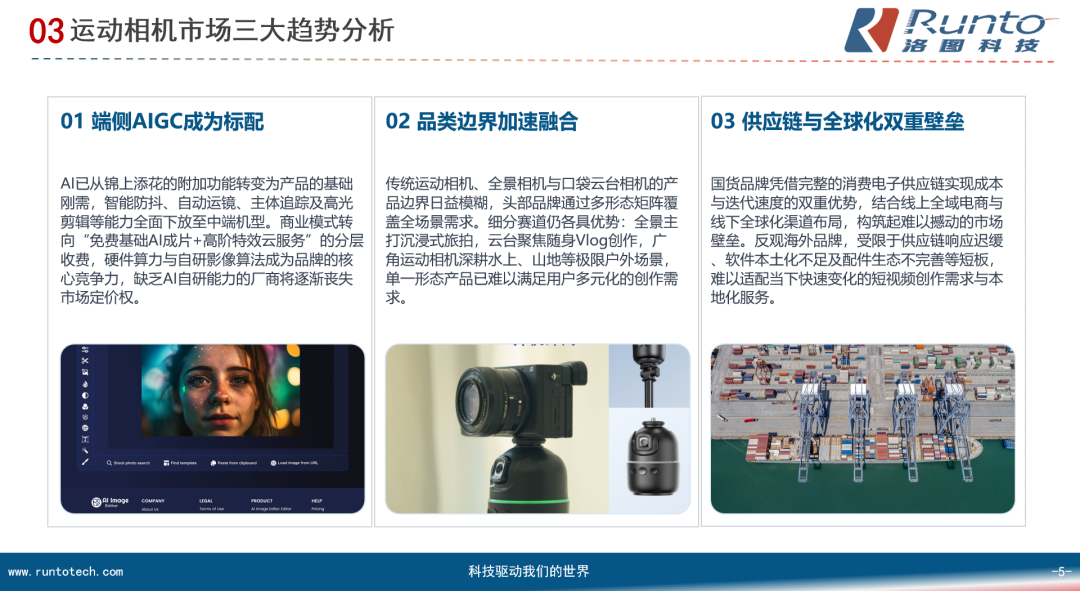
Trend 1: On-Device AIGC Becomes Standard, AI Creation Reshapes Product Core Competitiveness
All new products launched in H1 2026 feature on-device AI capabilities, with AI transitioning from an additional feature to a fundamental requirement. Smart image stabilization, auto-tracking, subject/motion tracking, highlight auto-editing, and scene semantic recognition are now widely available in mid-range models.
Simultaneously, business models are shifting: the bundled paid subscription model for AI editing alone is seeing declining market acceptance, while a tiered pricing model of 'free basic AI editing + advanced cloud services' has become mainstream. Hardware computing power, proprietary imaging algorithms, and supporting editing software ecosystems now serve as core benchmarks for differentiating brand competitiveness. Small and medium-sized brands lacking proprietary AI algorithms and hardware-software integration capabilities struggle to command premium pricing in the mid-to-high-end market, facing sustained pressure on user retention and repurchase rates.
Trend 2: Category Boundaries Blur, Yet Differentiated Advantages Remain
The boundaries between traditional sports cameras, panoramic cameras, and pocket gimbal cameras are gradually blurring. However, leading brands adopt a multi-form factor matrix strategy to cover all price points and scenarios, serving everyday creation needs through a unified product ecosystem. Insta360 expands its gimbal product line based on panoramic technology, while DJI introduces panoramic modules leveraging its gimbal stabilization expertise.
Differentiated advantages persist across segmentation products (Note: ' segmentation 产品' is translated as 'niche products' in context, but kept as is for precision). Panoramic cameras excel in immersive travel photography, gimbal cameras in portable vlogging, and wide-angle sports cameras in extreme outdoor scenarios like water sports and mountaineering. Currently, single-form factor products struggle to meet diverse user needs.
Trend 3: Supply Chain + Omnichannel Dual Barriers Establish Long-Term Advantages for Chinese Brands
From a market perspective, Chinese sports camera manufacturers currently enjoy two core barriers that are difficult to challenge in the short term: (1) a complete local consumer electronics supply chain enabling self-research and production of image stabilization lenses, AI chips, and waterproof bodies, offering cost and iteration speed advantages over overseas brands; and (2) an omnichannel distribution network comprising online e-commerce, offline outdoor stores, and localized overseas channels, covering China's lower-tier markets and incremental overseas markets in Europe, the U.S., Southeast Asia, and East Asia.
In contrast, overseas brands face shortcomings in China, including slow supply chain responsiveness, inadequate software localization, and incomplete accessory ecosystems, making it difficult to meet the rapidly evolving demands of short video creation. For a more detailed market analysis, refer to Runto's previous report, 'Research on the Industrial Underpinnings of Chinese Sports Camera Brands' Hot Sales in Japan and GoPro's Decline: How the UGC+AIGC Creation Wave Reshapes Market Dynamics.'
IV. Market Forecast
Sustained High Growth, Full-Year Revenue Expected to Exceed RMB 20 Billion
Runto analyzes that H1 2026 was a critical period for shaping China's sports camera industry landscape and clarifying technological directions.
Market competition no longer relies solely on hardware upgrades; AI creation capabilities, multi-form factor product matrices, and diversified channels now determine brands' long-term viability. DJI and Insta360 have formed a stable dual oligopoly through their early advantages in R&D and ecosystems. Legacy overseas brands lag in localizing products and software for China's short video creation ecosystem, with their online market share decline unlikely to reverse in the short term.
In H2, summer outdoor travel and pre-National Day stockpiling will continue to drive sales in China. Runto forecasts that full-year online market revenue for China's sports cameras will surpass RMB 20 billion in 2026.
Leading brands will focus on launching next-gen products priced above RMB 2,000, emphasizing lightweight design, extended battery life, and upgraded on-device AI computing power. The panoramic and gimbal segments, along with hybrid form factors, will become key battlegrounds and growth drivers. Additionally, integrated hardware-software ecosystems that connect shooting, AI editing, and content distribution will remain primary competitive dimensions in the market.
-
![]()
China Unveils Its First Embodied AI Development Bureau: Why Shunde Takes the Lead?
-
![]()
#Hytera HP780 #PDT Two-Way Radio #Industrial Private Network #Field Communication #Equipment for Extreme Cold Communication #Emergency Communication
-
![]()
Huawei Router Tops China’s Market, Xiaomi Claims Second Place Worldwide
-
Will Leading Content Creators All Transition into Sellers of 'AI Courses'?
-
![]()
Semi-annual Report | China's Sports Camera Market Nearly Doubles in Size in H1 2026, with DJI and Insta360 Dominating as a Dual Oligopoly; Full-Year E-commerce Sales Forecast to Exceed RMB 20 Billion
-
![]()
Automakers Embark on a Collective 'Downsizing' Path: Can Model Reduction Rescue Profits?
-
![]()
STO Express Under Scrutiny: Low Delivery Costs, but Safety Remains Paramount
-
![]()
Five Major Players Enter the Arena: The All-Out Battle for the Ultimate AI Office Super Gateway Begins