Zhong Shanshan Renews Critique of E-commerce: Are Retail Challenges Driven by Platform Dominance?
 08/12 2026
 541
541
Zhong Shanshan, the founder of Nongfu Spring, has not shied away from publicly voicing his dissatisfaction with e-commerce platforms on numerous occasions.
On August 8, during CCTV Finance's "Dialogue" program, Zhong Shanshan once again took aim at e-commerce platforms, stating, "E-commerce platforms are undeniably unique intermediaries." This remark reignited his ongoing conflict with these platforms, bringing it back into the public spotlight.
This seasoned industrialist, with three decades of industry experience, has consistently criticized platform shortcomings in nearly every public appearance over the past two years, maintaining a firm and unwavering stance.
A review of his public statements from the past two years clearly underscores this point.
At a 2024 event in Ganzhou, he directly stated that the relentless price cuts imposed by platforms are devastating local brands and the real economy. That same year, during his appearance on "Dialogue," he mentioned that traffic algorithms distort the normal business order and refused to participate in live-stream sales.
In early 2025, three WeChat Moments posts escalated his criticism, directly referring to leading e-commerce platforms as the "meat grinder" of the real economy and "Zhou Bapi" (a derogatory term for exploitative landlords) for small merchants. He accused platforms of squeezing merchants' profits and eroding offline employment.
This time, his accusations were devoid of emotional rhetoric but presented a more logically coherent argument:
E-commerce platforms, under the guise of eliminating intermediaries, have become even more powerful new-age intermediaries than traditional wholesalers by leveraging their control over traffic, pricing, and rules. He called for institutional constraints on platform power.
Are platforms truly the primary culprits behind industry overcapacity and price collapses, with no redeeming qualities?
01
Are Platforms the Culprits Behind Price Suppression?
Is cutthroat low-price competition a product of e-commerce, or did offline channels already exist in a state of stable, healthy competition with price stability?
Price competition is inherently a normal part of market economies. Even before the rise of e-commerce, low-price competition was prevalent among wholesale markets and street-side stores.
In the early days of the FMCG industry, unauthorized distribution and low-price competition in wholesale markets were persistent issues, with offline channels also engaging in malicious price suppression.
Low prices are not a one-dimensional issue.

Image Source: AI
By connecting directly with factories and leveraging digital warehousing and logistics, e-commerce reduces redundant costs from multi-layered distribution, enabling consumers to purchase goods at lower prices. This type of low pricing is a result of improved efficiency.
Another type of low pricing stems from platform leverage: relying on traffic monopolies, platforms use algorithmic rankings, promotions, and traffic allocation to coerce merchants into engaging in malicious price cuts.
Do platforms engage in such price suppression?
While we cannot deny its occurrence, many physical brands also actively participate in low-price promotions. E-commerce merely amplifies price competition transparency rather than being the root cause of overcapacity.
02
Competition Shifts Due to Changing Consumer Habits
Why do young consumer groups prefer online shopping?
The diversity of shopping scenarios eliminates time and location constraints while offering greater convenience.
Combined with interest-based and emotional consumption, young people purchase a wider variety of products.
National Bureau of Statistics data shows that online retail sales of goods nationwide surpassed 6.43 trillion in the first half of 2026, with platforms controlling massive user pools—a factual reality.
E-commerce platforms must also compete to acquire customers, attracting them not just through products but also content.
Today, online traffic costs have soared. Merchants need continuous ad investment and participation in discounts to gain visibility, with customer acquisition costs rising annually.
This competition has simply shifted traditional offline rivalries online.

Image Source: Screenshot from Taobao App
Of course, this does not mean offline businesses have no prospects. At its core, traffic represents user reach opportunities, and offline channels retain irreplaceable value.
Offline stores, anchored in commercial districts, enjoy stable and immediate natural traffic.
Foot traffic in convenience stores and supermarkets represents naturally precise consumer groups, with immediate consumption being an advantage online platforms cannot replicate.
For example, buying a bottle of water when thirsty—an immediate offline transaction—can never be fully replaced by online delivery.
Online and offline channels hold different meanings for brand owners.
Online traffic is highly concentrated on leading platforms, with merchants dependent on platform-derived traffic.
Offline traffic is dispersed across millions of terminals, giving brands stronger channel control without being constrained by single-platform rules.
Zhong Shanshan values precisely this traffic autonomy, arguing that online traffic requires platform dependence while offline traffic is jointly built by brands and distributors.
03
Financial Reports Reveal Zhong's Logic
Because Zhong Shanshan seeks greater autonomy, Nongfu Spring has consistently controlled its e-commerce sales ratio.
Since initiating its e-commerce layout in 2015, the company set a strict cap: e-commerce sales must remain at 3%-5% of total revenue, prohibiting online channels from disrupting price systems.
The 2025 financial report shows that controlling e-commerce penetration remains core to protecting distributor profits and stabilizing omnichannel pricing.
Historically, over 95% of Nongfu Spring's revenue came from offline distributors. In 2025, the company managed low-price behaviors on online platforms to avoid participatory overcapacity competition.
Its performance foundation lies in over 3 million offline terminals and 5,000+ distributors.
In Zhong's business logic, offline channels serve more than just sales functions.
Whether neighborhood convenience stores or rural grocery shops, these outlets act as consumer touchpoints—capillaries sustaining businesses through stable price differentials and supporting massive bottom-tier employment.
Persistent online platform dumping would collapse price systems. If offline stores face higher purchase costs than online retail prices, merchants become unprofitable, ultimately harming the entire industrial chain.
This dilemma faces many manufacturing firms during channel transformations.
Many entrepreneurs remain cautious about e-commerce due to reliance on offline distributor networks, as dual pricing systems risk systemic collapse.
Some companies have developed solutions, such as offering exclusive online/offline products to differentiate pricing.
However, Nongfu Spring's core products—primarily packaged water, with massive tea beverage sales but no differentiated online exclusives—make price segmentation difficult.
The "water transportation" model makes significant price differentiation even harder.
How much can water really sell for?
This question could undermine Nongfu Spring's entire business model.
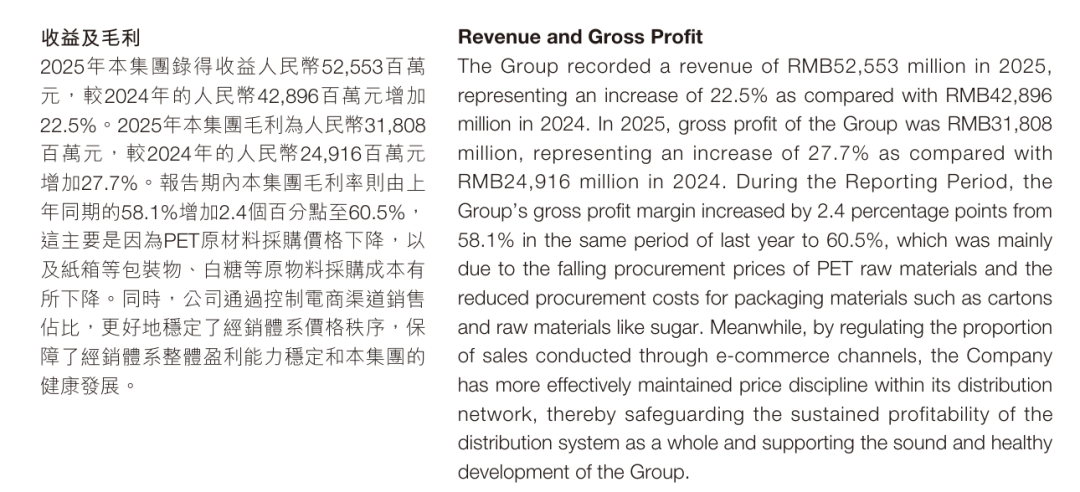
Image Source: Financial Report Screenshot
Zhong Shanshan's refusal to cede pricing and traffic control to platforms fundamentally stems from a desire to prevent platforms from dictating corporate operations.
To what extent this considers consumer interests remains unclear.
This debate revolves around industrial chain influence. What must be clarified is that platform operational issues should not be conflated with flaws in the platform business model itself.
Often, these situations represent natural market economy developments, and contradictions cannot be simply attributed to e-commerce as a business model.
-
![]()
Can a car priced at 80,000 yuan really have LiDAR? Features once exclusive to 300,000-yuan models now available at rock-bottom prices
-
![]()
He Shocked Silicon Valley, Yet Felt Every Day That the Company Was on the Brink
-
![]()
July Sees Record 65.1% Penetration Rate for New Energy Passenger Vehicles, Fueled by Robust Export Growth
-
![]()
After Three Months of Duan Jianjun Taking Over, Yu Kexin 'Goes Missing' as Top Sales Executive—Is Volvo's Core Management Facing Another Shake-Up?
-
![]()
Lexus Wants to Repeat Tesla's Playbook
-
![]()
Cars Priced at 50,000 Yuan Struggle in Sales, While Those Over 400,000 Yuan See High Demand
-
![]()
Analysis of BBA Reputation Index in July 2026: Service Issues Become a Common Problem
-
![]()
CATL Takes a Step Back, Li Auto Dives Deeper