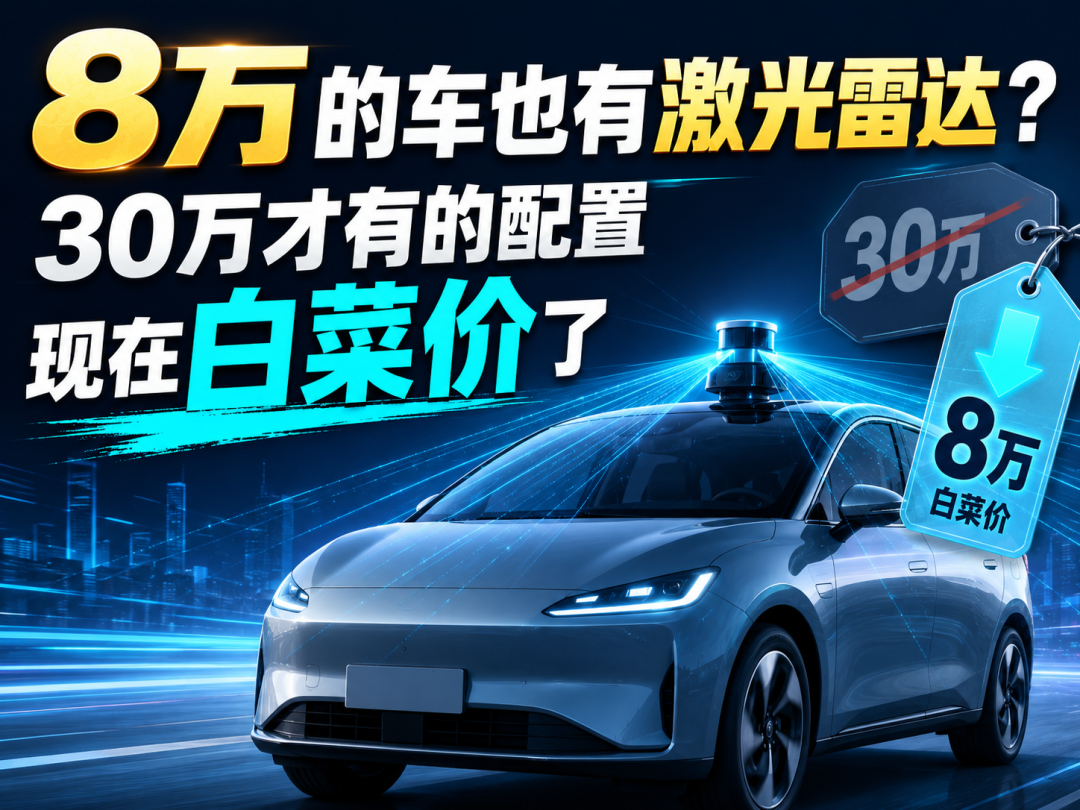
Can a car priced at 80,000 yuan really have LiDAR? Features once exclusive to 300,000-yuan models now available at rock-bottom prices
 08/12 2026
 531
531
Author | Jiang Xu Learn more financial information | BT Finance Data Pass The main text is 2,819 words long and is estimated to take 9 minutes to read
On August 11, 2026, the Leapmotor A05 was officially launched, with a price range of 63,900 yuan to 90,900 yuan across five versions. Among them, the 510 LiDAR version is priced at 85,900 yuan and is equipped with Qualcomm's 8650 intelligent driving chip. (Source: National Business Daily, August 11, 2026)
The significance of the 85,900 yuan price point lies not in the addition of another low-priced model, but in the fact that a sensing hardware component previously found primarily in vehicles priced at 200,000 yuan or even 300,000 yuan and above has now entered the 80,000-yuan compact car segment. The price war in intelligent driving is shifting from 'how much cheaper the whole vehicle is' to 'how low the entire hardware stack of sensing, computing power, and software can be pushed.'
If interpreted merely as automakers earning slightly less, the true industrial transformation would be overlooked. Behind the declining price of LiDAR lies a simultaneous reduction across four layers: component costs, chip integration, production scale, and vehicle platform.
1
The 80,000-yuan segment signals a new pricing trend

National Business Daily revealed that the Leapmotor A05's 510 LiDAR version not only brings LiDAR into the 80,000-yuan price bracket but also uses Qualcomm's 8650 as the computing foundation for its combined driving assistance system. (Source: National Business Daily, August 11, 2026) This indicates that automakers are no longer treating LiDAR as merely a 'premium feature' but are starting to incorporate it into high-volume models that emphasize cost control.
Price bracket shifts are more noteworthy than individual model specifications. Data from Gaogong Intelligent Automobile Research Institute shows that in 2025, the front-mounted LiDAR penetration rate in Chinese passenger vehicles was 11.15%, with projections for 2026 exceeding 20%. (Source: All-China Federation of Automobile Dealers Associations citing Gaogong Intelligent Automobile Research Institute, May 2026) As penetration expands from a few high-end models to mainstream price segments, suppliers gain larger order volumes, and automakers are more motivated to standardize hardware configurations across platforms.
Key data: Leapmotor A05 priced between 63,900 yuan and 90,900 yuan, with the 510 LiDAR version at 85,900 yuan; 2025 domestic passenger vehicle front-mounted LiDAR penetration rate at 11.15%, with industry projections for 2026 exceeding 20%. (Sources: National Business Daily, August 11, 2026; All-China Federation of Automobile Dealers Associations citing Gaogong Intelligent Automobile Research Institute, May 2026)
2
First layer: Radar itself becomes cheaper
The most visible change in automotive LiDAR is the rapid decline in unit prices. Industry reports compiled by Securities Times show that in 2016, Velodyne's 64-line mechanical LiDAR sold for approximately $80,000; by 2024, RoboSense's MX price had dropped below $200, and in 2025, Hesai's ATX also fell below the $200 threshold. (Source: Securities Times, April 14, 2026)
This is not a simple price comparison of the same generation of products. Over a decade, technological routes, integration methods, and production scales have all evolved, making it inaccurate to directly calculate the price drop of identical products from $80,000 to $200. However, it clearly demonstrates that LiDAR has transitioned from an expensive component in research and high-end models to an industrial part that can be mass-purchased by mainstream automotive supply chains.
Price reductions have also forced suppliers to integrate more functions into chips. Securities Times reported that RoboSense further integrated signal processing and other functions by replacing some third-party components with its self-developed SPAD-SoC, reducing costs in terms of circuit boards, power consumption, and overall expenses. (Source: Securities Times, April 14, 2026) This 'chipification' is not just about saving on a single component but reducing the complexity of the entire system.
3
Second layer: Scale begins to dilute costs
A fundamental principle in automotive components is that research, testing, production line, and supply chain costs can only be diluted when entering sufficiently large vehicle and sales volumes. After LiDAR penetration exceeds 10%, the market is no longer limited to orders from a few flagship models.
The inclusion of 80,000-yuan models pushes this logic further. Low-priced models have narrower profit margins per vehicle and are more sensitive to BOM costs. If LiDAR, intelligent driving chips, and related wiring, cleaning, and calibration remain costly, automakers would struggle to integrate the entire solution into 80,000-yuan products. Conversely, once low-priced models can accommodate these components, supply chain scale may continue to expand.
The following is a reasoning for readers' reference. The price reduction of intelligent driving hardware may create a cycle: supplier cost reductions enable more models to adopt the technology → increased adoption helps further dilute R&D and manufacturing costs → automakers then introduce the configurations to even lower price brackets. What truly determines whether this cycle continues is not the unit price of a single LiDAR but the cost and user experience of the entire system.
4
Third layer: Chips must also reduce costs
LiDAR serves as the 'eyes,' while intelligent driving chips act as the 'brain' processing information. As sensing hardware prices decline, automakers must also address the costs of computing platforms, software development, data loops, and functional adaptations. The inclusion of Qualcomm's 8650 in 80,000-yuan models indicates that chip platforms are also expanding into broader vehicle segments.
A common misconception arises here: if hardware appears similar, it is assumed that driving assistance capabilities are identical. In reality, even with LiDAR and the same type of chip, factors such as sensor quantity, installation positions, algorithms, calibration, functional scope, and vehicle braking and steering systems vary across models, affecting the overall experience. Lower hardware thresholds only mean that the 'entry ticket to the race' is cheaper, not that all participants perform equally.
5
Cheap does not equal autonomous driving
The mandatory national standard 'Safety Requirements for Intelligent Connected Vehicles - Combined Driving Assistance Systems,' released in July 2026, is set to take effect on January 1, 2027. It establishes unified requirements for the safety, failure response, and human-machine interaction of combined driving assistance systems. (Source: Ministry of Industry and Information Technology WeChat citing national standard release information, July 12, 2026)
This is also the most critical boundary in understanding low-cost intelligent driving: combined driving assistance remains 'assistive.' While price reductions allow more consumers to access sensor and computing capabilities, driving responsibility, functional boundaries, and usage conditions do not automatically change just because hardware is cheaper.
Framework to take away - Four layers of intelligent driving cost reduction: Sensor unit price decline → Chip and system integration → Large-scale model dilution → Configuration spread to lower price brackets. Ultimately, the focus should not be on 'whether LiDAR is present' but on whether the entire driving assistance system can balance cost, experience, and safety boundaries.
6
What does this mean for you?
First, for consumers planning to buy a car. The presence of LiDAR in low-priced models means that 'whether a certain hardware component exists' is increasingly unsuitable as a standalone criterion for vehicle selection. Instead, factors such as functional scope, driver monitoring, safety prompts, and actual usage conditions are more worth verifying.
Second, for the automotive supply chain. Costs for LiDAR, intelligent driving chips, domain controllers, wiring, thermal management, and software development must continue to be compressed to support lower price brackets. Those who can create stable mass-production solutions with fewer components and higher integration will have greater order flexibility.
Third, for the entire automotive market. Previously, competition in new energy vehicles focused first on batteries and range, then on cabins and charging infrastructure. In 2026, a new variable emerges: high-level sensing hardware is entering more affordable models. The shift of intelligent driving from a 'high-end selling point' to a 'standard configuration' is the more noteworthy change behind the 85,900-yuan price point.
How low has LiDAR's price dropped? The answer is no longer just the purchase price of a single component but that the threshold for the entire solution has fallen to the 80,000-yuan complete vehicle (complete vehicle) level. The true industry watershed is not 'which model installs it first' but who can minimize costs for sensors, computing power, software, and vehicle systems together while maintaining stability after mass production.
For ordinary consumers, new hardware components will increasingly appear on configuration lists; for the supply chain, the coming competition will be even more brutal because 'installation' is only the first step—'affordability, usability, and stability' determine whether the hardware can truly become mainstream.
What are your thoughts on this? Feel free to share your opinions in the comments section.
Reference Data Sources
• National Business Daily: 'LiDAR Available for 85,900 Yuan! Leapmotor A05 Pushes the Limits of Intelligent Driving Pricing,' August 11, 2026.
• Securities Times citing 21st Century Business Herald: 'Diverging Profitability in the LiDAR Industry: Automotive Volume vs. Robotics Profitability,' April 14, 2026.
• All-China Federation of Automobile Dealers Associations citing Gaogong Intelligent Automobile Research Institute industry data, May 2026.
• Ministry of Industry and Information Technology WeChat citing the release of 'Safety Requirements for Intelligent Connected Vehicles - Combined Driving Assistance Systems,' July 12, 2026.
This article is for public information compilation and industry research purposes only and does not constitute a vehicle purchase recommendation, product safety commitment, or investment advice. Driving assistance functions, applicable roads, functional scope, and usage responsibilities are subject to vehicle manuals, official software versions, and national regulations and standards. Content marked as 'reasoning' represents logical deductions based on public information and does not represent the positions of companies or regulatory authorities.
This article is an original piece by BT Finance and may not be used, reproduced, disseminated, or adapted without permission. Infringement will result in legal action.
-
![]()
Can a Small Car Priced at 63,900 Yuan Help Leapmotor Achieve Its Goal of 60% Overseas Sales?
-
![]()
Behind Two Renewed Agreements: Joint Venture Automakers Choose Long-Term Presence in China's New Energy Sector
-
![]()
Will Zunjie’s Launch of Two L3-Ready MPVs Spell the End of the ‘Price Markup Era’ for Alphard and Its Peers?
-
![]()
17 Strategies, 1.8 Billion Parcels, 12.5 Billion Yuan: Huizhou, Guangdong, Paves the Way for Autonomous Vehicle and Drone Delivery
-
![]()
Manus to Regain Independence, Former Shareholders Including Tencent to Repurchase Shares from Meta for $2 Billion
-
![]()
Starting at 99,900 yuan, the Updated Seal 06 Hits the Market. How Should Family Buyers Decide?
-
![]()
In-Depth Analysis of Volkswagen CARIZON’s Proprietary Intelligent Driving Technology
-
![]()
Can a car priced at 80,000 yuan really have LiDAR? Features once exclusive to 300,000-yuan models now available at rock-bottom prices