The Real Story Behind Zhong Shanshan’s ‘Criticism’ of E-commerce
 08/13 2026
 328
328
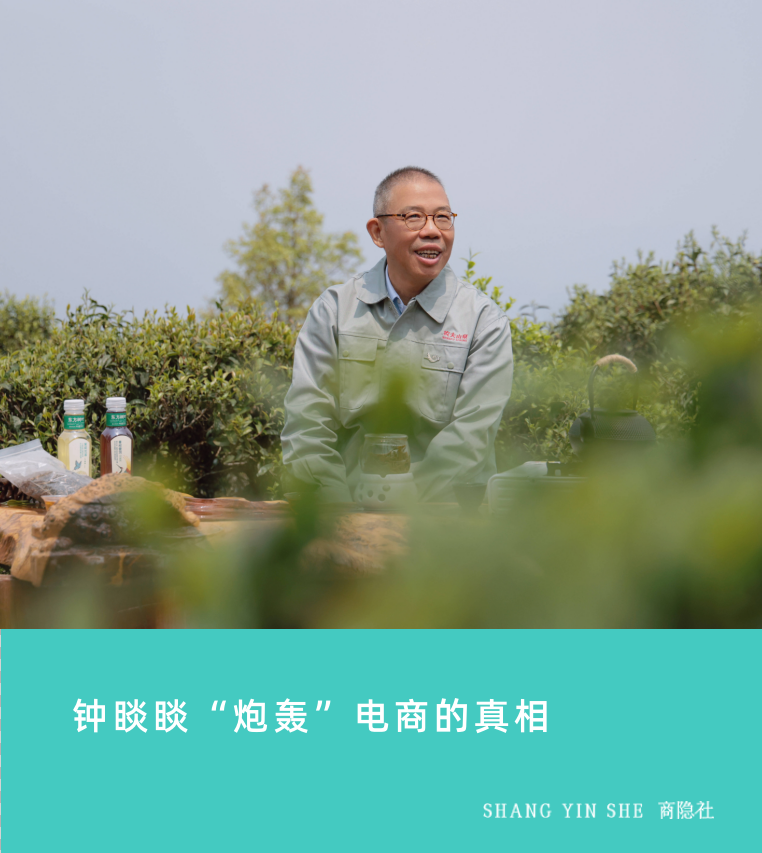
Zhong Shanshan may not be as genuinely incensed by e-commerce as he appears. Rather, his brand narrative demands that he sustain this outward display of displeasure.
Article by Haoran | This is an original piece from Shangyin Society. For reprint requests, please contact our editorial team.

Recently, Nongfu Spring founder Zhong Shanshan’s sharp critique of e-commerce platforms has ignited considerable debate.
On the evening of August 8, Zhong Shanshan made his fourth appearance on CCTV-2’s Dialogue program. Filmed at a jasmine tea production base in Hengzhou, Guangxi, after discussing topics such as jasmine tea culture, agricultural modernization, and rural revitalization with the host, he abruptly shifted focus, launching into a harsh critique of e-commerce platforms.
Zhong Shanshan argued that e-commerce platforms, under the guise of “eliminating intermediaries,” have dismantled traditional middlemen only to become powerful intermediaries themselves, dictating pricing and controlling traffic allocation. He emphasized that true trading platforms should have transparent and consistent fee structures, whereas e-commerce platforms can manipulate prices and traffic for every transaction.
He stressed, “These intermediaries are everywhere, wiping out many urban retailers.” This, he argued, has led to a shift in consumer behavior: many city stores once thrived on emotional, impulse-driven purchases during shopping trips, but such emotional consumption has now been stifled.
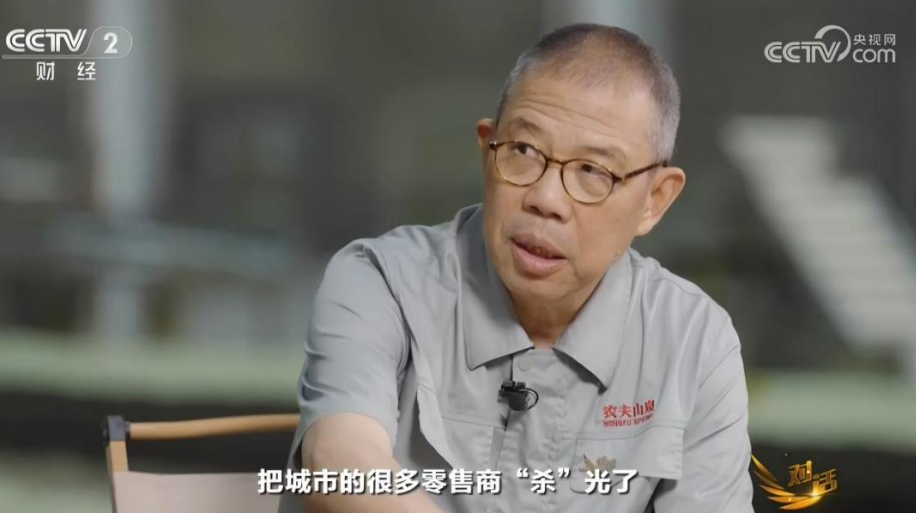
“By drawing young people into their phone screens, where is the creativity and emotional engagement? A society needs emotionality to foster creativity,” he argued, concluding that platform power must be curbed.
His remarks sparked a firestorm.
Both supporters and critics abound, as the pros and cons of e-commerce remain a topic of open debate.
Many argue that Zhong Shanshan’s comments stem from e-commerce platforms threatening his core interests.
Nongfu Spring’s business model relies on a multi-tier distribution network covering millions of distributors and neighborhood stores nationwide. This system operates stably by maintaining regional isolation and tiered pricing, ensuring reasonable profits for manufacturers, wholesalers, and retailers at all levels. However, e-commerce disrupts this by breaking down geographical barriers, with low-price competition and nationwide price comparisons threatening Nongfu Spring’s pricing system.
Yet this argument holds little weight. Data shows that Nongfu Spring’s online sales (traditional e-commerce + livestreaming + instant retail) have long stabilized at 3%–5% of total revenue, with nearly 95% coming from offline channels.
By 2025, Nongfu Spring’s gross margin reached 60.5%, with net profit exceeding 30%, cementing its position as one of China’s most profitable soft drink companies.
Moreover, its 2025 annual report stated that by controlling e-commerce sales penetration, the company stabilized pricing across its distribution network, safeguarding profitability and healthy growth.
In other words, e-commerce’s impact on Nongfu Spring’s pricing system is minimal, making Zhong’s public criticism on CCTV seem disproportionate.
Furthermore, the timing doesn’t align.
E-commerce price wars peaked from late 2022 to 2024.
Shortly after the price wars ended in November 2024, Zhong Shanshan singled out an e-commerce platform’s pricing system, calling it “a huge harm to Chinese brands and industries.”
In early 2025, he labeled the “four major e-commerce platforms” as “the meat grinders of China’s economy” and “exploiters of small merchants.”
That April, he escalated his rhetoric, claiming “farmers nationwide and the entire traditional industry are working for internet platforms.”
This year, he directly called for restricting platform power.
Yet e-commerce growth has significantly slowed in the past two years. Online retail’s share of total retail sales of physical goods peaked at 27.6% in 2023 before declining to 26.1% last year. Conversely, offline physical sales have rebounded compared to previous years.
In other words, Zhong remained silent during the height of the price wars but intensified his criticism as e-commerce momentum faded.
Some may dismiss this as mere emotional outbursts.
That seems unlikely. Zhong Shanshan, a former journalist, understands the power of public opinion. Even during the 2023 public opinion crisis triggered by Zong Qinghou’s death, he exercised restraint.
Instead of refuting specific online criticisms, he targeted the “giants” behind them, demanding that internet platforms assume legal responsibility for verifying information. He reframed his ordeal into a broader public issue. Additionally, he used authoritative media like Dialogue to articulate his business philosophy, emphasizing his rural roots and concrete actions, such as boosting farmers’ incomes across the supply chain.
This was a classic “you fight your battle, I’ll fight mine” strategy.
Someone so adept at navigating public opinion would surely anticipate the controversy generated by such remarks on a high-profile program.
So what is his true objective?

The answer may lie in a point he made: emotional consumption has been stifled, with young people trapped in their phone screens, losing both emotionality and creativity.
Many see this as a flimsy accusation against e-commerce, blaming it for stifling creativity.
But I believe Zhong views e-commerce platforms as hyper-rational machines that “de-emotionalize” consumption.
Powered by algorithms, e-commerce platforms prioritize quantifiable metrics like transaction prices, sales volumes, and fulfillment speed for traffic allocation, relentlessly pursuing efficiency. Emphasizing a product’s cultural significance or emotional value often proves futile, as algorithms reduce products to mere SKUs driving sales and traffic. To an algorithm, different bottled waters differ only by price per 500ml.
This hyper-rationality is e-commerce’s strength but undermines brand premiumization. Consumers cannot physically touch products or see complete product lines on shelves, weakening trust. They remain unaware whether your jasmine tea uses top-grade Hengzhou flowers or synthetic flavoring.
If a cheaper alternative appears online, consumers suspect price gouging, and algorithms reduce your visibility. Over time, perceptions of your product’s value erode.
For consumers, product value is a perception shaped by multiple factors, but e-commerce reduces it to a few parameters.
This isn’t a temporary choice driven by consumption downgrading. Once perceived as overpriced, that stigma lingers even if consumption rebounds.
Thus, during the fiercest e-commerce price wars, platforms promoted white-label products and “direct-from-factory” goods, stripping away all emotional factors and delivering products straight from factories to consumers. This epitomizes e-commerce’s hyper-rationality.
As a businessman with strong brand consciousness, Zhong Shanshan seeks to uphold and pursue high brand premiums. To do so, he must compete with e-commerce for the right to define value, requiring a unique brand narrative.
Notably, Zhong has appeared four times on CCTV-2’s Dialogue, each time following the same narrative logic.
His first appearance was in August 2024, amid public scrutiny. He addressed “online violence,” “traffic,” and “succession,” emphasizing his rural roots and how standardization, systematization, and contracting with farmers increased their incomes.
In that interview, he repeatedly stressed “altruism,” such as ensuring farmers profit from production and leaving margins for suppliers.
His second appearance was in December 2024, at Nongfu Spring’s massive orange-processing plant in southern Jiangxi.
Beyond discussing oranges and rural revitalization, he expressed disdain for entrepreneurs’ livestreaming, arguing it only generates short-term sales spikes, misleads farmers into overexpanding cultivation, and fails to build brand premiums through low-price dumping.
His third appearance was in April 2025, at a tea plantation in Yunnan’s Wuliang Mountains. Zhong discussed domestic tea industry challenges and supply chain value distribution. He reiterated his earlier point about e-commerce price wars harming farmers, stating, “Farmers nationwide and the entire traditional industry are working for internet platforms.”
Now, in Hengzhou, Guangxi, discussing agriculture, he again criticized e-commerce.
To many, this seems odd—why pivot to e-commerce criticism during agricultural discussions?
This is Zhong’s narrative style: a fixed pattern of “building” while “exposing.”
He “builds” the agricultural supply chain, emphasizing “altruism” and advocating for long-term industrialization, deep processing, stable orders, and value systems to boost farmers’ incomes and achieve supply chain win-wins.
He “exposes” e-commerce’s destructive price wars and lack of “altruism” or long-term thinking, where algorithms exploit “rule loopholes” to consolidate power.
He uses this stark contrast to reinforce his brand narrative, showcasing long-term value chain cultivation, fair profit distribution across all links, and stringent quality standards—factors that make his products feel more valuable than mere price tags suggest.
In previous years, many consumers might have dismissed supply chain win-win narratives, prioritizing low prices over industry dynamics. But after years of e-commerce price wars, more recognize that everyone sits on a supply chain, and price wars ultimately harm all stakeholders.
Thus, Zhong’s narrative resonates more today, explaining why he criticizes e-commerce now rather than during its heyday.
Zhong Shanshan may not be as genuinely incensed by e-commerce as he appears. Rather, his brand narrative demands that he sustain this outward display of displeasure.
-
![]()
Domestic Wi-Fi Chips Usher in Prime Era
-
![]()
HONOR Unveils Robot Phone, Yet AI-Driven Smartphones Still Await Market Breakthrough
-
![]()
Jiemei Technology Splurges 915 Million Yuan, Making a Bold Move into Optical Ultra-Precision Equipment
-
![]()
Intensifying Investment in Advanced Coating Equipment: Landun Optoelectronics Aims to Secure Majority Stake in Lanchuang Technology
-
![]()
Honor’s Ambition Demands More Than a Gimbal-Equipped Phone
-
![]()
IIHS Latest Fatality Report: Small Cars and Muscle Cars Are the 'Deadliest,' While Large Pickups Pose the Greatest Threat to Others
-
![]()
Can Leapmotor Sustain Its Leadership with a Low-Price Strategy?
-
![]()
Growing a Moving 'Head': Can Honor’s Robot Phone Revolutionize AI Smartphones?