What Are the Technical Requirements for Level 3 Automated Driving?
 01/07 2026
 635
635
Recently, numerous friends have reached out via private messages, inquiring about the technical prerequisites for Level 3 automated driving. Indeed, within the automated driving industry, Level 3 represents a pivotal milestone. Upon achieving Level 3, the system assumes primary responsibility for driving, relegating the driver to a supportive role. So, what technical conditions must be met to attain Level 3 automated driving?
What is Level 3 Automated Driving?
Level 3 Automated Driving, also known as Conditional Automation, marks a significant departure from lower automation levels. Under specific road conditions and operational scopes, the vehicle can autonomously execute most driving tasks. This includes perceiving the surrounding environment, controlling steering, acceleration, and deceleration, without requiring continuous manual intervention from the driver. The driver is only required to promptly resume control when the system requests a takeover.
This definition originates from the automated driving classification standard "Taxonomy and Definitions for Terms Used in SAE International’s Standards Related to Automated Driving" (SAE J3016), developed by the Society of Automotive Engineers (SAE). This standard is widely recognized globally as the benchmark for automated driving levels. According to this definition, a Level 3 automated driving system can automatically perform dynamic driving tasks (DDT) within a defined operational design domain (ODD) and clearly specifies, through human-machine interaction, when the system is responsible and when human intervention is necessary.
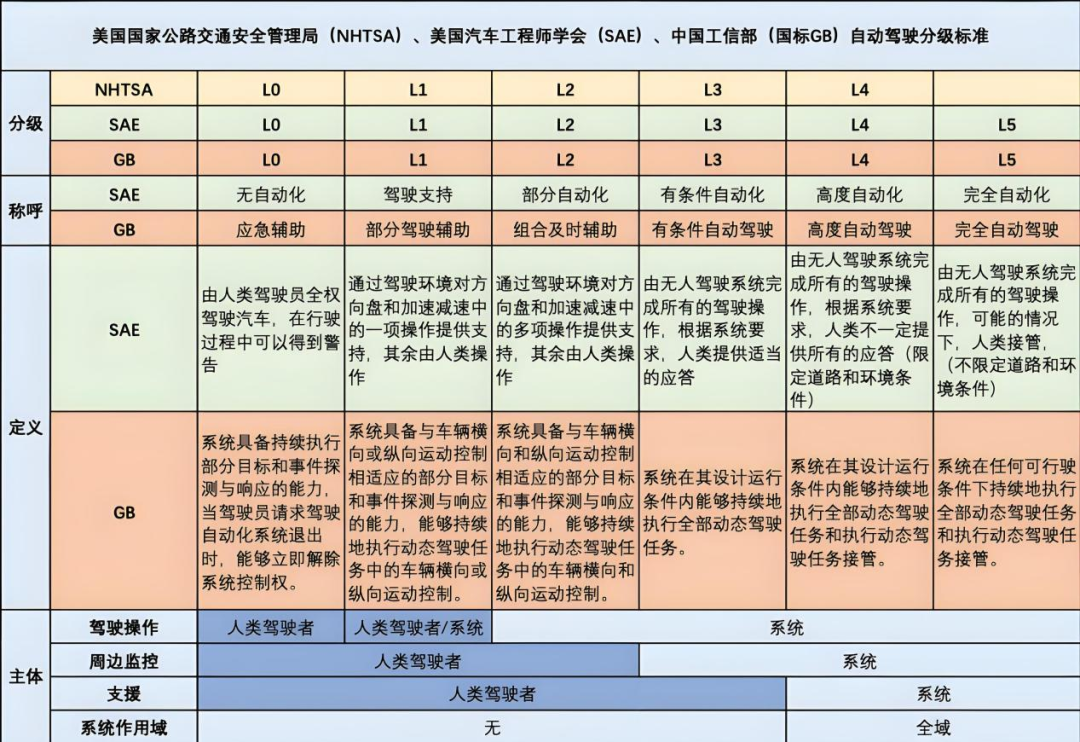
Classification of Automated Driving Levels. Image source: Internet
In China, the authoritative technical specification for automated driving systems is the "General Technical Requirements for Autonomous Driving Systems of Intelligent Connected Vehicles" (GB/T 44721-2024), which was released and implemented in September 2024. This standard applies to passenger and commercial vehicles equipped with automated driving systems, detailing requirements for the overall system, operational conditions, functional safety, human-machine interaction, data recording, and other aspects.
While this standard is not exclusive to Level 3, it clearly outlines a set of engineering and technical requirements for automated driving systems to safely and reliably perform dynamic driving tasks under defined conditions, handle abnormal situations, and interact with drivers. These are crucial for achieving Level 3 automated driving.
To attain Level 3 automated driving, simply installing a plethora of sensors is insufficient. This level necessitates a series of specific technical capability requirements, demanding the achievement of prescribed thresholds in various aspects, including standards, testing, system design, and data processing.
Perception and Environmental Understanding Must Operate Comprehensively and Reliably
A Level 3 automated driving system requires the vehicle to perceive and understand the surrounding environment in real-time and accurately using multi-sensor fusion. To achieve this, high-precision cameras, millimeter-wave radars, LiDAR, and other sensors must be seamlessly integrated. Data fusion technology is employed to combine information from diverse sources, enabling the vehicle to construct a 360-degree environmental perception map that encompasses key targets such as road structure, vehicles, pedestrians, traffic signs, and signals. The accuracy and completeness of perception directly determine whether the system can operate safely in real-world, complex traffic scenarios.
Therefore, various sensors must meet industry-recognized accuracy standards within their detection ranges. For instance, LiDAR must achieve centimeter-level ranging accuracy for static objects, while cameras must maintain high recognition rates for dynamic targets under varying lighting conditions. At the system level, the fused perception results must be stable and reliable enough to support subsequent decision-making and control.
Moreover, environmental perception transcends merely "seeing" objects; it requires "understanding" the scene. The system must effectively distinguish potentially dangerous targets from negligible distractions in complex traffic flows, providing the downstream decision-making and planning modules with contextually aware inputs to generate reasonable and safe vehicle control commands.
Decision-Making and Control Systems Must Be Capable of "Driving" Independently Under Defined Conditions
Achieving Level 3 automated driving requires more than just accurate environmental perception. After acquiring perception data, the system must be capable of making safe driving decisions and executing control. This includes planning the vehicle's driving path, controlling acceleration and deceleration, adjusting steering, and other dynamic driving tasks. Decision-making and control algorithms often consist of deep learning, path planning, and motion control modules, which must meet two fundamental requirements: real-time performance and safety.
1. Real-time performance: In complex traffic environments, the system must respond to external changes within tens of milliseconds to ensure timely control commands.
2. Safety: Before making control decisions, the system must assess various potential risks within a certain range and avoid erroneous judgments as much as possible. For example, when encountering a vehicle suddenly cutting in on a highway, the system must quickly judge and execute braking or evasive maneuvers without hesitation.
These capabilities are comprehensively verified through simulation, closed-course testing, and large-scale real-world road testing before commercialization to ensure that the vehicle does not pose risks due to control errors within its operational design domain (ODD).
Functional Safety and Minimum Risk Strategy Are Mandatory Requirements
An automated driving system must incorporate functional safety mechanisms to ensure a basic safety state in the event of software or hardware failures. According to "Road Vehicles - Functional Safety" (ISO 26262), when the system detects an internal fault, it must activate corresponding safety mechanisms (e.g., fault handling, entering a safe state, issuing driver warnings) to minimize risks and ensure the vehicle remains in a safe state. This is also known as the minimum risk strategy.
The minimum risk strategy refers to automatically decelerating the vehicle and steering it to a safe location when the system can no longer operate safely, while reasonably activating hazard warning lights and other measures to minimize accident risks. For example, if a severe perception fault occurs at high speeds, the vehicle must automatically determine a safe route, decelerate to a safe speed, and steer to an emergency stop lane, all within preset logic and safety boundaries. Clearly defining the minimum risk strategy and systematically designing its trigger conditions and execution behaviors are essential parts of Level 3 system design.
Human-Machine Interaction Design Must Clearly Specify When the Driver Should Intervene
The unique aspect of Level 3 automated driving is that it does not fully replace the driver but "entrusts" driving tasks under specific conditions, while the driver still needs to take over. In this mode, human-machine interaction design becomes paramount. This interaction is mainly reflected in two aspects.
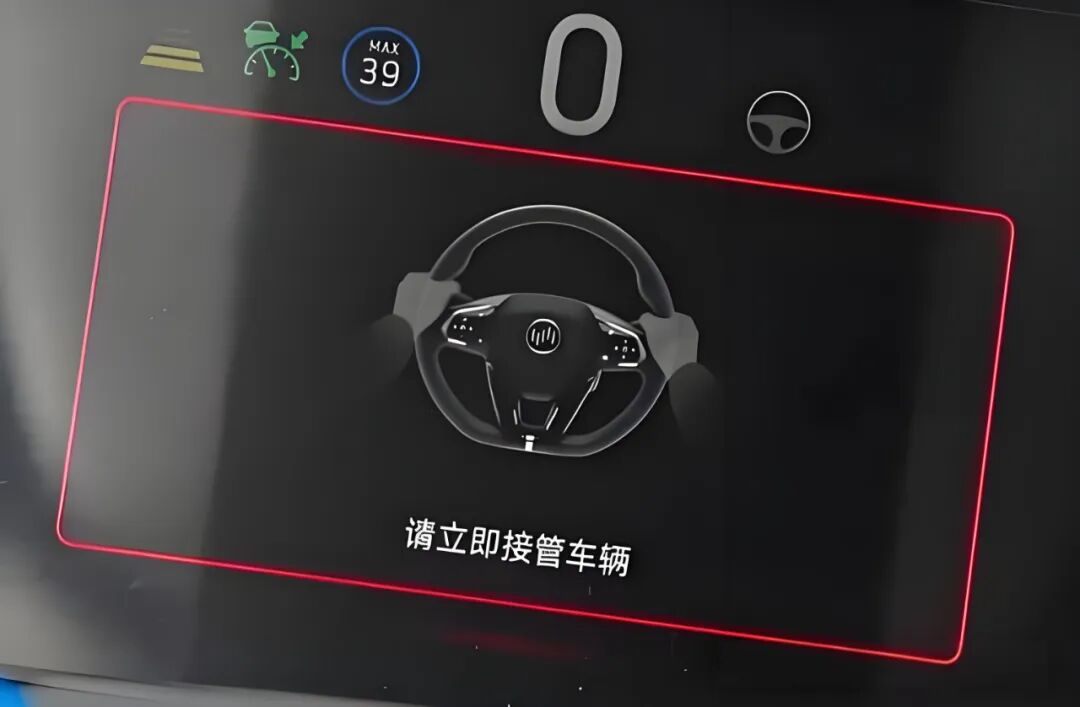
Image source: Internet
1. Direct feedback on system status: When Level 3 automated driving mode is activated, the cockpit display and audio prompts must clearly inform the driver of the current automated driving status and the operational conditions (e.g., highway, daytime restrictions) to let the driver understand the system's capabilities and limitations.
2. Clear takeover request and response process: When the system encounters situations beyond its capabilities, such as severe weather, blurred road markings, or complex traffic conditions, it must issue takeover requests to the driver through visual, auditory, and other means. These prompts should have a clear time window, allowing the driver sufficient time to switch from automatic mode to manual driving. The system must also continuously monitor the driver's attention status to ensure a timely response.
This is fundamentally different from Level 2 assisted driving, which requires the driver to continuously monitor the road and be ready to operate at any time. Level 3 allows the driver to relax their driving actions moderately but must ensure an effective response to takeover requests. Therefore, a Driver Monitoring System (DMS) must be installed in the vehicle to monitor the driver's status in real-time.
Data Recording, Storage, and Security Are Key Points for Technical Compliance
An automated driving system continuously generates massive amounts of data during operation, including sensor raw data, vehicle dynamics information, and system internal state and decision logs. The complete and reliable recording and storage of this data are essential for accident investigation, system optimization, and liability determination. The design specifications for data processing must comply with standard requirements.
Therefore, the vehicle must be equipped with a compliant data storage system (DSS). The recorded data should include vehicle driving data (e.g., speed, acceleration, steering signals), environmental perception data (e.g., raw or preprocessed data from cameras, radars, and LiDAR), as well as system operational status, driving decisions, fault codes, and human-machine interaction records.
The system must also have an event-triggering mechanism (e.g., automatically saving data from a critical time window before and after a collision warning or system fault) and meet storage security requirements for tamper resistance and physical damage resistance, which can be achieved through independent hardware units with write-protection functions. Access to stored data must also implement strict encryption and permission controls to protect personal privacy and data security.
Final Thoughts
The reason Level 3 automated driving generates so much discussion is primarily due to its fundamental shift in the primary responsibility for vehicle operation. It requires the vehicle to establish a complete technical system within a defined operational design domain, with high-precision perception as the foundation, real-time and safe decision-making as the core, and functional safety and data traceability as mandatory safeguards. This represents not just a breakthrough in a single technology but a comprehensive innovation in system architecture, safety philosophy, and standardization.
-- END --
-
![]()
Enflame Tech's IPO Journey: Navigating Over 5.9 Billion Yuan in Losses and Soaring Debt in Q1 This Year
-
![]()
Trillion-Yuan Giant Li Shufu 'Streamlines': Could Levc Be the Casualty?
-
![]()
AI Competes for Electricity and Generates Power in the Gobi Desert
-
![]()
The First Batch of Victims of the AI Bubble: Programmers
-
![]()
ByteDance, DJI, and Xiaohongshu Secure Top Three Positions Among China’s Fastest-Growing Unicorns
-
Tesla's in-car voice system in China is finally learning to 'understand human language'
-
![]()
Foreigners Are Amazed: Chinese Electric Vehicle Drive Systems Unveil Innovative 'Poses'
-
![]()
700,000 Brothers and the Future of Robots: Behind JD.com's 'Nirvana Plan'