Technological Leaps, Regulatory Evolution, and Cognitive Adjustments: How Intelligent Assisted Driving Safeguards Security
 01/30 2026
 477
477
China's New Energy Vehicle (NEV) sector has transitioned from the "initial phase" of scale expansion to the "advanced phase" of quality-driven growth. Intelligent connectivity and autonomous driving, as core competitive edges, now transcend traditional passive safety measures such as vehicle rigidity and airbags. Instead, they encompass a full-chain technological ecosystem spanning "perception-decision-control" and multidimensional risk management within "human-vehicle-road-cloud" interactions. On the corporate front, the 2025 Urban Navigation on Autopilot (NOA) Automotive Assisted Driving Research Report (hereinafter referred to as the "NOA Report") reveals that from January to November 2025, cumulative sales of passenger vehicles equipped with urban NOA functionality reached 3.129 million units, accounting for 15.1% of passenger vehicle insurance registrations—a 5.6 percentage point surge from 2024. Market adoption is accelerating at an unprecedented pace.
The recently published 2025 NEV Safety Perception Report (hereinafter referred to as the "Report") underscores this evolution: by 2025, the penetration rate of Level 2 assisted driving in Chinese passenger vehicles soared to 62.58%, with pivotal technologies like LiDAR and high-performance chips achieving widespread adoption. However, ambiguous functional boundaries, public cognitive biases, and data security vulnerabilities continue to pose latent threats to the industry's safe development.
▍Technological Ecosystem Development and Safety Enhancements Under New Regulatory Frameworks
Data from CheZhiWang indicates that complaints related to intelligent driving have risen year-on-year for seven consecutive years, primarily centered on issues such as false triggering of automatic braking, assisted driving malfunctions, and ineffective emergency braking. This trend aligns with the Report's identification of a "disconnect between system capabilities and user expectations."
The safety of autonomous driving in intelligent connected vehicles fundamentally hinges on a "three-tiered protective network" constructed through hardware redundancy, algorithmic refinement, and scenario-specific adaptation. According to the Report, China has attained global leadership in core autonomous driving technologies by 2025: multi-sensor fusion solutions have become mainstream, with automotive LiDAR achieving ±2 cm ranging accuracy across all scales and 0.1° angular resolution, enabling precise identification of traffic targets in complex environments like rain, fog, and nighttime conditions. End-to-end intelligent driving technologies are accelerating deployment, with companies such as XPeng and Li Auto rapidly iterating highway NOA and urban NOA functions through proprietary chips and algorithms. Some models even support local operation of large models, providing computational backbone for real-time decision-making.
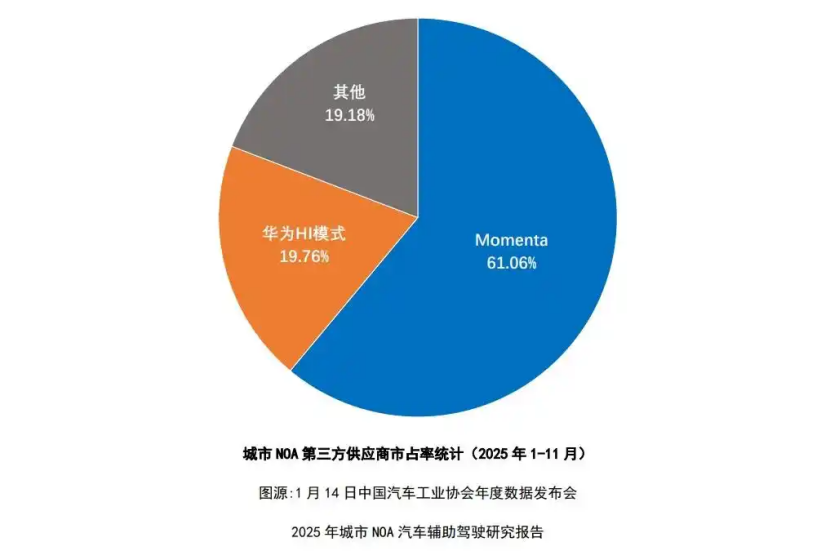
Furthermore, the NOA Report highlights that third-party provider Momenta has secured partnerships with mainstream domestic passenger vehicle enterprises, with 8 out of the top 10 global automakers collaborating with Momenta. Huawei's HI mode has been deployed in approximately 134,100 vehicles, capturing about 19.76% of the third-party supplier market share.
Concurrently, the widespread integration of steer-by-wire and brake-by-wire technologies has shattered the response limitations of traditional mechanical systems. Paired with dual-redundancy architectural designs, vehicles can maintain stability and controllability even during single-component failures. These technological strides collectively form the "hardware bedrock" for autonomous driving safety.
However, technological evolution introduces novel safety challenges. The Report notes that over 60% of assisted driving-related accidents in recent years stem from a "disconnect between system capabilities and user expectations." More alarmingly, such failures frequently occur in critical scenarios like high-speed driving and urban intersections, with post-sale explanations often citing "system anomalies" without pinpointing root causes—highlighting deficiencies in hardware calibration and software optimization for certain models. Additionally, sensitive data collected by intelligent connected functions, such as driving trajectories and facial information, faces risks of cross-border transmission and leaks.
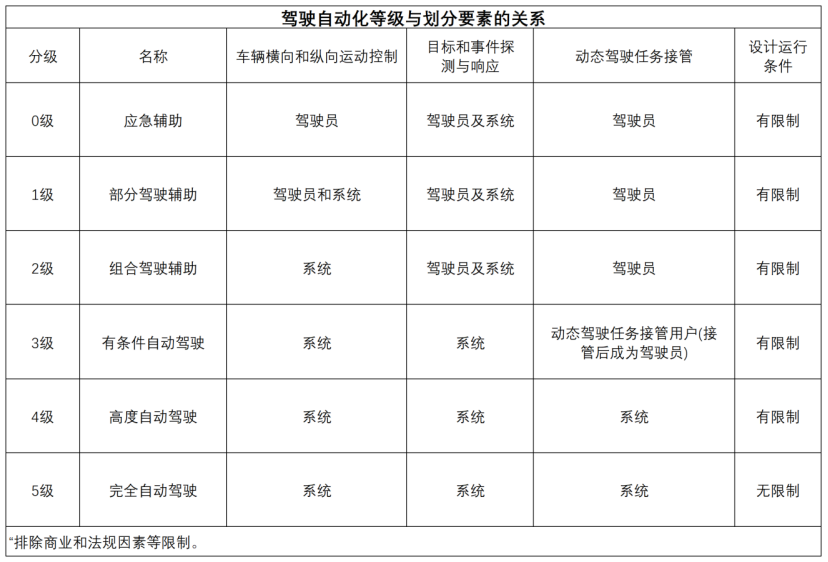
The new regulations implemented in 2026 address these pain points: the Intelligent Connected Vehicles Autonomous Driving Data Recording System (GB 44497-2024) mandates L3-level and above vehicles to install "data black boxes" that record vehicle speed, steering angle, sensor data, and human-machine interaction states in real time. In the event of an accident, these data can reconstruct scenarios and clarify liability boundaries between drivers and systems. This requirement effectively resolves previous disputes where automakers and users shifted blame, while providing evidentiary support for similar complaints. Meanwhile, the Vehicle Information Security Technical Requirements (GB 44495-2024) enforces localized storage of sensitive data and prohibits cross-border transmission of non-anonymized data, establishing a data security bulwark for intelligent connected functions and addressing the Report's concerns about "data privacy protection."
Advancing autonomous driving safety necessitates greater synergy between "technological implementation and scenario-specific control." The 2026 rollout of L3-level autonomous driving pilots (e.g., Chang'an Deepal S7i and BAIC Arcfox Alpha S HI models approved for operation in five cities, including Beijing and Shanghai) exemplifies this philosophy: pilot regions are strictly limited to highways and urban expressways, with maximum speed limits set at 80 km/h in Beijing and Shanghai and 50 km/h for congested road sections in Chongqing and Wuhan. L3 functionality is prohibited during adverse weather conditions like rain, snow, or fog.
This "scenario-constrained, speed-regulated" design provides a secure environment for technological validation while mitigating risks from inadequate scenario adaptation, aligning with the Report's assertion that "scenario safety is a cornerstone of autonomous driving safety." Notably, L3 pilots also compel automakers to refine "human-machine collaboration" mechanisms: systems alert drivers to take control through auditory/visual warnings and steering wheel vibrations. If no response occurs within 5–10 seconds, the vehicle automatically activates hazard lights and initiates a gradual stop.
▍Rectifying Public Cognitive Biases
Achieving autonomous driving safety requires not only "hard safeguards" from technology and regulations but also "soft collaboration" from public perception and usage behaviors. CheZhiWang data reveals that most complainants believe automakers exaggerate intelligent driving capabilities, having experienced functional misguidance or system misjudgments. These cases reflect discrepancies between automakers' "promotional expectations" and users' "actual experiences."
Such cognitive biases stem from multiple factors: fragmented media coverage of "assisted driving accidents" often amplifies extreme cases while overlooking broader safety data; some automakers, vying for market share, overhype "fully autonomous driving" concepts while obscuring functional limitations; additionally, entrenched driving habits from fuel vehicles lead to misjudgments when users encounter single-pedal modes or assisted steering functions.
The 2026 regulations address these issues by regulating corporate behavior and guiding user operations, providing policy support to rectify cognitive biases. To curb misleading automaker promotions, regulations explicitly prohibit packaging L3 autonomous driving as "fully autonomous driving," with violations subject to fines up to 2 million yuan—directly heeding the Report's call to "avoid overly exaggerating safety boundaries in technological promotions." Automakers must now clearly label functional applicability scenarios in marketing, such as "L3 applicable only to designated highway sections" or "system cannot handle sudden cut-ins," ensuring users understand technological boundaries before purchase.
Simultaneously, to address safety concerns around single-pedal modes in NEVs, regulations mandate that vehicles cannot decelerate to a stop solely by releasing the accelerator pedal under default settings; braking must occur via the brake pedal, and brake lights must activate automatically when kinetic energy recovery deceleration exceeds 1.3 m/s². This design eliminates conflicts between NEV and fuel vehicle driving habits, reducing accidents caused by operational misjudgments and helping users rationalize the role of "assisted functions."
The NOA Report observes that with substantive improvements in functional experiences, user trust and reliance on assisted driving have significantly increased. From January to November 2025, mainstream passenger vehicles priced below 300,000 yuan with urban NOA accounted for over 68.9% of sales—indicating that urban NOA has transitioned from a premium feature to a standard configuration in mainstream vehicles, entering a phase of rapid penetration among mass consumers. Meanwhile, technological breakthroughs in L3-level and above autonomous driving, scenario-based deployments, and supply chain synergies are drawing significant attention, propelling NOA technologies toward higher maturity levels and further boosting urban NOA penetration.
Adjustments to 2026 auto insurance regulations also guide user behaviors: owners with safe driving records and annual mileage under 10,000 km can enjoy 10%–15% premium discounts, while NEV battery coverage is included in comprehensive insurance. These measures incentivize standardized use of autonomous driving functions and reduce economic risks from accidents caused by cognitive gaps. Increasingly, users are proactively learning standards like the Intelligent Connected Vehicles Autonomous Driving Functional Design Operational Conditions and prioritizing models that pass C-NCAP intelligent safety evaluations during purchases. This shift toward "proactive safety awareness" injects vital momentum into the autonomous driving safety ecosystem.
Looking ahead, as technologies like solid-state batteries and vehicle-road-cloud coordination mature, autonomous driving safety will evolve toward "predictive safety": vehicles can preemptively identify high-risk road segments and driver fatigue states using vast road data, enabling "early warnings and active interventions." International standard harmonization and mutual recognition will also help Chinese intelligent connected vehicles mitigate compliance risks during global expansion.
Layout 丨 Yang Shuo Image Source: Qianku.com, China Association of Automobile Manufacturers
-
![]()
Enflame Tech's IPO Journey: Navigating Over 5.9 Billion Yuan in Losses and Soaring Debt in Q1 This Year
-
![]()
Trillion-Yuan Giant Li Shufu 'Streamlines': Could Levc Be the Casualty?
-
![]()
AI Competes for Electricity and Generates Power in the Gobi Desert
-
![]()
The First Batch of Victims of the AI Bubble: Programmers
-
![]()
ByteDance, DJI, and Xiaohongshu Secure Top Three Positions Among China’s Fastest-Growing Unicorns
-
Tesla's in-car voice system in China is finally learning to 'understand human language'
-
![]()
Foreigners Are Amazed: Chinese Electric Vehicle Drive Systems Unveil Innovative 'Poses'
-
![]()
700,000 Brothers and the Future of Robots: Behind JD.com's 'Nirvana Plan'