11 New 'Series 9' Models Sweep Across the Streets, Igniting the Flagship Car Competition Era
 02/24 2026
 521
521
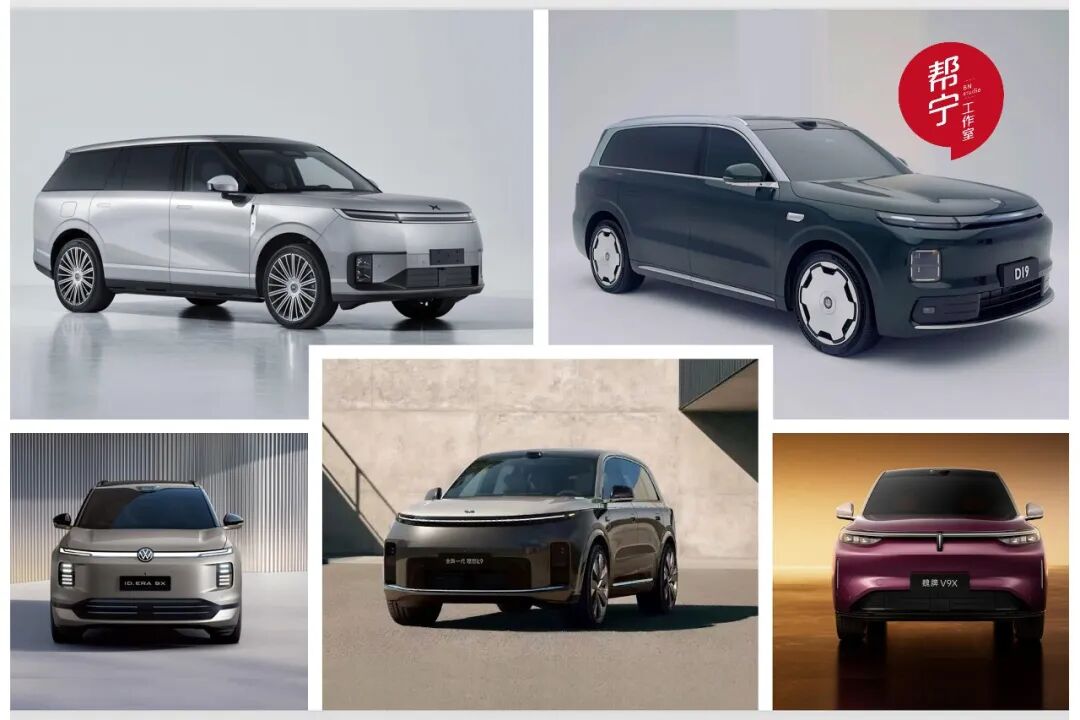
"The Premium Market is Also Facing Fierce Competition"
Author | Zhen Yao
Editor | Li Guozheng
Produced by | Bangning Studio (gbngzs)
As the automotive market hurtles into 2026, there's no slow buildup—just a full-scale onslaught of flagship models.
In less than 40 days since the year commenced, based on the new car listings disclosed by the Ministry of Industry and Information Technology and manufacturer information, approximately 11 flagship models bearing the '9' moniker, such as the NIO ES9, Li Auto L9 Livis, Zhijie V9, Leapmotor D19, Volkswagen ID.ERA 9X, Wey V9X, and Wendao V9, have made their grand entrances, signaling another intense showdown among Series 9 flagships in the industry.
Especially after entering February, the competition has reached a fever pitch: On February 9th, BAIC's ARCFOX premium product line, the "Wendao" series, was unveiled, focusing on SUVs and MPVs, with the first MPV named "Wendao V9". On the 7th, official images of the Wey V9X were released, positioning it as an "AI luxury six-seater flagship". On the 5th, Zhijie Automobile released official images of the V9's cabin, marking it as the first flagship MPV under the Hongmeng Zhixing brand.
On January 10th this year, BYD took the lead by launching the dual flagships, Han Series 9 and Tang Series 9, at the Dynasty Celebration, seemingly pre-empting influence in the premium segment.
2026 is destined to be a year when automakers collectively aim for the high-end market. There's no retreat, no hesitation. The Series 9 frenzy sweeping through the entire premium automotive market is poised to erupt shortly after the year begins.
▍01 Clustered Debuts
Any model daring to bear the '9' in its name is inevitably a masterpiece from the automaker, showcasing the most cutting-edge technologies, top-tier R&D achievements, and the most luxurious configuration experiences, all unreservedly piled on to embody the brand's strength.
As the Chinese automotive market bids farewell to incremental competition, premiumization and intelligence have become some of the few breakthrough sectors. In early 2026, the flagship battlefield is already smoky, with each model showcasing the automakers' ambitions and trump cards for ascending to the high end.
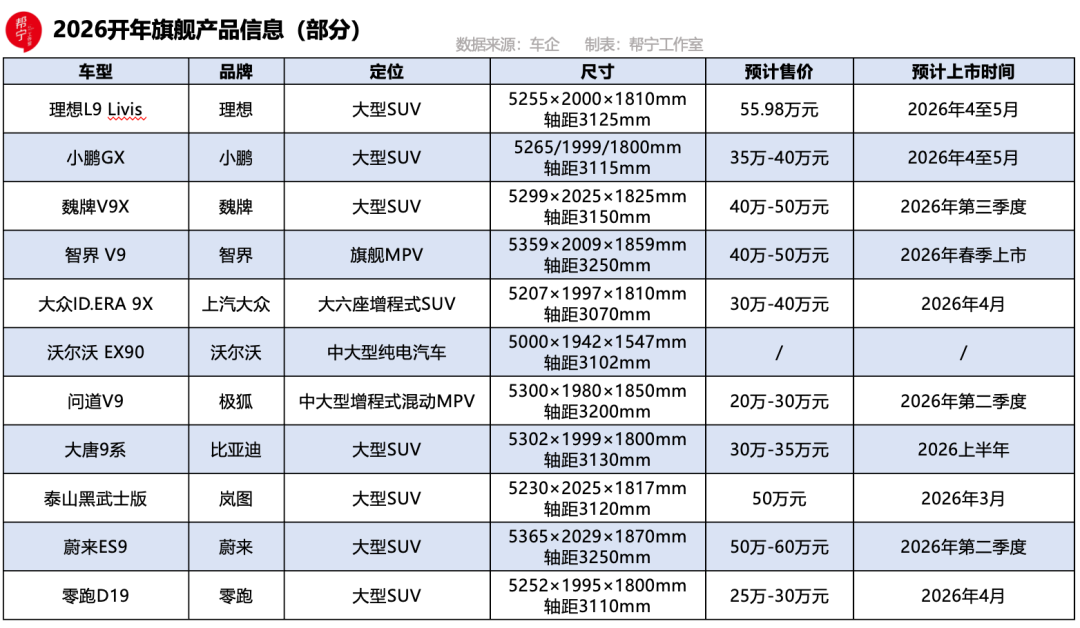
In terms of price, based on estimated prices from multiple sources, this new batch of Series 9 flagships forms a gradient ranging from 300,000 to 500,000 yuan.
In the 300,000 yuan range, the ARCFOX Wendao V9 and Leapmotor D19 enter, focusing on cost-effectiveness. In the 300,000-400,000 yuan range, XPeng GX and Volkswagen ID.ERA 9X cater to family practicality needs. At 300,000-350,000 yuan, BYD's Datang Series 9 carves out its niche. At 400,000-500,000 yuan, the Wey V9X and Zhijie V9 focus on luxury and technological integration. At 500,000 yuan and above, models like the Li Auto L9 Livis and VOYAH Taishan Black Warrior Edition compete on the same stage for influence.
In terms of size, since they all bear the '9' prefix, spaciousness is certainly a core selling point.
Regarding model types, SUVs dominate, with 9 models positioned as mid-to-large or large SUVs, exceeding 5.2 meters in length and with wheelbases ranging from 3100mm to 3250mm. The NIO ES9 leads in size, while the Wey V9X follows closely in wheelbase. Some SUVs boast prominent technological highlights, such as the optimized range extender and battery combination in the Li Auto L9 Livis.
MPVs also join the fray, with 2 models covering premium business and multi-person travel needs. For instance, the Zhijie V9 and ARCFOX Wendao V9 emphasize spaciousness and high luxury, with the former boasting a comprehensive range exceeding 1250 kilometers.
In terms of launch timings, these Series 9 models are highly concentrated in their market debuts, basically erupting in the first half of the year, with the second quarter being the main battlefield. In March, the VOYAH Taishan Black Warrior Edition will make its debut first. From April to June, 8 models will flood the market. The Wey V9X is expected to launch in the third quarter. The launch timing of the Volvo EX90 remains undetermined, adding uncertainty to the competition.
Amidst this Series 9 frenzy, automakers' leaders are frequently releasing signals of technological breakthroughs.
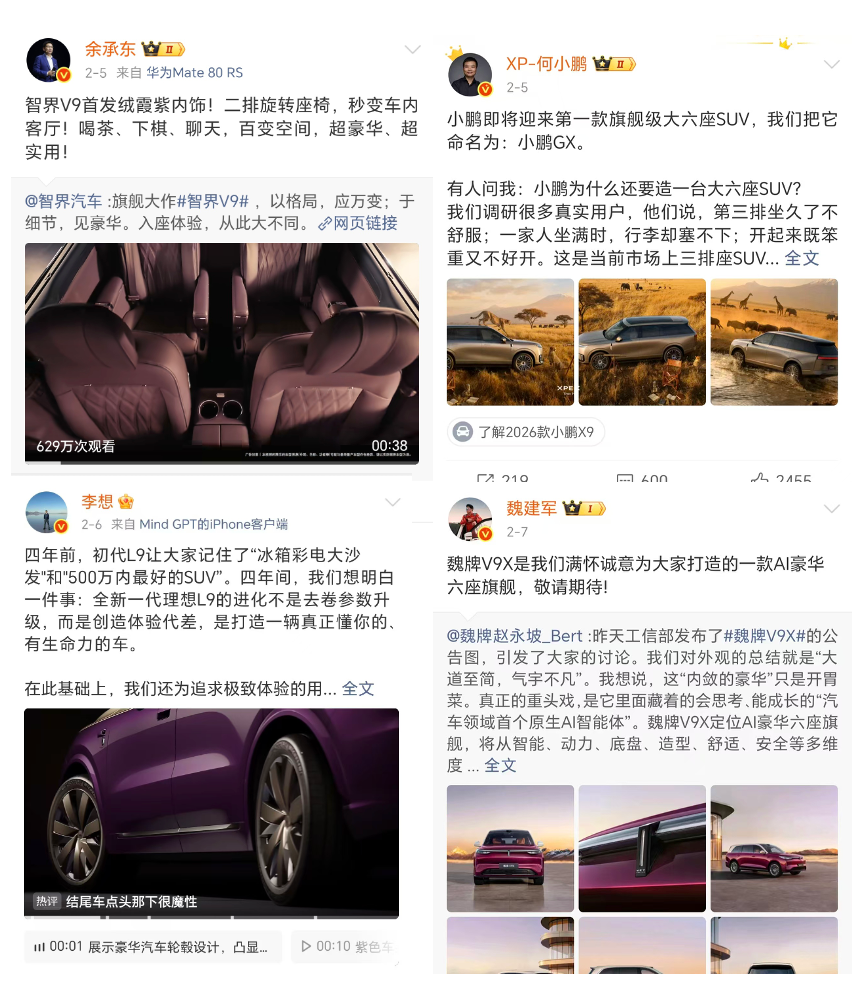
"No longer competing on paper parameters, but creating an experiential generation gap, transforming the new L9 Livis into an embodied intelligent robot," said Li Xiang, CEO of Li Auto. This model is equipped with two self-developed 5nm Mach 100 chips, delivering a computing power of 2560 TOPS, along with 360-degree LiDAR. It's the first model under 600,000 yuan to feature an 800V fully active suspension system and the industry's first "fully evolved" fully wire-controlled chassis.
Wei Jianjun, Chairman of Great Wall Motor, pins his hopes for Wey's ascent on the V9X. Positioned as an AI luxury six-seater SUV, it's built on Great Wall's high-end technology sequence, the Guiyuan S platform of the Guiyuan platform, integrating Great Wall's cutting-edge technologies.
"The XPeng GX is redesigned with a complete AI mindset," said He Xiaopeng, Chairman of XPeng Motors. "It's equipped with four self-developed XPeng Turing AI chips, delivering a local effective computing power of 3000 TOPS and possessing L4 autonomous driving capabilities."
This indicates that this year's flagship battle is a comprehensive contest of technology, brand, and user insight among automakers.
▍02 Losing Money for Shoutouts?
Automakers' collective bet on Series 9 is not blind following; previous "Series 9 legions" have laid a solid foundation with their track records.
Since its launch at the end of 2023, the AITO M9 has been on a roll, achieving a record of being the top-selling luxury car priced over 500,000 yuan for 21 consecutive months. The Li Auto L9, as a pioneer in the Series 9 track (segment), has accumulated deliveries exceeding 250,000 units, becoming a phenomenal product.
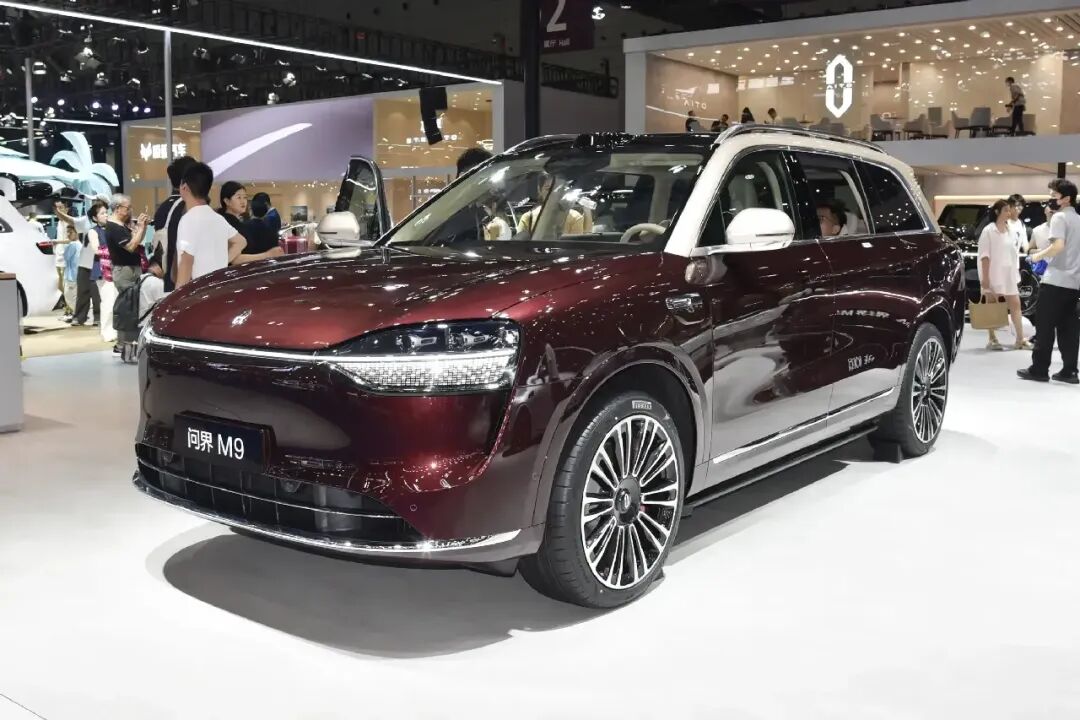
The Tengshi N9 and Zeekr 9X have also achieved remarkable results in their respective segments, continuously adding heat to the popularity of Series 9 models.
Now, the Series 9 model lineup continues to expand, with nearly 30 models currently on the market bearing the '9' in their names, according to incomplete statistics.
Behind the collective revelry of Series 9 models lies an industry consensus: the turning point for China's new energy vehicle market has arrived, the era of incremental competition is over, and the era of flagship competition has officially begun.
"By 2025, the new energy transformation of China's automotive industry will have been initially completed, with new energy passenger vehicle sales surpassing 50% for the first time," analyzed an industry insider. "As the market shifts from wild growth to high-quality competition, flagship models, as concentrated carriers of brand technology and reputation, naturally become the core focus for automakers to break through."
Currently, the Series 9 battle intensifies, with more new models set to debut densely. However, behind the seemingly prosperous facade lies a harsh reality in this niche market: flagships are great, but the market pie is not big enough to share. Not all Series 9 models will succeed, and it's likely that some automakers' hefty investments will go down the drain.
The latest data from Dongchedi lifts the "fig leaf" of the Series 9 market: in the past six months, among the domestic large flagship SUV market, only two models, the AITO M8 and M9, have achieved an average monthly sales volume of 10,000 units, forming a dual-hero pattern. Only three models have reached an average monthly sales volume of 5,000 units, and only three models can consistently maintain monthly sales of 2,000 units.
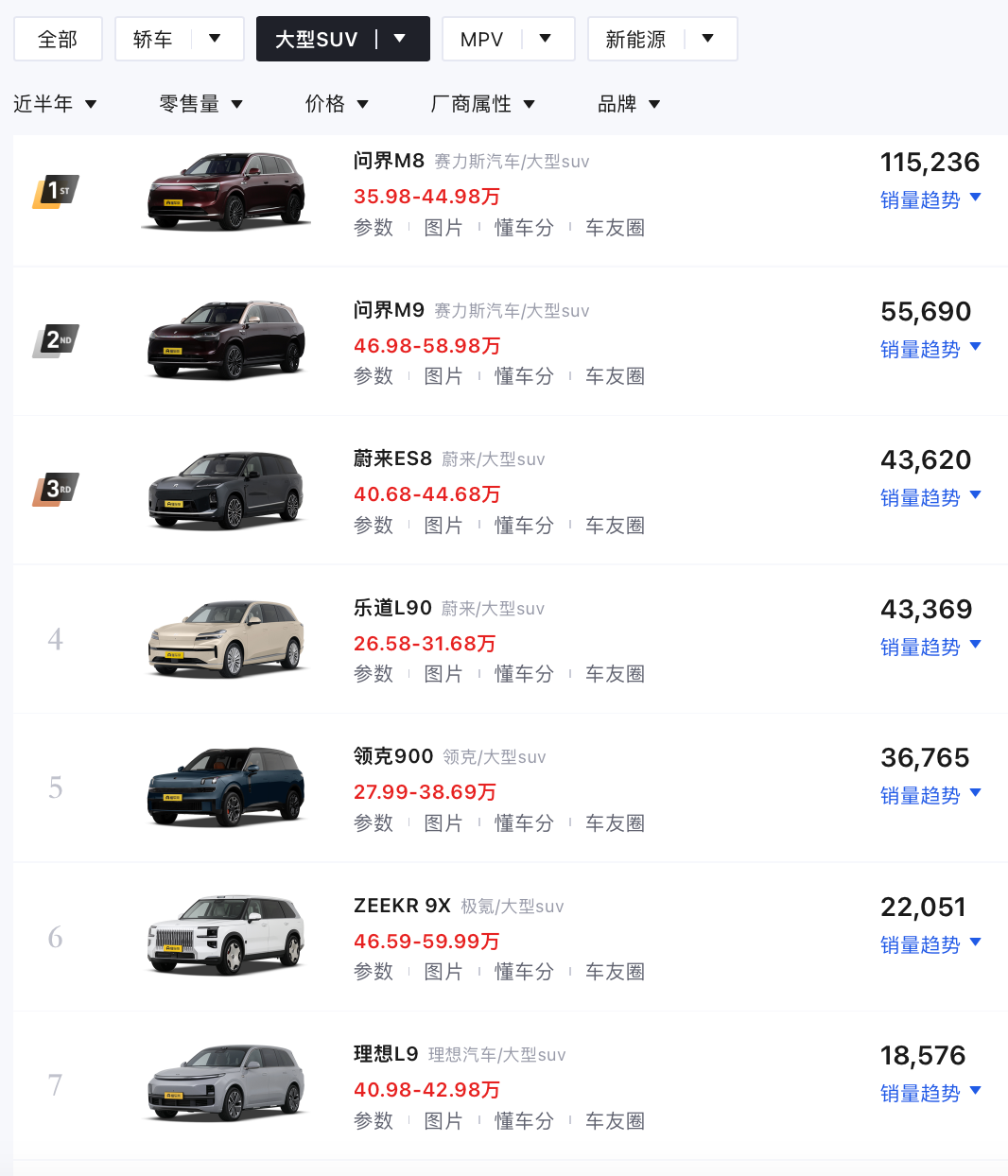 ● Image Source: Dongchedi
Head models are raking in profits, while tail models are struggling on the brink of survival, even at risk of being eliminated at any moment, becoming sacrifices in the flagship battle.
In fact, in 2026, slowing down to seek stability has become the main trend in the automotive industry, with continuous industry consolidation intensifying. For some automakers, blindly betting on Series 9 and piling on configurations without core technological barriers will make it difficult to establish a foothold.
As the industry insider put it, the number of mainstream automakers in China will eventually stabilize at around 15. Those without core competitiveness, hoping to ride the wave of the "Series 9" label, will ultimately be eliminated by the market.
"It's hard to tell them apart," complained a consumer about this flagship frenzy.
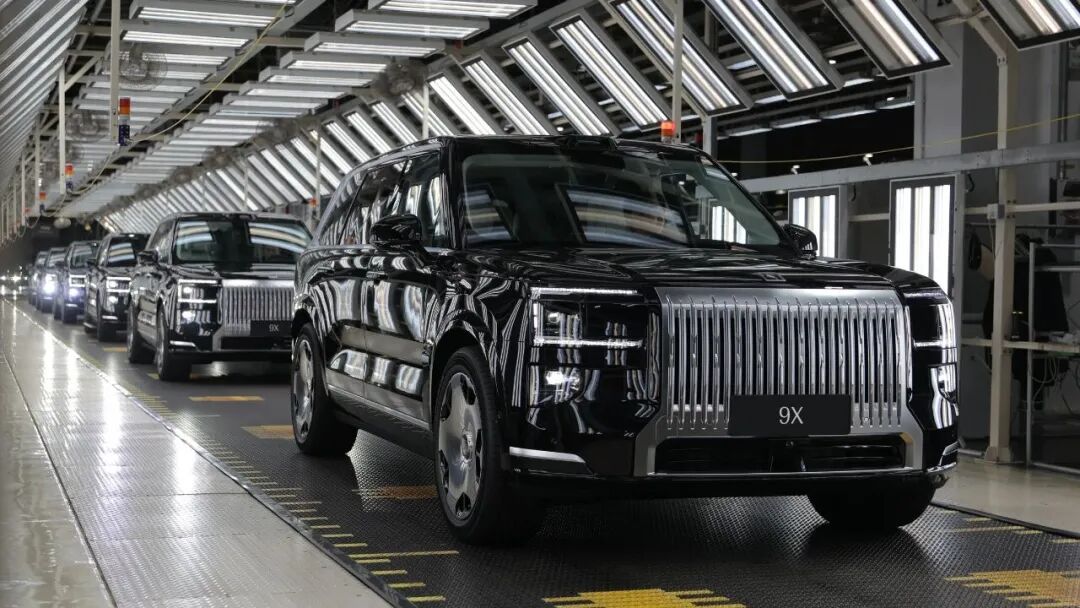
Debuting densely and highly homogenized, almost all Series 9 models promote spaciousness, high intelligence, strong power, and long range, with few models able to stand out with compelling differentiated labels.
You have air suspension, so do I; you have L2+ intelligent driving, so do I; you focus on family comfort, so do I... The Series 9 market has also fallen into internal competition and strain.
-
![]()
Luna Ultra Entangled in 'National Subsidy Fraud' Controversy, Insta360 Pushed to the Brink by DJI
-
![]()
People have long suffered from splash ads. Will the 'temporarily disappeared' traffic behemoth make a comeback?
-
![]()
GPT 5.6 Reclaims the Throne, Only to Face Strict Controls Again! Has AI Truly Reached a Turning Point?
-
![]()
When the Traffic Bubble Fades, AI Giants Start to Compete on 'Real Skills'
-
![]()
Wenxin Once Integrated Multiple Web Portals, but Its Impact Has Diminished
-
![]()
A 1.388 Million Yuan Answer Sheet: Insights into Huawei's Ultra-Luxury Car Strategy and Potential Concerns from the Debut of Zunjie S800 Grand Design and V800
-
![]()
Luna Ultra Mired in 'National Subsidy Fraud' Controversy, Insta360 Cornered by DJI
-
![]()
Legal Disputes, Share Unlock, and Pricing Controversies Converge: Insta360 Reaches a Pivotal Juncture