Is Tesla Cybercab the Pioneer Mass-Produced Car Without a Steering Wheel? Who Leads the 'Driverless Car' Race: Tesla, PIX Moving, or Waymo?
 02/25 2026
 493
493
Introduction
On February 18, 2026, Tesla CEO Elon Musk proudly announced on social media that the first mass-produced Cybercab had officially rolled off the assembly line.
This two-seater model, specifically designed for Robotaxi (autonomous taxi) services, stands out for its complete omission of the steering wheel, accelerator, and brake pedals, relying entirely on Tesla's FSD (Full Self-Driving) system. Tesla plans to commence large-scale production in April of the same year, aiming for an annual production capacity of 2 million units, with the cost per vehicle kept at approximately $25,000.
This news reverberated throughout the tech industry.
However, a critical question soon emerged: Is the Cybercab truly the first mass-produced autonomous vehicle in human history to forego the steering wheel and pedals?
To answer this, we must shift our focus from Austin, Texas, to Guiyang in southwest China, and to Silicon Valley in California.
Let's delve into this topic with 'Autonomous Vehicles Are Coming' (WeChat Official Account: wurenchelaiye)!
(For further reading, click: 'Tesla's First Cybercab Officially Rolls Off the Line, but Reports Surface of Musk's 'Robotaxi' Myth Crumbling: Only 42 Vehicles Deployed in 8 Months, 19% Availability Rate, 9x Accident Rate—Yet Still Promoting 2 Million Units?')
I. Tesla Cybercab: A Bold Declaration and a High-Risk Bet on Mass Production
The launch of Tesla's first Cybercab represents a significant milestone in Tesla's autonomous driving ambitions.
From a design standpoint, it fully embodies Musk's philosophy of 'optimal adaptation for autonomous driving.'
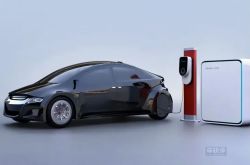
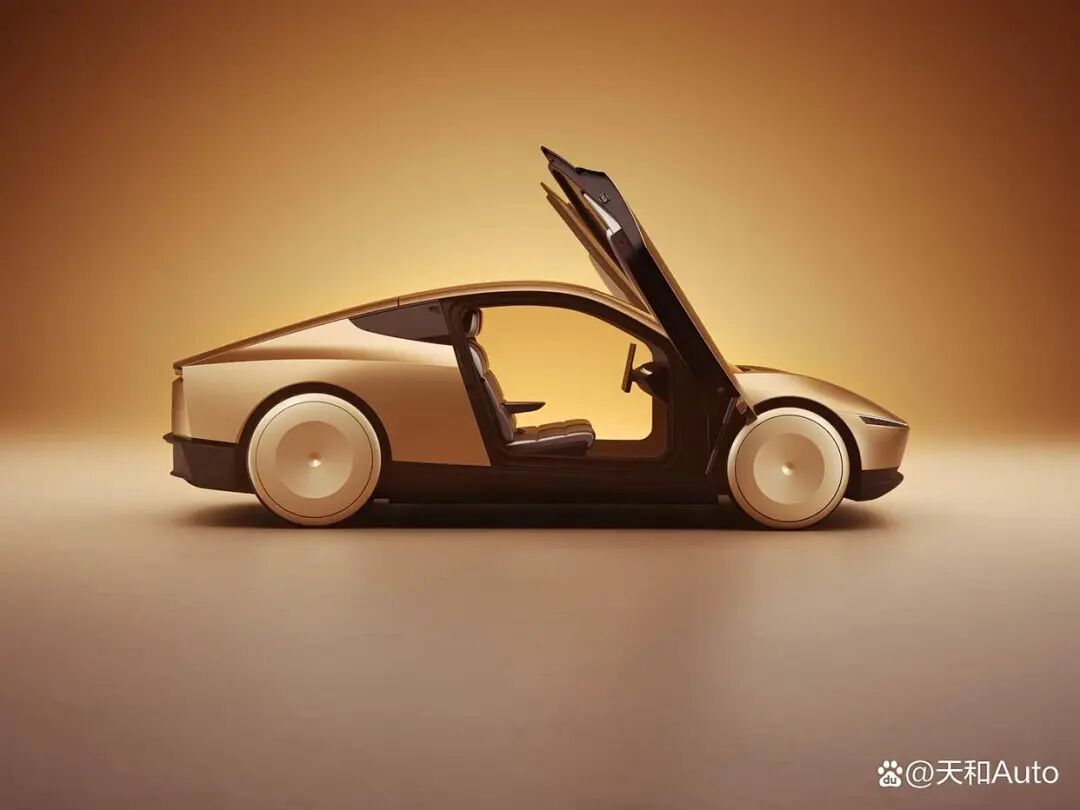
The vehicle features a two-door, two-seat configuration with gull-wing doors, incorporating only a central touchscreen as the interaction hub, while traditional cockpit components are entirely absent.
Its hardware redundancy design purports to support Level 5 autonomy, relying on Tesla's HW4.0 chip and a pure vision-based neural network.
Nevertheless, the Cybercab faces significant hurdles.
The primary obstacle is regulatory barriers.
U.S. Federal Motor Vehicle Safety Standards (FMVSS) mandate that vehicles be equipped with control devices such as steering wheels. Tesla must seek a federal exemption, which currently permits the deployment of only about 2,500 vehicles annually and is restricted to specific cities.
Secondly, issues of public trust and liability determination in accidents remain unresolved.
Despite these challenges, Tesla's aggressive timeline is remarkable: from the first vehicle rolling off the line to April mass production, and then to an annual capacity of 2 million units, it represents a high-stakes gamble against traditional automotive manufacturing norms.
Musk has reiterated the April production plan three times in just six months, demonstrating rare determination.
However, the title of 'pioneer' may already be beyond the Cybercab's reach.
II. PIX Moving: The 'Hidden Champion' from Southwest China and an Earlier Mass Production Reality
While Tesla grapples with regulatory exemptions, a company in Guizhou, China, had already achieved mass production and global deployment of steering wheel-free autonomous vehicles at an earlier date.
The Robobus, independently developed by Guizhou PIX Moving Intelligent Technology Co., Ltd., is a complete vehicle product 'without a cockpit, steering wheel, foot pedals, or rearview mirrors.'
(For further reading, click: 'Guizhou: PIX Moving's Robobus Accelerates with 'Digitalization'! PIX Moving's Autonomous Vehicles Have Entered 30 Countries and Regions Worldwide')
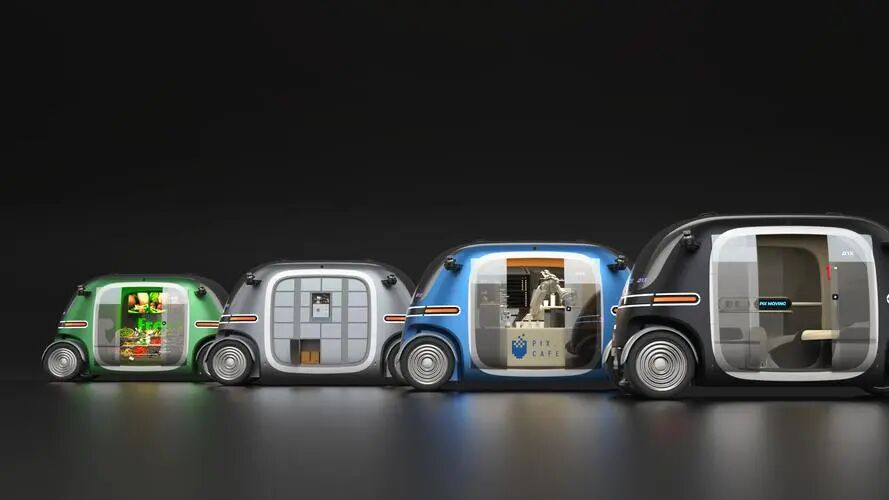
The PIX Moving Robobus adopts a symmetrical design with no distinct front or rear, enabling bidirectional movement.
The crucial timeline: According to a Xinhuanet report on August 30, 2024, this Robobus was already explicitly referred to as the company's 'first mass-produced complete vehicle product for passenger transport' and had been sold to over 30 countries and regions worldwide.
This indicates that by at least August 2024, PIX Moving's steering wheel-free autonomous vehicles had already achieved mass production and commercial delivery.
This is at least one and a half years earlier than Tesla's Cybercab, which rolled off the line in February 2026.
More specific data supports this:
On August 6, 2024, PIX Moving's Robobus officially received Guiyang's first autonomous driving test license for passenger transport, allowing testing on approximately 13.5 square kilometers of public roads.
By 2025, its products had been deployed in over 30 countries globally, applied in diverse scenarios such as rural shuttles in Japan, airport shuttles in Europe, and night market retail in the Middle East.
The company even established a mass production base in Huzhou, Zhejiang, with an annual capacity of 1,000 units.
PIX Moving's approach differs markedly from Tesla's.
Instead of challenging passenger vehicle regulations, it focused on commercial applications like shuttles and retail vehicles in low-speed, closed, or semi-closed scenarios.
This pragmatic strategy allowed it to bypass the most daunting regulatory hurdles and bring steering wheel-free vehicles to market sooner.
III. Google Waymo: From 'Radical Concept' to 'Pragmatic Mass Production'
As a pioneer in autonomous driving, Waymo explored 'steering wheel-free' designs even earlier than Tesla but ultimately chose a different path.
As early as 2015, Waymo (then Google's autonomous driving project) developed the world's first autonomous demonstration vehicle for public roads 'without a steering wheel or pedals.'
In 2022, its concept car developed in collaboration with Geely also featured a steering wheel-free design, symbolizing its technological leadership.
However, when transitioning towards large-scale mass production, Waymo made a pragmatic adjustment.
Its next-generation autonomous taxi, the Ojai (formerly known as the Zeekr RT), set to launch in 2026, reintroduces an operable steering wheel in its mass-produced version.
(For further reading, click: 'Google Waymo's Sixth-Generation Autonomous Vehicle Hits the Road: The Ojai Model Built on Geely's Platform! Can a Chinese Chassis + U.S. Brain Outpace the Autonomous Driving Robotaxi Race?')
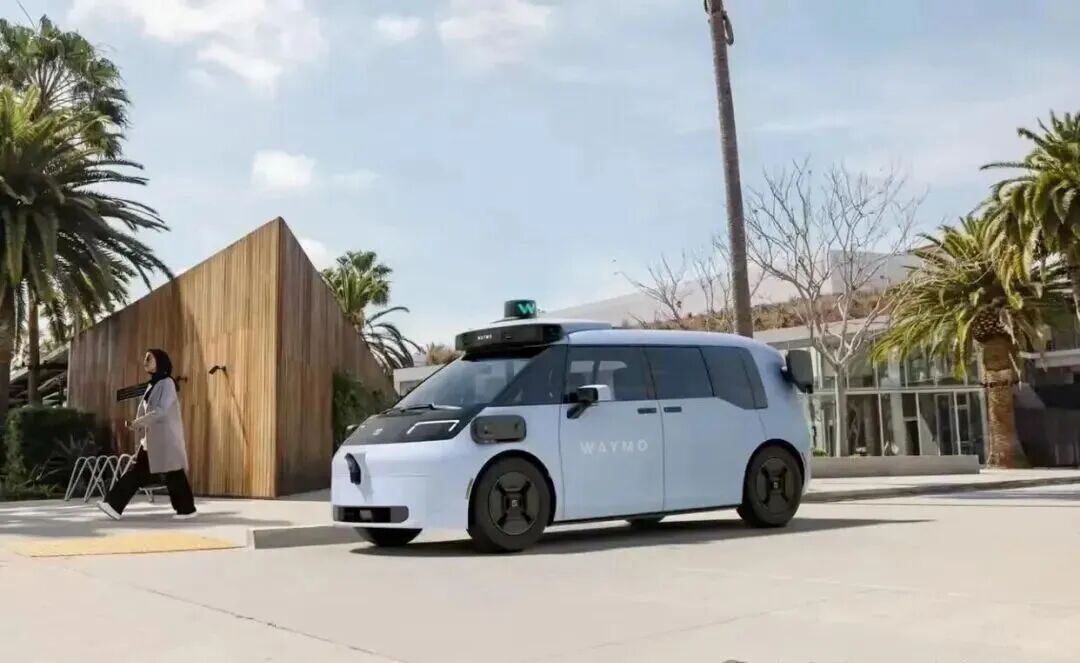
Waymo's VP of Engineering explained the decision: the new system is 'the core engine driving the company's next phase of expansion,' designed specifically for long-term expansion and mass production across multiple vehicle platforms.
Clearly, Waymo believes that retaining the steering wheel is a rational choice at this stage to gain broader regulatory approval, lower user psychological barriers, and achieve rapid scale expansion.
While Waymo's sixth-generation system reduces the number of sensors, it still adheres to a multi-modal fusion approach combining LiDAR, radar, and cameras, forming a stark contrast with Tesla's pure vision-based solution.
Its goal is clear: to gradually advance commercialization while ensuring extremely high safety redundancy.
IV. Racing Logic: The Triple Divide of Technological Philosophy, Market Focus, and Business Strategy
The differing choices of Tesla, PIX Moving, and Waymo on the 'steering wheel-free' path reflect profound divergences in technological philosophy, target markets, and business logic.
1. Technological Philosophy
Tesla advocates for 'bionic intelligence,' believing autonomous driving should rely primarily on vision (cameras) and the brain (AI models) to understand the world, justifying the radical removal of all redundant sensors and control devices.
Waymo adheres to an 'engineering reliability' philosophy, trusting that multi-sensor fusion and high-definition maps are essential for navigating complex environments and ensuring absolute safety, thus retaining the steering wheel in mass-produced vehicles as a compromise with regulations and reality.
PIX Moving leans more toward scenario-based engineering, achieving functionality with relatively simplified sensor schemes in specific low-speed scenarios for rapid deployment.
2. Market Focus
Tesla targets Robotaxi services on urban open roads, the 'crown jewel' of autonomous driving and the greatest challenge in terms of regulations and technology.
PIX Moving focuses on shuttle services in specific scenarios like tourist attractions, industrial parks, and airports—a niche market with clear demand and relatively relaxed regulations.
Waymo positions itself between the two, operating Robotaxis in multiple cities while emphasizing system platformization and scalability for future multi-scenario coverage.
3. Business Strategy
Tesla needs a flagship product like the Cybercab to support its lofty valuation (with a price-to-earnings ratio of 300x) and tell a grand narrative of transitioning from selling cars to operating a mobility network.
As a startup, PIX Moving's top priority is survival and cash flow, securing orders and revenue through rapid mass production and delivery to prove the viability of its business model.
Waymo, as an industry leader seeking financing at a valuation of hundreds of billions of dollars, needs to demonstrate robust expansion capabilities, a clear path to profitability, and an impeccable safety record rather than radical designs.
Thus, who is 'pioneer' is not solely determined by technological capability but is the result of corporate strategy, market judgment, and risk appetite.
So, returning to the original question: Is Tesla's Cybercab the first mass-produced autonomous vehicle in human history without a steering wheel or pedals?
The answer is no.
According to verifiable public information, as early as 2015, Google Waymo developed the world's first autonomous demonstration vehicle for public roads 'without a steering wheel or pedals.'
The Robobus from Guizhou PIX Moving Intelligent Technology Co., Ltd. in China had already achieved mass production and global sales by at least August 2024, also lacking a steering wheel and pedals.
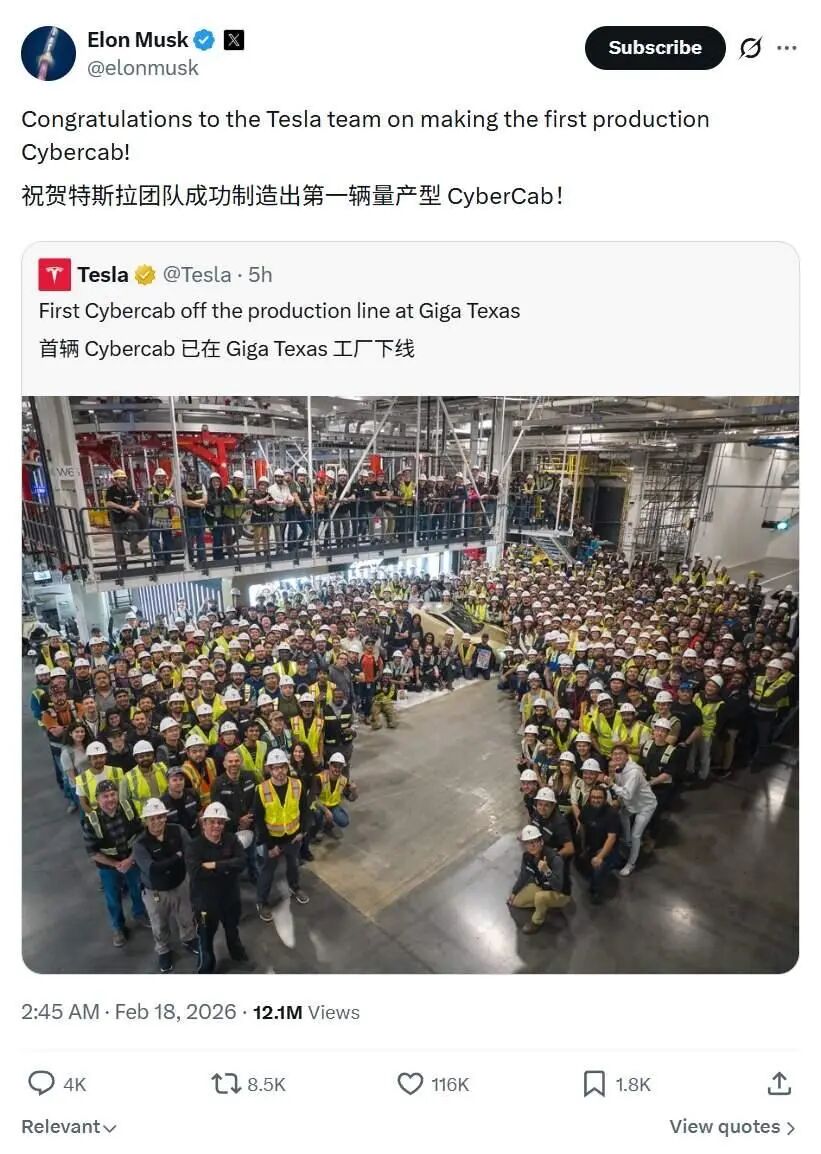
On February 18, 2026, the day Tesla's Cybercab rolled off the line, Musk posted on X: 'Congratulations to the Tesla team for successfully manufacturing the first mass-produced Cybercab!'
He didn't claim 'world's first' or 'historic first.' The restraint was perfectly measured.
In conclusion, 'Autonomous Vehicles Are Coming' (WeChat Official Account: wurenchelaiye) believes:
When the steering wheel disappears from the cockpit, what vanishes is not just a control component but also a century of human driving habits and ingrained perceptions of transportation.
The finish line of this race is not about who crosses the mass production line first but whose design can first win regulatory approval, market trust, and truly transform how we travel.
The show has just begun.
What do you think, dear reader?
#AutonomousVehiclesAreComing #AutonomousDriving #SelfDrivingCars #DriverlessVehicles
-
![]()
Depreciation Rate on Par with Mobile Phones: Just 40% Value Retention After Three Years—Why Do Battery Electric Vehicles Lose Their Worth?
-
![]()
Clearing Bugatti Stock Worth 7 Billion: Why is Porsche 'Cutting Ties'?
-
![]()
Don’t Dismiss Huawei’s Potential in Sedans Just Because the Shangjie Hasn’t Hit It Big Yet
-
![]()
Unsold Cars in China Find Success Overseas
-
![]()
Ghosn: Only I Can Save Nissan, Shareholders Beg Me to Return
-
![]()
Expanding Automobile Consumption: It's Time to Address the High Cost of Electric Vehicle Repairs
-
![]()
Luna Ultra Entangled in 'National Subsidy Fraud' Controversy, Insta360 Pushed to the Brink by DJI
-
![]()
People have long suffered from splash ads. Will the 'temporarily disappeared' traffic behemoth make a comeback?