Discourse Power of the 'National Team' in the Intelligent Electric Era | Patterns and Trends of 2026 ⑥
 02/25 2026
 571
571
Lead
Introduction
The competition among FAW, Dongfeng, and Changan hinges on their grasp of intelligent development.
This article is selected from Patterns and Trends of 2026
The dust has not yet settled in the 2025 Chinese auto market, with the final sales figures of the three major central automotive enterprises now in: FAW Group at 3.302 million units, Changan Automobile at 2.913 million units, and Dongfeng Motor at 2.4725 million units. This ranking of 'FAW leading, Changan catching up, and Dongfeng under pressure' may seem clear, but it is merely a Periodic scoreboard (interim scorecard) of the central enterprises' intelligent and electric transformation. This competition has never been just about scale; it is more about the deep-seated rivalry in technology, capital, talent, and strategy, which will determine the national team's right to survival and discourse power in the intelligent electric era.
For Changan Automobile, 2025 is a year of both pride and anxiety. On the surface, it has steadily caught up with FAW with a total sales volume of 2.913 million units and an 8.5% year-on-year increase. More importantly, after being upgraded to a central enterprise last year, Changan has completely avoided the passive situation of being acquired by Dongfeng and has opened up new channels for development.
However, this glory of upgrading has not completely dispelled Changan's market-oriented anxieties. Behind the apparent sales growth, the hidden issue of valuation has become a growing concern for Changan's development. Since Zhao Fei took over as the general manager of Changan Automobile last year, the question investors have asked him the most is, 'When will Changan's stock price rise?' The stock price of Changan Automobile has remained sluggish, forming a stark contrast with its steadily increasing sales volume.
As the three major models of Changan's transformation, Changan Qiyuan, Shenlan Automobile, and Avita were expected to become the core forces supporting its valuation. However, their performance in 2025 still fell short of investor expectations. They have not formed scalable competitiveness and have failed to enter the first tier in the new energy vehicle (NEV) sector. This state of 'progress in transformation but not meeting expectations' has directly led to a lack of confidence in Changan in the capital market and has made the catcher's anxiety even more apparent.
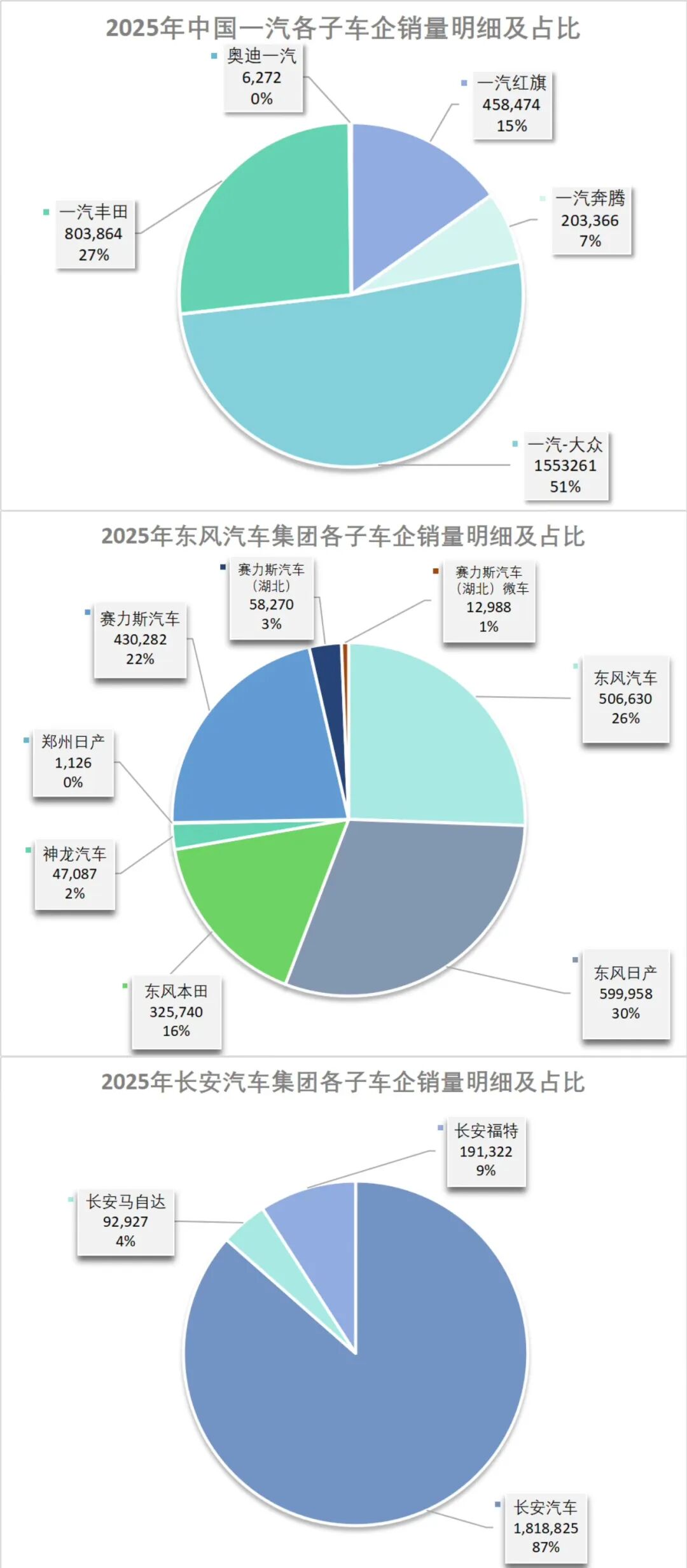
Among the three central enterprises, Dongfeng is undoubtedly the most 'discontented' in 2025. On the surface, its total sales volume of 2.4725 million units has slightly decreased by 0.33% year-on-year, ranking last among the three central enterprises and bearing significant market pressure. More frustratingly, the highly anticipated major integration between Dongfeng and Changan in the middle of last year failed to be completed as scheduled and ultimately ended with Changan's upgrade, leaving Dongfeng stranded in public question (doubt) and criticism.
However, upon closer inspection, Dongfeng's 2025 is not without highlights. Its hidden transformation competition is even more courageous and determined. Despite the slight decrease in total sales, Dongfeng has achieved remarkable results in its new energy transformation: its annual new energy sales volume has exceeded 1.04 million units, a 21% year-on-year increase, with self-owned new energy sales accounting for a high 34.91%. Behind these achievements are Dongfeng's dual breakthroughs in the new energy sector: LanTu Automobile has led the high-end breakthrough of central enterprises' new energy brands, breaking the monopoly of private brands and new forces in the high-end new energy market; Dongfeng Nissan N7 has innovated in the joint-venture new energy sector, injecting new momentum into the electric transformation of the joint-venture segment.
Dongfeng's deep cooperation with Huawei is its biggest bet and the key to its breakthrough in 2026. At the end of 2025, the first tooling prototype of Huawei Qiankun|Yijing, jointly built by Dongfeng and Huawei, officially rolled off the production line and will make its debut at the Beijing Auto Show in April 2026, opening up Huawei's second battlefield of intelligent vehicles besides HarmonyOS Intelligent Mobility.
At the same time, the deep cooperation model between Dongfeng Mengshi and Huawei will also make its debut later in 2026. This model will become the first pure-blooded hardcore off-road SUV under the Huawei brand and is expected to showcase its hardcore strength in this niche market with its differentiated positioning.
Dongfeng's most decisive competition in 2025 lies in its future-oriented personnel layout. During the 10-year rapid growth from 2005 to 2015, the post-60s management team under Dongfeng played a crucial role but also led to the collective suppression of the post-70s generation. This talent gap left Dongfeng passive in the new energy and intelligent transformation that began in 2020.
In 2025, Dongfeng ushered in a highly symbolic personnel iteration: Feng Changjun, born in 1978, was promoted to general manager of the company. A large number of young cadres with a research and development background, such as Yang Yanding (born around 1980, Dean of the R&D Institute), Wang Junjun (General Manager of Dongfeng Yi Pai Technology), and Wan Liangyu (General Manager of Mengshi Technology), have risen to core positions. This vibrant and tech-savvy new management team has injected new vitality into Dongfeng's transformation and has also given the outside world hope for Dongfeng's future breakthrough.
In the history of the Chinese automotive industry, FAW Group has always been irreplaceable. As the eldest son of the People's Republic, it carries historical missions and Responsibility of the times (epochal responsibilities), which determine that it is never limited to mere sales competition.
In 2025, FAW Group has maintained its leading position with a steady and progressive performance. Its vehicle sales volume reached 3.302 million units, successfully outperforming the overall market amid intense market fluctuations, which is particularly remarkable in the fiercely competitive auto market. In 2025, FAW Group made frequent moves in the capital market, acquiring stakes in Leapmotor and the intelligent driving supplier Zhuoyu Technology, integrating into new energy and intelligent technology through capital operations. At the same time, its capital interactions with GAC Group continued, with substantial breakthroughs expected in 2026.
Meanwhile, a deeper competition lies in the layout of missions and talents. Unlike Changan and Dongfeng's market-oriented breakthroughs, FAW Group has always shouldered the exploration responsibilities of central enterprises in the fields of re-industrialization and intelligent manufacturing in the new era. As Group Chairman Qiu Xiandong said at the group's talent work promotion meeting on December 9 last year, 'Talent is the primary resource for enterprise development. FAW Group must not only cultivate first-class talents to serve its own development but also contribute outstanding talents to the industry and the country. This is our mission and responsibility as a central enterprise.'
Since 2023, FAW Group has continuously provided a large number of executives to the industry and central enterprise system, focusing on talent cultivation in the fields of new energy and internationalization. This talent output not only demonstrates FAW Group's system advantages but also reflects its discourse power in the industry. It is also subtly promoting the overall upgrade of the Chinese automotive industry.
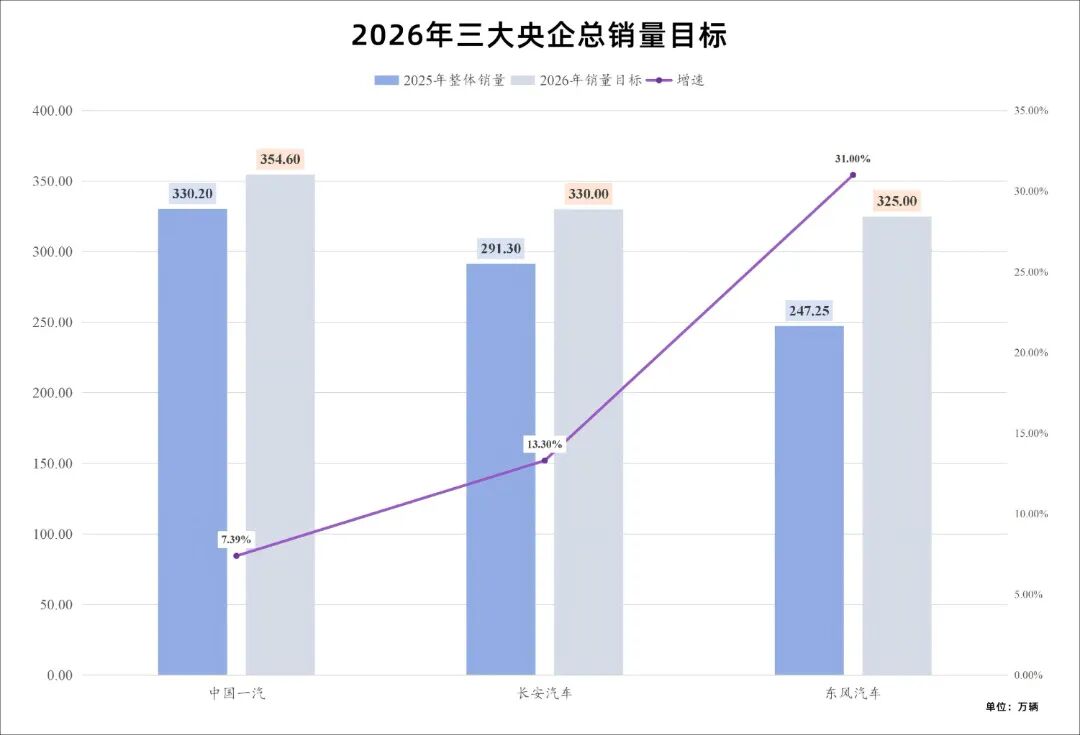
In 2026, the goals of the three major central enterprises will be clearly distinct. Behind the divergence between aggressive and robust (prudent) strategies lie their respective strategic anxieties. Dongfeng has played an aggressive card, setting a target of 3.25 million units, a year-on-year increase of over 30%; Changan remains pragmatic, with a target of 3.3 million units, a mere 3.5% year-on-year increase, but hiding its edge; FAW Group has set its sights on sales volume of 3.546 million units and revenue of 570.04 billion yuan, tackling three major tasks: increasing the proportion of self-owned brand new energy vehicles to over 50%, raising R&D investment intensity to 6%, and doubling overseas sales volume.
In the new year, the competition will intensify: FAW Group's capital layout and talent output, Changan's new energy breakthrough and valuation restoration, and Dongfeng's Huawei cooperation and the efforts of its young team will all unfold comprehensively. This is not only a market breakthrough battle for the three major central enterprises but also a microcosm of the Chinese automotive industry's transformation from scale expansion to quality improvement. As the 'national team in car manufacturing,' their transformation results will not only determine their own futures but also influence the national discourse power in the intelligent electric era.
——This article is selected from Patterns and Trends of 2026
Editor-in-Chief: Cao Jiadong Editor: He Zengrong
THE END
-
![]()
Don’t Dismiss Huawei’s Potential in Sedans Just Because the Shangjie Hasn’t Hit It Big Yet
-
![]()
Unsold Cars in China Find Success Overseas
-
![]()
Ghosn: Only I Can Save Nissan, Shareholders Beg Me to Return
-
![]()
Expanding Automobile Consumption: It's Time to Address the High Cost of Electric Vehicle Repairs
-
![]()
Luna Ultra Entangled in 'National Subsidy Fraud' Controversy, Insta360 Pushed to the Brink by DJI
-
![]()
People have long suffered from splash ads. Will the 'temporarily disappeared' traffic behemoth make a comeback?
-
![]()
GPT 5.6 Reclaims the Throne, Only to Face Strict Controls Again! Has AI Truly Reached a Turning Point?
-
![]()
When the Traffic Bubble Fades, AI Giants Start to Compete on 'Real Skills'