Auto Exports Propel Supply Chain Breakthrough丨Prospects and Trends in 2026 ②
 02/25 2026
 510
510
Lead
Introduction
Only by significantly boosting exports can Chinese automakers sustain their growth momentum.
This article is excerpted from "2026 Landscape and Trends"
“As long as there are sales, anywhere can be home!” Sam, who recently transitioned from the domestic sales team to the international division, joked with me during a layover in Paris en route to Algiers, North Africa, just after New Year's Day. “The company has set a KPI for the international division to achieve a 50% growth increase this year. As soon as the year began, we all set off for our respective regions.”
As the domestic auto market price war reaches a deadlock and OEM profits are squeezed by upstream suppliers, coupled with global supply chain disruptions and rising trade barriers, exports have become the primary driver of growth for the Chinese auto market in 2026. They also represent the core battleground for Chinese automakers seeking breakthroughs amid multiple pressures. Exports carry the hope of breaking the deadlock when the domestic market is under strain and shoulder the responsibility of forging ahead amid global supply chain fragmentation.
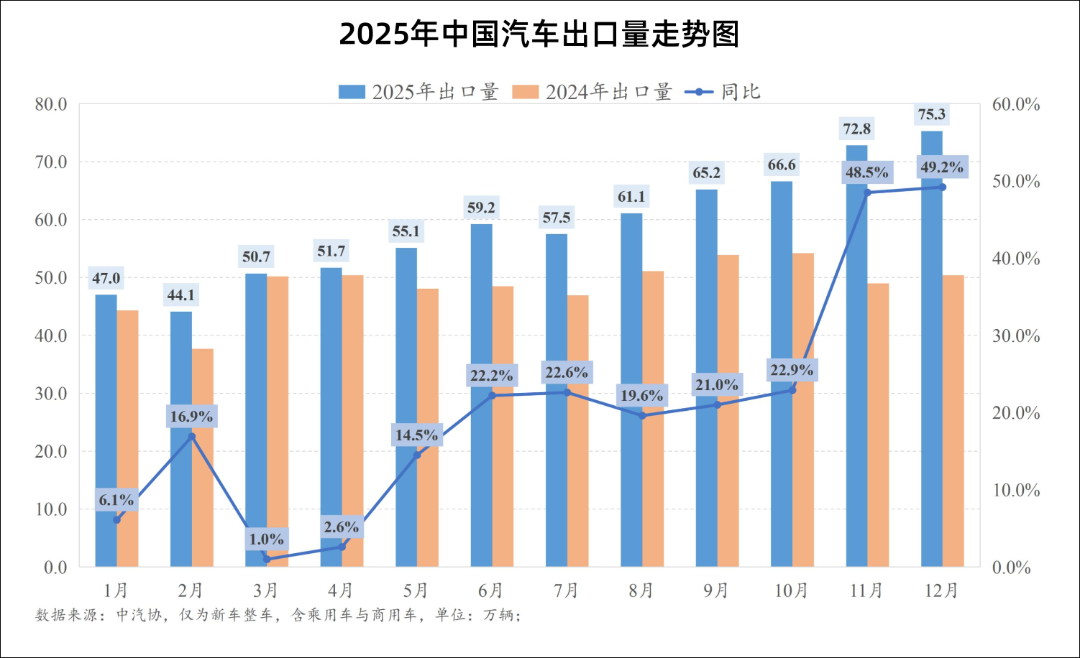
Auto Business News predicts that Chinese auto exports are expected to maintain growth of around 12-15% this year, nearing 8 million vehicles, thereby offsetting the downward pressure on the domestic market.
“We're the only ones in the country with North American certification, and Canadian dealers have already started placing orders!” On January 28th, Feng Qingfeng, CEO of Lotus Cars, told Auto Business News, “Thanks to this tariff adjustment, the Eletre, originally priced at $220,000, is now adjusted to around $100,000.”
Feng Qingfeng and Lotus Cars' good fortune can be attributed to the outcomes of Canadian Prime Minister Mark Carney's visit to China in January. On January 17th, Canada announced the removal of the previous 100% additional tariffs on electric vehicles made in China, replacing them with a 6.1% most-favored-nation tariff within an annual quota of 49,000 vehicles, with the quota set to increase to 70,000 over five years. Although 49,000 represents less than 2.5% of Canada's annual auto sales of 2 million vehicles, it has nonetheless breached the heavily fortified North American market.
Earlier, the amicable resolution of the Sino-European automotive trade dispute once again safeguarded Chinese auto exports. Chinese autos sold 810,982 units in Europe last year, accounting for 6.1% of Europe's 13.3 million vehicle sales, with a year-on-year increase of over 99% from 2024. The astonishing increase of 109,800 units in December alone sent shivers down the spines of European automakers like Volkswagen, Renault, and Fiat.
On July 14th of last year, in Tashkent, the capital of Uzbekistan in Central Asia, at a newly renovated BYD showroom that was once a Mercedes-Benz 4S store, a young couple with their son, around 10 years old, were selecting the newly launched BYD Song EV in Uzbekistan, priced at approximately 395,300,000 soums, equivalent to RMB 220,000. The local guide and driver, Lao Ka, told me that BYD is considered a mid-to-high-end vehicle locally, affordable only to some affluent locals and civil servants. In contrast, a brand-new Chevrolet Cruze costs just over RMB 100,000.
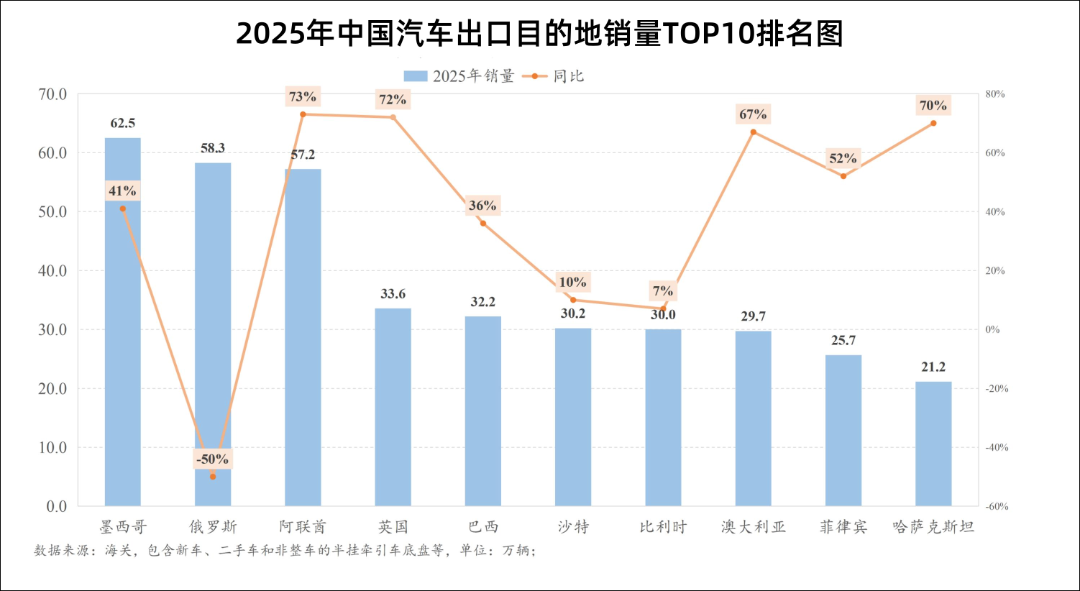
In Uzbekistan, BYD's market share soared from 0 to nearly 20% in just one year. With annual total vehicle sales of 300,000, Uzbekistan serves as a typical example of BYD's ambitious overseas strategy. After achieving a record-breaking 1.05 million overseas sales in 2025, the outside world has become highly sensitive to BYD's overseas targets for 2026. UBS and CICC believe that BYD's overseas sales this year could rise to the 1.5-2 million range.
The technological revolution in intelligent electrification and the demand revolution driven by new consumption trends since 2020 are thoroughly transforming the automotive industry. At the forefront of this transformation, the Chinese automotive industry will continue to expand globally. Therefore, following vehicle exports, the next step is for the domestic supply chain to strongly capitalize on this opportunity to go global.
The robust growth of auto exports is the core support for China's new energy and intelligent supply chain to navigate global divergences and enhance global competitiveness, as predicted by Goldman Sachs in a 2026 report titled “Navigating Divergences, Seizing Incremental Opportunities.” However, due to ongoing Sino-U.S. tech and trade disputes, the globalization process of the automotive industry has been severely impacted. In the second half of 2025, Tesla, General Motors, and Ford announced plans to remove Chinese parts supply chains from the North American market by 2027 at the latest, a move that harms both sides and foreshadows the severing of supply chains in core industries between China and the U.S., as exemplified by NIO.
Pressure is compelling a transformation in China's auto export model from pure trade to a more integrated approach. Firstly, strong exports must drive the entire supply chain to go global, promoting the global layout of core components such as batteries, electric motors, and autonomous driving chips. Companies like BYD, CATL, and Gotion High-Tech are building global production and R&D systems, forcing the supply chain to shift from cost-driven to technology and ecosystem-driven, thereby breaking the technological monopoly of traditional automotive supply chains held by Europe, the U.S., Japan, and South Korea.
Secondly, as rising global trade barriers erode the previous 30% cost advantage of China's electrification supply chain, the continuous expansion of export scale will strengthen supply chain economies of scale, reduce R&D and production costs of core components, and form a virtuous cycle, enhancing China's supply chain's bargaining power in the global market.
Late last year, on the way from central London to the airport, a prominent BYD sign hung on a roadside pillar. Next to the BYD logo, the remnants of the giant NISSAN brand logo had not been completely erased, symbolizing the transition between two eras and reflecting the unstoppable trend of China's globalization.
——This article is excerpted from "2026 Landscape and Trends"
Editor-in-Chief: Cao Jiadong Editor: He Zengrong
THE END
-
![]()
Depreciation Rate on Par with Mobile Phones: Just 40% Value Retention After Three Years—Why Do Battery Electric Vehicles Lose Their Worth?
-
![]()
Clearing Bugatti Stock Worth 7 Billion: Why is Porsche 'Cutting Ties'?
-
![]()
Don’t Dismiss Huawei’s Potential in Sedans Just Because the Shangjie Hasn’t Hit It Big Yet
-
![]()
Unsold Cars in China Find Success Overseas
-
![]()
Ghosn: Only I Can Save Nissan, Shareholders Beg Me to Return
-
![]()
Expanding Automobile Consumption: It's Time to Address the High Cost of Electric Vehicle Repairs
-
![]()
Luna Ultra Entangled in 'National Subsidy Fraud' Controversy, Insta360 Pushed to the Brink by DJI
-
![]()
People have long suffered from splash ads. Will the 'temporarily disappeared' traffic behemoth make a comeback?