Geely and BYD Step Up Efforts: Giants Aren't Willing to Lose in the Breakthrough Battle for New Energy Pickups
 05/26 2026
 428
428
As the domestic passenger vehicle market enters a stage of fierce competition where "every inch of territory is contested," leading automakers are as if by prior agreement ly turning their attention to a segment once considered "niche"—new energy pickups.
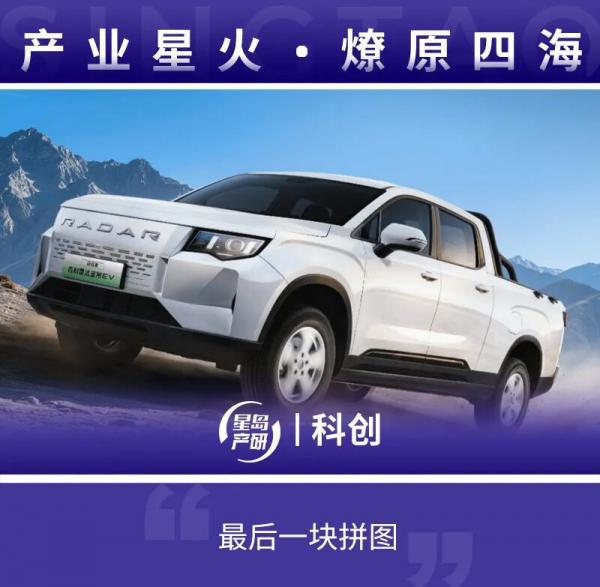
On May 15, Geely Automobile Holdings Limited (00175.HK, hereinafter referred to as "Geely") announced that it would fully acquire all equity in Radar Automobile (Shandong) Co., Ltd. (hereinafter referred to as "Radar Shandong"), Radar Automobile Sales Co., Ltd. (hereinafter referred to as "Radar Sales"), and Thai distribution company Radar Thailand for approximately RMB 218 million. After the acquisition, the three companies will become wholly-owned subsidiaries of Geely.
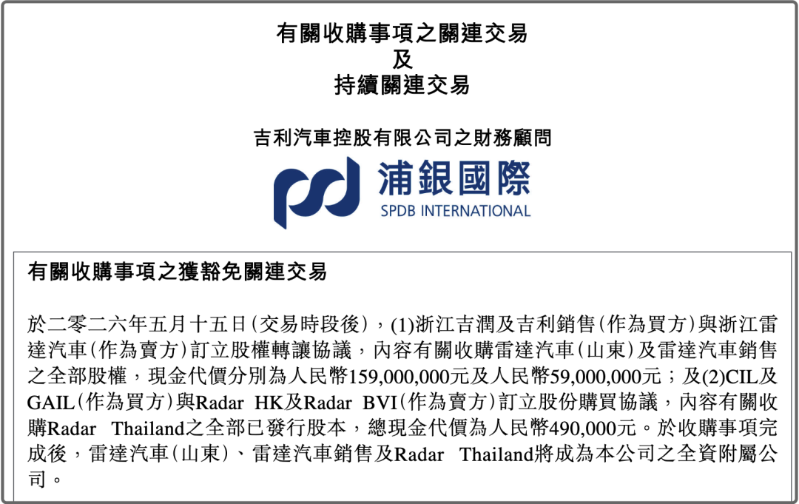
▲Screenshot of Geely's Announcement
Relevant information shows that the Radar brand will be integrated into Geely's "China Star" brand lineup, falling under the pickup business line.
Notably, just two days earlier, on May 13, Xiong Tianbo, General Manager of BYD's (002594.SZ, 01211.HK) Fangchengbao Automobile, also stated that its Shark pickup would be sold domestically this year and officially enter the Fangchengbao lineup.
Almost simultaneously, two major domestic automakers made their moves. At a time when the passenger vehicle market has reached extreme levels of competition, pickups—once considered a marginalized niche segment—are becoming the next battleground for industry giants.
Geely's RMB 218 Million "Big Synergy" Ledger
The deal for Geely to acquire Radar is not complicated.
According to Geely's announcement, the approximately RMB 218 million acquisition is divided into three parts: Zhejiang Jirun Automobile Co., Ltd. will invest RMB 159 million to acquire all equity in Radar Shandong; Zhejiang Geely Holding Group Automobile Sales Co., Ltd. will invest RMB 59 million to acquire all equity in Radar Sales; and Geely's overseas entities, CIL and GAIL, will jointly acquire all share capital of Radar Thailand for RMB 490,000.
Among them, Radar Shandong holds the core assets and value of the Radar pickup products, manages the Radar product lineup, and oversees the entire industrial chain, covering upstream component procurement, midstream vehicle manufacturing, and downstream automobile sales. Radar Sales is primarily engaged in the retail business of automobiles and automotive spare parts, while Radar Thailand is mainly involved in the distribution of electric vehicles in Thailand.
These three transactions enable Geely to acquire the complete business chain of Radar pickups, from production to market. For Geely itself, spending RMB 218 million to bring Radar under its umbrella aligns with the requirements of its "Taizhou Declaration" and the "One Geely" strategy. Therefore, Geely's acquisition of Radar pickups is not merely a simple asset reallocation but a key move in consolidating resource management under its "One Geely" strategy.
"The directors believe that integrating Radar is expected to consolidate the Group's position in the pickup segment and support its overall market positioning," Geely stated in its announcement. The acquisition also helps optimize the layout and resource allocation of the Group's passenger vehicle business. By incorporating Radar's operations into the Group's internal system, the Group expects to enhance synergies in product planning, resource allocation, and brand management, thereby reducing redundant investments, improving operational efficiency, and strengthening cost control.
On May 25, Zhang Xiang, Secretary-General of the International Intelligent Transportation Technology Association, told Sing Tao Daily that Geely's acquisition of Radar could add a new business segment, allowing it to leverage Radar's existing market, customers, and overseas networks. "Given that automobile exports are a hot topic in China's automotive industry, and Geely is a listed company, the acquisition will make Geely's financial data look good. This acquisition may bring Geely a '1+1>2' effect. Strategically, it is very correct and represents a win-win strategy," Zhang said.
BYD's "Shark" Makes a Comeback
Unlike Geely, which integrated internal resources through capital operations, BYD chose to enter the fray by introducing new products.
On May 13, at the launch event for the Baoling 8 and Baoling 5 flash-charging models, Xiong Tianbo announced the return of the Shark pickup and confirmed that the brand would officially join the Fangchengbao lineup.
"For a global leader in new energy vehicles like BYD, it must have a complete presence in every segment to facilitate healthy, sustainable, and stable corporate development," Zhang Xiang said.
The Shark is BYD's first global new energy pickup, built on the company's DMO super hybrid off-road platform. In May 2024, the Shark was officially launched in Mexico and subsequently entered overseas markets such as North America and Australia, with average monthly exports stabilizing at around 3,000 units.
"BYD's integration of the Shark pickup into the Fangchengbao lineup is a classic example of 'technology platform reuse + brand momentum leveraging,'" Lu Kelin, an internationally certified innovation management consultant and founder and CEO of Lukedao Technology, told Sing Tao Daily. The Shark, built on the DMO off-road platform, shares its core architecture with the Baoling 5 and Baoling 8, meaning minimal marginal R&D costs. As BYD's premium off-road brand, Fangchengbao has already established a user perception of "ruggedness + intelligence." With the Shark now part of the lineup, there is no need to build brand awareness from scratch; it can directly share channels and service systems.
He further noted that from a strategic perspective, BYD's decision to first launch the Shark in overseas markets like Mexico in 2024, validate product maturity, and then bring it back to China represents a low-risk "export-to-domestic" pathway. This move also indicates that BYD is completing its "full-category" portfolio—after sedans, SUVs, MPVs, and off-road vehicles, pickups have become a necessary addition to cover all-scenario mobility.
In addition to technological synergies and shared supply chains and channels, Bai Wenxi, Vice Chairman of the China Enterprise Capital Union, also told Sing Tao Daily that Fangchengbao's positioning as a rugged off-road brand aligns with the outdoor attributes of pickups, helping to enhance product premiums and complete the product matrix while precisely targeting high-end new energy consumer groups.
Why Are Giants Targeting Pickups?
In fact, it's not just Geely and BYD; more and more Chinese automakers are accelerating their layout (layout) in new energy pickups.
Great Wall Motors (601633.SH, 02333.HK) has long been deeply involved in the pickup segment, with its Great Wall Cannon brand establishing strong market recognition, surpassing 180,000 units in sales by 2025. In terms of new energy, in 2024, Great Wall developed a hybrid off-road pickup, the Shanhai Cannon Hi4-T, based on its Tank platform's super hybrid Hi4-T architecture. At the Beijing Auto Show in April this year, the global intelligent hybrid pickup Great Wall Cannon Hi4-T opened for pre-sale, covering four models across commercial and passenger series.
In 2024, Changan Automobile (000625.SZ) launched its first super extended-range pickup, the Changan Hunter. At the 2025 Shanghai Auto Show, Changan introduced the world's first super large extended-range digital-intelligent pickup, the Changan Hunter K50.
Peng Tao, Executive Vice President of Changan Automobile, previously stated that Changan pickups would serve as a sub-category under Changan's digital-intelligent new energy brand, Changan Qiyuan, positioned as a "digital-intelligent evolutionary new pickup." Leveraging synergies from Changan's "Shangri-La," "Boundless Ocean," and "Beidou Tianshu" initiatives, Changan is committed to the new energy sector, accelerating its global layout, and promoting the widespread adoption of intelligent technologies.
"The giants' increased focus on pickups is not merely a simple category expansion but a dual positioning to capture 'profit lowlands' and 'overseas growth,'" Lu Kelin said.
Data released by the China Passenger Car Association for 2025 shows that from January to December 2025, the domestic pickup market sold 589,000 units, up 11.8% year-on-year. Among them, new energy pickups totaled 73,000 units, a 243% increase.
"Against the backdrop of intensifying price wars in the passenger vehicle segment, where per-unit profits are severely squeezed, pickups, especially new energy pickups, still maintain relatively high gross margins. Their commercial attributes mean users are less price-sensitive than in the passenger vehicle segment, while scenarios like off-roading and outdoor activities support premium pricing," Lu Kelin said.
He further noted that this also marks a shift in China's automotive industry competition logic from "full-category expansion" land grabs to "full-category deep cultivation" value excavate (excavation). Leading automakers are no longer satisfied with mere presence but are pursuing strength.
"Although the pickup market is small, it features high barriers, high repurchase rates, and a high proportion of exports, making it a litmus test for companies' technological platformization capabilities and global operational abilities. Chery, Changan, BYD, and Geely entering the fray simultaneously is essentially about building 'multi-category combat' capabilities for the next round of global competition," Lu Kelin believes.
"Pickups are currently a very important market overseas. No Chinese automaker aiming to expand internationally should ignore or abandon pickups," Zhang Xiang pointed out. For traditional foreign automakers, new energy pickups represent a weak spot, while Chinese automakers excel in R&D and design with low costs, giving them strong competitiveness overseas. Markets like the U.S. and Southeast Asia have significant demand for new energy pickups and offer new energy subsidies. "This is a major advantage for Chinese automakers competing internationally. We must act quickly to develop this market," Zhang said.
-
![]()
Geely and BYD Step Up Efforts: Giants Aren't Willing to Lose in the Breakthrough Battle for New Energy Pickups
-
![]()
From Selling Computers to Selling AI: How Far Has Lenovo Come?
-
![]()
What Enlightenment Does the Successfully Verified Trillion-Dollar Anthropic Bring to SaaS Enterprises?
-
![]()
Li Auto L9 Livis: Caught Between 'Daddy Car' and 'AI'
-
![]()
From 'Flying Machines' to 'Embodied Intelligent Agents': How Embodied Intelligence is Revolutionizing the Commercial Landscape of Low-Altitude Equipment
-
![]()
Launch of the Lynx S10: Why is DeepRobotics Developing a Small Wheeled-Legged Robot?
-
![]()
AI Accelerator: The Powerhouse Behind AI Algorithm Operations and Applications
-
![]()
Ferrari Luce Electric Debuts: Ferrari’s Essence Endures in the Electric Age | On-Site Report