2026 CPC Annual Meeting Forum: NIO | Li Bin Unveils RMB 100 Million Cost-Saving Opportunity for the Industry: Standardized Battery Cells & Unified Chip Specifications, No Profit Redistribution
 04/15 2026
 512
512
In China's intelligent electric vehicle (IEV) sector, a recurring pattern emerges with each new vehicle launch: a surge in orders outpaces delivery capabilities initially, only for production to ramp up months later when demand has already waned, resulting in inventory pile-ups. This cycle, which repeats annually, incurs billions in losses for the industry.
At the 2026 CPC Annual Meeting Forum, Li Bin, the founder of NIO, identified this phenomenon as the "New Vehicle Launch Effect Death Valley." To tackle this issue, he proposed two industry-wide initiatives—standardizing battery cell specifications and unifying chip specifications—with a measurable outcome: achieving over RMB 100 million in cost savings across the industry by reducing waste, without any profit redistribution.
After reading this article, you will gain insights into: why NIO continues to face challenges despite its rapid growth, the true cost of the "New Vehicle Launch Effect Death Valley," the rationale behind the proposals for standardized battery cells and unified chip specifications, and the measurable value these initiatives bring to the entire industry.
First, the scorecard: NIO's resurgence amid industry headwinds
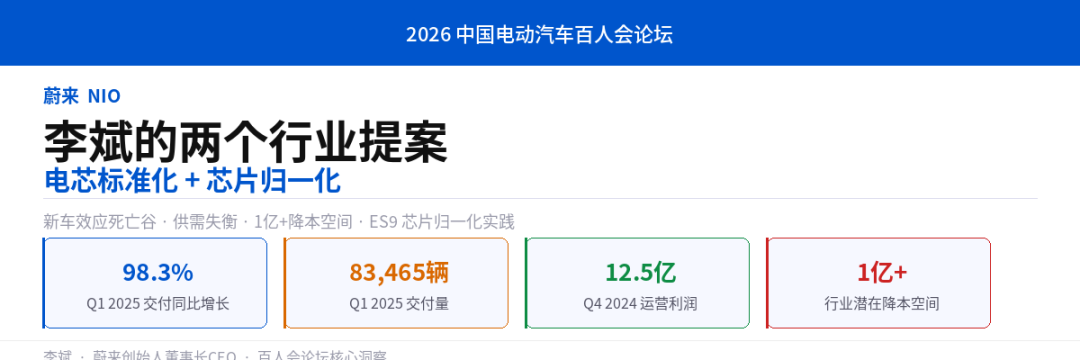
NIO's performance highlights: In Q1 2025, NIO delivered 83,465 vehicles, marking a 98.3% year-over-year increase. Additionally, the company achieved its first-ever quarterly operating profit of RMB 1.25 billion in Q4 2024, amidst widespread industry pressure.
However, Li Bin did not solely focus on these accomplishments. He dedicated more time to discussing industry-wide challenges, emphasizing that while volumes are on the rise, revenue and profitability are not keeping pace, which is the industry's most pressing issue. He argued that the root cause lies in supply-demand imbalances.
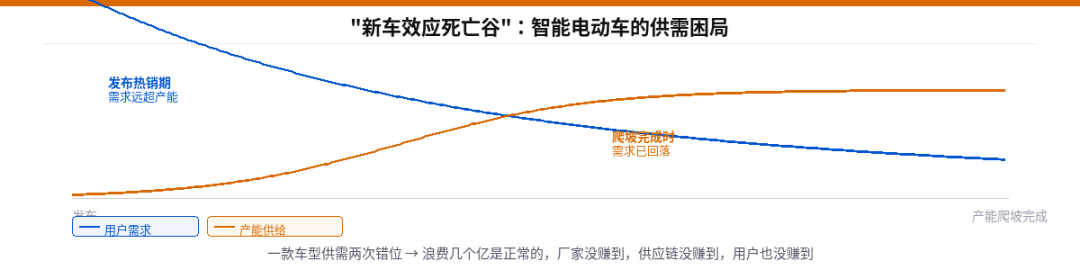
New Vehicle Launch Effect Death Valley: Awaiting delivery at launch, no orders post-ramp-up
Li Bin described a cycle that is familiar to all but rarely analyzed systematically: a new vehicle is launched, generating a surge in demand, but customers must wait for delivery. The supply chain responds by working overtime, investing in equipment, and hiring additional staff to ramp up production. By the time capacity catches up, demand has already declined, leaving no orders—a most regrettable timing.
Li Bin put it bluntly: mismatches in supply and demand for a single model can result in hundreds of millions in losses. These losses are incurred by manufacturers, suppliers, and customers alike—simply wasted.
The greater pressure stems from the cost structure: batteries and semiconductors now account for over 50% of the total cost of IEVs, and this 50% is largely beyond the control of automakers. Supply-demand mismatches lead to alternating periods of inventory build-up and underutilized capacity.
Two root causes: Non-standardized battery cell specifications & excessive chip varieties
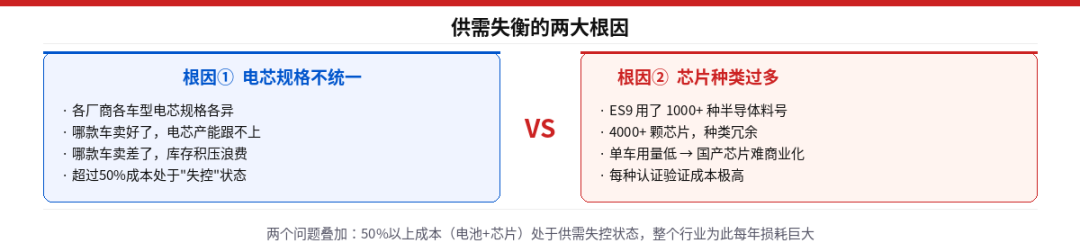
Li Bin attributed the supply-demand imbalance to two solvable structural issues.
The first is the lack of standardized battery cell specifications. Each automaker uses different cell specifications, leading to shortages for popular models and excess inventory for underperforming ones. The analogy is clear: when you need AA batteries, you don't care whether they're Duracell or Energizer—the standardized size makes them interchangeable.
Li Bin's key insight: today's lithium iron phosphate, medium-nickel ternary, and high-nickel ternary battery chemistries have largely converged on their optimal physical structures, making standardization feasible. This insight forms the core premise of his proposal.
The second issue is the excessive variety of chips. Li Bin revealed a specific figure: the NIO ES9 uses over 1,000 semiconductor part numbers and 4,000 chips. Many chips with identical functions have different part numbers due to historical reasons. NIO is working internally to reduce this to 400 varieties.
Two industry proposals: Standardized battery cells & unified chip specifications
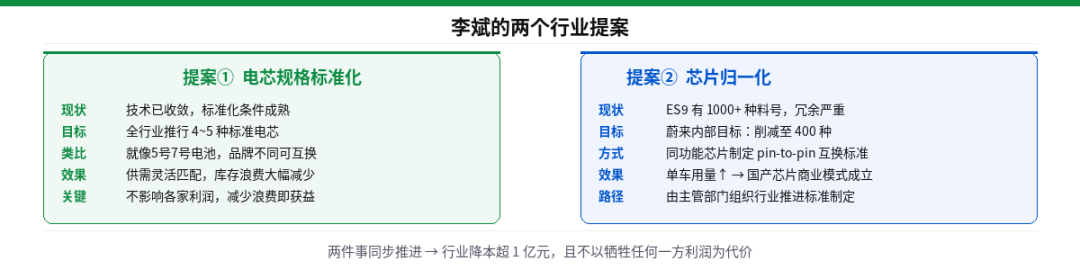
Based on these root causes, Li Bin proposed two specific industry initiatives at the forum.
Proposal 1: Promote standardized battery cell specifications. The industry should adopt 4-5 standard cell types with interchangeable specifications. Li Bin emphasized timing: the German Industrial Association's attempt to promote the VDA standard failed a decade ago because battery technology was not yet mature. Today, the optimal physical structures of mainstream chemistries have stabilized, making standardization feasible without stifling innovation.
Proposal 2: Promote unified chip specifications. Regulatory authorities should organize automakers to develop pin-to-pin interchangeability standards for chips with identical functions, with multiple suppliers offering interchangeable solutions for each category.
The relationship between chip unification and localization rates: higher vehicle-level chip usage makes basic chips (costing a few cents each) commercially viable, enabling true localization. Unification is a prerequisite for import substitution, not an option.
ES9: A pioneer in chip unification
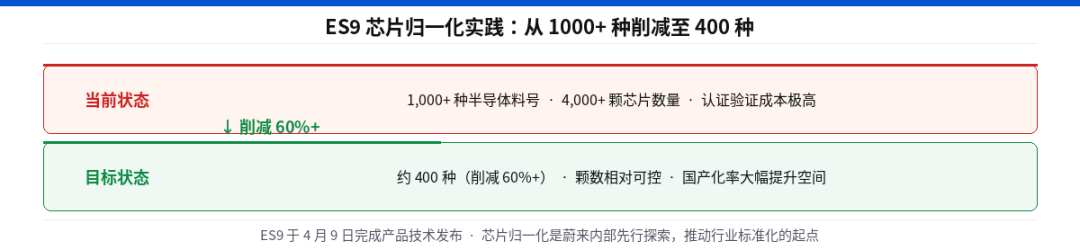
The ES9 was technically unveiled on April 9. Li Bin disclosed that NIO is already implementing chip unification internally, aiming to reduce over 1,000 part numbers to 400.
While the number of chips cannot be reduced (as higher electrification and intelligence require more chips), the variety can be significantly cut. There is no reason for 10 different part numbers for chips with the same function in a single vehicle. NIO's efforts represent an enterprise-level exploration ahead of industry-wide standardization.
Quantifiable value: Over RMB 100 million in cost savings without profit redistribution
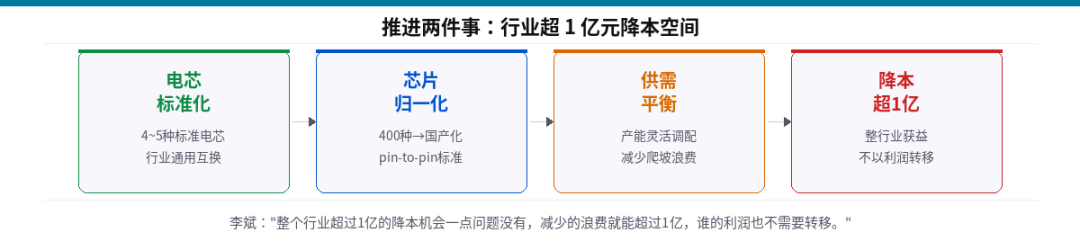
Li Bin provided a specific estimate: implementing these two initiatives will unlock over RMB 100 million in industry-wide cost savings. Savings of a few thousand yuan per vehicle add up to over RMB 100 million at scale.
More importantly, this is not a zero-sum game where "battery companies transfer profits to automakers" or "chip companies transfer profits to car companies." It is about reducing waste—inventory build-up, idle capacity, and production inefficiencies caused by supply-demand mismatches. The savings represent pure efficiency gains, benefiting the entire supply chain.
"Over RMB 100 million in industry-wide cost savings is certain. Reducing waste alone will exceed RMB 100 million—a few thousand yuan per vehicle, with no profit redistribution required."
— Li Bin, Founder, Chairman & CEO, NIO, at the 2026 CPC Annual Meeting Forum
After reading this article, you now have:
① An industry diagnosis: The "New Vehicle Launch Effect Death Valley" is caused by two supply-demand mismatches, rooted in non-standardized battery cell specifications and excessive chip varieties.
② A timing judgment: Battery technology has matured, making standardization feasible—now is the optimal window for implementation.
③ Two specific proposals: 4-5 interchangeable standard battery cell types + pin-to-pin chip interchangeability standards, with NIO's ES9 already leading internal implementation.
④ A quantifiable conclusion: Over RMB 100 million in industry-wide cost savings, achieved purely through waste reduction, without any profit redistribution.
"Over RMB 100 million in industry-wide cost savings is certain. Reducing waste alone will exceed RMB 100 million—a few thousand yuan per vehicle, with no profit redistribution required."— Li Bin, Founder, Chairman & CEO, NIO, at the 2026 CPC Annual Meeting Forum
This article is based on a speech by NIO's Li Bin at the 2026 China Electric Vehicle Centennial Committee Forum. It has been organized using insights and AI skills to objectively present core information and industry trends, providing information and inspiration without representing Vehicle's stance.
*Reproduction or excerpting without permission is strictly prohibited.
-
![]()
Jitian Xingzhou: A Pioneer in Optical Payloads Secures Hundreds of Millions in Series B Funding!
-
![]()
Orders Secured Through to the Second Half of the Year! The Rationale Behind the 'Surge' in Demand for This Company’s Optical-Grade Base Films
-
![]()
Beyond Patents: The Retail Rivalry of Insta360 and DJI Unfolds
-
![]()
180 Billion Market Cap Vanished! How Did Seres Fall So Far?
-
![]()
Blockbuster! Domestic storage takes the global double crown for the first time, from an AI company
-
![]()
China Spearheads Formulation! World's Pioneering Global Technical Regulation for Automated Driving Systems Greenlit and Unveiled
-
![]()
Farewell to Pulsed Support Policies: Three Major Auto Policy Directions from Multiple Departments Take Effect on the Same Day
-
![]()
Embercore AI’s Accelerated Funding: The Robot Industry’s Shift Toward ‘Learning Systems’