From a Staggering 4.4 Billion Yuan Loss Over Three Years to a Quarterly Profit of 8.93 Million Yuan: Has Yonyou Turned the Corner?
 04/23 2026
 465
465
By Yang Jianyong
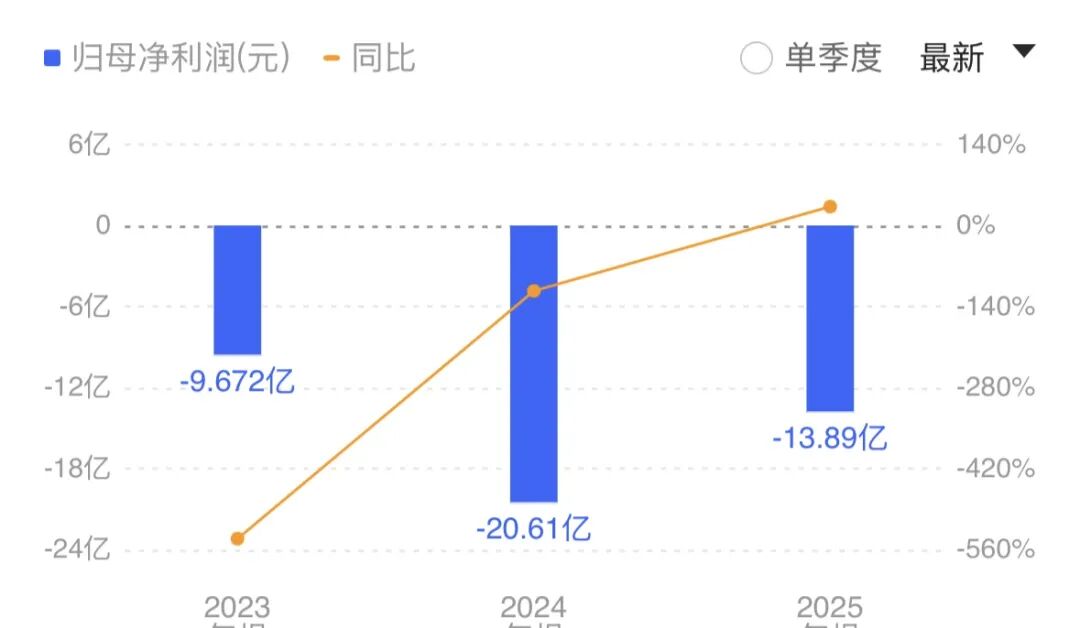
In 2025, Yonyou reported revenue of 9.181 billion yuan, showing a marginal increase of 0.32% year-on-year. The annual loss amounted to 1.389 billion yuan, a significant reduction from the 2.061 billion yuan loss in 2024, representing a 32.6% improvement. Notably, the fourth quarter marked a return to profitability, with earnings reaching 8.93 million yuan for that period.
Emergence of a Turning Point in Profitability
From stabilizing revenue to achieving quarterly profitability, there are signs that Yonyou has reached a turning point in its performance. Since 2023, Yonyou has faced its most significant operational challenges, incurring a loss of 967 million yuan that year—its first annual loss in over two decades since going public. This downward trend persisted, resulting in cumulative losses of 4.4 billion yuan over the past three years, plunging the company into unprecedented financial distress.
In 2023, Yonyou embarked on its largest-ever business organizational model upgrade. However, this transition significantly impacted performance, as factors such as workforce expansion and increased marketing efforts led to surging costs, undermining profitability.
In response to mounting losses, Yonyou began controlling its workforce size and optimizing staff structure to curb costs. By December 2025, the company employed 19,055 people, a decrease of 5,894 from the 24,949 employees in December 2023.
The optimization of staff structure and reduction in employee numbers have yielded positive results in cost control. Revenue turned positive in the second quarter of 2025, and annual revenue stabilized, shifting from negative growth in the previous year to a steady recovery. This operational improvement has laid a solid foundation for achieving comprehensive profitability in 2026. However, challenges persist, including industry competition and the impact of AI large models on the SaaS sector.
AI Cloud Transformation Battle: Kingdee Leads in Profitability, Yonyou Shows Signs of Recovery
In China's enterprise management software market, Yonyou and Kingdee are the two most prominent vendors, forming a competitive duopoly often referred to as "Yonyou in the North, Kingdee in the South." Competition between the two is intense, particularly as Kingdee solidifies its position in the SME market while accelerating its penetration into the large enterprise segment, exerting significant pressure on Yonyou and leading to stark contrasts in their performance.
In 2025, Kingdee reported revenue of 7 billion yuan, up 12% year-on-year, and a net profit of 93 million yuan, with adjusted net profit reaching approximately 232 million yuan. This marked an end to five consecutive years of losses, achieving a successful turnaround.
Notably, both Kingdee and Yonyou have been transitioning towards AI+cloud services, enduring years of losses in the process. Consequently, which company would achieve profitability first has drawn significant attention. Kingdee emerged as the first vendor to achieve annual profitability. Critically, Kingdee's revenue is on an upward trajectory, while Yonyou's growth remains sluggish, creating a stark "fire and ice" contrast in their performance.
Kingdee's robust revenue growth and overall profitability stem from its subscription-first and AI-first strategy, which has driven sustained growth in cloud subscription services and unlocked economies of scale. Simultaneously, its AI strategy has enhanced competitiveness in the large enterprise market, with product lines like Cosmic and Star vastly accelerating penetration into this segment, gradually realizing business scale effects.
Seizing market opportunities presented by large models, Yonyou has followed suit by launching its enterprise service large model, YonGPT, and actively integrating with models such as DeepSeek, Doubao, and Tongyi Qianwen to advance its AI+cloud transformation strategy. Its AI business has continued to make breakthroughs, with contracted amounts (contract values) reaching 1.67 billion yuan in 2025.
Overall, through measures such as optimizing workforce structure, streamlining employee numbers, effectively controlling costs, and actively pursuing AI+cloud transformation, Yonyou has achieved quarterly profitability and is gradually emerging from its transformation pains. The company is poised to embrace the dawn of comprehensive profitability, with expectations of initiating a virtuous cycle of performance recovery and value reshaping in 2026.
In Conclusion
Since the advent of ChatGPT, global artificial intelligence development has reached new heights, with various large model services injecting vitality into innovation across industries. As large model technologies continue to iterate and breakthrough, AI applications are transitioning from question-answering modes to AI Agent-based intelligence, fundamentally reshaping the logic and efficiency of enterprise management from the ground up.
With the increasing maturity of agent development systems, AI+SaaS is evolving towards greater efficiency, intelligence, and personalization, potentially expanding the value proposition of enterprise software. Frost & Sullivan projects that China's AI SaaS market size will surpass 150 billion yuan by 2027.
AI stands as one of the core factors driving growth and profitability improvement for SaaS service providers. Factors such as enterprises' demand for cost reduction and efficiency enhancement, the maturity of cloud computing infrastructure, and breakthroughs in large model technologies will drive rapid development of AI SaaS, presenting SaaS vendors with new growth opportunities.
Yang Jianyong, a Forbes China contributor, expresses views that are solely his own. He is dedicated to in-depth analysis of cutting-edge technologies, including AI large models, artificial intelligence, the Internet of Things, cloud computing, and smart home appliances.
-
![]()
AI Giants Start Borrowing to Fuel Computing Power Race
-
ByteDance Initiates Largest B2B Structural Adjustment, This Time It's Truly Different
-
![]()
Let's Talk About Kingsoft Office's Mid-Year Outlook and the True Strength of Its AI-Powered Office Solutions
-
Despite 150 Million Users, Struggles Persist: AIShige Faces Tough Competition from Seedance and Kling in AI Video Monetization
-
![]()
Ensuring Safe Gear Shifting in the Automotive Industry: Transitioning from 'Product Oversight' to 'Full-Chain Governance'
-
![]()
Net Profit Soars to $133.7 Billion! Azure Revenue Tops $100 Billion, with AI Fueling Microsoft's Growth
-
![]()
Before 6G Hits the Market, the U.S. Forges a 'Rules Alliance': What Challenges Await Chinese IoT Enterprises?
-
![]()
Intelligent Driving's 'Little Blue Light' Faces Ban: Night Glare and Cut-in Risks Prompt Official Action