ByteDance: A "Fake Fall" in Profits
 04/23 2026
 687
687

Author|Tang Fei
Recently, multiple media outlets, citing sources familiar with the matter, disclosed ByteDance's financial performance in 2025—overseas revenue surged nearly 50%, but net profit fell more than 70% year-on-year.
The news sparked market uproar.
On April 20, Li Liang, Vice President of Douyin Group, publicly clarified and provided a key explanation: the 70% decline was the result of calculations under International Financial Reporting Standards (IFRS), which included non-cash factors such as changes in preferred stock and option costs, and "did not reflect operational substance." Excluding these accounting factors, "the company's overall revenue and profit still grew."
On one hand, overseas business is surging; on the other, book profits have plummeted. What lies behind these seemingly contradictory figures? How profitable is ByteDance truly? We use a three-tiered logic to interpret this "split" performance.

First, TikTok Shop delivered stunning results in 2025.
According to reports, ByteDance's overseas revenue grew nearly 50% in 2025, far exceeding the domestic growth rate of about 20%. Overseas revenue's share of total revenue rose from 25% in 2024 to over 30%, a record high. TikTok Shop's GMV grew nearly 70% year-on-year in 2025, with 400 million active consumers, becoming the primary driver of ByteDance's increased overseas revenue share.
By market, research and analysis firm eMarketer data shows that after entering the U.S. in September 2023, TikTok Shop's sales there grew 400% in 2024 and 108% in 2025. According to TikTok Shop, during the four-day "Black Friday-Cyber Monday" period from November 28 to December 1, 2025, GMV in the U.S. market exceeded $500 million, with nearly 50% more U.S. consumers purchasing goods via TikTok Shop.
In Southeast Asia, Momentum Works data shows TikTok Shop became the industry's second-largest player, just behind Shopee, in just four years, closing in on Shopee with growth significantly above industry levels. According to TikTok Shop, its cross-border e-commerce GMV during Southeast Asia's "Double 12" in 2025 grew 2.7 times year-on-year.
In Europe, TikTok Shop has launched in the UK, Ireland, Germany, Spain, France, Italy, and other countries, with growth exceeding 100% in 2025. Recently, TikTok Shop plans to enter Poland, the Netherlands, and Belgium, accelerating its European expansion.
Latin America and Japan were new markets for TikTok Shop in 2025. Momentum Works data shows that in Brazil, TikTok Shop's GMV grew 25-fold in its first three months. Nikkei Asia, citing sources, reported that Japan's market saw GMV grow 20-fold within four months of launch.

Second, TikTok-related advertising revenue remains its cornerstone. In 2025, TikTok's global ad revenue reached approximately $33.1 billion, up 40.5% year-on-year.
Notably, in 2025, TikTok faced multiple rounds of U.S. ban extension debates but ultimately preserved this critical market in early 2026 by establishing a data security joint venture. The temporary resolution of policy risks boosted brand and advertiser confidence, creating conditions for stable overseas expansion.
Business tech media Business Insider recently expressed optimism about TikTok's future, noting that it seems to have overcome U.S. ban challenges, potentially easing concerns for major brands that had hesitated to join. More importantly, U.S. consumers have begun shopping regularly on TikTok Shop, fostering platform loyalty.
The strong performance of these two main business segments further drove up ByteDance's valuation.
On April 15, 2026, ByteDance issued an internal email launching a new round of option repurchases. The repurchase price was $229.5 per share for current employees and $201.96 per share for former employees.
Historical data shows ByteDance's 2021 repurchase price for current employees was $126 per share. At the latest price of $229.5 per share, the company's internal valuation has surged 82% over four years.

The 70% figure sounds alarming, but as Li Liang explained, much of it is "paper loss."
First, ByteDance is not yet publicly listed, but during financing, investors' preferred shares are classified as financial liabilities under IFRS. When the company's valuation rises, the fair value appreciation of preferred shares must be recorded as an expense—no cash outflow occurs, but it reduces book net profit.
The same logic applies to employee options. In 2025, ByteDance granted large-scale options (especially special project options for the Seed team), with option costs recorded as expenses as the company's valuation rose. These "non-cash, non-operational" accounting expenses, counted under IFRS, significantly "artificially reduced" net profit.

Second, heavy investment in AI strategy has "consumed" part of ByteDance's profits.
Over the past year, ByteDance has made continuous strides in AI, with Doubao Assistant achieving multimodal generation, AI programming, and intelligent agent interaction upgrades. Volcano Engine's MaaS business became the fastest-growing segment, with large model training efficiency and inference performance ranking among the industry's best. These require significant human and financial resources.
Finally, ByteDance's domestic business growth has indeed encountered bottlenecks.
According to media reports, Douyin e-commerce's GMV growth rates were 80% in 2023 and 35% in 2024, but only about 25% in 2025, with expectations dropping to 20% in 2026.
Despite the slowdown, it should be noted that this growth is based on a GMV of approximately 4.3 trillion (as of late 2024), so the overall scale remains enormous.
Li Liang acknowledged in his response: "Douyin e-commerce's growth slowdown and increased investments in emerging businesses led to a slight decline in operating profit margins in the second half of the year."
These three factors combined created ByteDance's "paper loss."

This "gain and loss" raises a deeper question: Why is ByteDance heavily investing in AI?
First, ByteDance's development focus in recent years has been clear: "AI + Overseas."
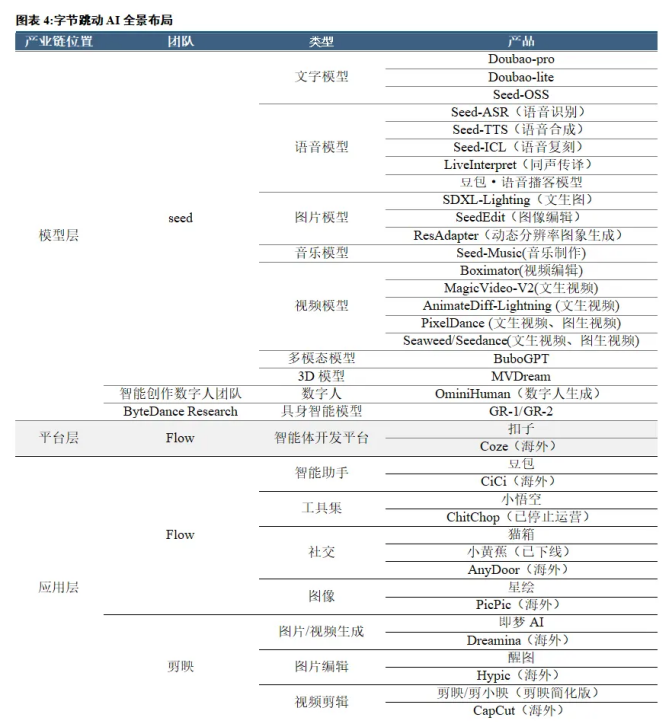
Source: CITIC Construction Investment
As widely known, AI is the future trend and a significant industrial opportunity. According to CITIC Construction Investment data, ByteDance's AI layout (AI layout) now spans three levels: model, platform, and application layers. Its product types cover not only common categories like text, language, images, and intelligent assistants but also niche areas like digital humans, embodied AI, and 3D models.
This means ByteDance is transforming from a "traffic company" to a "global AI infrastructure company."
Its core AI product, Doubao, has become a leader in domestic AI products. According to QuestMobile data, as of March 2026, Doubao's monthly active users (MAU) reached 345 million, ranking first among domestic AI-native applications. Additionally, Doubao's large model daily token calls exceeded 120 trillion, doubling in three months and growing a thousandfold since its debut, ranking first in China and third globally.
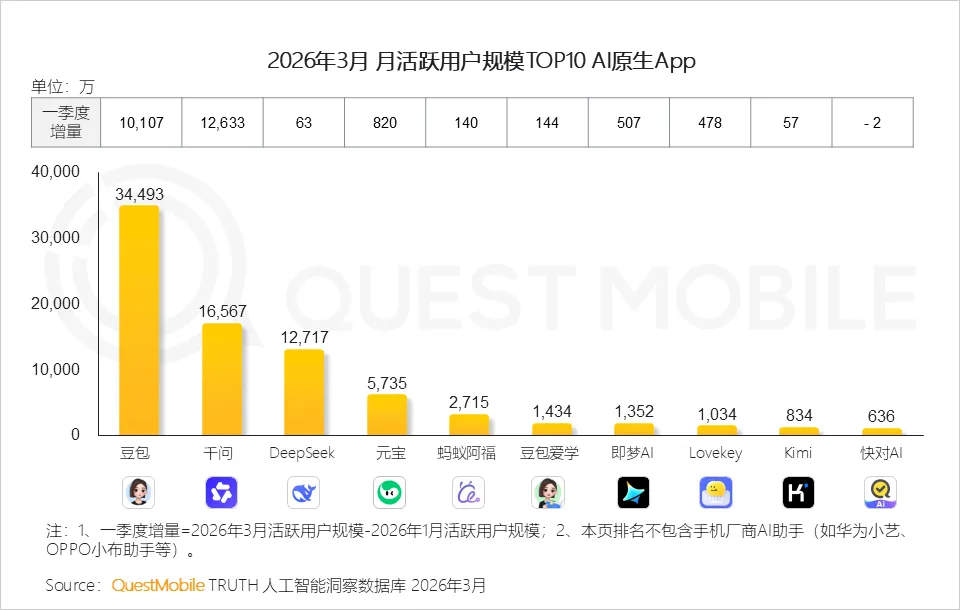
Source: QuestMobile
Meanwhile, ByteDance is driving AI from "scenario popularization" to "commercial value realization." In early March 2026, Doubao began internal testing of a "shopping and ordering" feature, allowing users to browse products and complete payments directly within the Doubao App without redirecting to Douyin or other e-commerce platforms, achieving a closed-loop "chat-and-order" experience.
Second, AI achievements are expected to help ByteDance achieve larger-scale overseas growth.
Besides the well-known TikTok, ByteDance's overseas products include the news platform TopBuzz, video creation platform Vigo Video, video editing software CapCut, music streaming app Resso, educational app Gauth, AI chat-focused Dola, short drama platform PineDrama, and the planned game go overseas (overseas) platform GameTop.
If ByteDance's AI capabilities can be validated and commercialized domestically, it could leverage its global product matrix to achieve "AI +" across various fields, enabling large-scale cost reductions, efficiency gains, and profit creation.
MiniMax's prospectus shows its consumer-facing business has a gross margin of only 4.7%, mainly due to nearly zero commercialization of Xingye in China. Excluding Xingye, the consumer business gross margin nears 50%, on par with its B2B segment. This suggests ByteDance, with its massive global user base, could capture more consumer-side revenue through its existing product matrix and diverse AI features.
In summary, ByteDance is fighting two battles simultaneously: an AI technology race and an overseas survival race, and it cannot afford to lose either.
This is no easy choice. As a person close to ByteDance said, "If you only look at this year's and next year's profit statements, you'd think ByteDance has gone crazy. But if you look at the competitive landscape five years from now, you'd think not doing this would be crazy."
Over the past decade, ByteDance has been known for "ultimate efficiency"—algorithm-driven recommendations, A/B testing, rapid iteration, all serving growth. But now, the company is undergoing a profound strategic transformation, shifting from pursuing short-term profits to betting on long-term technological barriers.
This profit turmoil reflects that the internet industry has entered a critical phase of transitioning from old to new growth drivers. AI is no longer an optional track but a "ticket to the future" that determines survival—missing out could mean elimination. Giants like Alibaba, Tencent, and Baidu are also ramping up AI investments, essentially trading short-term inputs for future market entry.
This high-stakes gamble of "trading the present for the future" has no clear short-term answer.
-
![]()
Wang Huiwen, Former Meituan Executive, Achieves 20-Fold ROI, Supports 24 AI Startups
-
![]()
Another AI Computing Power Unicorn Launches IPO! Founded by a Changjiang Scholar
-
![]()
OFILM Holdings Secures Zhongke Daojing, Marking a Significant Leap in the Optical Communication Industry!
-
What Will Be the Next Key Battleground for Large Models After AI Coding?
-
![]()
Leapmotor's Sales Soar, Yet Hidden Concerns Loom
-
![]()
China’s Action Camera Market Soars: 3.12 Million Units Sold in Six Months, DJI Secures 74% Dominance
-
![]()
Zhang Yiming: Strategic Retreat as a Path Forward
-
![]()
Exploring Charging for Some Features of QianWen App: Can It Follow the Path of Doubao?