Norway's Auto Market Insight: Fuel Vehicles Nearly Exit, Chinese Brands Enter Mainstream Arena
 05/06 2026
 478
478
While most global markets are still weighing the choice between fuel and electric vehicles or hesitating over charging infrastructure and battery costs, Norway has provided the clearest answer with its performance. The latest data from the Norwegian Road Traffic Information Council (OFV) shows that in March 2026, new passenger vehicle registrations in Norway grew by 32.9% year-on-year, with EVs accounting for 98.4%—a new monthly record, surpassing the previous high of 98.3% set in September 2025. Only 22 gasoline-powered vehicles and 126 diesel vehicles were registered in March, a rarity even in Norway, a leader in electrification.
However, behind Norway's nearly 'all-electric' new vehicle market, significant structural shifts are underway: traditional European brands' market positions are rapidly eroding, while Chinese brands are entering the mainstream competitive landscape at an unprecedented pace. This is not just a Norwegian story but a preview of Europe's broader electrification transition.
▍EV Market Share Hits 98.4% in March, Fuel Vehicles Nearly Exit
Norway's electrification journey has shifted from 'acceleration' to 'finalization.' In the first quarter of 2026, 27,175 new passenger vehicles were registered in Norway, with EVs comprising 97.9%. This means only 558 non-electric passenger vehicles were registered in the first three months of the year, compared to 2,606 during the same period last year.
Notably, the electrification wave extends beyond new vehicles. In March, EVs accounted for 32.2% of used car transactions, up from 24.4% last year, while their share in the used van market doubled from 4% to 8%. The commercial vehicle sector is also accelerating: electric trucks represented 51.6% of new registrations in March, and electric lorries increased from 19% to 22.2% year-on-year. Norway is transitioning from 'all-new-vehicle electrification' to 'full-fleet electrification,' expanding EV consumption and enhancing market maturity.
▍European Brands Decline, Tesla and Chinese Brands Rise
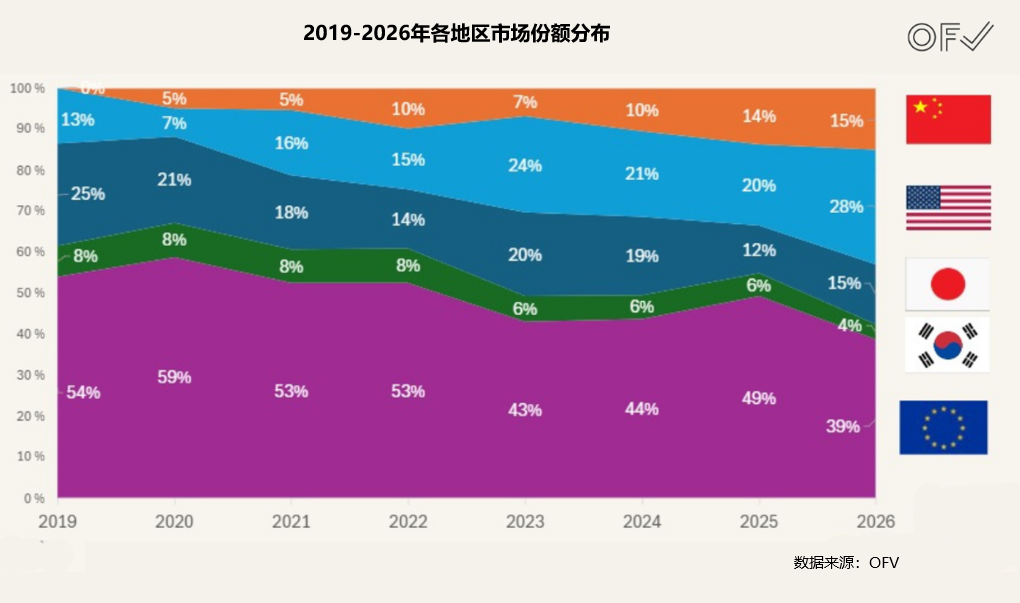
Quarterly OFV data reveals a sustained decline in European brands' market share in Norway: from 54% in 2019 to 38.7% in Q1 2026, including a drop from 49.6% in Q1 2025 to 38.7% in Q1 2026. Traditional European brands have seen significant declines in registration volumes and market share, leaving European automakers at a disadvantage.
The market share lost by European brands is being filled by Tesla and Chinese brands. In March, Tesla led the brand rankings with a 34.8% share, with the Model Y alone selling 4,288 units, accounting for nearly a quarter of the market.
Chinese brands' performance is also noteworthy. Their market share surged from nearly zero in 2019 to 14.9% in Q1 2026. In 2025, Chinese brands sold 24,524 new vehicles in Norway, representing 13.7% of the market—a 3.3-percentage-point increase from 2024. Their monthly share peaked at 17% in December. Geir Ingve Stokke, OFV director, noted that Chinese automakers are rapidly becoming integral to Norway's market by launching competitive EV models in key segments.
Meanwhile, Chinese brands' market share surpassed Japan's (14.7%) and South Korea's (3.7%), making them the third-largest automotive group in Norway after European (39%) and U.S. (28%) brands, firmly entering the mainstream competitive landscape.
▍March Spotlight: BYD, XPeng, Zeekr Lead Chinese Contingent
Focusing on Chinese automakers' performance, they sold approximately 1,920 vehicles in Norway's new car market in March, accounting for 10.8% of the total. However, their growth rate far exceeded the market average:
- BYD led Chinese brands with 782 units, up 139% year-on-year, capturing a 4.4% market share. Its Sealion 7 model delivered 476 units, ranking among Norway's top 10 best-selling models.
- XPeng sold 460 units, a 62.5% year-on-year increase, entering Norway's top 10 brand rankings.
- Zeekr sold 308 units, surging nearly 389% year-on-year, demonstrating strong market momentum.
- MG, one of the earliest Chinese brands in Norway, sold 210 units in March but saw a 50.2% year-on-year decline. With new brands entering the market, MG faces pressure to reallocate its market share.
Chinese brands sold 3,229 vehicles in Q1 2026, accounting for 11.8% of the market. From BYD's doubling growth to XPeng and Zeekr's rapid expansion, Chinese brands have established a diversified product matrix spanning entry-level to premium segments, accelerating their market penetration in Norway.
Norway's rapid electrification stems from the absence of domestic automakers to protect, no tariff barriers for EVs, and Europe's densest charging infrastructure. Industry insiders call Norway the 'European EV Laboratory,' where any brand's success or failure foreshadows outcomes in other European markets.
Chinese automakers in Norway now compete on par with international brands but must remain vigilant against Tesla's dominance and potential policy countermeasures from European brands. Additionally, they should swiftly develop used-car and after-sales service systems. With new-vehicle electrification nearing completion in Norway, EVs' share in the used-car market is rising rapidly. Maintaining healthy residual values and establishing localized maintenance and recycling networks will determine whether brands can build a sustainable user base in Norway and use it as a springboard to enter Nordic and broader European markets.
Layout 丨 Zheng Li
Source 丨 OFV
Image Source 丨 Qianku.com
-
![]()
Is Zhipu's Trillion-Yuan Market Cap, Despite No Profit, Truly 'Outrageous'?
-
![]()
XiaoPai Unveils Home AI Brain, Paving the Way for Smart Homes to First Grasp 'Home Understanding'
-
![]()
Is the Future of Extended-Range EVs Pure Electric or Li Auto’s 5C Extended-Range? A Li Auto Executive Shares Insights
-
Ant Group’s New Board of Directors: Signaling a New Era?
-
![]()
Google Initiates TPU Sales, as Industry Leaders Eye AI Chips for 'Cost-Effective Tokens'
-
![]()
Input Methods: The Rising Star in AI! WeChat, Doubao, and Qianwen Lead the Charge into the Voice Input Era
-
![]()
Struggling to Sell? Cut It Out! Toyota, Volkswagen, and Changan Lead the Charge in Streamlining, Eliminating Non-Core Products in the Blockbuster Model Era
-
![]()
Arm China and Volcano Engine Join Forces to Expedite Cloud Computing and AI Infrastructure Rollout