Sales Dip, New Energy Soars: Unveiling the 'Facade' and 'Core' of China's April Auto Market
 05/08 2026
 480
480
In April 2026, China's auto market presented a paradoxical performance.
Data from the China Passenger Car Association (CPCA) revealed that retail sales of passenger cars in April were estimated at approximately 1.42 million units, marking a 20-25% year-on-year decrease and a 13.8% month-on-month drop. From April 1-26, retail sales amounted to just 1.004 million units, a 24% year-on-year decline. Cumulative sales from January to April reached 5.226 million units, down 19% year-on-year. Focusing solely on this negative retail growth might suggest that the industry is on the brink of a downturn.
However, another set of figures paints a starkly different picture. In the same month, nationwide wholesale shipments of new energy passenger cars by manufacturers soared to 1.22 million units, achieving a 7% increase both year-on-year and month-on-month, showcasing dual growth. The historic transition from fuel-powered to electric vehicles (EVs) is unfolding faster than anticipated by most industry players. In a saturated market, the encroachment of new energy vehicles (NEVs) on the overall market has become an irreversible trend.
▍Domestic Market 'Pie' Shrinks, but Allocation Shifts
While the sustained growth in NEV penetration signifies a structural shift, April's sales results from individual automakers confirm a broader trend: the 'new energy transition' and 'scale expansion' are bridging the gap between the overall market chill and individual brand heat.
Firstly, consider the traditional leading domestic automakers. SAIC Motor claimed the April sales crown among Chinese automakers with 328,000 units, up 8.5% year-on-year, maintaining its top position for four consecutive months, with its self-owned brands contributing nearly 70% of sales. BYD sold 321,000 units in April, up 6.9% month-on-month, though year-on-year growth slowed due to a high base effect from the previous year, with cumulative sales from January to April reaching 1.0216 million units.
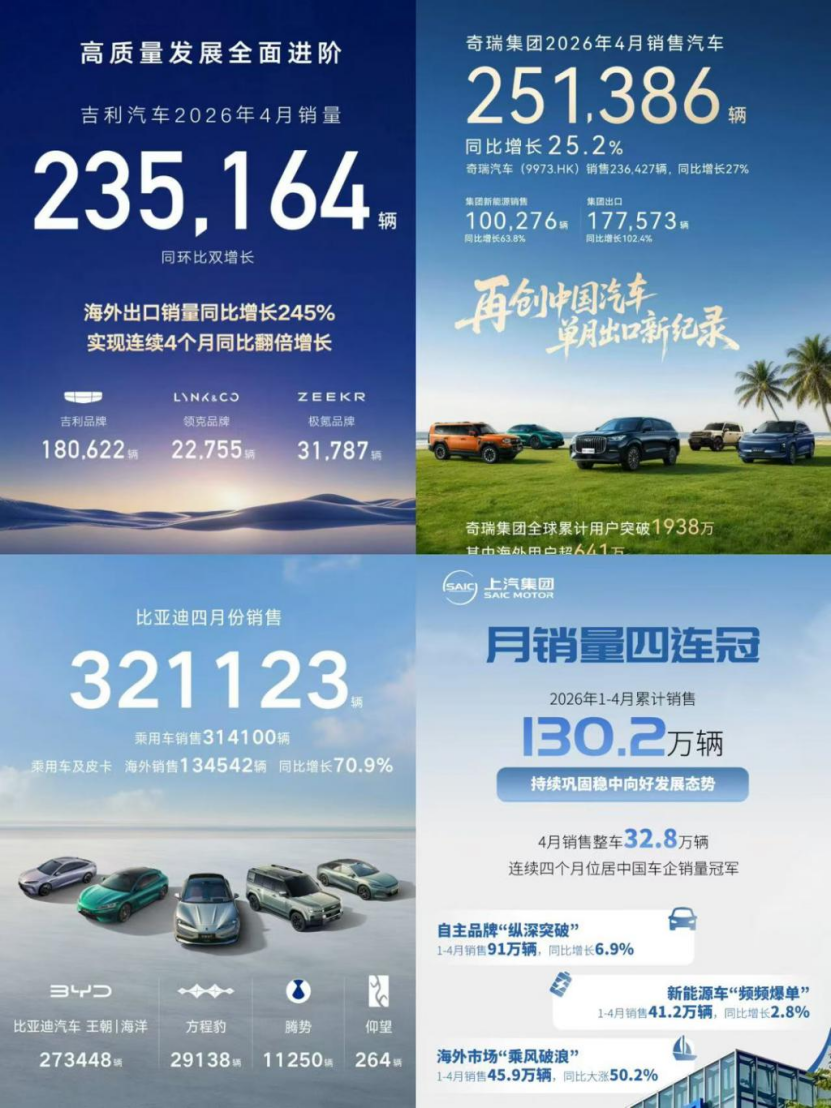
Chery Group held steady at third place with 251,000 units, up 25.2% year-on-year, the fastest growth among leading automakers. Geely Auto and Changan Auto followed with 235,000 and 209,000 units, ranking fourth and fifth, respectively. Great Wall Motor sold 106,000 units, up 6.25% year-on-year, gradually emerging from an adjustment phase. The combined market share of the top five domestic automakers exceeded 65%, solidifying the dominance of traditional domestic brands.
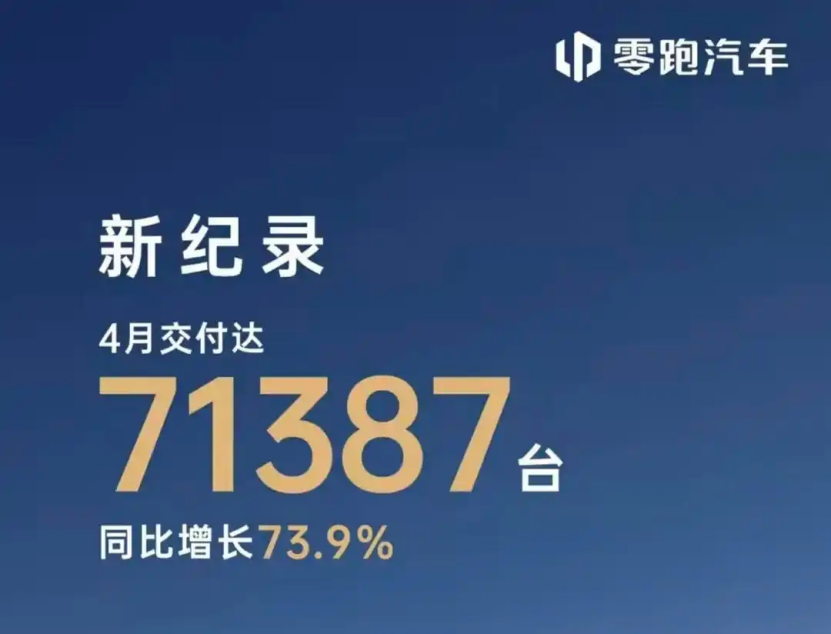
The changes among new entrants were even more striking. Leapmotor shone brightly, delivering 71,387 units across its lineup in April, up 73.9% year-on-year, setting a brand record for monthly deliveries and becoming the only new entrant to surpass 70,000 units in a single month.
Leapmotor's success stems not from a single blockbuster model but from its cost-control capabilities driven by in-house R&D and a dual-track product strategy that combines extended-range and pure electric vehicles. Amid industry-wide price wars, Leapmotor still offers 'high-spec at affordable prices' in the mid-range segment, catering to consumer sensitivities. More notably, Leapmotor leveraged Stellantis' overseas channels to rapidly expand exports, with overseas shipments exceeding 40,000 units in Q1, creating a dual-cycle growth pattern by absorbing domestic production capacity for export.
Li Auto delivered 34,085 units, with cumulative deliveries exceeding 1.66 million, maintaining its position in the first tier. HiPhi delivered 32,759 units, up 18.9% year-on-year, with cumulative growth from January to April reaching 36%, as Huawei's smart driving differentiation continues to pay dividends. Zeekr delivered 31,787 units, up 132% year-on-year, leading mainstream new entrants in growth. XiaoMI Auto delivered over 30,000 units, up 50% month-on-month, breaking into the first tier with just one model (SU7), fully validating its ability to convert online traffic and ecosystem users into real orders.
For every winner, there's a loser. XPeng delivered 31,011 units in April, the only top-tier new entrant to see a year-on-year decline. Last April's concentrated deliveries of the XPeng G6 created a high base, while this year's flagship SUV, the XPeng GX, is still in its pre-launch phase, leaving a product gap. Meanwhile, Huawei has significantly diluted XPeng's smart driving edge. Still, XPeng's April deliveries marked its best monthly performance in 2026, and its ability to rebound with new models warrants attention.
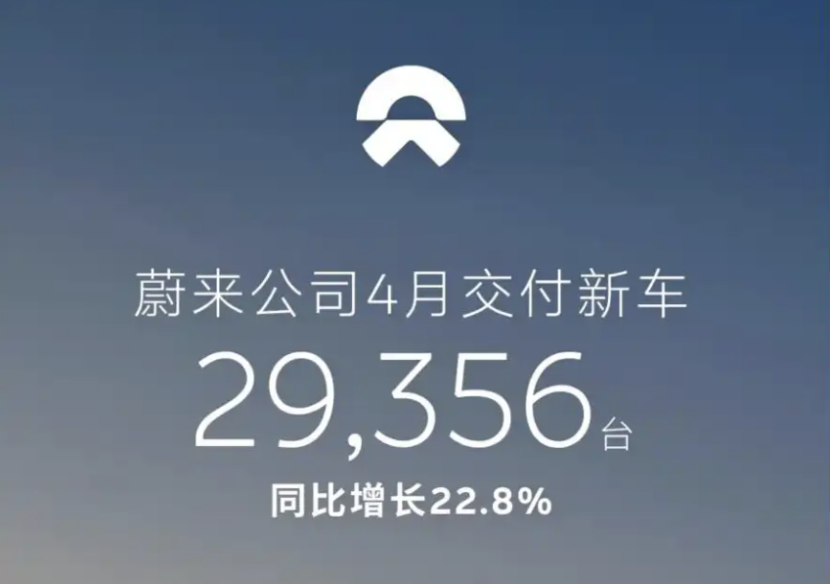
NIO delivered 29,356 units in April, up 22.8% year-on-year, maintaining overall stability. NIO's three-brand strategy with Leapmotor and Firefly is expanding its user base, with cumulative deliveries from January to April exceeding 112,000 units, up 71% year-on-year, retaining a clear advantage in the premium pure electric market above 300,000 yuan.
In April, 10 new entrant automakers each surpassed 20,000 monthly deliveries, with the overall delivery threshold rising, but the sales gap between brands widening. Brands lacking scale will face harsher survival pressures.
However, behind these impressive penetration rates, concerns loom. On one hand, channel pressures are mounting, with some dealerships experiencing 'wholesale-retail inversion'—manufacturers pushing inventory to dealers faster than retail demand can absorb it, leaving many new vehicles stuck in dealership lots, with selling at a loss becoming common. On the other hand, the 'price war' itself is backfiring: nearly 70 models have entered promotional channels this year, but the more frequent price cuts strengthen consumer wait-and-see sentiment, lengthening sales cycles and trapping the market in a 'the more prices drop, the more consumers wait' negative cycle.
▍Overseas Exports: From 'Icing on the Cake' to 'Second Front'
Shifting focus overseas, April's picture brightens considerably. Multiple automakers set new export records, with the export growth curve transforming from mere 'icing on the cake' to a 'second front' offsetting domestic pressures.
Chery Group leads the export race unchallenged. In April, Chery exported 177,573 units, up 102.4% year-on-year, setting a new record for monthly exports by a Chinese brand. This means 70.7% of Chery's April sales went overseas—for every 10 vehicles sold, over 7 were exported. Cumulative exports from January to April reached 570,884 units, up 66.3% year-on-year, solidifying Chery's position as China's top auto exporter. Chery has now exported over 100,000 units monthly for 12 consecutive months, with overseas operations providing stable profits amid intense domestic competition.
BYD's global expansion is also accelerating. April overseas sales hit 134,542 units, up 70.9% year-on-year, a new monthly record, with exports accounting for over 42% of total sales for the first time. Cumulative overseas sales in the first four months exceeded 450,000 units, with overseas markets evolving from a growth driver to a core profit pillar. As domestic price wars squeeze per-unit profits, overseas markets are becoming a vital profit source for BYD.
Geely Auto exported 83,186 units in April, up 245% year-on-year, doubling year-on-year for four consecutive months, the fastest growth among leading automakers. Zeekr entered the French market with four models, while Lynk & Co accelerated its European rollout via Volvo's channels, capitalizing on Geely's overseas resources from past cross-border acquisitions.
Changan Auto delivered 72,700 units overseas in April, up 69.9% year-on-year, with its globalization strategy yielding significant results. Great Wall Motor's overseas sales grew 56.93%, accounting for nearly 47.5% of its total monthly sales. Combined, the top five domestic automakers exported nearly 500,000 units in April alone.
The collective overseas breakthrough by domestic brands is no accident but the result of multiple structural factors. Firstly, systemic improvements in NEV product competitiveness have shed the image of Chinese brands as mere 'low-cost alternatives' overseas. Secondly, soaring global oil prices—driven by Middle East tensions pushing up Brent crude—have sharply increased fuel costs for overseas consumers, boosting willingness to switch to NEVs and directly stimulating demand.
Thirdly, more automakers are shifting from simple vehicle exports to building full-process overseas factories, regional manufacturing, and localized delivery systems, transforming from 'Chinese companies abroad' to 'local companies with Chinese DNA'.
This transformation is no short-term tactical move. As Chery Vice President Wang Lang stated at the Intelligent Electric Vehicle Development Summit, China's auto exports are at a historic inflection point—this is not just linear growth in export numbers but a fundamental shift from trade expansion to structural rise.
Of course, the overseas road is not smooth. EU anti-subsidy investigations, localized competition in emerging markets, and geopolitical uncertainties all pose new barriers to Chinese automakers' globalization. But one thing is clear: as domestic NEV penetration continues to rise, incremental space is visibly shrinking—going overseas is no longer an option but a necessity.
China's auto market in April saw retail declines, intensifying price wars, and rising dealership inventory pressures, all reminding the industry that the era of high-speed growth is fading, replaced by a harsher market of fixed demand. For consumers, this is a good time—fierce competition brings more and better product choices, while technological advances make cars smarter, greener, and safer. However, consumers should also stay rational, focusing not just on price and specs but also on product quality, after-sales service, and brand reputation.
Layout | Yang Shuo
Image sources: Qianku.com, major automakers
-
![]()
Total Investment Hits Nearly 3.28 Billion! Goertek Launches Mass Production of 12-Inch Transparent Substrate Wafer for AR Glasses’ Micro-Nano Optical Components
-
![]()
Why Is This Precision Optical Film Leader Worth Reevaluating with a Tens of Millions Procurement?
-
![]()
AI Costs Plummet by 90% Over Nine Years: Key Insights from Davos You Shouldn’t Miss
-
Doubao, Your Late-Night AI Companion, Now Eyes Profitability
-
![]()
SRC Empowers SEER Intelligence to Reach a Market Cap of Tens of Billions, Yet Fails to Sustain Profitability
-
![]()
China’s Embodied AI Industry Faces Fierce Domestic Competition, Making Overseas Expansion Essential for Survival
-
![]()
32.8 Billion Yuan Investment! Goertek’s 12-Inch AR Glasses Optical Wafer Base in Lingang Begins Operations
-
![]()
How Far is the All-New Li Auto L8 from Being the Best Five-Seat SUV with In-House Full-Stack Development?