Toyota Stays Calm, BYD Springs into Action
 05/08 2026
 428
428
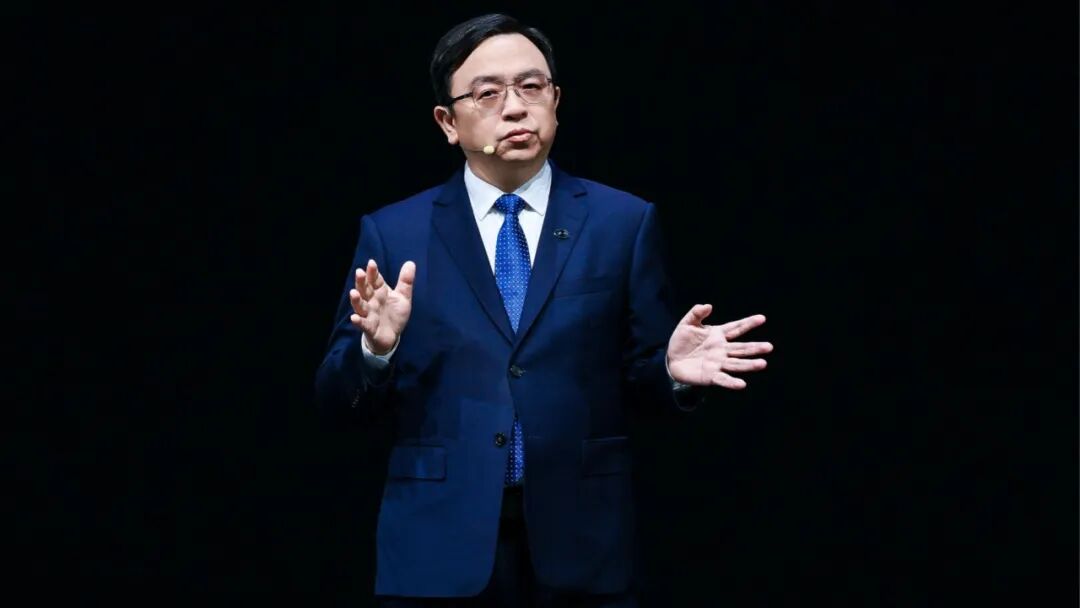
While BYD seizes the moment, Toyota patiently awaits the ebb of the tide.
Original content from Autopix (ID: autopix)
Toyota is seldom seen in such a precarious position.
Recent statistics reveal that in March 2026, Toyota's global sales stood at approximately 897,900 vehicles, marking a 7.3% year-on-year decrease and the second consecutive month of decline. Both the Japanese domestic and overseas markets are witnessing a downturn.
For an automaker that sells tens of millions of vehicles annually and has long dominated global sales, this is indeed an uncomfortable scenario.
Toyota has stumbled, but it remains unperturbed. The decline is attributed to delivery disruptions during the RAV4 model changeover, a sudden slowdown in the Middle Eastern market, and simultaneous pressures in the Chinese and U.S. markets.
Meanwhile, BYD continues to accelerate its global expansion.
In April 2026, despite facing domestic sales pressure, BYD achieved a new milestone in overseas markets. Monthly sales of passenger vehicles and pickup trucks overseas reached 134,500 units, a 70.9% year-on-year increase, with cumulative overseas sales in the first four months hitting 454,300 units.
This is no ordinary growth; it's a sprint amidst a fleeting opportunity. BYD knows the window is closing and must act swiftly, setting sail while the waves are still high.
Toyota, on the other hand, is in no rush; it believes the waves will eventually recede.
01
Joint Venture 2.0: Leveraging Intelligence as a Leverage
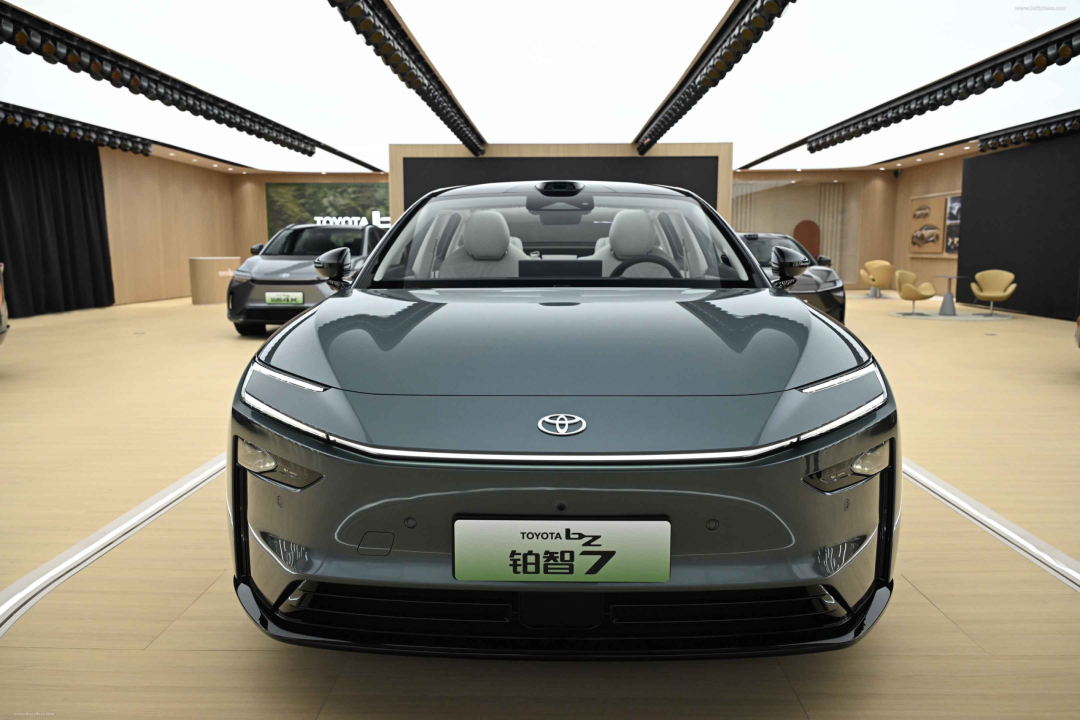
In early 2026, GAC Toyota introduced a new model, the bZ4X 7.
Priced starting at 147,800 yuan, this pure electric vehicle boasts a 600-kilometer range and a HarmonyOS cockpit.
While bearing the Toyota logo, the car's "brain" is powered by Huawei, with many components sourced from local Chinese suppliers. The product definition is led by a Chinese engineering team.
The bZ4X 7 is not an isolated case. GAC Toyota now develops all its new energy vehicle models under Chinese engineering leadership, collaborating with Huawei, Xiaomi, Tencent, and Momenta for ecological cooperation.
Volkswagen, Buick, Audi, and Nissan are following suit in this car manufacturing approach. In the Chinese automotive industry, this trend is known as Joint Venture 2.0, where foreign brands provide the brand and channels, while Chinese partners contribute technology, product definition, and the supply chain. China's local electrification and intelligent capabilities are being exported in reverse to joint venture brands.
From the bZ4X to Buick's Envision Max, Volkswagen's ID.ERA, Jinbiao, and AUDI, the大规模 (mass) rollout of Joint Venture 2.0 products is based on one realization: the initial moat of intelligence is not as deep as initially thought.
Breaking down intelligence, it encompasses two aspects. One is the configuration layer, including features like large screens, in-vehicle systems, voice control, and L2+ advanced driving assistance. The other is the system layer, involving backend competitions like data closed loops and intelligent iteration efficiency.
The paces of these two layers are diverging.
The configuration layer is rapidly becoming standardized. Over the past three years, the cost curve for L2+ advanced driving assistance has declined faster than anticipated. Huawei ADS has entered the 250,000 yuan price range, XPENG's urban NOA has been delegated to the 150,000 yuan level, and BYD's Divine Eye C has achieved highway NOA at the 100,000 yuan level.
Once a capability can be popularized in a 100,000 yuan car, it ceases to be a differentiated weapon for premium brands and becomes an entry ticket. L2+ is becoming ticket-like; without it, you fall behind; having it does not constitute a moat, and even premiums are shrinking.
Driving this standardization is the supplier ecosystem. Huawei, Momenta, Horizon Robotics, and others have packaged high-level intelligent driving into procurable solutions, enabling automakers to acquire and integrate them to obtain qualified capabilities. With money and willingness, any automaker can bring its intelligence up to par within 24 months.
The intense competition in the Chinese market is essentially a side effect of this standardization. With similar suppliers, chips, and solutions, product differentiation is naturally thinning out.
To say that intelligence has completely stopped evolving would be incorrect. Capabilities like large models, L4 autonomous driving, in-vehicle intelligence, and physical AI are still evolving. Players like Li Auto and XPENG that insist on full-stack self-research are still accumulating advantages, but that's another battle.
In the short term, the industry has entered a strange intermission where the gap in the configuration layer is rapidly narrowing, while the gap in the system layer remains invisible. Gaps in the system layer, which consumers cannot perceive, cannot be translated into purchasing decisions.
The main arena of competition is shifting. From an arms race in intelligent configurations back to more classic dimensions: cost, scale, channels, and supply chain depth.
And this happens to be the home turf of century-old giants like Toyota and Volkswagen.
02
BYD Seizes the Moment, Toyota Defends Its Territory
Understanding the signal behind Joint Venture 2.0 reveals the true reason for the frenetic overseas expansion of BYD, Geely, and Chery in recent years.
They are not just vying for markets but also time.
In a strategic drill within a leading independent brand, it was projected that around 2027, international giants like Toyota and Volkswagen would catch up with Chinese automakers in terms of product capabilities. Therefore, before then, Chinese automakers would enjoy a period of bonus from product generational gaps in the global market. At the same price point, Chinese brands would offer significantly better electrification and intelligent experiences.
As early as 2024, Wang Chuanfu was described by the media as entering a "global jet-setter mode," with a string of overseas trips to Vietnam, Munich, Brazil, Chile, and Japan. Now, it's clear that this was the company's top leadership personally seizing the window of opportunity.
For Chinese automakers, going overseas is a timeline, not a choice. If they haven't established brand recognition and channels in major overseas markets by 2027, once international giants launch competitive electric products, leveraging their decades-old brand trust, dealer relationships, and financial services, it will be exponentially more difficult for Chinese automakers to capture market share.
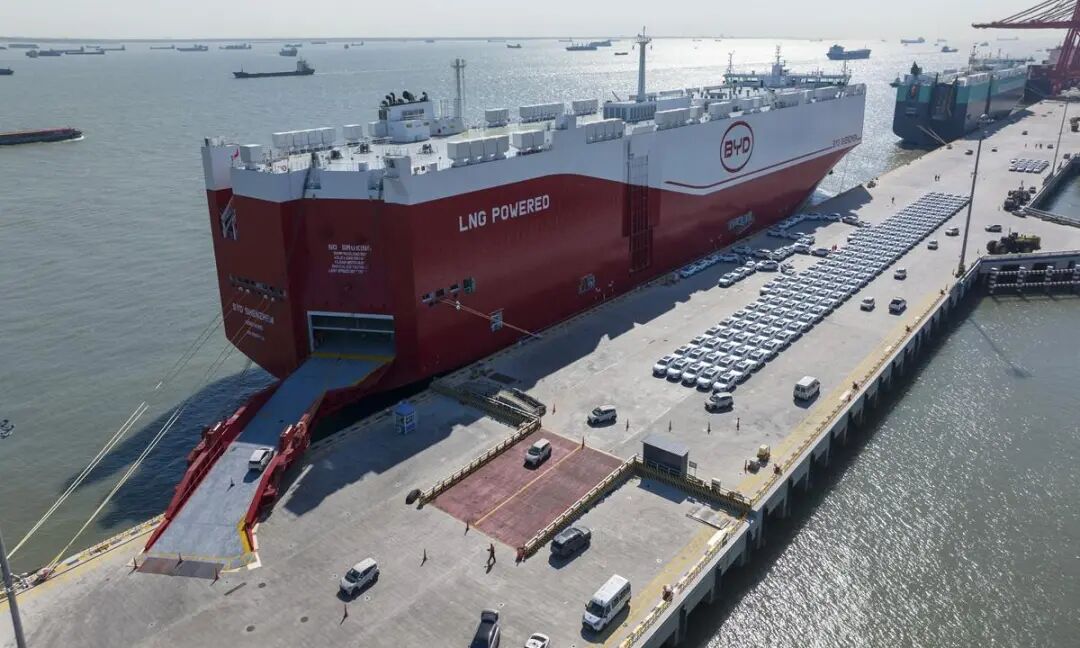 ▍BYD's "Shenzhen," capable of carrying 9,200 standard vehicles
In the same industry trend, Toyota's situation is completely different.
Over the past decade, Akio Toyoda has been labeled a "stubborn opponent of electric vehicles."
While the entire industry went all-in on electrification and Wall Street rewarded Tesla with market value, competitors like Volkswagen, Stellantis, Mercedes-Benz, Honda, and Ford were heavily investing in electrification and even setting timelines to stop developing fuel vehicles. Toyota, under pressure, promoted hybrids, retained hydrogen energy, delayed pure electric platforms, and its market value was long overshadowed by Tesla and BYD.
But Toyota could withstand it.
The first reason it could withstand it is performance. In fiscal year 2024, Toyota's net profit was approximately 4.94 trillion yen, a record high, and it remained high at 4.77 trillion yen in fiscal year 2025 despite a decline.
In 2025, Toyota sold 11.323 million vehicles, a new record. Its Chinese market share looked ugly, but globally, China has never been Toyota's most profitable market. North America is, and its sales there have been rising over the past three years.
The second reason is the momentum of its hybrid products. Hybrid electric vehicles account for nearly half of Toyota's global sales and are the most profitable product segment. Growth in the North American market over the past three years has been almost entirely driven by hybrids, and hybrids in Europe have even edged out some pure electric share. Fuel and hybrid vehicles continue to dominate in Southeast Asia, the Middle East, and Latin America.
The third reason is its supply chain assets. Close primary suppliers like Aisin, Denso, and Toyota Boshoku are a community of fate with Toyota's headquarters, and they have cash flow in the fuel and hybrid era.
These things don't appear on monthly sales charts, but they constitute Toyota's true cash foundation. With these as a safety net, Toyota has split its transformation into several timelines.
In the short term, it uses hybrids and fuel vehicles to safeguard profits; in the medium term, it fills in its battery and software capabilities; and in the coming years, it leaves openings for solid-state batteries, Robotaxi, and mobility services.
For next-generation batteries, Toyota ranks first globally in the number of patents in the solid-state battery field. It is attempting to build software platforms like Arene itself, retaining its own vehicle safety and integration capabilities; while supplementing its capabilities in cockpits, intelligent driving, ecosystems, and L4 through collaborations. In China, it collaborates fully with Huawei, Momenta, Tencent, and Pony.ai, with the bZ4X 7 directly using the HarmonyOS cockpit. Globally, it collaborates with NVIDIA and Pony.ai on L4.
If we re-examine all of Toyota's actions from the perspective of the industry's endgame, its strategy becomes much clearer: using time to buy space, using a full-industry-chain layout to hedge against uncertainty, and betting on being a long-term winner. It's not betting on a specific technology but ensuring it is not eliminated by any single change.
03
One Seizes Time, One Buys Time
Getting the world's largest automaker, with 370,000 employees and annual sales of tens of millions, to remain patient when everyone is rushing in the same direction is harder than the strategic judgment itself.
Akio Toyoda can do it. He bears the surname "Toyoda," and this founding family identity carries almost religious weight in Japanese corporate culture.
Companies under the professional manager systems of Volkswagen, Stellantis, Honda, and Ford derive their CEOs' power more from board authorizations, capital market trust, and performance within their terms. Once the industry winds shift to "full electrification," they must adopt a sufficiently aggressive transformation stance.
So during the peak of the pure electric narrative from 2020 to 2023, they one after another invested in platforms, batteries, factories, and software teams, drawing steep future demand curves.
Stellantis recorded a net loss of 22.3 billion euros in 2025, Ford confirmed 10.7 billion USD in Model e asset impairments and EV project cancellation costs, and Honda canceled three EV models in North America, expecting related losses of up to 2.5 trillion yen.
Ordinary professional manager CEOs must deliver performance results within their terms. Akio Toyoda does not; his commitments to his family and employees far outweigh those to shareholders. This allows him to say, "If electrification is the wrong direction, I would rather Toyota slow down," without the board replacing him.
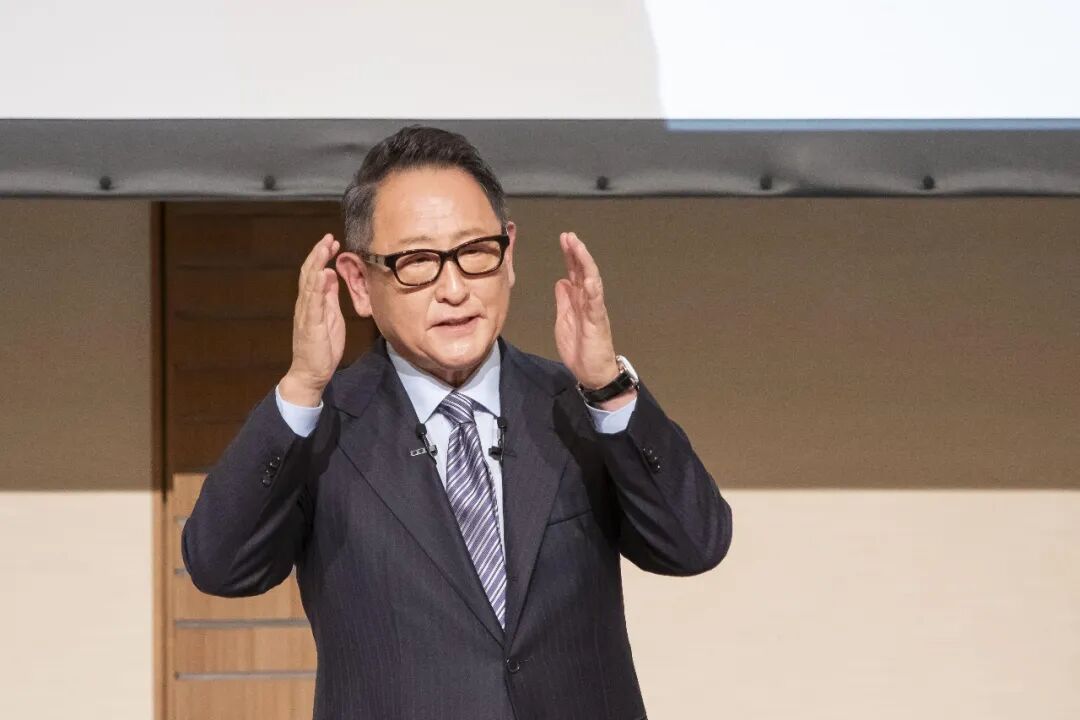 ▍Akio Toyoda
Viewing BYD and Toyota side by side, both implicitly share a fundamental judgment: intelligence will eventually be commoditized. The current fierce competition in electrification plus intelligence does not determine the endgame.
In the private consumption dimension, the bonus period for automotive intelligence will not be long. Therefore, BYD must accelerate its attack, while Toyota must do its utmost to defend. Meanwhile, new forces like Li Auto and XPENG must place their strategies in the dimension of physical AI and extend their battle lines.
BYD and Toyota share a common choice: they are still automotive companies. Within the automotive dimension, neither believes that a pure intelligence narrative can define the automotive endgame. Both view automobiles as a heavy industrial business.
Toyota's core competitiveness lies in its supply chain, integrating the entire supply chain system into a community of fate. BYD follows a different version, opting for more aggressive vertical integration in the early stages of new energy when it had fewer choices, making its own batteries, motors, and electronic controls, and keeping as much as possible in-house.
One is a Toyota-style supply chain community, and the other is a BYD-style vertical integration. The resonance between the two companies in judging their core competitiveness is overshadowed by their respective situations.
Toyota is in no hurry because it believes the endgame will return to its home turf.
BYD must act fast because it must change the location of the home turf before the endgame arrives.
This is original content from Autopix (autopix) and is not authorized for reproduction.
-
![]()
Total Investment Hits Nearly 3.28 Billion! Goertek Launches Mass Production of 12-Inch Transparent Substrate Wafer for AR Glasses’ Micro-Nano Optical Components
-
![]()
Why Is This Precision Optical Film Leader Worth Reevaluating with a Tens of Millions Procurement?
-
![]()
AI Costs Plummet by 90% Over Nine Years: Key Insights from Davos You Shouldn’t Miss
-
Doubao, Your Late-Night AI Companion, Now Eyes Profitability
-
![]()
SRC Empowers SEER Intelligence to Reach a Market Cap of Tens of Billions, Yet Fails to Sustain Profitability
-
![]()
China’s Embodied AI Industry Faces Fierce Domestic Competition, Making Overseas Expansion Essential for Survival
-
![]()
32.8 Billion Yuan Investment! Goertek’s 12-Inch AR Glasses Optical Wafer Base in Lingang Begins Operations
-
![]()
How Far is the All-New Li Auto L8 from Being the Best Five-Seat SUV with In-House Full-Stack Development?