Toyota's Era of Sky-High Profits Draws to a Close
 05/13 2026
 532
532
Lead-in
Introduction
For the new management team, the immediate operational priorities are stabilizing the profitability foundation and halting the profit decline.
A few days ago, Toyota Motor Corporation unveiled its financial results for the fiscal year 2025 (spanning from April 2025 to March 2026). This marked the inaugural annual performance briefing led and hosted by the company's newly appointed President and CEO, Kon Chintai, in his new role.
Kon Chintai is no stranger to Toyota's financial results briefings. During his previous tenure as Chief Financial Officer, he was a regular presence at these events, offering the media detailed explanations and professional insights into key financial metrics, such as revenue, profits, and business strategy. He was a prominent figure at these gatherings.
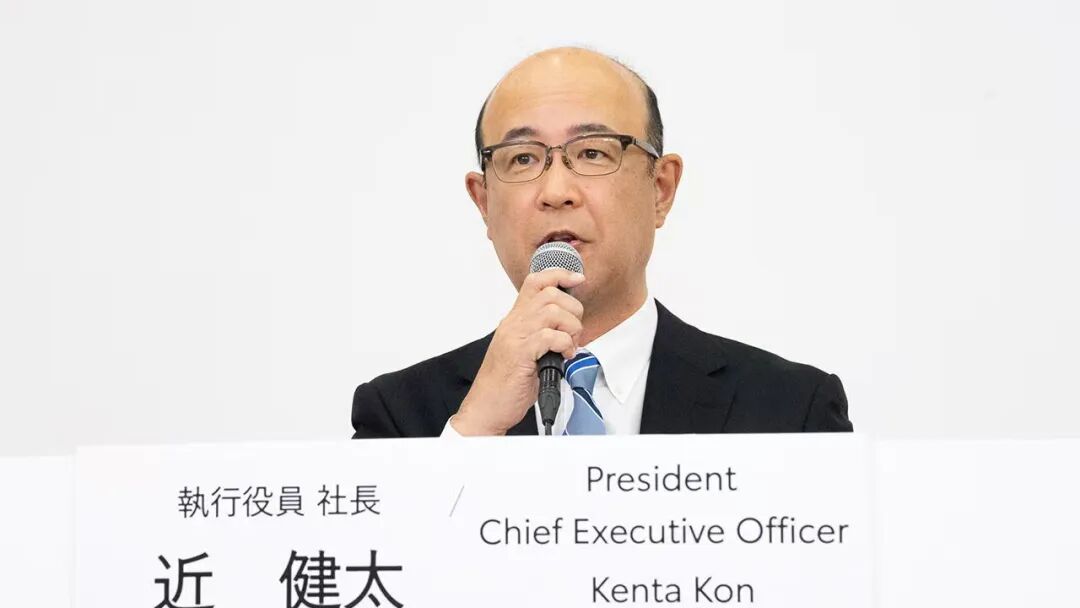
While his face is familiar, his role and responsibilities have evolved.
However, for Kon Chintai, the changes extend beyond his title; his mindset and the company's fundamental operational dynamics have also shifted.
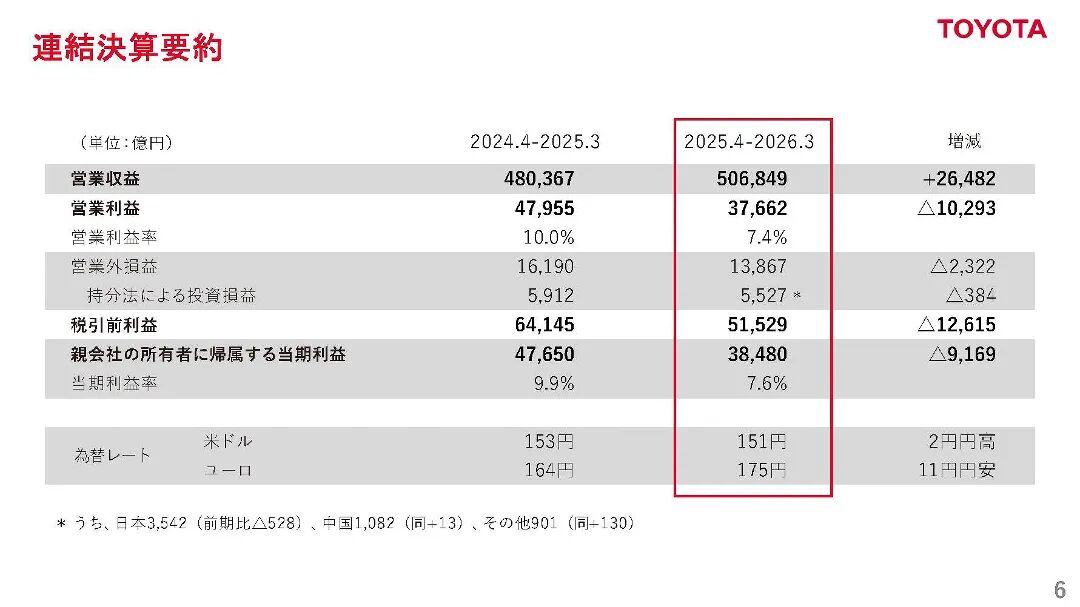
In FY2025, despite a 5.5% year-on-year (YoY) increase in sales, Toyota's net profit plummeted by 19.2% YoY, and its operating profit dropped by 21.5% YoY, marking the second consecutive year of profit contraction. The operating profit margin also declined from a record high of 11.9% to 7.4%, leaving Toyota grappling with the dilemma of "revenue growth without profit expansion."
Looking ahead to the new fiscal year from April 2026 to March 2027, Toyota's business outlook is cautious and pessimistic. The company anticipates a significant 22% YoY decline in net profit, indicating that Toyota—once a paragon of profitability in the global automotive market—will face a third straight year of declining profits.
01 Two Years of Declining Profits
50.68 trillion yen—
This figure represents Toyota's total annual sales for FY2025, equivalent to approximately RMB 2.2 trillion at the current exchange rate, marking a steady 5.5% YoY increase.
From a revenue standpoint alone, these results are impressive. Not only did Toyota surpass the 50 trillion yen sales milestone for the first time in its history, but it also became the first Japanese company to achieve this feat, redefining the revenue ceiling for Japanese enterprises.
However, a closer examination of profitability reveals significant concerns in Toyota's performance over the past fiscal year. Data indicates that operating profit reached 3,766.2 billion yen, a sharp 21.5% YoY decline; net profit attributable to parent company owners stood at 3,848 billion yen, a 19.2% YoY drop, signaling a clear contraction in profitability.
For years, in the global automotive industry's quest for dominance, Toyota and Volkswagen have each held their own, standing as equals. Volkswagen has long led in terms of revenue and sales volume, leveraging its massive production and sales scale, global factory network, and workforce. Meanwhile, Toyota has consistently topped the industry in profitability, boasting a leading profit level and a market valuation that dwarfs all other global automakers.
However, Toyota's once-formidable profit advantage is now waning, and its once-stable profit moat is showing signs of erosion. Both net profit and operating profit fell by around 20% YoY, marking the second consecutive year of profit contraction. The operating profit margin also slid from a record high of 11.9% to 7.4%.
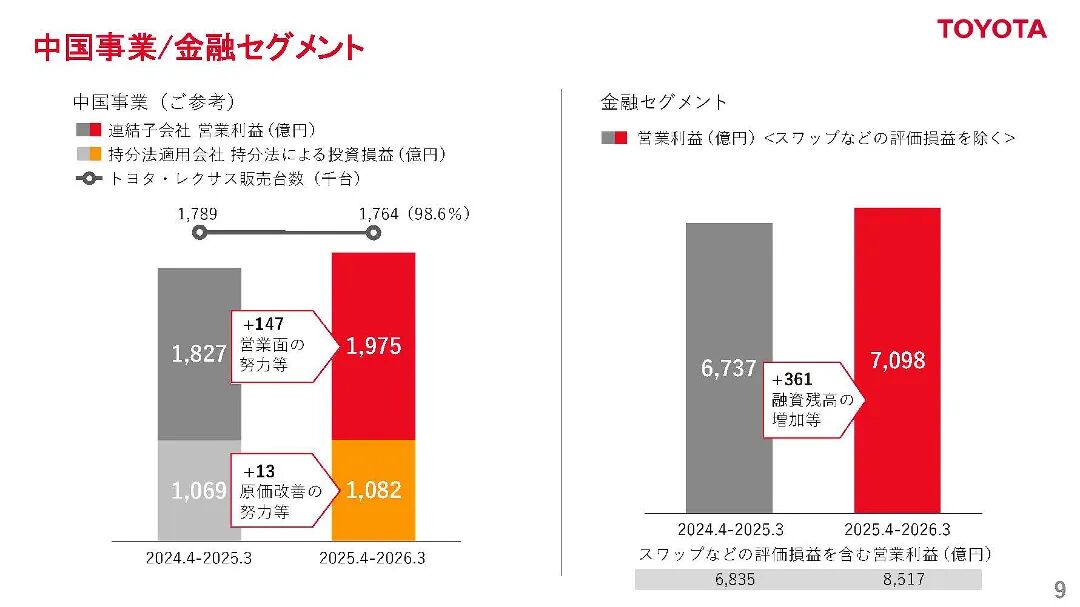
Specifically, while operating profit from joint ventures in the Chinese market increased, Toyota experienced YoY declines in core markets such as Japan, North America, and Europe, with the North American market directly falling into the red, recording a loss of approximately 298.6 billion yen.
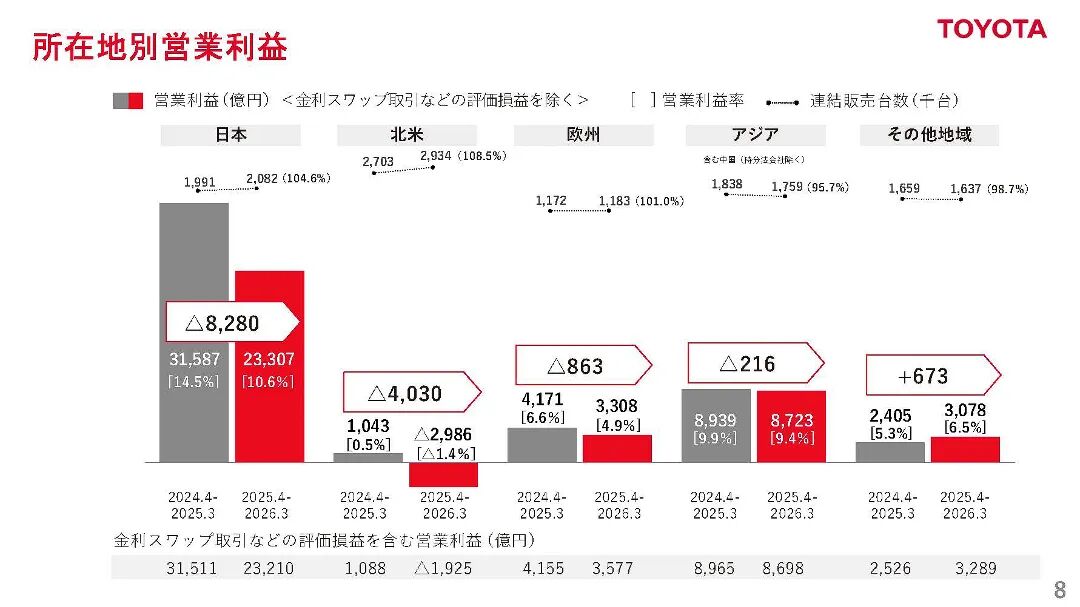
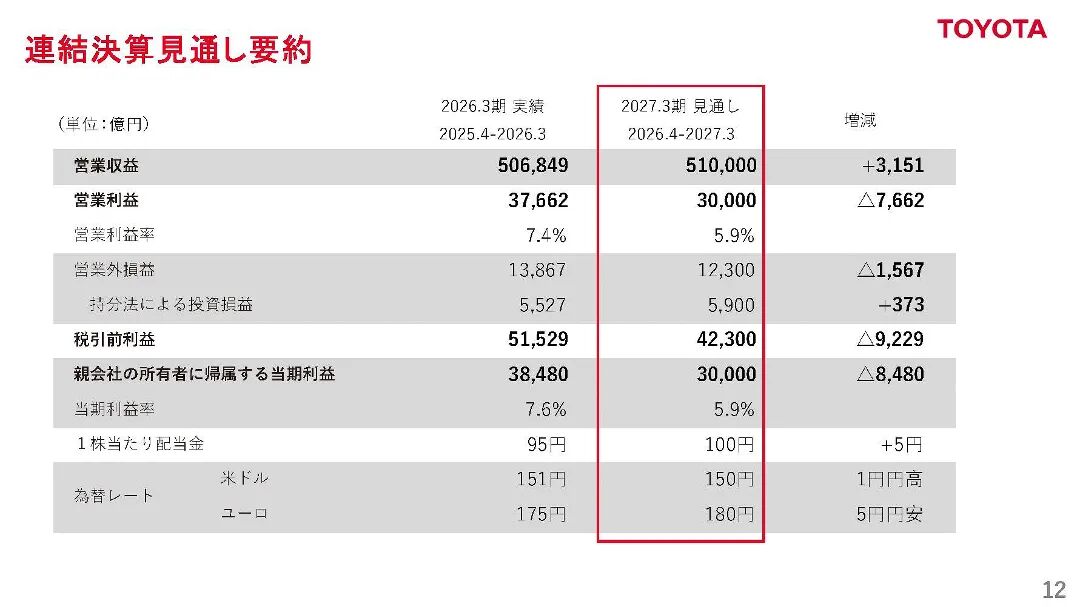
At the financial results briefing, Kon Chintai announced the business outlook for FY2026 (April 2026-March 2027). Toyota expects revenue of 51 trillion yen for the new fiscal year, a slight 315.1 billion yen YoY increase; operating profit is projected at 3 trillion yen, a 766.2 billion yen YoY decline, marking Toyota's third consecutive year of profit contraction.
Notably, Toyota forecasts an operating profit margin of 5.9% for the new fiscal year—not only significantly lower than historical levels but also falling behind its past status as a "high-profit benchmark," placing it in the weaker range among global mainstream automakers.
In the past, Toyota's operating profit margin consistently remained above 10%, serving as an absolute benchmark and ceiling for industry profitability. In FY2025, its operating profit margin fell to 7.4%, already indicating a significant decline. For the upcoming FY2026, Toyota's profit margin forecast directly places its profitability at a multi-year low.
Even amid a cycle of declining profits, Toyota maintains a high-intensity investment pace. The company expects R&D spending to reach 1.6 trillion yen in FY2026, approximately RMB 77.76 billion, a 5% YoY increase, setting another record high.
The majority of this R&D funding will be allocated to core areas such as talent development, autonomous driving, and new energy vehicles. Equipment investment is expected to reach approximately 2.3 trillion yen, a slight 4% YoY decline, but still remaining at a high level.
02 Persistent Pressure from the "Three Major Challenges"
What factors are dragging down Toyota's performance?
The U.S.-Iran conflict is squeezing profits.
At the financial results briefing, Toyota's finance chief acknowledged that, excluding the negative impact of the Middle East situation, FY2025 performance could have achieved further positive growth.
Currently, Toyota exports approximately 500,000–600,000 vehicles annually to the Middle East. However, under the influence of the U.S.-Iran conflict, nearly half of this business has been impacted. Shipping disruptions in the Strait of Hormuz have restricted Toyota's main export models to the Middle East, particularly high-margin models like hardcore SUVs and pickup trucks—such as the entire Land Cruiser series and the Prado—which are highly sought after in the Middle Eastern market.
When discussing the current state of profitability, President Kon Chintai stated that there are currently no signs that the impact of the U.S.-Iran conflict on performance can be curbed. Data shows that from January to March this year, affected by the U.S.-Iran conflict, Toyota's total operating profit stood at 569.4 billion yen, nearly halved and reaching its lowest YoY level in three years.
The impact of the Iran conflict on Toyota is nearly all-encompassing, affecting raw material costs, transportation fees, and the supply of automotive assembly parts. Particularly at this stage, supply chain disruptions are gradually spreading through Japan's automotive industry chain, causing deep-seated effects, with Toyota and its related supply chains bearing a severe brunt.
On one hand, the U.S.-Iran conflict brings ongoing logistical turmoil, with rising pressures from increased raw material prices and shortages of basic materials like aluminum and resin. On the other hand, since it is impossible to predict which parts will suddenly become unavailable, Toyota can only make more conservative and cautious profit forecasts to navigate this unprecedented "supply blind spot."
Another influence comes from U.S. tariffs.
At this financial results briefing, a Toyota spokesperson bluntly stated that the tariff policies introduced by the U.S. Trump administration directly dragged down the company's operating profit by as much as 1.38 trillion yen, accounting for 37% of its annual operating profit.
The U.S. has long been Toyota's largest single market and core profit pillar. From a sales perspective, the North American market (primarily the U.S.) contributed 2.93 million new vehicle sales in the previous fiscal year, accounting for approximately 28%–30% of Toyota's global total sales. In terms of profit, North America has consistently been Toyota's highest-margin regional market, year-round contributing as much as 30%–40% of its operating profit, earning it the nickname "profit cow."
After the financial results were released, Japanese media analyzed the specific reasons for profit pressure under the headline "U.S. Tariffs, Middle East Conflict, and the Chinese Market Become the 'Three Major Challenges' Weighing on Toyota's Profitability." However, in reality, the first two factors have a more direct and fatal financial impact on the company, representing the most pressing core challenges for Kon Chintai in the short term.
On one hand, tariffs represent rigid additional costs that Toyota cannot fully pass on to consumers in the short term, directly eroding its pre-tax profit. Additionally, to maintain its annual sales target of nearly 3 million vehicles in the U.S., Toyota is unwilling to significantly raise prices in the North American market and can only absorb tariff costs internally, further suppressing profit margins.
On the other hand, shipping disruptions in the Strait of Hormuz represent a hard logistical blockade, leading to factory production cuts, order delays, and dealer stockouts, with no short-term alternatives available.
"Currently, the focus is on short-term control," Kon Chintai stated at the financial results briefing. Toyota's management team is now exploring countermeasures for its profitability dilemma. At present, Toyota is concentrating on discussing shared parts and raw material solutions while accelerating the search for alternative materials and optimizing supply chain structures. Production-side improvements are also being implemented to enhance overall operational efficiency.
By streamlining parts categories and selectively screening material specifications, Toyota further rationalizes its inventory structure, bringing stock levels closer to reasonable levels while enabling smoother and more efficient overall production rhythms.
Take the practical implementation at Japanese domestic factories as an example: some plants have reduced parts categories by up to 80%—even basic components like screws and standard tooling are being standardized and unified to reduce costs and simplify production management at the source.
These internal adjustments, which focus on deep cultivation and operational refinement, serve as both emergency measures to address the current profit decline and as a buffer for future electrification transformation and global market volatility. Whether Toyota can stabilize its profitability foundation and halt the profit decline through deep supply chain and production system reforms has become the most critical operational challenge for the new management team in the coming period.
Editor in Charge: Du Yuxin Editor: He Zengrong
THE END
-
![]()
Auto China 2026: Chinese Brands Lead the Green and Smart Future | Cover Story: In China, for the World – Auto China 2026 Special Report (Part 3)
-
![]()
Can Tencent Music Win This Defensive Battle by Integrating Himalaya?
-
![]()
Volvo Asia Pacific: No More 'Successor' Era!
-
![]()
China's Auto Market in April: A 2.5% Sales Decline, a 74% Export Surge, and Profit Margins Below 3.5%
-
![]()
Toyota's Era of Sky-High Profits Draws to a Close
-
![]()
Can Trump Pave the Way for Chinese Automobiles in the US Market with Musk’s China Visit?
-
![]()
Can the New Unisplendour Group Break Away from Being a 'Huawei Alternative' After Resolving Its Hundred-Billion-Yuan Debt?
-
![]()
What technology enabled XPENG to eliminate LiDAR from its intelligent driving systems?