Automotive Market News: BYD Releases China's First 4nm Intelligent Driving Chip
 06/01 2026
 519
519
☆ Stock Star
Weekly Report on the New Energy Vehicle Industry
According to Shanghai Metals Market, the spot market for electrolytic cobalt remained generally stable this week, with prices experiencing slight downward pressure. As the end of the month approaches, mainstream smelters have largely completed their sales tasks, maintaining stable quotes. Downstream alloy and magnetic material enterprises continue to adopt a need-based procurement model, without relaxing their control over raw material inventories.
The current price gap between electrolytic cobalt and low-priced cobalt salts has largely closed, with low industry willingness for reverse dissolution production. The market is expected to remain volatile in the short term, with price increases still reliant on a boost from the cobalt salt market.
01. Institutional Views
Huachuang Securities believes:
Looking ahead to 2026, with the implementation of industry policies aimed at curbing 'excessive competition,' the price war is expected to gradually subside. Coupled with rising oil and gas prices, exports of new energy vehicles are set to experience rapid growth, contributing to increased profits per vehicle.
Overall, profit margins per vehicle for leading domestic automakers are expected to stabilize, while joint venture brands continue to face pressure. New energy vehicle startups are poised to enter a phase of scaled profitability.
In terms of investment, the main theme for the automotive sector this year remains the overseas expansion of electric vehicles. As market styles evolve, data strengthens, and research granularity improves, the electric vehicle overseas expansion chain is expected to be revalued.
Kaiyuan Securities points out:
Starting from Q2 2026, the humanoid robot industry is accelerating towards mass production and capitalization. Tesla's Optimus V3 has initiated mass production, with the Fremont production line being retrofitted for deployment in July-August. Figure 03 live-streamed 200 hours of package sorting, handling nearly 250,000 parcels with efficiency approaching human levels. Concurrently, four domestic manufacturers—Unitree, DeepRobotics, RoboTech, and Ubtech—are intensively pursuing IPOs, marking the industry's entry into a phase of hardware implementation, ecosystem development, and capitalization.
02. Macro Events
MIIT: Adhering to Legal Means to Regulate the Recycling of Power Batteries for New Energy Vehicles
On May 28, Li Lecheng, Convenor of the National Work Team for the Recycling of Power Batteries for New Energy Vehicles and Secretary of the Party Leadership Group and Minister of the Ministry of Industry and Information Technology, presided over the team's second meeting. The meeting emphasized that 2026 marks the beginning of the '15th Five-Year Plan' period and a critical year for implementing the tasks outlined in the 'Action Plan for Establishing a Sound Recycling System for Power Batteries of New Energy Vehicles.' It is essential to further unify thinking and ensure the implementation of various tasks with a persistent and focused approach.
Efforts should be strengthened in work coordination, focusing on enhancing collaboration in areas such as the establishment of regulations, policies, and standard systems, as well as research on major issues. Existing policies should be effectively utilized, while new policies should be developed. Adhering to legal means to regulate recycling is crucial. Regulatory enforcement should be enhanced through joint special operations to standardize the recycling and utilization of used power batteries. Violations such as illegal sales of used power batteries, production of substandard products using used power batteries, failure to fulfill information traceability responsibilities, environmental pollution from illegal dismantling, and unlicensed operations should be investigated and dealt with in accordance with the law, reinforcing the deterrent effect and standardizing the order of used power battery recycling.
MIIT Releases Key Points for Automotive Standardization Work in 2026
On May 26, the Ministry of Industry and Information Technology released the key points for automotive standardization work in 2026, which include improving the planning of the automotive standard system.
This involves completing the preparation of the '15th Five-Year Plan' technical standard system construction plan for the automotive industry, conducting solid pilot research on the feasibility of 'promoting, transforming, and strengthening' standards, scientifically evaluating the implementation effectiveness of the roadmap for compulsory national standards in the automotive sector and initiating revisions as appropriate, improving and implementing standard systems in key areas such as intelligent connected vehicles, automotive chips, new energy vehicles, and low-carbon development in the automotive industry, focusing on researching standard systems for automotive quality reliability and solid-state batteries for vehicles, updating and improving standard sub-systems for data governance and application, as well as automotive artificial intelligence, and proactively layout (Note: ' layout ' is kept as is due to its strategic planning context, which may not have a direct single-word English equivalent) standard research in cutting-edge areas.
Shenzhen's '15th Five-Year Plan' Outline: Vigorously Developing Emerging Pillar Industries Such as AI Terminals, Low-Altitude Economy, and Embodied Intelligent Robots
On May 26, the 'Outline of the 15th Five-Year Plan for National Economic and Social Development in Shenzhen' was released, proposing to seize important opportunities in emerging sectors.
It aims to vigorously develop a number of emerging pillar industries, including AI terminals, low-altitude economy, embodied intelligent robots, marine economy, and commercial aerospace. Accelerate the research, development, and application of new-generation intelligent terminals such as AI-powered smartphones and computers, smart home devices, and smart wearables, actively promoting the large-scale application of whole-body intelligence, whole-vehicle intelligence, and whole-house intelligence.
Establish systems for the development of the low-altitude economy, including rules and regulations, infrastructure, and equipment industries, optimize airspace support, expand scenario-based business models, and consolidate and enhance international competitiveness. Elevate the development level of embodied intelligent robots, achieving breakthroughs in key core components, the integration of artificial intelligence and robotics, multimodal perception, high-precision motion control, and dexterous operation, creating a global hub for scientific and technological innovation and industrial development in embodied intelligence. Strengthen and expand new growth points in the marine economy, such as marine oil and gas, ship and offshore engineering equipment, marine electronic information, and marine biopharmaceuticals.
03. Industry News
CPCA: Retail Sales of Passenger Vehicles in China from May 1-24 Down 24% Year-on-Year
On May 27, the China Passenger Car Association released data showing that from May 1-24, retail sales of passenger vehicles in China reached 989,000 units, down 24% year-on-year but up 10% month-on-month. Year-to-date retail sales reached 6.594 million units, down 19% year-on-year.
From May 1-24, retail sales of new energy passenger vehicles reached 619,000 units, down 11% year-on-year but up 13% month-on-month. Year-to-date retail sales reached 3.377 million units, down 16% year-on-year. From May 1-24, the penetration rate of new energy retail sales in the passenger vehicle market was 62.5%; from May 1-24, the penetration rate of new energy wholesale sales by passenger vehicle manufacturers was 63.6%.
SAE-China's Hou Fushen: Accelerated Application of New Materials in Automotive Intelligence and Electrification
On May 27, at the 2026 Automotive New Materials Conference, Hou Fushen, Vice President and Secretary-General of the Chinese Society of Automotive Engineers, stated that traditional fuel vehicles require over 200 types of materials for manufacturing. In comparison, intelligent new energy vehicles require over 400 types of materials, with the total material usage doubling.
According to predictions in the 'Technology Roadmap for Energy-Saving and New Energy Vehicles 3.0' by the Chinese Society of Automotive Engineers, by 2030, the penetration rate of new energy models in China's passenger vehicle market is expected to exceed 70%; L2-level intelligent assisted driving functions will be fully popularize (Note: ' popularize ' is translated as 'popularized' to convey the widespread adoption) in the passenger vehicle sector; and the market penetration rate of models equipped with L3 and L4-level advanced autonomous driving functions will also exceed 35%. This industrial upgrading will drive innovative applications in various sub-sectors of automotive materials, including electronic materials, electrochemical materials, and functional materials.
04. Company Dynamics
BYD Releases China's First 4nm Intelligent Driving Chip
At the BYD Intelligent Strategy Launch Event held on the 28th, BYD unveiled China's first 4nm intelligent driving chip, 'Xuanji A3,' which has commenced mass production. Supporting L3 and L4 autonomous driving, the three chips offer a total computing power exceeding 2100TOPS. It is reported that the chip, deeply optimized in combination with BYD's self-developed algorithms, achieves a 100% increase in computing power utilization.
XPENG Group Selected as One of the First Signed Projects Under Guangdong Province's Strategic Emerging Industry Investment Guidance Fund
On May 27, the launch ceremony for Guangdong Province's Strategic Emerging Industry Investment Guidance Fund was held in Guangzhou, with XPENG Group selected as one of the first signed projects. Chairman and CEO He Xiaopeng emphasized at the ceremony that strategic emerging industries require 'patient capital' capable of spanning cycles. XPENG will remain committed to independent research and development, continuously increasing investment in scientific research, and fully tackling core technologies in physical AI. With the support of the fund, it aims to make the low-altitude economy 'take off,' autonomous driving 'hit the road,' and embodied intelligence 'come into use,' transforming innovative technologies into real industrial strength.
Pony.ai Raises 2026 Robotaxi Revenue Target to 3.5 Times 2025 Levels
On May 26, Pony.ai announced that it has raised its 2026 revenue target for autonomous driving ride-hailing services from the previously estimated 3 times the 2025 levels to over 3.5 times. Pony.ai also stated that it will increase its year-end target for the size of its autonomous taxi fleet from 3,000 units to over 3,500 units.
05. Secondary Market
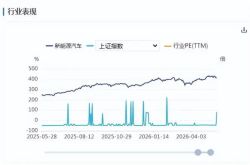
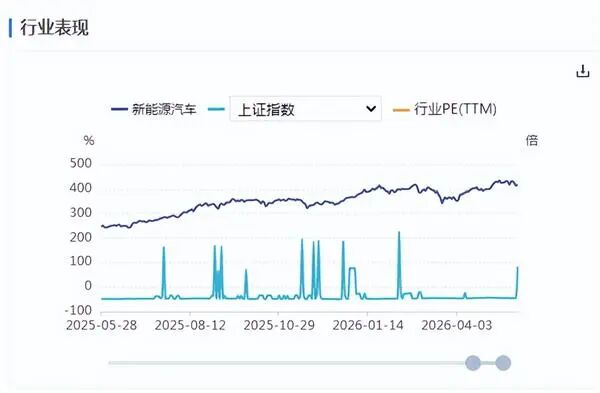
Industry Performance
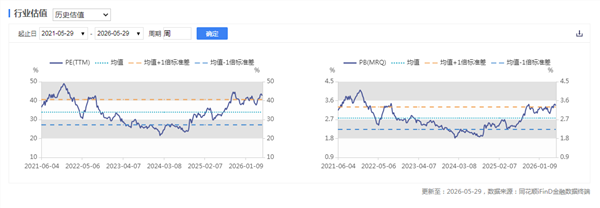
Industry Valuation
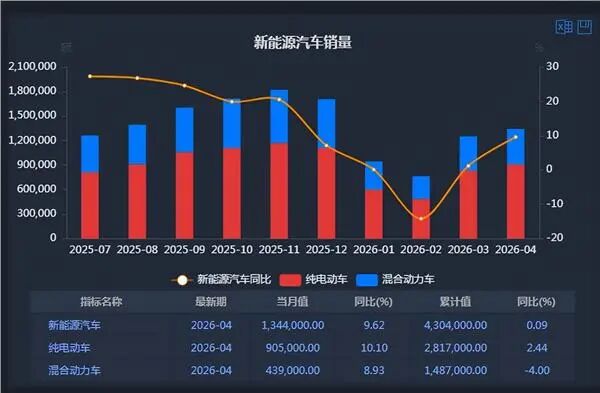
New Energy Vehicle Sales
06. Raw Material Prices
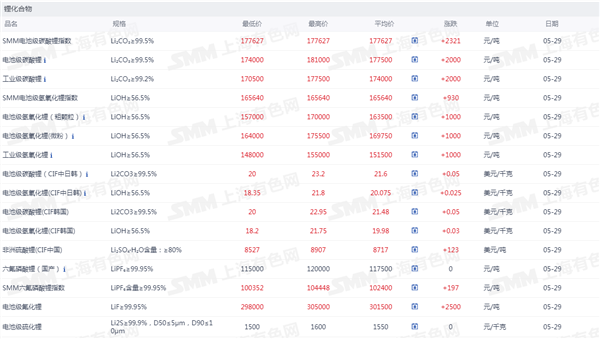
Lithium Compound Spot Prices
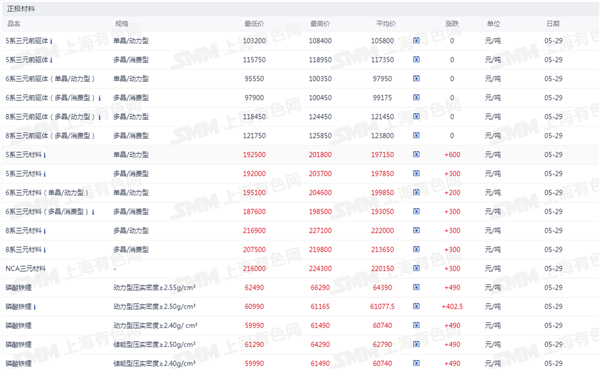
Cathode Material Prices
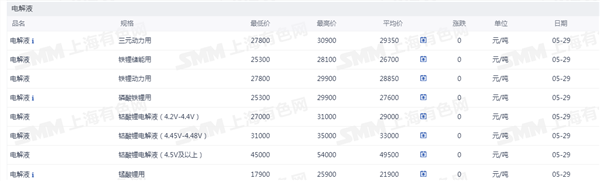
Electrolyte Prices
 - End -
-
![]()
Sales Plummet by 90%! Why Is Dongfeng Peugeot Citroën Automobile Struggling to Maintain Its Foothold in the French Car Market?
-
![]()
How Far Are We from AI Payments When Agents Want to 'Take Over' Our Wallets?
-
![]()
The First Cold Shower for All-in AI: Cost Reduction Hasn't Arrived, But the Token Bill Has
-
![]()
Automotive Market News: BYD Releases China's First 4nm Intelligent Driving Chip
-
![]()
Changan Qiyuan Intelligent Driving Accident: A Wake-Up Call for the Entire Intelligent Driving Sector
-
![]()
Toyota Changes CEOs Twice in Three Years Amid Challenges
-
![]()
Why Did the Former Chairman of Ferrari Get 'Angry' About Its First All-Electric Model, Luce?
-
Exclusive! Gas Leak at SK Hynix’s Cheongju Facility in South Korea Leaves 6 Injured—Could DDR5 Prices Surge Once More?