CCTV, People’s Daily, and Other Media Outlets Weigh In: Is a Weight-Based Tax for Electric Vehicles on the Cards?
 06/05 2026
 372
372
On the same day, both CCTV and People’s Daily weighed in with their perspectives on the ongoing debate surrounding road maintenance fees for electric vehicles.
On June 4th, People’s Daily published an article delving into the topic of road maintenance fees for electric vehicles, advocating for a problem-solving approach to the “oil vs. electricity” debate. The commentary explicitly stated that completely exempting electric vehicles from road-related costs and placing the entire national road maintenance burden on fuel vehicles would, in the long run, lead to an unfair distribution of tax burdens and widen the funding gap for maintenance, necessitating system optimization. As supportive policies for new energy vehicles are phased out and the industry matures, with purchase tax incentives gradually being withdrawn, restoring fairness in road use costs is becoming a general trend. However, it emphasized that there would be no abrupt introduction of a “road maintenance fee for electric vehicles,” no blanket fee imposition, and no retroactive collection of past fees. Instead, a gradual and dynamically optimized approach would be adopted, drawing on the experiences of new business models such as e-commerce and mobile payments.
Notably, this marked the first time People’s Daily had voiced its opinion on this issue.
It is anticipated that in the future, the traditional fixed road maintenance fees will be phased out, and new charging methods will be explored, such as taxing based on actual mileage driven or implementing a tiered fee system based on vehicle curb weight.
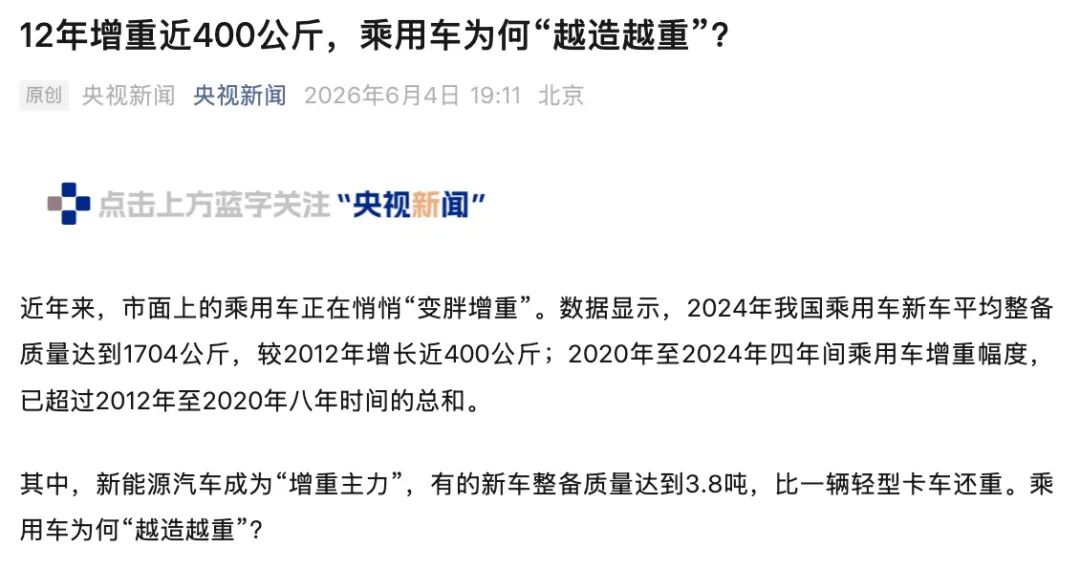
Also on June 4th, CCTV strongly condemned the trend of increasing vehicle weights. CCTV News pointed out that in recent years, passenger vehicles on the market have been quietly and collectively “gaining weight.” Data revealed that the average curb weight of new passenger vehicles in China reached 1,704 kilograms in 2024, up nearly 400 kilograms from 1,312 kilograms in 2012, with the pace of weight gain accelerating. By comparing data, CCTV News noted that the weight increase of passenger vehicles from 2020 to 2024 surpassed the total increase over the eight years from 2012 to 2020. Among them, new energy vehicles have emerged as the “primary contributors to weight gain,” with many mainstream new energy models having a curb weight exceeding two tons, and some new models reaching 3.8 tons, heavier than a light truck.
The simultaneous discussion of road maintenance fees for electric vehicles by CCTV and People’s Daily, along with CCTV’s criticism of their weight, seems to hint at the possibility of a weight-based tax for electric vehicles.
Not only People’s Daily and CCTV but also another authoritative media outlet, Guangming Daily, recently published a commentary discussing how electric vehicles should contribute to road maintenance. Guangming Daily pointed out: 1. The “user-pays” mechanism established by early tax and fee reforms can no longer encompass all road users at this stage. 2. In the competitive electric vehicle market, many manufacturers attract consumers through “material stacking,” leading to continuously increasing vehicle weights. Many electric vehicles have a total weight exceeding 2.4 tons, with the heaviest mass-produced electric vehicle weighing nearly 4 tons, approaching the self-weight of a light truck. The increase in vehicle weight results in exponential growth in damage to roads and bridges.
Guangming Daily also noted that it is clearly inappropriate for fuel vehicle users to shoulder the entire responsibility for road maintenance funding. As the public funding pool for road maintenance continues to shrink, it will inevitably drive social systems and laws to update promptly. Guangming Daily emphasized the urgent need to discuss how to involve new energy vehicles in bearing the responsibility for road maintenance as soon as possible, restoring the fair principle of “pay more for more use, pay less for less use.”
Judging from the statements of authoritative media, the introduction of a “road maintenance fee” for electric vehicles seems inevitable, but adjustments will be made in form, and implementation will be “gradual.” Currently, two popular proposals for fee collection methods have been circulating within the industry.
The first proposal is charging based on mileage driven. In late February this year, an image labeled “10 provinces and municipalities to pilot a mileage tax for new energy vehicles” went viral on social media platforms, sparking widespread concern among vehicle owners and potential buyers. The rumor claimed that 10 provinces and municipalities, including Chongqing, Hainan, Zhejiang, Guangdong, Jiangsu, Shandong, Sichuan, Hubei, Hunan, and Fujian, would pilot a mileage tax for new energy vehicles starting January 1, 2026, with a base rate of 0.12 yuan per kilometer and higher rates for overweight models ranging from 0.14 to 0.15 yuan per kilometer. On February 27th, tax departments and car dealerships in the involved provinces and municipalities uniformly denied the existence of such a pilot program, stating that the online information was purely false.
The second proposal is charging based on weight. Although this rumor has been widely circulated, there is already international precedent to refer to. According to reports, Texas, USA, has imposed an annual registration fee of $200 on pure electric vehicles since September 2023, which will be used for road construction and maintenance. Starting from May 2028, Japan will impose an additional “EV weight tax” on private pure electric vehicles and plug-in hybrid vehicles, superimposed on top of the existing vehicle weight tax, adopting a tiered mechanism where the heavier the vehicle, the higher the tax, to bridge the fuel tax gap caused by the popularization of electric vehicles.
In addition to these three authoritative media outlets, many party and government media have recently discussed this topic, particularly criticizing vehicle weight. This indicates a high possibility that electric vehicles will be charged based on their weight. The question now is, if subsidies for electric vehicles are canceled and a weight tax is imposed, will this impact the consumer market? Our assessment is that new energy vehicles have become a trend, and the fees will only cause short-term market fluctuations, with the long-term trend remaining unchanged.
-
![]()
MiniMax Faces an Uphill Battle to Reclaim Its Initial Vision
-
![]()
Is XPENG Lagging Behind the Industry Leaders?
-
![]()
The Various Aspects of Life in the Era of Involution: Six New Forces Strive to Find Profit Points
-
![]()
AI Reshapes Globalization: New Opportunities for Chinese Enterprises Going Global
-
![]()
Across-the-Board Decline: Joint Venture Brands Feel the 'Boomerang' Effect
-
![]()
The More the US Attempts to 'Suppress' China, the More Innovative Chinese Automakers Grow?
-
![]()
CCTV, People’s Daily, and Other Media Outlets Weigh In: Is a Weight-Based Tax for Electric Vehicles on the Cards?
-
Lenovo Aims to Continue Spinning Its AI Narrative