Used Fuel-Powered Vehicle Prices Plummet, Losing Two Years' Value in Just Two Months
 06/15 2026
 413
413
Lead-in
Introduction
In the face of fierce industry competition or market consolidation, for individual operators, it ultimately comes down to a fight for survival.
Descending to the underground second-floor parking garage, Mr. Du, a used car dealer known for his home pickup services, bends over to inspect the headlights of a vehicle. Upon spotting a familiar seller with whom he has had seamless collaborations in the past, Mr. Du straightens up and greets him with a relaxed demeanor.
"This is our editorial colleague, here to inquire about the used car market."
When asked about the reported decline in prices of used fuel-powered vehicles, Mr. Du's cheerful smile momentarily fades, replaced by a slight frown and a more serious tone. "Yes, prices have been on a downward trend for a while. Starting from March this year, in just two months, prices have plummeted to levels seen one or two years ago."
Mr. Du admitted that since the beginning of the year, affected by soaring fuel prices and the introduction of new pure electric vehicle models, the prices of used fuel-powered vehicles have struggled to stabilize and have continued to decline. In some cases, after acquiring new vehicles, if they cannot be sold within a week or half a month, prices may dip below the acquisition cost, resulting in losses.
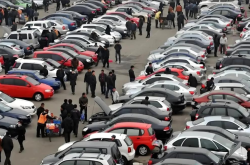
Acquiring vehicles means facing pressures from inventory buildup, slow turnover, and potential losses; not acquiring vehicles means having a large amount of idle capital that incurs high interest costs. Without other revenue growth points, the dealership cannot operate normally. Amid the wave of sharp price declines for used fuel-powered vehicles, all dealers find themselves caught in a dilemma, unable to move forward or retreat.
01 Market Out of Control: Used Fuel-Powered Vehicle Prices Continue to Plummet
"This year, the price drops have been quite significant," Mr. Du explained. The used fuel-powered vehicle market typically follows certain patterns, but this year's price collapse has completely disrupted those patterns.
"In previous years, everyone would try to clear their inventory before the Chinese New Year and then rebuild it after the holiday. If inventory was hard to rebuild after the holiday, dealers would raise their acquisition prices accordingly. Those who acquired vehicles at high prices would not want to incur losses, so they would try to stabilize the market. Generally, the market would remain relatively stable until April or May before gradually declining."
However, this year after the holiday, prices of used fuel-powered vehicles have been on a downward trend and have not stabilized. Mr. Du believes that the clustered launch of new electric vehicle models and rising fuel prices are the two main culprits behind the price declines of used fuel-powered vehicles. "We can clearly feel that after the conflict drove up fuel prices, fuel-powered vehicles have sold very poorly. Especially those with large displacement engines—they're extremely hard to sell."
From overall market data, in May, the penetration rate of new energy vehicle retail sales in China reached 62.9%, indicating that the era of pure electric vehicles is becoming increasingly inevitable. Correspondingly, the dual decline in market share and prices of fuel-powered vehicles has become an unavoidable pain point.
Also in May, the average price of new fuel-powered vehicle models that underwent price reductions was RMB 166,000, with an average reduction of RMB 25,000, a 14.9% decrease. In the first five months, the average price of new vehicle models that underwent price reductions in the overall passenger vehicle market was RMB 241,000, with an average reduction of RMB 32,000, a 13.1% decrease.
The price reductions of new vehicles quickly spread to the used car market. Whether classic entry-level models or high-end luxury models, price floors have been shattered. The severe shocks in prices have also left the market without basic short-term regulatory capabilities.
"For example, we acquired a Honda Fit Crosstar version at the end of April for over RMB 50,000. Now, more than a month later, it hasn't sold, and we're definitely going to incur losses. At the end of April, we also acquired an Infiniti QX50 with 95,000 kilometers on the odometer for just RMB 78,000. Does that sound cheap?" Mr. Du said, turning to us. From his tone, it was clear that such a price would have been unthinkable a few years ago. Mr. Du continued, "Moreover, the owner had originally opted for Bose audio. But we sold this car at a loss of over RMB 10,000. It just sold last week for RMB 65,000."
Even more extreme was a luxury vehicle handled by Mr. Du in March. At the time, the acquisition price was RMB 220,000. Two or three months later, a vehicle with the same condition, mileage, color, and configuration could only fetch RMB 180,000.
It is understood that used car dealers primarily have two channels for selling vehicles: one is wholesale to fellow dealers. "If you can sell it to them at a price higher than your cost, you make a profit," explained a used car dealer who works with Mr. Du.
Larger boutique dealerships in Shanghai, seeking to save effort and ensure a reliable supply, prefer to source vehicles from dealers like Mr. Du. Although wholesale prices are higher, guaranteed brand strength also ensures selling prices.
In today's rapidly changing market, timing is crucial for achieving a win-win situation between dealers and boutique dealerships. "If you sell to a fellow dealer, maybe after a week or half a month, your original acquisition cost may no longer be covered," Mr. Du said.
In response, Mr. Du and his peers refer to the practice of passing vehicles among dealers as "hot potato." "You wholesale it to me, I pass it to him. Either sell it at a markup or sell it at a loss—it just depends on who gets stuck with the last one." With reduced market transaction volumes, the circulation of used cars among dealers has become increasingly frequent.
Apart from passing vehicles among dealers, the most traditional way for used car dealers to sell vehicles is directly to consumers. Compared to the former method, selling to consumers generally yields higher prices and is less time-sensitive for vehicle turnover. "If we can sell it within a month, we won't incur losses."
According to survey data from the China Automobile Dealers Association, the average inventory cycle in May was 40 days, with over 35.9% of used car dealers having an inventory cycle exceeding 30 days. By Mr. Du's standards, over one-third of used car dealers are operating at a loss.
Why are inventory cycles so long? Mr. Du attributed it to the significant impact on the rigid demand for purchasing used fuel-powered vehicles: "Taking Shanghai as an example, users have many options for nearly new vehicles, and fuel-powered vehicles also require license plates. Moreover, consumers now would rather squeeze onto the subway than buy a fuel-powered vehicle."
As a used car dealer with a certain scale in the industry, Mr. Du's stores are located in first- and second-tier cities such as Chengdu, Hangzhou, Xiamen, Shanghai, Beijing, and Guangzhou. Even so, he still finds it difficult to withstand the impact of price declines and shrinking market size.
"The used car market has completely changed. A few years ago, it might have been a seller's market, with relatively standardized vehicle prices and stable market conditions. But now it's determined by buyers: if someone wants a car, that's the price; if no one wants it, that price doesn't exist. It's similar to a market with prices but no buyers."
Under these dramatic market changes, store sales have shrunk significantly. Previously, Mr. Du's team could consistently sell 500 to 600 vehicles per month through wholesale and retail combined. Now, that number has dropped to 300 to 400. "Many small stores have closed. Some only had a dozen vehicles in stock, and once inventory built up, they were done." Faced with the exit of former peers, Mr. Du has become accustomed to it.
02 Warming Trend for Used Electric Vehicles, But They Can't Support the Market Alone
While the used fuel-powered vehicle market has taken a sharp downturn, the used electric vehicle market is gradually picking up.
"Now, the development of many peers is the opposite of a few years ago. Previously, they specialized in fuel-powered vehicles and avoided electric ones. Now it's the reverse—they'd rather work with electric vehicles and earn less, at least without incurring losses," Mr. Du said. Although the residual value rate of new energy vehicles is generally not high, their high turnover rate is an advantage, especially in the Yangtze River Delta and Pearl River Delta regions where Mr. Du operates. Infrastructure for charging and road conditions are better, vehicle conditions are superior, and consumer acceptance is higher, making used electric vehicles a promising business.
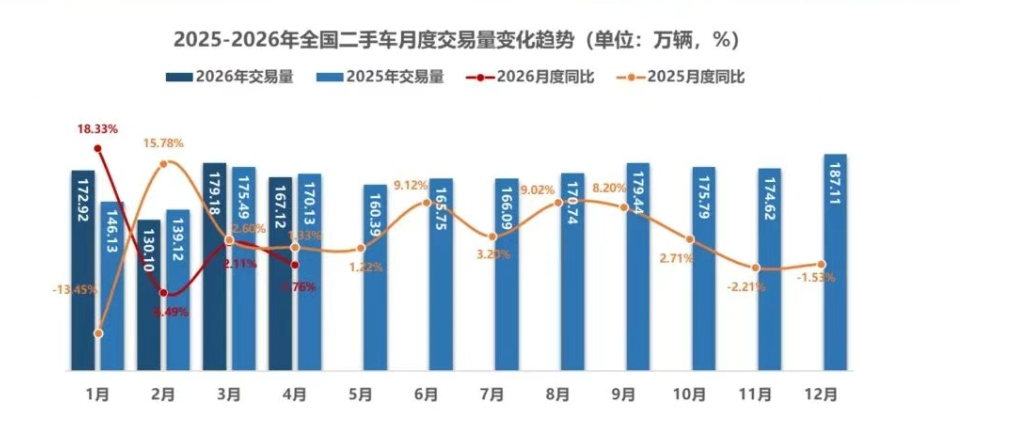
Data from the China Passenger Car Association clearly confirms this trend. In April, when used car transaction volumes declined both year-on-year and month-on-month, the used new energy vehicle market stood out, with transaction volumes reaching 143,000 units, up 2% month-on-month and 21.6% year-on-year. From January to April, used new energy vehicle transaction volumes reached 548,000 units, up nearly 30% year-on-year.
The author's childhood friend, who works at a dealership in northern China, also confirmed this industry trend consistent across northern and southern markets. "Prices of used fuel-powered vehicles have generally dropped. The market is too transparent. Our boss can now earn RMB 5,000 selling a fuel-powered vehicle and make RMB 10,000 including loan rebates. (But) Tesla and Li Auto are doing better, especially Tesla—they sell quite well."
Among traditional luxury brands' three-year residual value rates in May, Tesla ranked second with 56.5%, just behind Porsche. Mr. Du said Tesla's market performance has remained relatively strong. A 2022 Tesla Model 3 likely had an acquisition price of around RMB 120,000 last year, and it might still be at that price this year.

Although market attitudes toward pure electric vehicles have shifted, clear operational restrictions still exist in the used electric vehicle market. "For example, if an electric vehicle model is about to launch a new version, we can't acquire the current version for resale. Sometimes, when a model is updated, prices for the entire used vehicle series may drop," Mr. Du said.
Amid industry panic over new model iterations and depreciation of older models, used models with circulation value, such as those from Jiyue, Weltmeister, and HiPhi, have defied the trend and maintained stable prices, becoming unique in the used electric vehicle market. For example, the Jiyue 01 maintains a stable market price between RMB 90,000 and RMB 100,000.
This phenomenon of "stabilizing against the trend" also indicates that opportunities still exist amid overall market price declines. Just as market turbulence doesn't only bring price drops and store closures—it also hides opportunities for industry consolidation through survival of the fittest. Lao Shen said that low-quality stores that relied on deceiving consumers for one-time transactions are being rapidly eliminated, and the involvement of third parties like Chaboshi is gradually establishing industry norms amid the pain of transformation.
In fact, this trend of "intense industry competition + accelerated consolidation" has already spread throughout the entire automotive industry chain. From upstream component suppliers to midstream OEMs, and downstream dealers and used car dealers, as well as industry media, the entire chain is undergoing painful transformation. This transformation eliminates outdated production capacity and market irregularities while forcing the entire industry to upgrade toward standardization, regulation, and healthy development.
Whether it's intense industry competition or market consolidation, for individual practitioners, it ultimately comes down to a fight for survival. When discussing this year's market conditions and the continuous exit of peers, Mr. Du expressed anxiety: "The general consensus in the industry is that used fuel-powered vehicle prices will continue to decline this year and may only stabilize next year. Many people are exiting because they've held on for a long time without seeing hope."
Enduring the industry winter and waiting for a market recovery to achieve a turnaround has become the only hope for all remaining used car dealers and even the entire industry. However, in this severe market environment, the automotive industry's winter is becoming increasingly long and difficult.
Editor-in-Chief: Shi Jie Editor: He Zengrong

THE END

-
![]()
Haiqing Zhiyuan Prepares for HKEX Debut: Revenue Jumps Despite Profit Challenges and Worsening Cash Flow
-
![]()
The Big Three Telecom Giants Face Accusations of Overcharging Loyal Customers: Why Do Costs Rise with Tenure?
-
![]()
Competitor’s CTO Criticizes Extended-Range Tech; Seres’ Zhang Xinghai Fires Back: It’s Far From “Pointless”
-
![]()
"Football Unites the World," But Not the North American Auto Industry
-
![]()
Electric vehicles are indeed cheaper, but who says gasoline cars are doomed?
-
![]()
The Consensus Between Li Shufu and Li Bin Indicates the Obsolescence of Blockbuster Logic
-
![]()
Used Fuel-Powered Vehicle Prices Plummet, Losing Two Years' Value in Just Two Months
-
![]()
Hidden Presence: Chinese Automakers 'Lurking' in the U.S. Market