Why is Hyundai Willing to Acquire Boston Dynamics at a Loss?
 06/29 2026
 520
520
Produced by Zhineng Technology
Boston Dynamics CEO Robert Playter sent an internal memo to all employees: 'We are about to become a wholly-owned subsidiary of Hyundai Motor Group.'
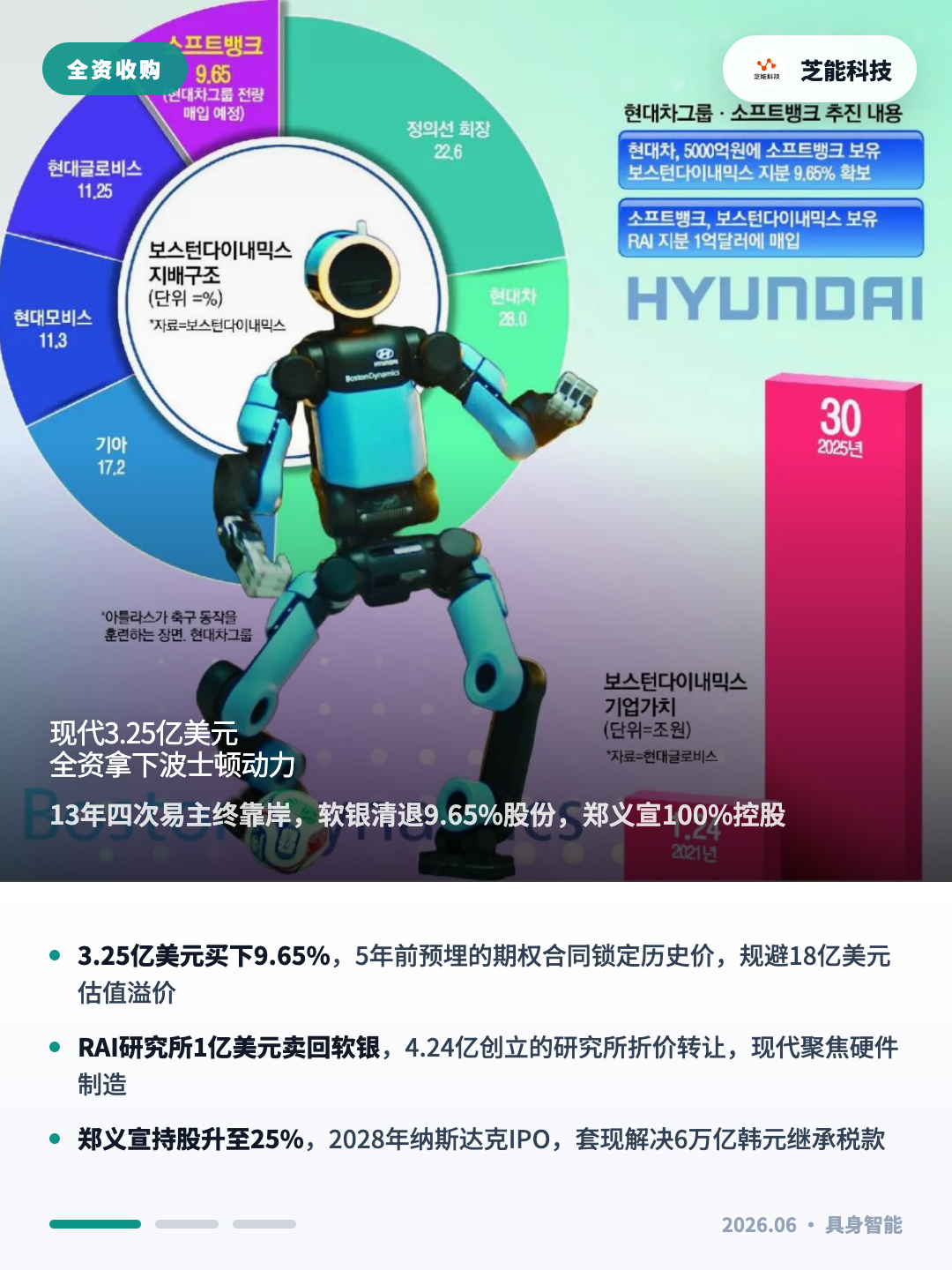
Over the past thirteen years, Boston Dynamics has changed ownership four times. Google acquired it only to find it burned money without generating profits, later selling it to SoftBank. SoftBank, after four years, realized commercialization was still distant and sold an 80% stake to Hyundai Motor while retaining less than 20% as a wait and see (wait-and-see) position.
In the 2021 transaction, Hyundai contributed $880 million, with SoftBank retaining 20%. If Boston Dynamics did not go public within four years, SoftBank had the right to sell its shares back to Hyundai at the original price within a 30-day window starting June 21, 2026.
Four years later, the IPO did not materialize. On June 21, 2026, SoftBank walked in and placed its remaining 9.65% stake, along with an exercise notice, on the table. The price was locked in five years prior: $325 million. Without hesitation, Hyundai paid 500 billion won to settle the remaining amount. Thus, Boston Dynamics became 100% owned by Hyundai.
01 How Much Is Boston Dynamics Really Worth?
Based on the $325 million purchase price for a 9.65% stake, the overall implied transaction valuation of Boston Dynamics is $3.37 billion. Compared to the $1.1 billion benchmark at the time of the initial acquisition in 2021, the book value has tripled. Not unreasonable.
Hyundai Glovis, a Hyundai Motor subsidiary, conducted a fair market assessment of Boston Dynamics in its 2025 annual report, valuing it at 30 trillion won, or approximately $22 billion.
This valuation seems particularly optimistic. In 2026, amid a valuation surge in the Physical AI sector, with Tesla Optimus and Figure AI frequently discussed at multibillion-dollar valuations by venture capital, $22 billion is not outrageous.
At $22 billion, the fair market value of SoftBank's 9.65% stake would be $2.12 billion. Subtracting the $325 million exercise price, Hyundai Motor gains nearly $1.8 billion in paper profit.
Almost simultaneously, Hyundai sold control of the RAI Institute back to SoftBank for approximately $100 million.
The RAI Institute, founded in 2022 and led personally by Boston Dynamics founder Marc Raibert, is a cutting-edge AI research institution. Hyundai, Kia, Mobis, and Boston Dynamics collectively invested $424 million. Selling it for $100 million results in a $324 million write-down.
SoftBank made a significant concession to Hyundai on the arbitrage space of Boston Dynamics' equity (being forced to sell at a $3.37 billion valuation rather than $22 billion), while Hyundai made an equivalent concession to SoftBank on the price of the RAI Institute. In the eyes of both boards, the overall accounts balanced.
The RAI Institute is an academic institution, and most of its algorithms, papers, and datasets are publicly or semi-publicly available. To Chung Eui-sun, this represents a luxurious behavior with low return on capital. He no longer wants to spend money on open basic science. What he wants is for all core technologies to be locked away in Boston Dynamics' own closed-door labs and factories.
There has been considerable debate in the global AI and robotics communities about whether this 'abandon academia, bet on industry' choice is too decisive. Academic long-distance running is left to SoftBank and Google, while Hyundai aims to make Atlas work in its own factories.
Hyundai Motor's investment banking team and capital markets department have already begun preparing for Boston Dynamics' Nasdaq IPO, targeting a window in 2028, coinciding with the large-scale deployment of Atlas in factories. If Boston Dynamics successfully goes public in 2028, its valuation could conservatively reach 100 trillion won (over $70 billion).
Technologically, Boston Dynamics has undergone a profound transformation in the past two years.
◎ Before April 2024, all Atlas promotional videos showcased backflips, dancing, parkour, and jogging on treadmills. Atlas was hydraulically driven.
Hydraulic systems offer exceptional expressiveness and explosive power, delivering stunning visual effects. However, they cost millions of dollars per unit, require constant maintenance by professional engineers in temperature- and humidity-controlled labs, and suffer from hydraulic leaks, valve wear, and high component complexity. Running 24 hours a day in an automotive assembly plant is impossible.
◎ In April 2024, the hydraulic Atlas was officially retired. Boston Dynamics introduced the all-electric Atlas.
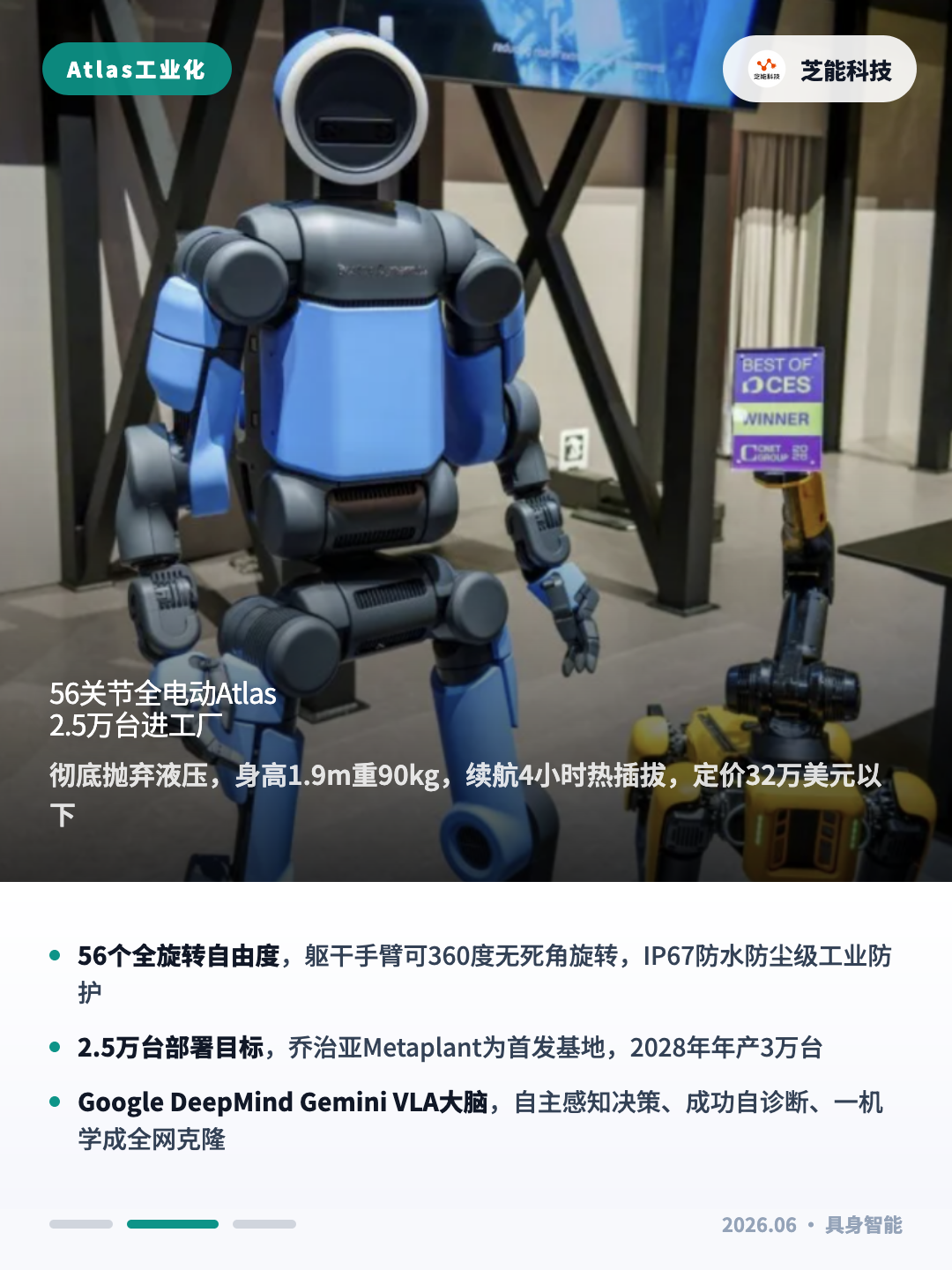
The all-electric Atlas is an order of magnitude cheaper than its hydraulic predecessor and possesses the basic qualities required for industrial scenarios: IP67 water and dust resistance (washable with water), operational in temperatures ranging from -20°C to 40°C, and a 4-hour battery life with autonomous hot-swappable battery replacement.
It features 56 degrees of freedom, with many joints using full-rotation continuous joints without mechanical limit angles. The torso and head can rotate 360 degrees like rotors, eliminating the need to turn around when grasping heavy objects on the ground or at height.
02 Hyundai Motor's Considerations
Hyundai Motor's deployment timeline is extremely tight.
In October 2025, the first batch of all-electric Atlas robots was sent to Hyundai's newly built Metaplant mega-factory in Georgia for field testing, with CBS's 60 Minutes covering the entire process.
In 2026, the Atlas production line will launch at the Boston headquarters, with all capacity already booked. The first mass-produced units will be shipped to Hyundai's robotics application centers and Google DeepMind research labs.
Hyundai aims to deploy 25,000 to 30,000 Atlas humanoid robots in its global factories by 2028.
Boston Dynamics CEO Robert Playter set a strict threshold for Atlas: it must learn new factory tasks within a day or two and achieve 99.9% reliability to secure a permanent position on the production line.
Hyundai Motor's pricing strategy is straightforward: each Atlas is priced strictly below $320,000.
Hyundai's financial planning department calculated based on labor costs in U.S./European/Korean automotive assembly lines: hiring two highly skilled assemblers for two years costs approximately $320,000 to $350,000.
Pricing an Atlas below this figure ensures that any automotive manufacturing plant can immediately see the cost-benefit: buying machines is cheaper than hiring humans.
Hyundai Motor, being one of the world's largest automakers, knows exactly how much each factory process costs in terms of labor. Securing its own factories first sets an example for the rest of the world.
Hardware is just the first step; software must keep pace.
At CES 2026, Hyundai announced a deep collaboration with Google DeepMind. DeepMind integrated Gemini Robotics-ER 1.6—a visual-language-action (VLA) foundation model tailored for the physical world—into Atlas's central edge computing system.
This VLA model's capability is not just identifying 'what an object is' but understanding what is happening in the workshop: hydraulic oil leaks, unclosed fire doors, or abnormally high readings on a simulated dashboard. Atlas can explain its risk assessments to the factory backend in natural language.
More critically, it possesses 'successful self-diagnosis' capabilities.
Previously, when a robot's mechanical gripper failed to grasp an object or a part slipped due to wire harness elasticity, it would Stupidly (foolishly) continue with subsequent actions.
The new-generation Atlas can detect part displacement within milliseconds through a multimodal perception loop, immediately interrupt actions, reposition, fine-tune angles, and adaptively control force. This is truly useful on the production line.
There is also a data loop.
Once an Atlas in a Hyundai factory learns a new workstation operation through VR demonstration or digital twin simulation, the underlying neural network weight updates can be remotely replicated to all Atlas robots in all factories worldwide within half a day via the Orbit industrial cloud.
This is the most significant difference after AI enters factories: learning is not accumulated machine by machine but learned by one and mastered by all.
Since its founding in 1992, Boston Dynamics has never achieved accounting profitability. From 2022 to 2025, it accumulated losses of 1.5594 trillion won (approximately $1 billion), with losses widening each year: a net loss of 528.4 billion won in 2025, up nearly 20% year-on-year. Revenue was only 150.1 billion won, less than a fraction of the losses.
Full ownership means Hyundai Motor will now shoulder all these losses alone. SoftBank will no longer share the burden. With Hyundai Group's 2025 profit margin around 2.8%, using thin automotive profits to fill the robotics sinkhole, how long Wall Street's patience will last is uncertain.
Hyundai Motor's labor union in South Korea is a force even the government avoids confronting. The union has issued a strong statement: no Atlas robot can enter Hyundai's domestic factories in Ulsan, Asan, or Jeonju without full union review, signatures, and equivalent layoff compensation.
This is why Hyundai's initial deployment target of 25,000 units is firmly anchored in the non-union factory in Georgia, U.S.
To keep the price below $320,000, Hyundai Motor heavily relies on low-cost components from suppliers in Guangzhou, China, and East Asia. However, amid escalating U.S.-China geopolitical friction, this triangular supply chain—manufactured in the U.S., sourced from China, and decided in Seoul—could fracture (break) at any moment due to export controls.
Summary
Hyundai Motor's timing in fully acquiring Boston Dynamics is impeccable. Not three years too early (when the all-electric Atlas had not yet emerged) nor three years too late (when valuations in the Physical AI sector might have soared beyond Hyundai's reach). It coincides perfectly with the all-electric Atlas transitioning from labs to factories and the Nasdaq IPO entering the preparation phase.
-
![]()
The Unstoppable Rise of 'Optical Progress and Copper Decline': Sunny Optical’s Strategic Vision for the Next Decade
-
![]()
AI + Going Global in the Second Half: No Intermission for Robot Vacuum Cleaners
-
![]()
The Suffering Endured in E-commerce, Walmart Doesn't Want to Repeat in AI
-
![]()
What Does the Doubling of New Energy Vehicle Exports Mean?
-
![]()
Ghosn: 'Only I Can Save Nissan'
-
![]()
Volkswagen Lays Off 100,000 Employees, The Elephant Sits Down
-
![]()
Expanding Production Capacity! Yutong Optics Acquires Approximately 1.5 Hectares of Industrial Land in Chang'an, Dongguan
-
![]()
Why Is Nokia Making a Comeback in the AI Era?