Administrative Benchmark Audi A6L Sees Massive Price Drop: 60% Discount, RMB 200,000 Reduction, Entry-Level Model Hits Two-Decade Low, Three-Year Residual Value Falls Below 50%
 07/02 2026
 522
522
Audi's entire range of gasoline-powered vehicles has undergone substantial price cuts, with the A6L model reaching a record-breaking 60% discount at dealerships. Sluggish sales and declining residual values are compelling the brand to abandon the premium pricing strategy traditionally associated with luxury vehicles.
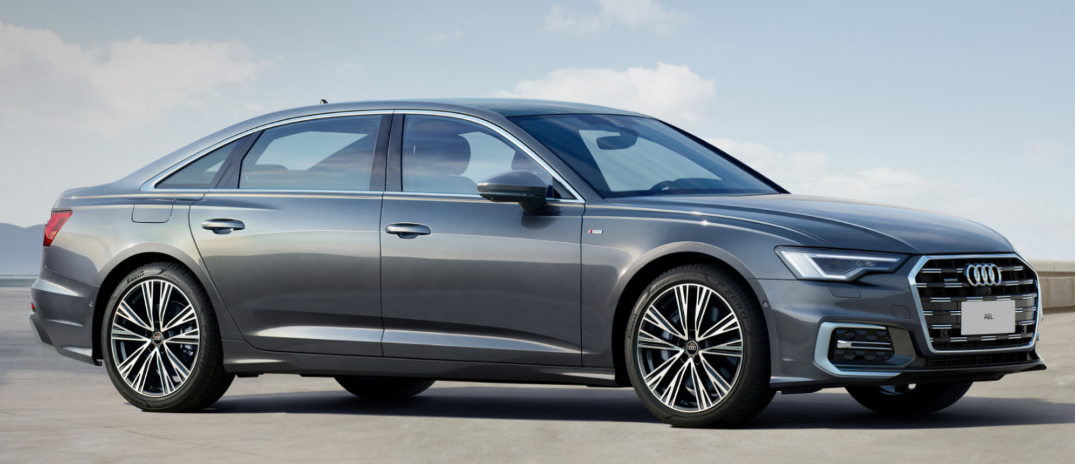
According to a report by Sina Technology on June 30, the domestic luxury gasoline vehicle market is currently experiencing its most significant price slump ever, with Audi's flagship models collectively seeing steep price reductions. The base price of the Audi A6L has plummeted to its lowest level in two decades.
Once considered a coveted status symbol, the Audi A6L used to command waiting periods of several months, and dealers even imposed mandatory decoration price hikes a decade ago. However, the scenario has undergone a sea change.
Presently, the Audi A6L is being offered with discounts generally exceeding RMB 160,000, with certain 4S stores in select cities slashing prices by up to RMB 200,000. The base price of the entry-level model has now dropped to approximately RMB 270,000, marking a more than 40% reduction from the official guide price, effectively a 60% discount.
Audi's financial report for the first quarter reveals that roughly 127,000 vehicles were sold in the Chinese market from January to March 2026, reflecting a 12% year-on-year decline. Cumulative sales of the mainstay A6L model plummeted by 32.8% in the first four months, while monthly sales of the A4L model nosedived by 60%. The core gasoline vehicle lineup is experiencing a collective downturn. Furthermore, data released by the China Automobile Dealers Association in April indicates that Audi's three-year residual value has dropped to 49.8%, making it the sole brand among the BBA (BMW, Benz, Audi) trio to fall below the 50% mark.
An official Audi customer service representative responded to the New Knowledge Research Institute, stating that the company currently only provides market guide prices. The manufacturer's suggested retail price for the 2026 A6L ranges from RMB 427,900 to RMB 558,900, with final transaction prices determined by dealers.
An Audi dealer informed the New Knowledge Research Institute that discounts and incentives vary across different models.
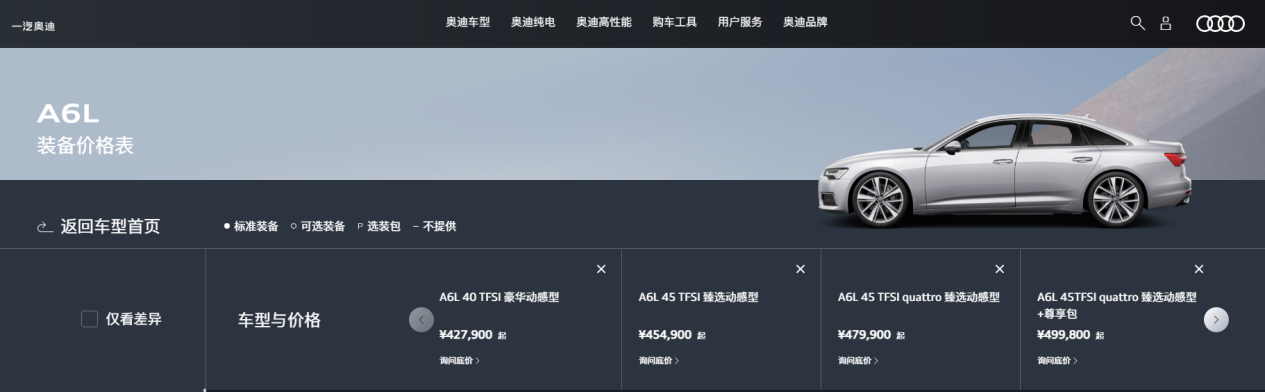
At present, the official guide prices for Audi's A6L models all exceed RMB 400,000. The base price for the A6L 40 TFSI Luxury Dynamic starts at RMB 427,900, the A6L 45 TFSI Premium Dynamic at RMB 454,900, the A6L 45 TFSI quattro Premium Dynamic at RMB 479,900, and the A6L 45 TFSI quattro Premium Dynamic + Premium Package at RMB 499,800.
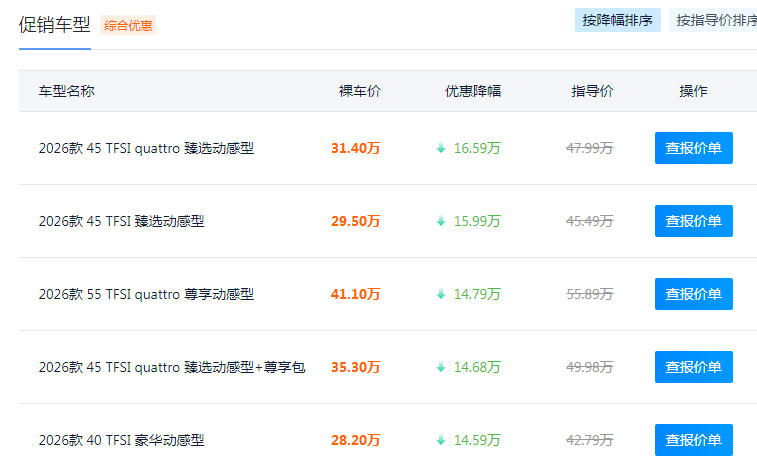
According to A6L discount quotes provided by two Audi 4S stores on Autohome, the 2026 45 TFSI quattro Premium Dynamic is being offered with a discount of RMB 165,900, bringing the base price down to RMB 314,000. The 2026 45 TFSI Premium Dynamic comes with a discount of RMB 159,900, reducing the base price to RMB 295,000. The 2026 40 TFSI Luxury Dynamic is available with a discount of RMB 145,900, lowering the base price to RMB 282,000.
Audi's recent significant price reductions are a response to market transformation and corporate strategic shifts. According to Autohome's analysis, luxury brands previously relied on brand prestige and scarcity to maintain high prices. However, consumers' vehicle evaluation criteria have evolved from 'brand logos' to 'overall experience.' The competitive edge currently enjoyed by new energy models is compelling traditional gasoline-powered luxury vehicles to reevaluate their market positioning.
Driven by product refresh cycles, Audi is clearing the way in the market for a new generation of electric and intelligent models, with gasoline-powered models entering the inventory clearance phase and thus opting for price reductions.
At the market consumption level, consumers' perception of 'luxury' is shifting from external appearance and engine displacement to interaction smoothness, ecological connectivity capabilities, and full lifecycle costs. New energy models at comparable price points offer significant advantages in these areas, making it challenging for older gasoline-powered models to cater to the needs of a new generation of users. Therefore, the price reductions are not merely promotional tactics but also a necessary strategic move for traditional luxury brands seeking to realign with the evolving market trends.
The pricing paradigm of the current gasoline vehicle era is crumbling, and a new value system driven by electrification and intelligence is taking shape. Opting for substantial price reductions reflects Audi's courage and resolve to redefine luxury in this transformative era.
-
![]()
MathWorks: Generative AI Holds Great Potential, Yet a Trusted Toolchain is Essential for Flawless Operation
-
![]()
Small Earphones, Big Business
-
![]()
Volkswagen Slashes 100,000 Jobs, Mercedes-Benz Axes Year-End Bonuses: What’s Ailing German Auto Titans?
-
![]()
Doubao Can No Longer Offer Free Services to 345 Million Users: China's Era of Free AI Is Drawing to a Close
-
![]()
How Can Chinese Small Home Appliances Conquer Southeast Asia Through 'Dimensional Competition'?
-
![]()
Why are top intelligent driving players betting on reinforcement learning?
-
![]()
June 2026 Automobile Complaint Index Rankings: Persistent Problems Ignite Grievances Among Long-term Vehicle Owners
-
![]()
Avita Takes Another Stab at HKEX Listing: Facing the Urgency of Sustaining Operations Amid 11.2 Billion Yuan Loss Over Three Years