In the Next Decade of Joint Ventures, Honda Should Move Away from 'Stubbornness'
 07/24 2026
 526
526
Lead
Introduction
Fully handing over product development rights to China is the first thing Honda should do in the post-joint venture era.
Half of 2026 has passed, and we’ve heard too much about the changes in China’s auto market.
The penetration rate of the new energy market continues to rise, price wars have pushed the entire industry chain into shock, profits have plummeted, and Chinese automakers have risen collectively, making all foreign companies nervous, both domestically and internationally...
Amid such observations, no matter how chaotic the current situation is, there is always consensus on one direction: In the future, the Chinese market will not accommodate so many automakers. After repeated market shakeouts, only a few top players will truly remain in China. As long as the economic environment does not improve, the so-called "small but beautiful" way of operating will disappear amid endless internal competition.
Whenever discussing the future of joint ventures, most voices focus on the simplest multiple-choice question: "live or die."
Perhaps some will always believe that things can go both ways, but with market changes over the past few years, a strict rule for joint ventures has already been established: Without humility, there is no way forward. No amount of rationality can justify otherwise.
This year, as Volkswagen and Toyota have set aside their arrogance and heeded the advice of their Chinese partners to launch a series of localized products, regardless of the results, they have set an example for all joint ventures. Trying to use past strategies to deal with China’s future holds no hope.
For all joint ventures in China, all decisions made in 2026 can only go in one direction. From now on, they must understand that "joint venture" is merely a facade; essentially, everyone will be a Chinese company.
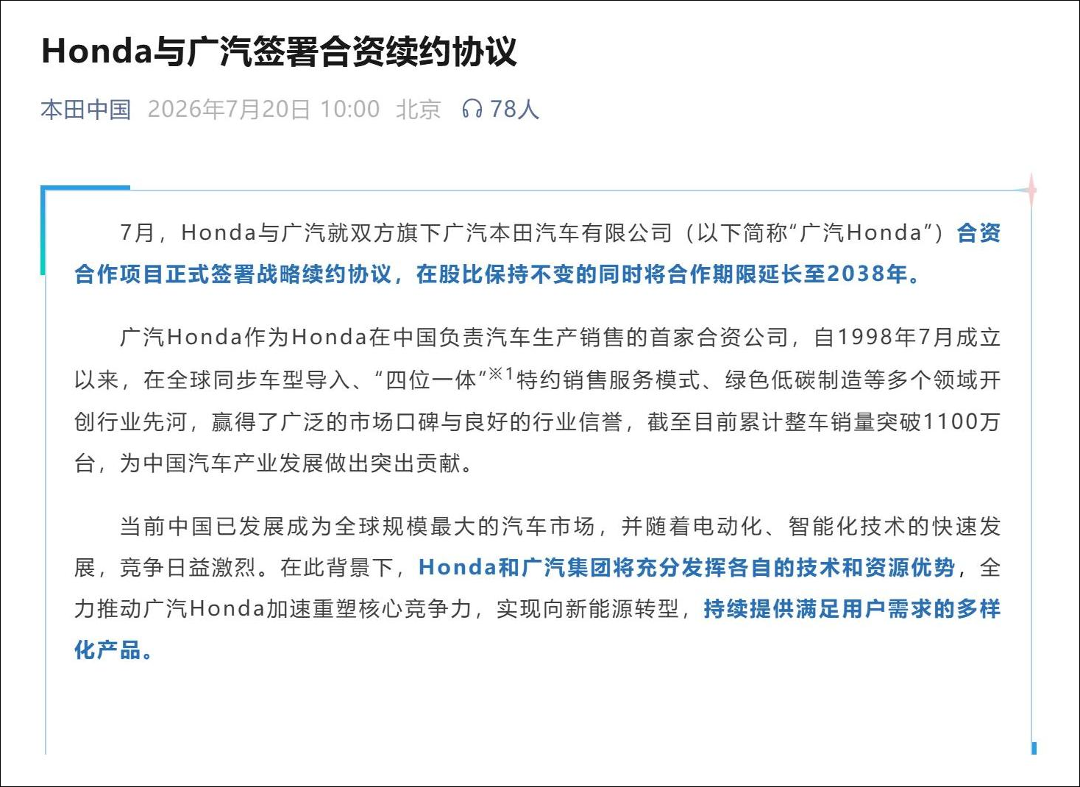
Recently, GAC Honda decided to renew its joint venture agreement, extending the cooperation period until 2038, securing a 12-year "lifeline." However, in reality, this relationship does not guarantee the joint venture's survival but gives Honda one last chance.
In the new era, if Honda repeats its old mistakes, it will truly be kicked out of the market. Along the way, it may fall into a completely passive predicament in the global industrial transformation.
01 Let the Glory of the Past Be Past
Like all previous joint venture renewals, GAC Honda's official statement this time remains very "traditional."
"Leverage respective strengths," "accelerate reshaping core competitiveness," and "achieve transition to new energy." These phrases have repeatedly appeared on the strategic roadmaps of various joint ventures over the past few years, reflecting firm confidence and giving the impression that the next move will outmaneuver everyone.
But with so many precedents, I believe that everyone in the industry still paying attention to joint ventures has already become desensitized. No one cares what heartfelt remarks Honda makes this time; what truly matters is whether Honda's actions in this new cooperation cycle align with the expectations of a post-joint venture era enterprise.
Compared to peers who have swallowed their pride and humbly learned from independent Chinese automakers, if Honda hesitates, drags its feet, or lets pride get in the way, the Chinese market will show no mercy.
Of course, if Honda simply wants to treat China as a technology export hub for its new energy transition, without caring about local sales, then disregard these remarks.
Over more than 20 years of Honda's joint venture in China, we know well where this brand's pride comes from.
In July 1998, in Huangpu, Guangzhou, the Accord rolled off the production line. At that time, China’s auto market was still in its infancy.
While keeping its products up-to-date, Guangzhou Honda (later renamed GAC Honda) introduced the "4S dealership" sales and service model, propelling China’s automotive distribution into a new dimension.
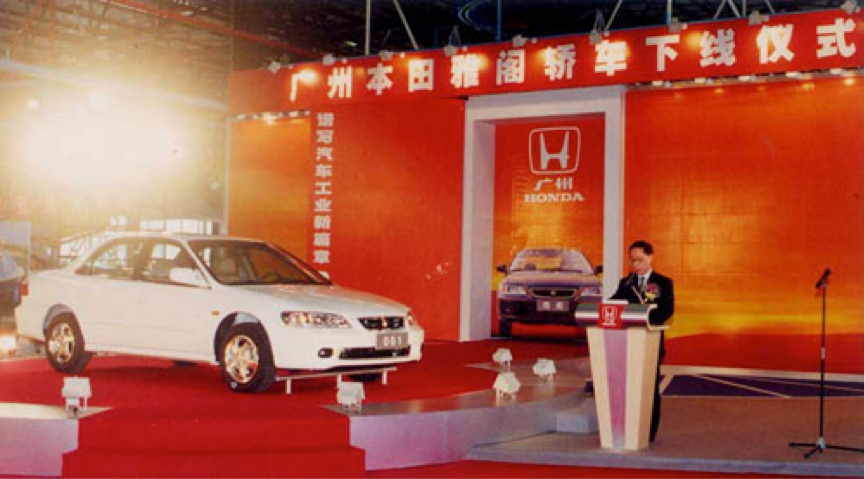
Since then, names like Fit, Vezel, Odyssey, Accord, and Breeze from GAC Honda’s product lineup have dominated their respective segments. In 2020, GAC Honda’s annual sales peaked at 805,800 units, with Honda’s total sales in China reaching 1.627 million. For many who grew up in the joint venture system, these were numbers that would make them smile in their dreams.
Today, cumulative sales of 11 million units are not just cold numbers but represent the trust built with users over time. For a long time, GAC Honda represented a "safe choice"—hassle-free, good resale value, and excellent mechanical quality. That was the dividend of the Chinese market and the confidence given by Honda’s technology.
With this track record, it’s only natural that Honda would remain stubborn in its electrification transition. While Chinese companies are racing ahead in three-electric technology and intelligent equipment evolution, Honda believes that the driving pleasure it values can surpass the advantages of "color TVs, refrigerators, and big sofas."
The results are clear: repeatedly charging ahead on what it considers the right path, not because Honda is unaware of how violent the external environment has changed, but because its confidence makes it believe that the experience it accumulated in China over more than 20 years can alter market demand.
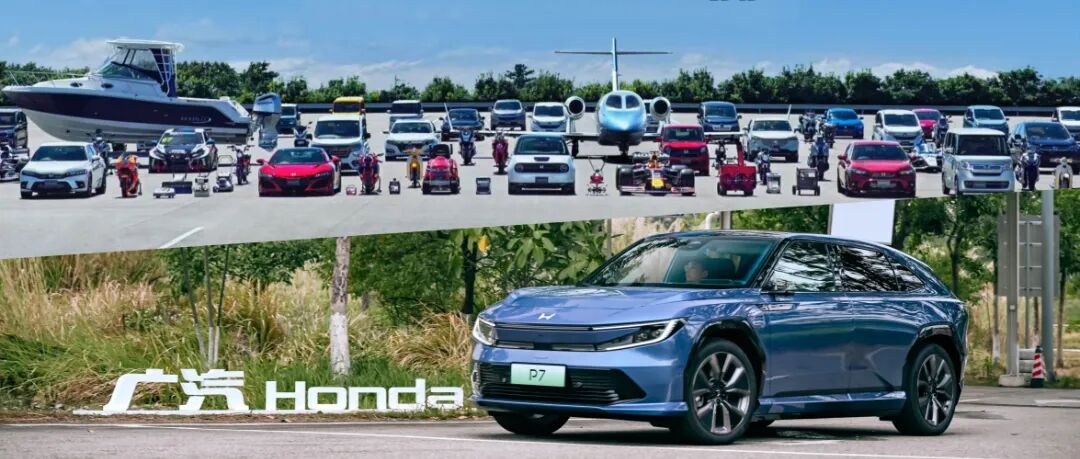
From VE-1 to e:NP1, e:NP2, and then P7, this is a branch of Honda’s electric vehicle evolution chain in China. Unfortunately, Honda has spent five years trying to understand China’s new energy market, like entering a time bubble floating in the sky. When the external environment has been completely overhauled by the new generation, those past glories now appear to be shackles holding Honda back.
In the first half of 2026, GAC Honda’s cumulative sales were only 68,318 units. I believe that no matter how thorough the analysis of this data is, it holds no reference value at this stage because, from now on, China’s auto market has lost patience.
Joint venture? Independent? Traditional? Or new forces? To survive, to avoid being trapped in the fault line between the old and new eras, there’s no one to rely on but oneself to understand the logic of change in China’s auto market.
02 'Arrogance' Is Meaningless in the Face of Development
Over the past six months, we’ve heard too many counterintuitive news about Honda.
Canceling the goal of "completely halting sales of fuel vehicles by 2040," terminating the development and production of three all-electric models in the Honda 0 series for North America, freezing investment in a Canadian battery factory, halting the electric vehicle project co-developed with Sony, and announcing the suspension of sales of its only all-electric model, Prologue, in the U.S. market, putting its cooperation with General Motors on hold...
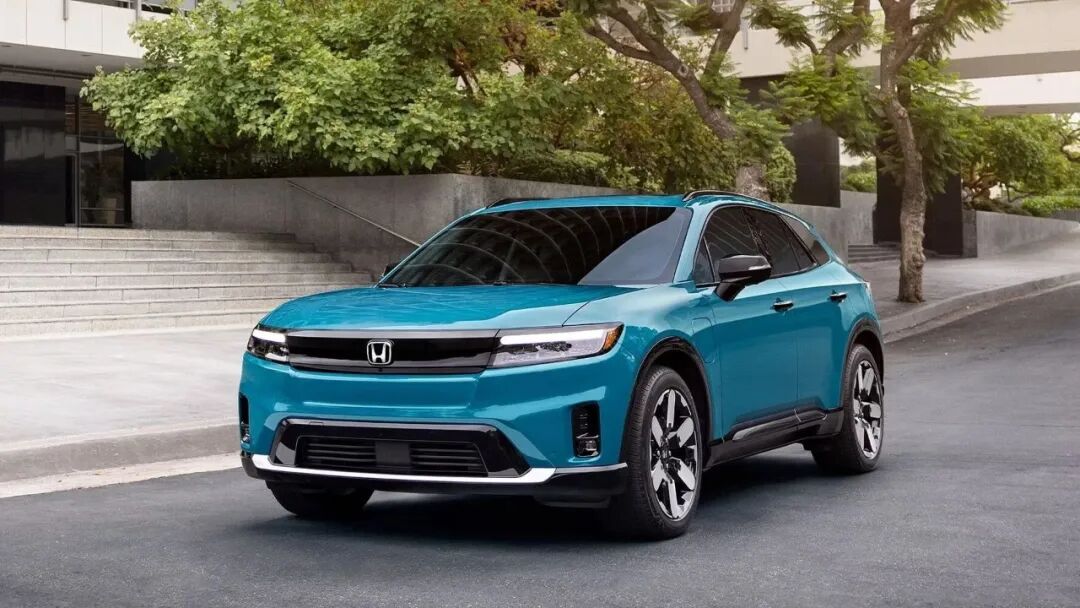
To cut costs and reduce losses, Honda seems to have no choice but to take these measures.
Looking ahead from 2026, Honda may believe it overestimated global demand for all-electric vehicles and is now shifting its strategic focus back to the old path of "hybrid-focused, fuel-supported," reducing investment in electrification transition while elevating hybrid and next-generation fuel vehicle development to unprecedented heights to protect its bottom line.
But in China, Honda’s only path is to diverge from the international market.
Nikkei News once ran a series of front-page reports titled "Don’t Sink, Japanese Cars" and put forward a very extreme viewpoint. To redeem themselves, Japanese automakers must humbly take off-the-shelf Chinese electric vehicles, rebadge them with their own logos and designs, and sell them.
Those familiar with Japanese work ethics know how unconventional such a move would be. Since the oil crisis, Japan has never compromised in a national pillar industry like automobiles. The premise of cooperative R&D and platform sharing is that Japan must have significant participation and say.
Yes, in the Renault-Nissan-Mitsubishi alliance, the weaker Mitsubishi sought technology and platforms from the French and even partnered with GAC early in China to revive the Artoker, but Mitsubishi’s representativeness in Japan’s automotive industry pales in comparison to leading Japanese automakers.
Unless facing a life-or-death situation, it’s almost impossible for giants like Toyota, Nissan, and Honda to humble themselves.
Following Mazda, starting in 2025, after seeing that the launches of the Ariya and bZ4X made no waves, Nissan and Toyota both took action. They partnered with Dongfeng and GAC to respectively launch the N7/N6/NX8 and the bZ3X/7. The relatively positive market feedback not only helped them understand Chinese consumers’ demands but also served as another wake-up call for Honda.
In partnerships, is "rebadging" a shameful act? Clearly not. Since the global automotive industry has had a mature R&D system, such operations have occurred at any stage and in any sales region to spread R&D costs or expand product depth.
In the 1980s, even Honda engaged in transactions with the Rover Group. The two sides exchanged models for rebadging production. Honda provided the Civic and Accord to Rover, while Rover provided the first-generation Land Rover Discovery to Honda, renamed the Crossroad, becoming Honda’s only off-road vehicle sold in Japan.
Later, model exchanges between Honda and Isuzu included SUVs, MPVs, sedans, and even pickups.
So, as the technological balance of the automotive industry’s transition increasingly tilts toward China, what burden can Honda not shed?
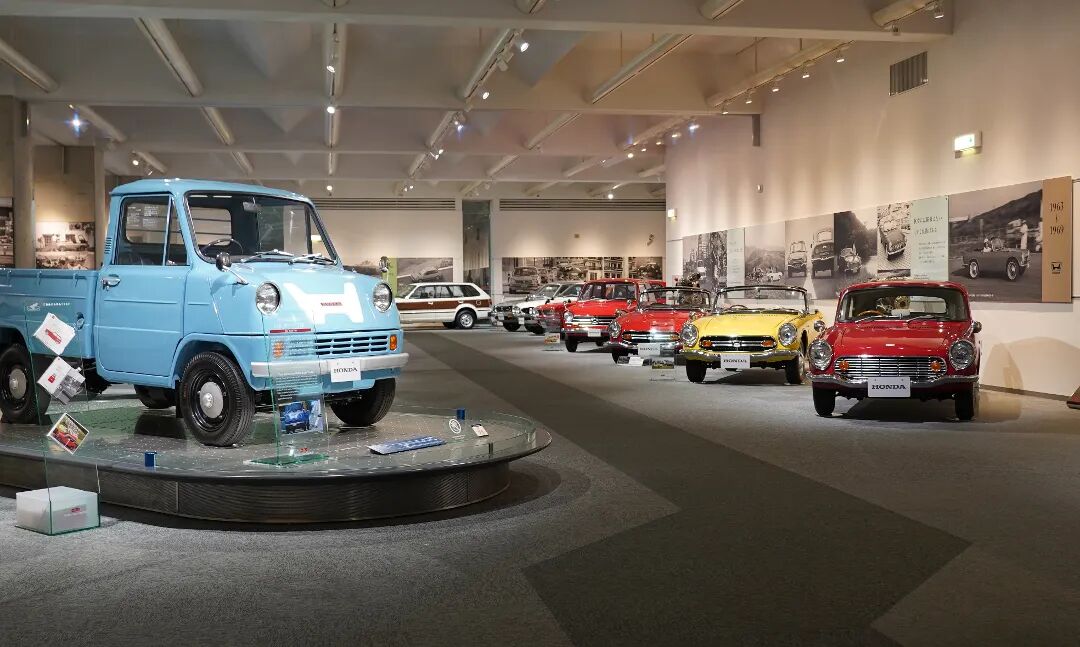
The only thing I can think of is that in the past 30 years, Honda has buried that dark history with its strength, and for emotional and rational reasons, the proud Honda is unwilling to humble itself again, especially when the object is Chinese automakers, whom it once looked down upon.
At the Honda Collection Hall in Tochigi, Japan, among all the exhibits in Honda’s collection, not a single one is a rebadged vehicle. There is only the romance and confidence unique to Honda. Presumably, this is why.
The next decade of joint ventures is a new phase for GAC Honda to reorganize and start anew, but for Honda, shortening the joint venture duration from the original 30 years to 10 years means it may still harbor its own obsessions.
Honda should know that GAC has what it lacks. Whether it’s systematic R&D results in new energy vehicles or a mature understanding of current Chinese consumers’ driving needs, Honda can directly use them. For the future, it depends on how Honda interprets the phrase "leverage respective strengths."
Today, unlike Toyota’s approach of global localization, Honda remains more enthusiastic about maintaining control in a partnership.
In China, for GAC Honda, Honda has merely set another ten-year agreement. During this period, Honda can entrust all planning to China and allow the Chinese partner to endow (fùyǔ - give) new direction to the brand’s soul, but if the results do not meet Honda’s expectations, I believe the joint venture will truly struggle to continue.
Editor-in-Chief: Shi Jie Editor: He Zengrong

THE END
-
![]()
Focus | CCCC’s Takeover of Greentown Comes to Fruition: Why Did the 11-Year ‘Control Without Authority’ Era End?
-
![]()
Final Verdict: The 2026 China Auto Forum Shines with Unique Characteristics at a Pivotal Moment
-
![]()
Tencent Maintains Matrix Approach, Alibaba Merges Entry Points: Tech Titans Initiate AI Agent Consolidation
-
![]()
Geely Secures Portion of Ford’s Spanish Production Capacity
-
![]()
Tesla Stalls This Second
-
![]()
Elon Musk's 'Money-Burning' Spree: All Car Sales Profits Poured into AI
-
![]()
Why Did Tesla’s Profits Drop and Cash Flow Go Negative?
-
![]()
AI Titans Are All in the Red: Time for Intelligent Driving Car Buyers to Reassess?