Hirose Alice’s Smile Reveals the Last 'Fig Leaf' of Japanese Automotive Industry
 07/28 2026
 407
407
Introduction
The precise strategies of Chinese companies have pushed Japanese 'keyboard warriors' to the edge.
Against a vibrant yellow backdrop, Japanese national idol Hirose Alice, donning a striking red outfit and accompanied by an adorable otter, flashes her signature healing smile as she introduces BYD’s latest offering for the Japanese market, the RACCO (Otter) model.
Recently, BYD meticulously crafted a TV commercial to promote its latest all-electric 'light vehicle' (K-Car) product, the Otter, for its launch in Japan. From the script to the scenes, and even the casting and makeup, the commercial exudes a distinctly Japanese style, almost indistinguishable at first glance from local K-Car product advertisements, such as those for the Honda N-BOX and Suzuki Spacia. Throughout the commercial, aside from the exposed BYD logo, not a single word or shot deliberately emphasizes that this is a Chinese automotive brand.
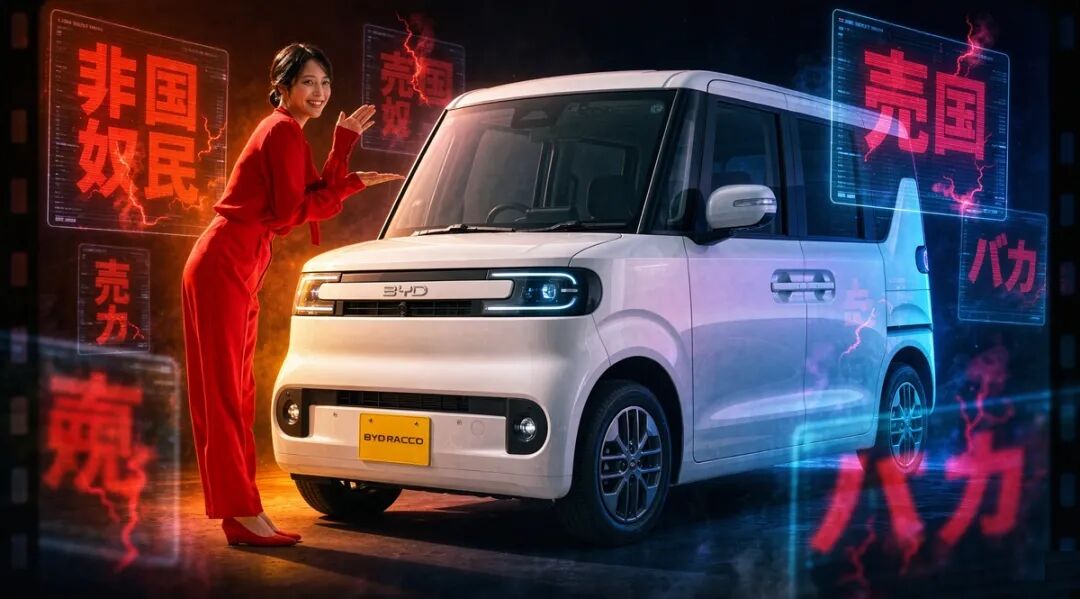
Yet, it was precisely this thoroughly Japanese-style commercial and the purely Japanese K-Car product it promoted, entirely developed by a Chinese company, that sparked an unprecedented wave of online harassment against Hirose Alice, the commercial’s spokesperson.
'This cannot be dismissed as just an ordinary commercial! It's exploiting Japanese goodwill to attack Japan's key industries!'
On the social media platform X (formerly Twitter), self-proclaimed 'conservative' Japanese netizens were outraged, promptly labeling Hirose Alice as 'unpatriotic' and a 'mercenary lackey.' In their eyes, no matter how Japanese the commercial and product appeared, it could not be positively interpreted as 'respecting local customs and culture.' Instead, it was seen as insidious and even despicable—because the more your product meets their standards and the more your commercial resembles a 'Japanese car,' the more it proves that you not only want to seize market share but also intend to encroach upon their home turf. As a result, being called 'unpatriotic' was the least of Hirose Alice’s problems; had it been a different era, 'non-national' would have been the most fitting label for her.
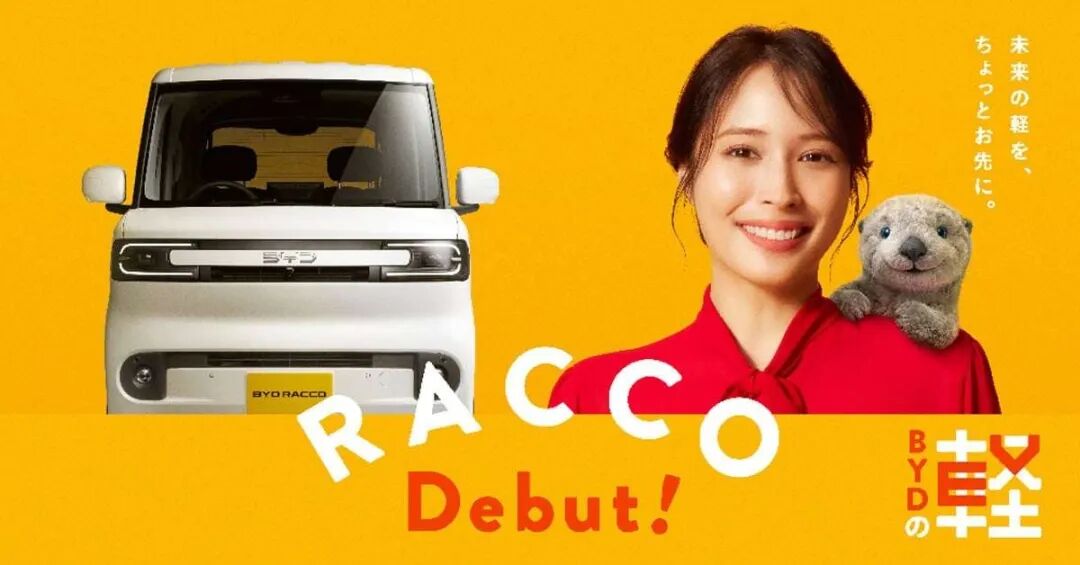
Figure: The official banner for the Otter, featuring a completely Japanese composition and aesthetic, even down to the color grading. Japanese netizens, unable to find any real issues, resorted to harassing the female spokesperson.
Even on Japan's largest anonymous female community, girlschannel.net, evaluations of Hirose Alice were relatively dignified and somewhat rational, focusing more on the issue than the person. However, many local netizens hurled the most intense profanities at her, with some remarks being particularly vile.
Yet, beneath this cyber spectacle, we must ask: Are these Japanese online mobs truly enraged solely by Hirose Alice's 'unpatriotic' behavior?
01 K-Car: The Last Bastion of Japan's Automotive 'Yamato Damashii'
Many people stereotype the Japanese as generally ignorant and shallow, oblivious to changes in the global economy and technology, and unable to perceive their nation's comprehensive decline in recent years, instead clinging to fantasies of 'Japan first.' This is not entirely accurate, at least in the automotive industry, where a significant portion of the Japanese population possesses a clear awareness. However, they often choose to feign ignorance in daily life, relying on collective self-censorship and pretending nothing is amiss to maintain a sense of stability.
After all, even within Japan, the momentum of Chinese companies at recent Tokyo Motor Shows has made it futile to turn a blind eye or deaf ear. Nevertheless, some Japanese hold a peculiar belief that no matter how impressively the Chinese build 'large vehicles,' when it comes to the Japanese domestic market, only K-Cars that align with their society and national conditions truly matter. They argue that only Japanese companies, which truly understand Japanese society and the practical needs of car owners, can build good K-Cars. No matter how advanced Chinese EVs are, they cannot produce vehicles that comply with Japanese K-Car regulations and adapt to Japan's narrow streets and unique aesthetics.
In essence, this represents the last 'national defense line' of 'Yamato Damashii' reflected in the automotive industry!
To be honest, this logic is somewhat far-fetched, reminiscent of the Daoguang Emperor and his court's belief that 'simply cutting off trade in tea and rhubarb with the foreign barbarians would cause these meat-eating barbarians to die from indigestion.' However, the Japanese do not see it that way, and their reasoning is readily available—since January 2023, BYD has sold a total of fewer than 10,000 units in Japan, including the ATTO 3 (Yuan Plus overseas version), Seal, Dolphin EV, Dolphin DM-i, and the compact Dolphin model. While sales have been modest, the reasons are evident: insufficient dealerships (fewer than 70 by the end of 2025), targeted denial of subsidies by the Ministry of Economy, Trade, and Industry, and a lack of charging infrastructure in Japan. However, the most critical issue remains the absence of products that comply with Japan's unique vehicle regulations.
Among the currently sold product lineup in Japan, the Dolphin, while classified as an A0-class compact car by Chinese standards, does not meet the Japanese Ministry of Land, Infrastructure, Transport, and Tourism's definition of a 'light vehicle' and thus cannot enjoy the purchase tax, new car weight tax, and annual vehicle tax exemptions for K-Cars. It also misses out on various road toll discounts, insurance and annual inspection benefits, and even preferential parking policies in various Japanese regions.
However, anyone with logical thinking skills should recognize by now that the notion that only Japanese companies can build good K-Cars is merely drawing a target around the bullet hole. Ultimately, it boils down to a product adaptation issue based on policy. For any complete vehicle manufacturer with robust product definition and R&D capabilities, the only barrier is whether they deem the market worthwhile.
And now, a 'giant crocodile' has indeed set its sights on it...
02 A 'Fierce Beast' in Otter's Clothing
At first glance, the Otter appears to be a product under BYD's Ocean Network, with a name that evokes a sense of cuteness. However, it essentially represents BYD's standard operating procedure, this time achieving a 'precise fit' within the Japanese market. Many Japanese, upon learning about its specifications, consider it a 'fierce beast' disguised in a soft and cute exterior, infiltrating the Japanese market.
The vehicle measures 3395mm in length, 1475mm in width, and 1800mm in height, precisely adhering to the Japanese Ministry of Land, Infrastructure, Transport, and Tourism's regulations for K-Cars, which stipulate a maximum length of 3400mm, width of 1480mm, and height of 2000mm. Its overall structure is based on the widely recognized optimal N-BOX design for K-Cars and features dual sliding doors.
In terms of the crucial range for electric vehicles, the Otter comes in three variants: 200, 300Plus, and Pramium, equipped with 22.4kWh and 35.84kWh blade batteries, respectively. The official range is 210 kilometers for the 200 variant and 320 kilometers for the 300Plus and Pramium variants. Additionally, this K-Car of Chinese origin boasts a feature currently considered a game-changer in the Japanese market—external discharge capability, with a maximum power output of 1.5kW.
Earthquakes and typhoons are commonplace in Japan, often leading to power outages during disasters, necessitating that every household have an emergency power source. Especially in the past year, with escalating tensions in the surrounding region, the Japanese government has encouraged citizens to equip their homes with emergency power systems. However, a 16kWh home energy storage system costs two million yen on the market, and many Japanese households are reluctant to spend such a sum. Purchasing an all-electric K-Car with external discharge capability solves both transportation and emergency power needs for Japanese households, making it highly competitive.
Among the current K-Cars in the Japanese market, the Nissan Sakura and Mitsubishi eK X EV are the only all-electric competitors. However, both are based on electrified modifications of existing internal combustion engine platforms, representing the previous generation of 'oil-to-electric' conversions. They are equipped with only 20kWh battery packs and have an official range of 180km. Faced with the Otter, developed on a pure electric platform, their performance disadvantages become glaringly apparent.
Moreover, BYD possesses extensive experience and far deeper technological accumulation in the three electric systems (battery, motor, and electronics) compared to Japanese companies. When comparing the officially declared range figures, it's evident which would suffer more significant discounts—a matter that requires little thought. As for external discharge capability, these two older models simply do not offer it.
However, aside from these two veterans, there is still one other competitor to consider. Honda is currently advancing the electrification of its N-ONE model, introducing the all-electric K-Car named N-ONE e:.
From its name, it may seem like an electrified version of the N-ONE, but Honda claims to have thoroughly revised it, adopting a 'battery box bottom-mounted' design. According to the WLTC standard, its range can reach 270km, and it also features a maximum external discharge power of 1.5kW. Thus, it can be roughly considered to have approached the technical level of the pure blood new energy platforms launched by Chinese counterparts around 2018-2019.
Since BYD's high-profile unveiling of the Otter in 2025, the development pace of the N-ONE e: has significantly accelerated. Honda recently brought the trial production model of this product to the Goodwood Festival of Speed and will open pre-orders on August 1st. However, its official launch will not occur until after the Munich Motor Show in September this year.
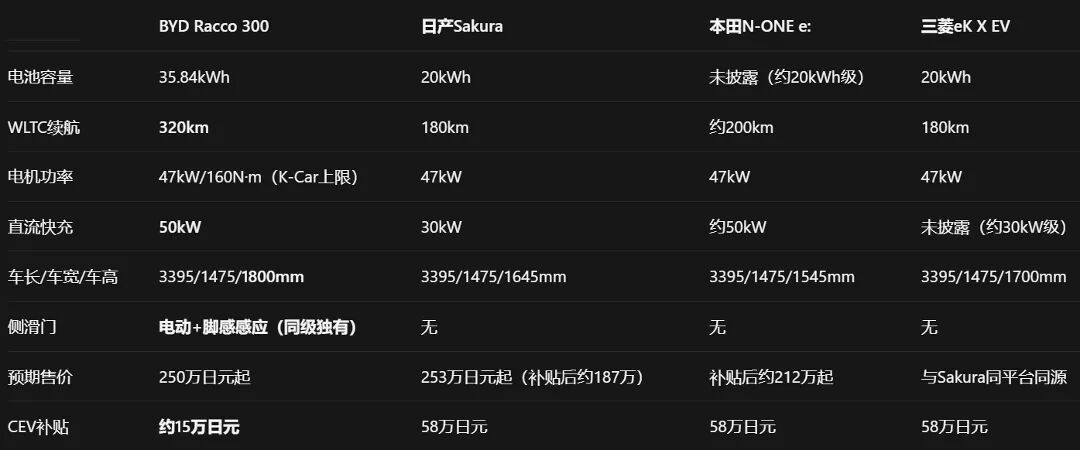
Figure: The performance characteristics of the aforementioned models make it almost immediately clear which is superior.
Of course, compared to these new and old competitors, the Otter has one significant 'flaw': its subsidies are noticeably smaller than those of local competitors.
Japan updated its Clean Energy Vehicle (CEV) subsidy policy this year, allowing Japanese car owners purchasing the Sakura, eK X EV, and even the N-ONE e: to receive a subsidy of 580,000 yen, reducing the subsidized price to 1.87 million yen (Sakura/eK X EV) and approximately 2.12 million yen (N-ONE e:). In contrast, the Otter has only been approved for a subsidy of around 150,000 yen, resulting in a starting price of 2.35 million yen, significantly higher than its competitors.
03 Plundering Their Lairs, Sweeping Through Their Dens
Of course, as we write this, we must avoid the misconception that BYD is the only Chinese automaker eyeing the Japanese K-Car market. How could such a business opportunity lack the presence of Chery, which never misses any overseas market, and Wuling, which specializes in 'small car' businesses?
On May 27th this year, Chery, in collaboration with four partners (Japanese Autobacs, Gotion High-Tech, Japanese Anest Iwata, and Yueda Group), announced the establishment of a joint venture company, EMT, in Tokyo. They plan to launch a new all-electric brand, EMTA, without using the Chery logo, effectively entering the Japanese market incognito.
The first vehicle from EMT will be an all-electric K-Car. Based on currently available information, the new car's range will be between 155-220km, with pricing ranging from approximately 1.74-2.48 million yen depending on the variant, on par with comparable internal combustion engine K-Cars, directly competing with the Honda N-BOX.
Crucially, Chery is leading this project with a team of former Honda and Mazda engineers from Japan to oversee the vehicle's architecture design, while Chery primarily contributes the three electric systems and cabin driving technology. This strategy of 'using Japanese expertise to counter Japanese companies' is ruthless, eliminating excuses about 'not understanding Japanese road conditions' and even tearing away the fig leaf of 'aesthetics not aligning with Oriental aesthetics.'
According to Chery's plans, the new car will begin deliveries in Japan next spring, manufactured at the Yueda Yancheng plant.
Moreover, Chery's ambitions are substantial, with the EMT brand planning to launch at least four new models by 2029. Currently, the partners have already begun discussing the establishment of local production facilities in Japan after 2030.
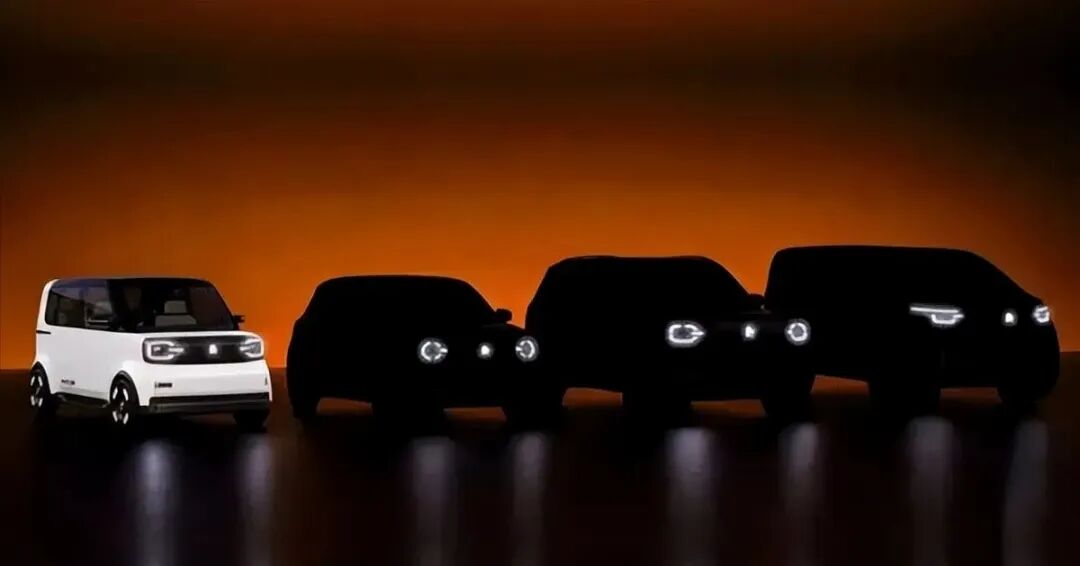
Figure: Don’t assume Chery is 'practicing asceticism' just because they have less publicity and a lower profile...
While local production and supply chains are beneficial for the Japanese market, given the Japanese propensity for narrow-mindedness, the remarks are naturally unpleasant. On 2ch, Japanese netizens have discussed this matter, generally believing that 'this is not just about selling cars; it's a technological 'Black Ship'' (a reference to Commodore Perry's Black Ships that opened Japan to the West).
As for Wuling, this automaker has always prided itself on 'building what the people need,' so when entering the Japanese market four years ago, it initially targeted not passenger cars but the commercial light logistics segment of the K-Car market. This classic approach of encircling cities from the countryside is very 'Chinese.'
In September 2022, Guangxi Automobile Group (Wuling New Energy) signed a G050 mass production contract with Japanese ASF Co., Ltd. The Japanese side paid the R&D fees, and Wuling contract-manufactured the G050, designed as a K-Car commercial vehicle that smoothly passed Japanese TDS certification. This right-hand drive product offers a range of approximately 230km and can be equipped with a solar charging panel in its top-tier variant.
Since its commencement of mass production and subsequent market launch in April 2023, the vehicle has set a relatively conservative target of '100,000 units sold within five years.' However, by the beginning of this year, the G050 had already secured a substantial procurement order from Sagawa Express, intended to replace its aging fleet of internal combustion engine delivery vehicles. This achievement propelled the G050 to the forefront of the market share for new energy logistics vehicles in Japan, effectively preempting the livelihoods of Japanese commercial vehicle manufacturers before capturing their market share.
It is noteworthy that the G050, a compact vehicle, was listed in the Ministry of Industry and Information Technology's declaration directory last October, effectively marking its return to China. Wuling's strategic move not only generated profits but also reintroduced a mature model to the domestic market, with the Japanese market serving as a testing ground this time.
Now, let's revisit the initial topic.
The online harassment directed at Hirose Alice can be seen as a futile emotional outburst.
Some Japanese elites, such as the late Suzuki chairman who once declared, 'We will never succumb to the Chinese market,' recognized the looming threat early on. Nevertheless, despite their deep-seated anxieties and tough rhetoric, all Japanese business and political decision-makers, including him, find themselves powerless against the relentless march of history.
As for the grassroots netizens, constrained by their limited understanding, they can only vaguely perceive the increasingly dire situation. They resort to cyberbullying an innocent actress as an outlet for their frustrations, while concealing their profound lack of confidence in their own country's industrial competitiveness.
Japan's vaunted 'Kuuki' culture, characterized by a tacit understanding at the social group level where people remain silent despite knowing the truth, choosing not to breach the unspoken barriers, appears particularly absurd in this context. This 'air' attempts to dictate and dissuade celebrities from accepting advertisements from Chinese brands. However, the invisible hand of market forces tells consumers from another perspective: this car offers high configuration, low pricing, and disaster resilience. Once 'air' fails to withstand the test of cost-effectiveness, this hypocritical balance will inevitably crumble.
The launch of BYD's Hai Otter, coupled with Chery's EMTA's period of dormancy and deep cultivation, along with the circuitous market penetration of the Wuling G050, signifies that the Chinese automotive industry has grown robust enough to execute 'precision strikes' on any front. We have not only mastered the art of crafting high-quality vehicles but also learned to play by your rules, communicate in your language, and undermine your foundations.
On July 28th, the Hai Otter will be officially unveiled. Regardless of the online rants and raves from Japanese netizens, one fact remains unchanged: the last bastion of private territory for Japanese cars has been infiltrated by Chinese automakers 'wielding excavators.' If even a market as heavily regulated, prejudiced, and fortified as Japan can be breached, then which market in the world, lacking the support of local automakers, can remain impenetrable to us?
As for Hirose Alice, there's no need to panic. When the Hai Otter enjoys robust sales, the Japanese will continue to scold and purchase simultaneously. By then, you will still stand as the national goddess at the forefront, accepting commissions with a smile. After all, compared to the illusory fantasy of 'Japan Number One,' the pragmatic minds of the Japanese people always keep a more realistic tally.
Editor-in-charge: Du Yuxin Editor: He Zengrong

THE END
-
![]()
Is Design the Root of the Problem? The Lexus ES Dilemma: Despite New and Old Models Coexisting Post-Redesign, Sales Plummet by 40%
-
![]()
Are Japanese Automakers Now Taking Cues from China? A Perspective on Japan's Reversal in Learning
-
![]()
In the First Half of the Year, Car Companies’ Profit Margin Plummets to 3.8%! CPCA: Automakers Must Speed Up Battery Production Amid Upstream Pressures | MINGJING Pro
-
![]()
Tesla’s Q2 Revenue Rises, Yet Profitability Slips; Energy Storage Margins Take a Dive
-
Chinese Automakers Strike Gold Overseas: Prices Double?
-
![]()
Joint Ventures, Once Dismissed, Are Now Making a Comeback
-
![]()
Automotive Market News: Retail Penetration Rate of New Energy Vehicles Reaches 62.8%
-
![]()
Once a Sales Leader Among New Car Manufacturers, Now Selling Equipment at Bargain Prices