Yutong Bus Steps Up the Rollout of an External Circulation Marketing Model Among Listed Companies
 07/29 2026
 527
527
Recently, Yutong Bus has established three new automotive sales and service companies: Yuwei Shuntong (Hebei), Yuwei Shuntong (Nanning), and Yuwei Shuntong (Qingdao). With the ongoing establishment of regional sales entities, a direct sales entity network, built on the foundation of "listed company control + key employee equity participation," is taking shape at an accelerated pace. Yutong Bus is steadily expediting its deployment of an external circulation marketing model among listed companies.
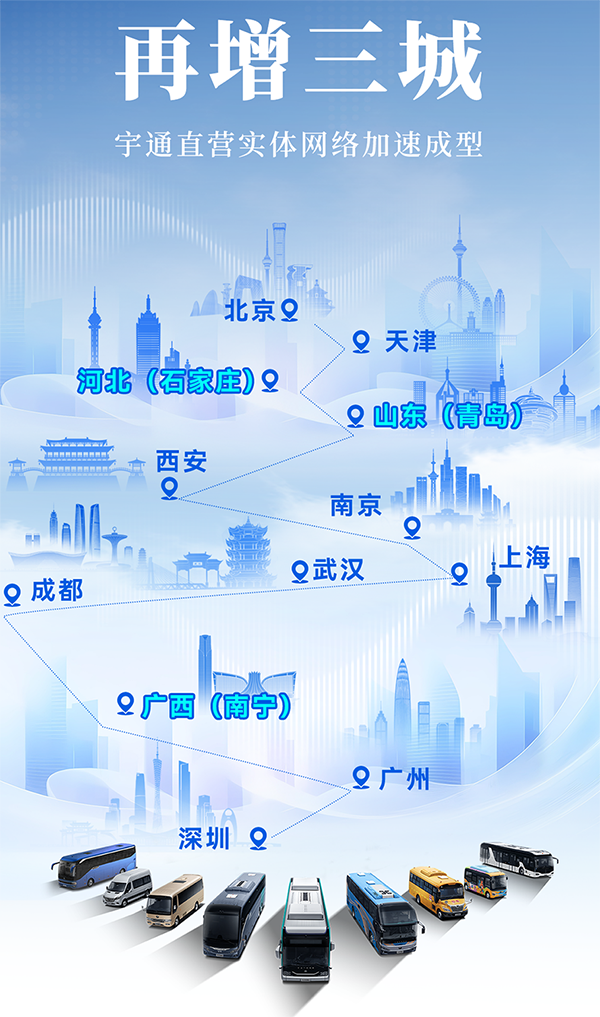
Business information reveals that as of June 2026, Yutong has set up 13 regional sales companies in key cities and provinces, including Shenzhen, Shanghai, Chengdu, Xi'an, Nanning, Qingdao, and Hebei. These companies cover core markets in East China, Southwest China, North China, the Bohai Rim, and the Beibu Gulf. The equity structure of each entity is highly consistent: the Yutong Bus system holds nearly 70% for absolute control, while frontline key personnel, such as regional general managers and district managers, hold the remaining nearly 30% of the equity and serve as legal representatives.
Senior executives from Yutong Bus uniformly serve as company directors, achieving a seamless integration of headquarters control and localized operations. These joint ventures act as the operational entities for Yutong user centers (direct sales stores) in various regions. Unlike traditional dealer agency models, the Yuwei Shuntong platform operates through direct sales (engaging directly with customers to deeply understand their differentiated needs), direct service (swiftly responding to customer maintenance needs and continuously providing feedback for product upgrades), and direct financing (flexibly matching financial solutions for different scenarios). Its business spans the entire service chain, including vehicle sales, original factory maintenance, finance and insurance, and charging and battery swap facilities, creating a closed-loop for full lifecycle services of commercial vehicles.
By advancing this model, Yutong can, on the one hand, overcome the limitations of traditional dealers, take control of the channels, unify service standards, and directly reach end customers, such as government and enterprise clients and logistics companies. On the other hand, it can establish a more flexible talent incentive system. Compared to the complex equity incentives of listed companies, the equity participation mechanism for employees in regional companies offers faster realization, aligning regional operational benefits with core sales teams and stabilizing key personnel. Additionally, innovative businesses, such as charging and battery swap operations and used vehicle sales, can be piloted in joint venture platforms, isolating trial-and-error risks, smoothing out performance fluctuations of the listed company, and continuously expanding a nationwide grid-based offline direct sales network.
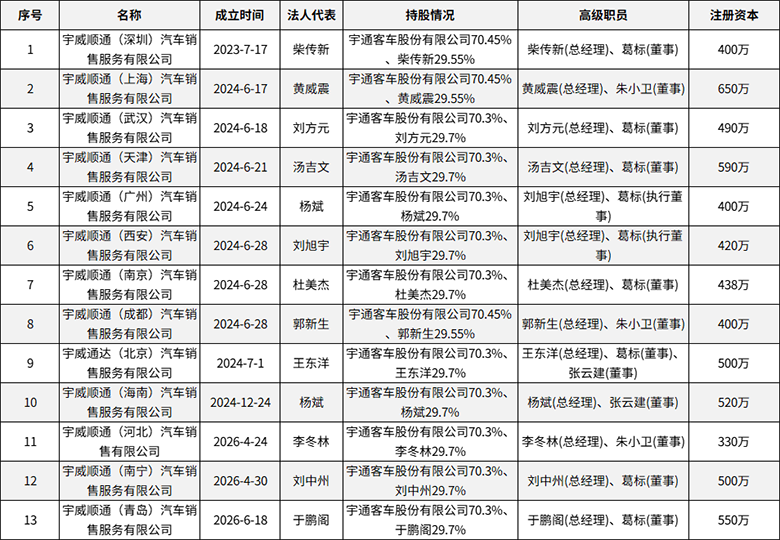
The choice of a holding (controlled) joint venture structure for automotive sales and service companies aims to strike a balance between control and autonomous operations. Yutong maintains absolute control, ensuring unified brand pricing and strategic consistency, while granting regional teams a degree of operational autonomy to effectively adapt to differentiated market conditions across regions. Regional leaders holding operational rights for Yuwei Shuntong in various regions have effectively become "market governors."
This structure embodies a clear logic of personnel isolation: marketing terminals, which are directly linked to market interests, have been separated from the management system of the listed company. Under the 70-30 equity model, team benefits are entirely tied to regional operational performance, but at the cost of regional leaders largely severing their path to return to the listed company's senior management. In terms of organizational control, Yutong may establish a new functional department to coordinate nationwide direct sales outlets while retaining a special reporting mechanism, allowing regional direct sales leaders to report directly to top management. This approach delegates local operational autonomy and stimulates expansion through equity participation while relying on top-level direct channels to firmly control strategic direction, creating a delicate balance.
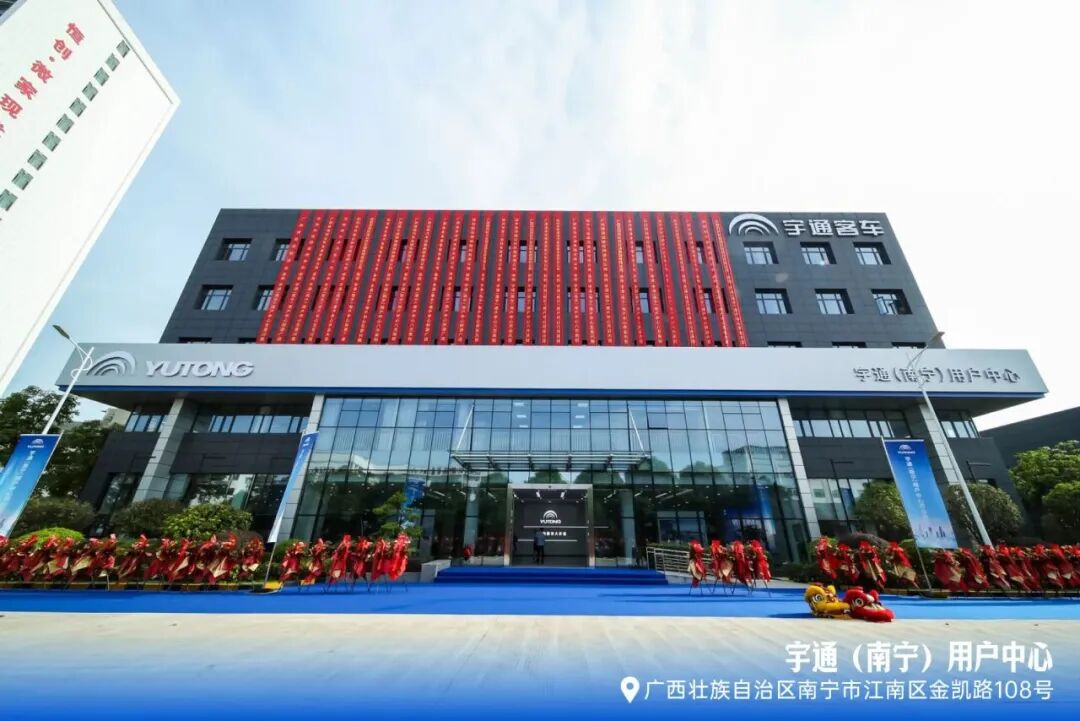
Direct store showrooms and maintenance facilities represent significant asset investments. The joint venture model can share expansion costs and alleviate capital expenditure pressures on the listed company. Regional leaders, who are also shareholders, help curb behaviors such as short-term sales surges and disorderly price competition. As the commercial vehicle market enters a phase of inventory competition, with the focus shifting from products to channels and full lifecycle services, Yutong's direct sales joint venture channel model offers a novel solution to industry challenges. Leveraging offline user center entities, Yutong not only shortens the distance to customers but also supports the expansion of its full product range, including buses, light trucks, heavy trucks, and sanitation vehicles, effectively solidifying its domestic market foundation. From pilot testing in Shenzhen in 2023, the concentrated launch of eight enterprises in 2024, to the continuous opening of new stores in multiple locations in 2026, Yutong's direct sales channel expansion continues to accelerate. This unique external marketing operation system is poised to become Yutong's core competitive advantage in the domestic market.
-
![]()
McKinsey 2026 Mobility Report: Consumers Are Redefining What Makes a 'Good Car'
-
![]()
Duan Jianjun Spearheads Premium Project as Volvo Sets Sights on Rivaling Zunjie with New Flagship Model
-
![]()
Absent from New Energy Vehicle Rural Promotion, Leapmotor Turns Its Gaze Overseas
-
![]()
Reclaiming Global Dominance! Apple’s Market Cap Surges to $5 Trillion in Cook’s Epic Finale
-
![]()
Sales Soar: Has Ora Staged a Remarkable Comeback?
-
![]()
What Kind of AI Phones Do We Actually Need?
-
![]()
DingTalk, Feishu, and WeCom's Silent 'March Eastward'
-
![]()
Is 'Data Scarcity' More Fatal Than 'Computing Power Shortage'? Is It Bringing Disaster?