Half-Year Profit Plummets by 30%! Volkswagen Group's 5-Hour Supervisory Board Showdown Rejects Plant Closures and 100,000 Job Cuts
 07/30 2026
 462
462
Written by | Guanchejun
Volkswagen Group, Europe's largest automaker, is grappling with a crisis far more formidable than merely declining sales: internal strife.
On July 24th, Volkswagen Group unveiled its half-year financial results for 2026.
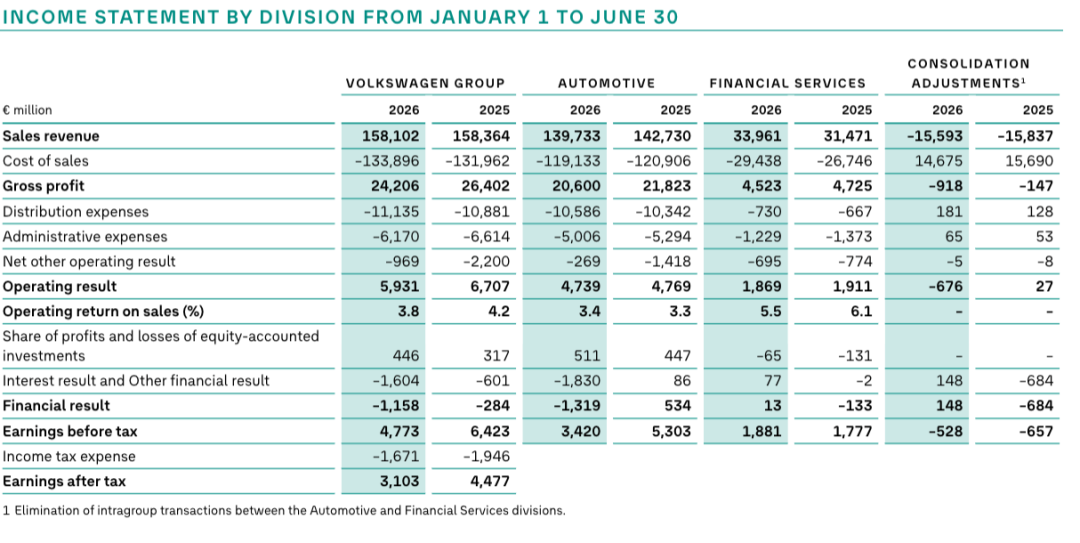
Guanchejun noted that in the first half of the year, Volkswagen Group's revenue reached €158.1 billion, experiencing a marginal year-on-year decline of 0.2%. However, the profit drop was more pronounced, with operating profit plummeting by 11.6% year-on-year, resulting in a mere 3.8% profit margin, significantly below the long-term target of 8%-10% set for 2030. After-tax profit was directly reduced by 30%.
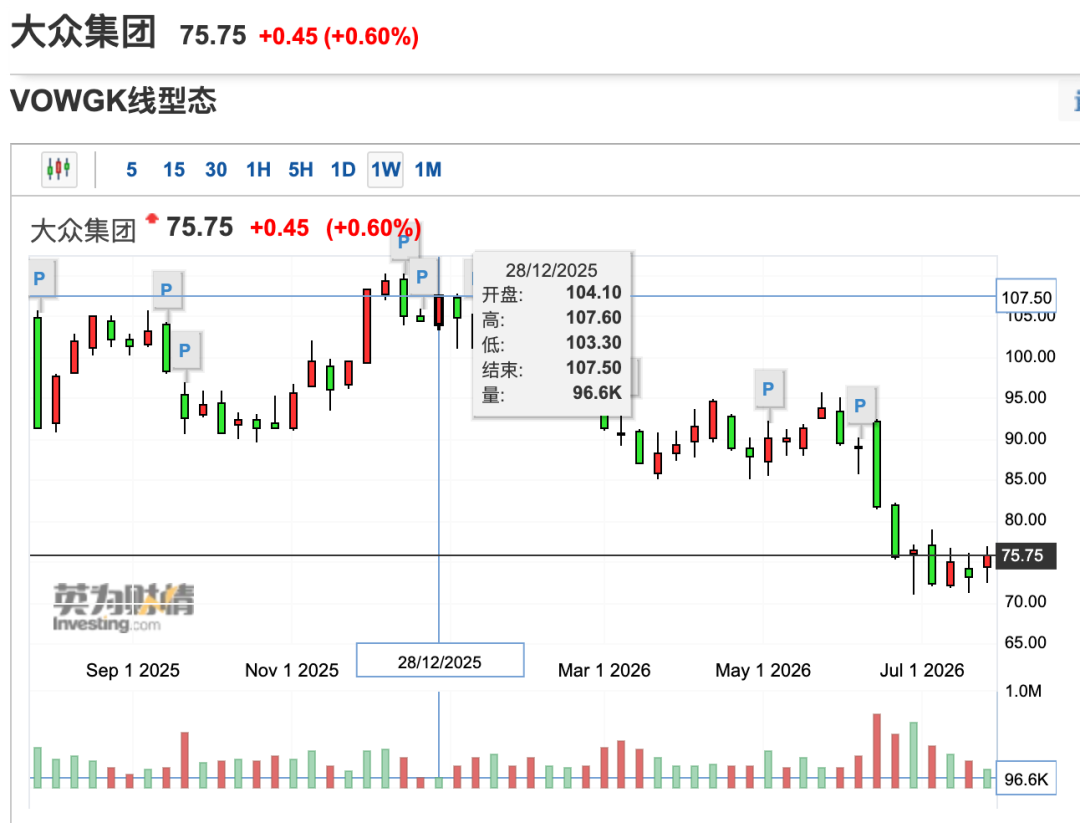
More alarmingly, Volkswagen's stock price has plummeted by approximately 30% this year.
But that's not the end of the story; even more dramatic than the financial figures is the recently concluded 'behind-the-scenes drama' reminiscent of palace intrigue.
More than two weeks ago, Volkswagen's supervisory board convened for a grueling five-hour meeting, during which management's radical restructuring plan—which included shutting down four factories in Germany and slashing up to 100,000 jobs—was decisively rejected. The opposition votes came from employee representatives, with a final tally of 12 to 7.
Management viewed the same financial report as a 'survival crisis,' while labor unions interpreted it as 'reform yielding results.'
The divide is now out in the open, and neither side appears capable of swaying the other.
Why does management perceive a survival crisis? Hidden behind the first-half profit decline is a 6.3% drop in Volkswagen Group's global deliveries, a staggering 31.6% decline in joint venture sales in China, and a 63.6% reduction in joint venture equity profits.
Interestingly, Guanchejun pointed out that Volkswagen's global sales, excluding China, actually witnessed a slight uptick of 0.6%, suggesting that the problem lies squarely in China and is attributable to the 'dimensionality reduction attack' from Chinese domestic brands.
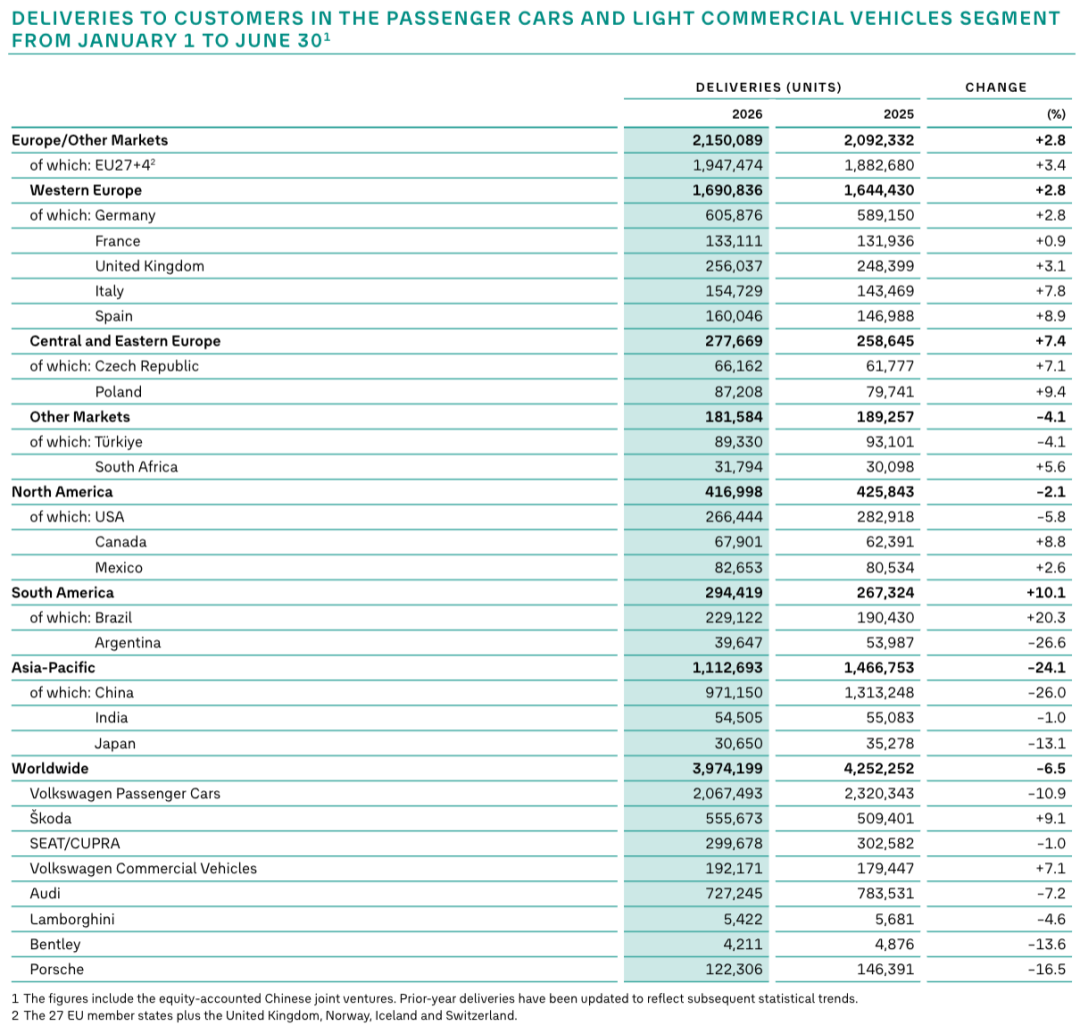
Furthermore, the truck and financial businesses continued to weigh down Volkswagen's performance, with the 'other/consolidation offsets' category recording a loss of €1.05 billion. Capacity at German domestic factories is also severely underutilized (overcapacity), with the Zwickau factory projected to have only 42% capacity utilization by 2030.
Management proposed sweeping reforms: halving the model lineup, reducing global production capacity to 9 million vehicles, planning to shut down four German factories, and cutting an additional 50,000 jobs, bringing the total job cuts to up to 100,000, all aimed at rapidly reducing costs to support heavy investments in electrification and software.
Why do labor unions view the reform as showing results? Because in the first half of the year, Volkswagen Group's core brand group's operating profit rose by 4.5% against the trend, with continuous improvements in the luxury segments of Audi and Porsche;
Losses at software subsidiary CARIAD significantly narrowed, and battery business losses were reduced by over €100 million, with quality businesses collectively increasing profits by about €1 billion.
Guanchejun observed that the core disagreement between the two sides lies in management's advocacy of first cutting capacity and personnel to reduce costs, then restoring product competitiveness; while labor demands first straightening out products, intelligent technologies, and regional layouts, then adjusting factories and jobs.
Moreover, the core dissatisfaction among the workforce is that a labor agreement was signed at the end of 2024, with employees agreeing to voluntarily cut 35,000 jobs, saving the company €1.5 billion in annual labor costs, in exchange for retaining domestic factories and no forced layoffs.
In just a year and a half, management seeks to overturn this agreement.
The labor unions bluntly stated: the company's missteps in electrification pace, software development delays, and strategic misjudgments in the Chinese market are management's decision-making failures, which should not be borne by frontline workers.
Many may wonder why labor unions dare to be so confrontational. Because at Volkswagen, major decisions are never made by the CEO alone, nor even by a simple majority.
Volkswagen has a 'dual moat':
The first layer: The supervisory board comprises 20 seats, with shareholders and employees each holding half. In case of a tie in ordinary resolutions, the chair has the deciding vote, but factory closures require a two-thirds majority of all supervisors. With collective opposition from employee representatives, you cannot pass.
Even more formidable is the 'Volkswagen Law,' which governs this company with special federal legislation, requiring over 80% of shares to approve major matters. The government of Lower Saxony holds 20% of the voting rights, effectively possessing a veto power.
The state government has made it clear: 'We support cost-cutting, but factory closures are not the future solution.'
"So, no matter how urgent CEO Oliver Blume is, he cannot bypass this legal wall.
Finally, Guanchejun wants to emphasize that Volkswagen's crisis is not merely about overcapacity or profit decline, but about an old empire discovering that its governance structure, interest patterns, and cultural inertia, which it relies on for survival, are ten thousand times harder to change than building an electric vehicle when transitioning to a new world.
The game theory (strategic interactions) in the second half of 2026 will intensify. The workers' assembly at the end of August may mark the commencement of a new storm.
All charts in this article, unless specified otherwise, are sourced from public disclosures through various channels. We hereby acknowledge and express our gratitude! The views expressed herein are for reference only and do not constitute investment advice.
-
![]()
Initiation of Control over Access for Intelligent Driving's 'Little Blue Lights'
-
![]()
Is the Intelligent Driving Blue Light, a Source of Pride for Lixiang and AITO Owners, Facing a Ban?
-
![]()
Embarrassing Meta: Promises Made, Money Invested, but No 'Fruits' Yet
-
![]()
BMW Announces Thousands of Job Cuts via 'Voluntary Exit Scheme'
-
![]()
Official Announcement: Intelligent Driving Blue Light Banned Due to Safety Concerns; Automakers React Swiftly | Mirror Pro
-
Each Truck Can Cut Fuel Costs by 200,000 Yuan Annually! Why Are New Energy Vehicles Scarce in the Booming Electric Heavy Truck Market Led by CNHTC, Sany, and Dongfeng?
-
![]()
Kingsoft Office Triples Performance Amidst Trust Controversy
-
![]()
The Leading Self-owned Brand Changes Hands in the First Half of the Year, with the Top Five Automakers Showing Diverse Trends