Official Announcement: Intelligent Driving Blue Light Banned Due to Safety Concerns; Automakers React Swiftly | Mirror Pro
 07/30 2026
 511
511
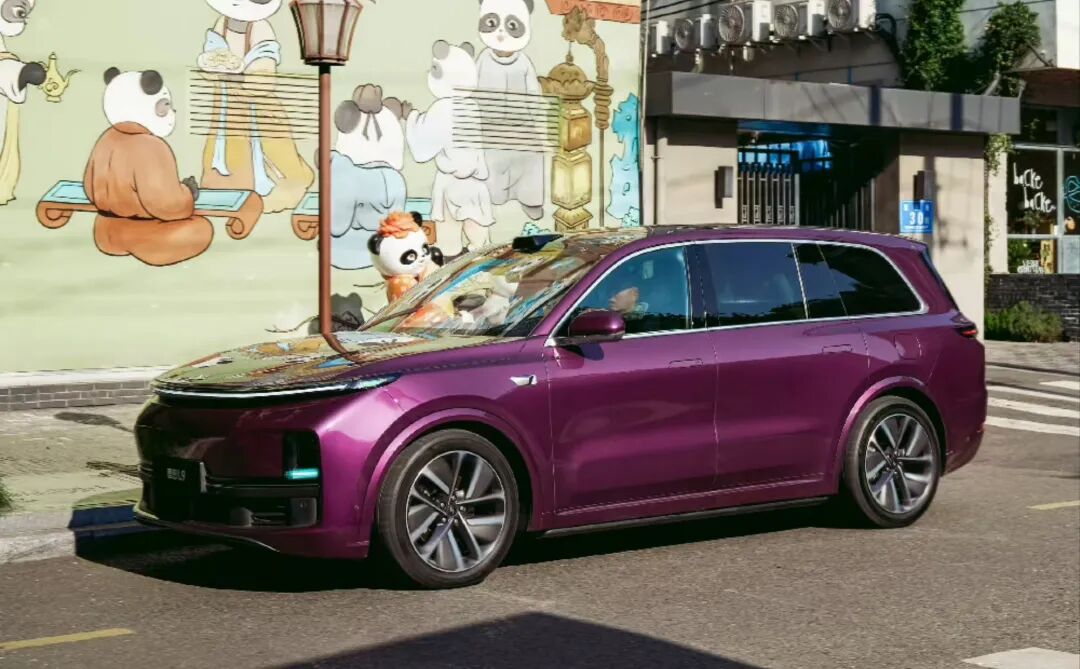
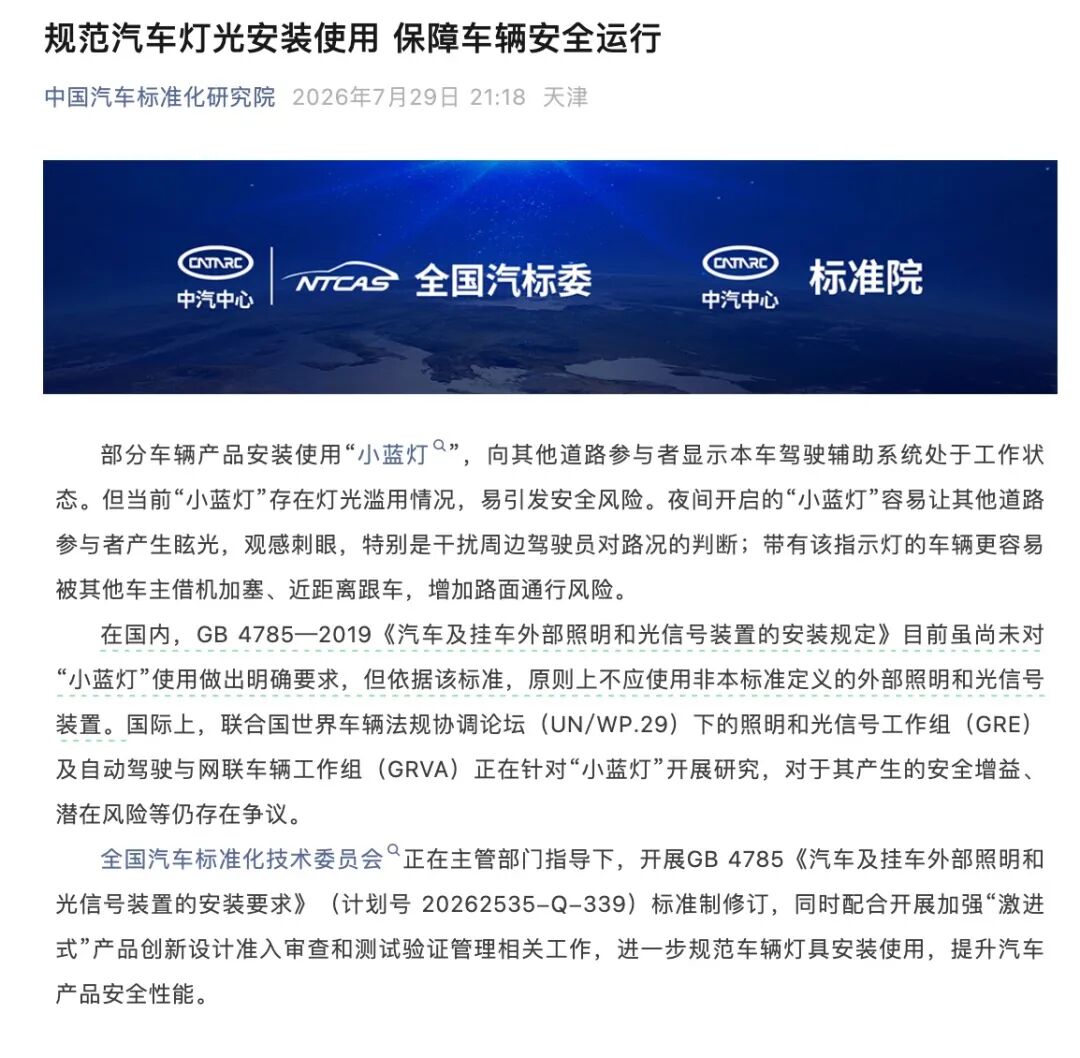
The intelligent driving 'Blue Light' has been abruptly suspended. On the evening of July 29, the China Automotive Standardization Institute (hereinafter referred to as the 'Automobile Standards Committee') issued a statement explaining the reasons for the suspension. The committee stated that the current use of the 'Blue Light' is prone to misuse, which can easily lead to safety hazards. When activated at night, the 'Blue Light' can cause glare for other road users, resulting in visual discomfort and particularly interfering with surrounding drivers' judgment of road conditions. Vehicles equipped with this indicator light are more likely to experience cut-ins or tailgating from other drivers, thereby increasing road safety risks.
The Automobile Standards Committee pointed out that domestically, although GB 4785—2019 'Installation Requirements for External Lighting and Light Signaling Devices of Automobiles and Trailers' has not yet explicitly addressed the use of the 'Blue Light,' the standard stipulates that, in principle, external lighting and light signaling devices not defined by the standard should not be used. Internationally, the Working Party on Lighting and Light Signaling (GRE) and the Working Party on Automated Driving and Connected Vehicles (GRVA) under the United Nations World Forum for Harmonization of Vehicle Regulations (UN/WP.29) are currently researching the 'Blue Light,' with ongoing debates regarding its safety benefits and potential risks.
It is reported that under the guidance of the competent authorities, the Automobile Standards Committee is revising GB 4785 'Installation Requirements for External Lighting and Light Signaling Devices of Automobiles and Trailers' (Planned Number: 20262535-Q-339). Additionally, efforts are being made to strengthen the review and testing management of 'aggressive' product innovation design access, further standardizing the installation and use of vehicle lighting and enhancing the safety performance of automotive products.
Early on the morning of July 29, news surfaced that the installation of intelligent driving 'Blue Lights' on passenger vehicles would be prohibited due to non-compliance with GB 4785 'Installation Requirements for External Lighting and Light Signaling Devices of Automobiles and Trailers.' Furthermore, starting from the 410th batch of product declarations by the Ministry of Industry and Information Technology (MIIT), prototype vehicles equipped with 'Blue Lights' will not be approved for product announcements. The MIIT will also discuss measures to address vehicles already sold with Blue Lights. This news immediately sparked heated discussions.
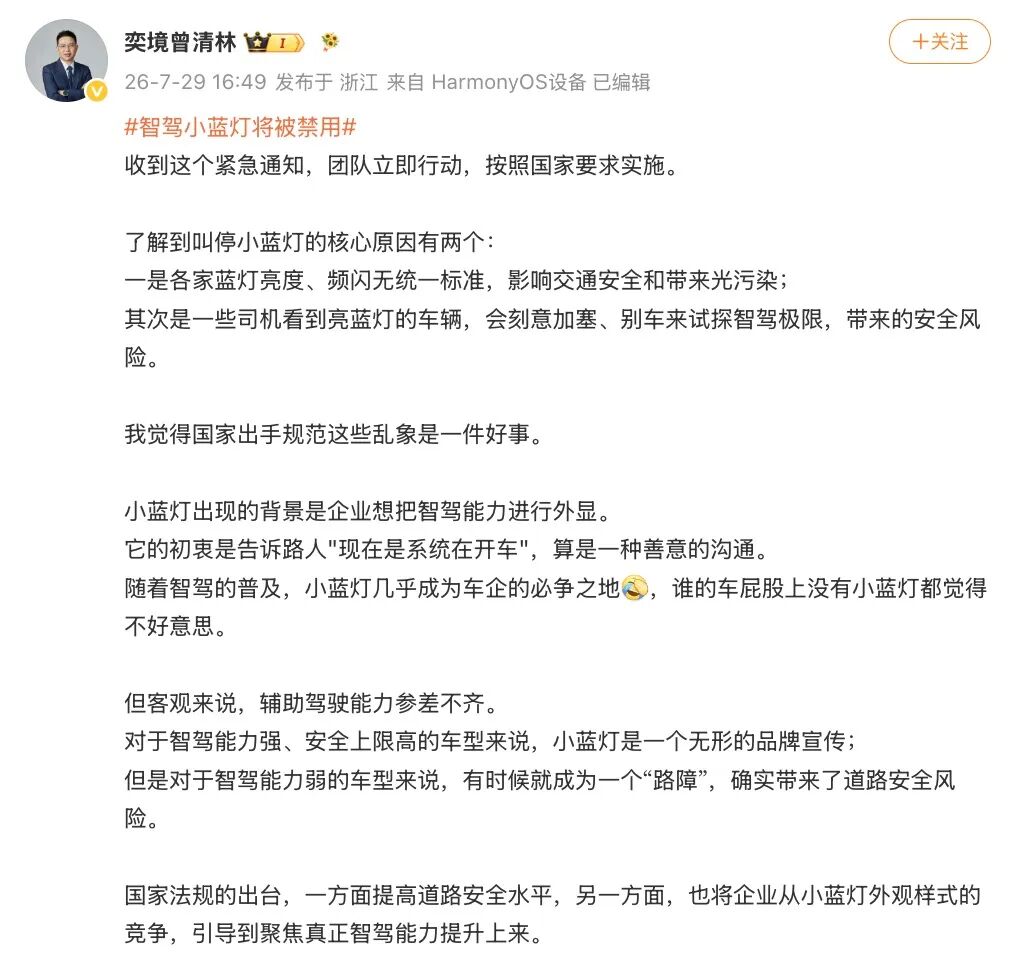
Upon the announcement, multiple automakers swiftly responded, confirming the authenticity of the rumors. Zeng Qinglin, General Manager of Yijing Auto, wrote, 'Received this urgent notice, and our team immediately took action to comply with national requirements.' Geely also stated through media channels, 'We are aware of the news and will strictly adhere to national regulations, awaiting further instructions.' Li Xiang, an executive at Li Auto, lamented on social media, 'Cherish the 'Blue Light' while you still can.'
This development implies that a batch of new models pending declaration may need to urgently adjust their design plans, potentially affecting their market launch timelines. Additionally, Ma Lin, Vice President of NIO, cautiously stated, 'I checked online and found no explicit regulations yet.'
In addition to prohibiting new vehicles from featuring the Blue Light function, another issue of concern is how to handle vehicles already sold with Blue Lights. Currently, there is no official document mandating the removal or deactivation of the lights by vehicle owners. Industry insiders analyze that in the future, automakers will likely address compliance issues related to the Blue Light through OTA (Over-the-Air) updates.
The so-called intelligent driving Blue Light is an indicator for the assisted driving system, which illuminates when the vehicle's assisted driving is activated to remind surrounding traffic participants that the vehicle is in assisted driving mode. Li Auto was the first domestic automaker to implement the intelligent driving 'Blue Light,' featuring it on the Li L9 in 2022. Subsequently, the intelligent driving 'Blue Light' has been widely adopted in the industry, with models from brands such as Seres, XPeng, Xiaomi, NIO, BYD, and Zeekr incorporating it. XPeng even offered a paid installation service for older vehicle owners without the Blue Light. Additionally, decorative Blue Light accessories are available for purchase on certain shopping platforms.
However, the intelligent driving Blue Light has always existed in a regulatory gray area. The current mandatory national standard GB 4785-2019 imposes strict requirements on the types, colors, and installation positions of automotive external lighting devices but does not mention the category of 'intelligent driving status lights.' In other words, the Blue Lights on the market lack a clear compliance basis and uniform implementation standards, relying solely on individual automaker designs.
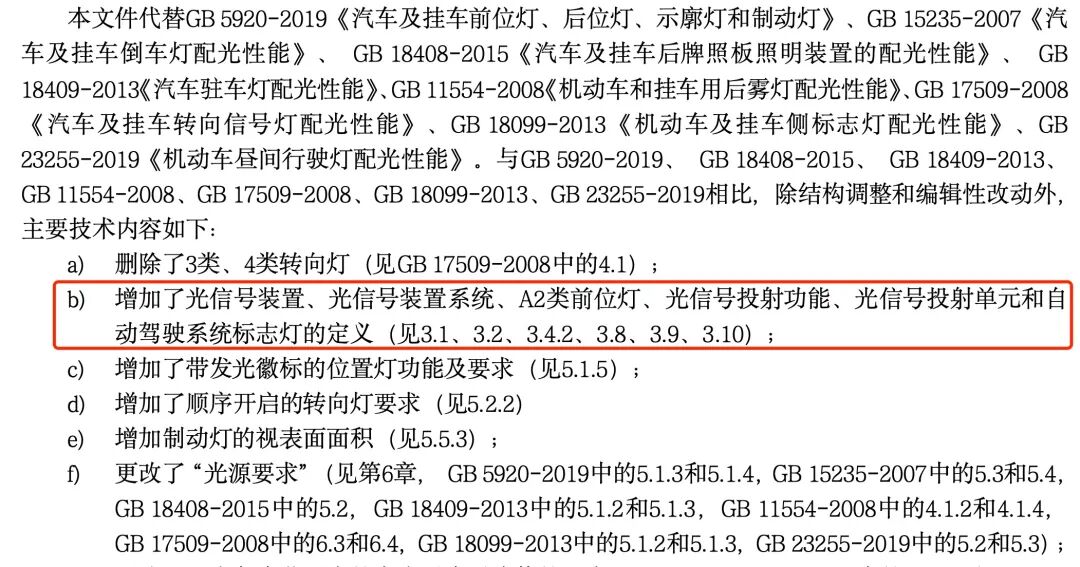
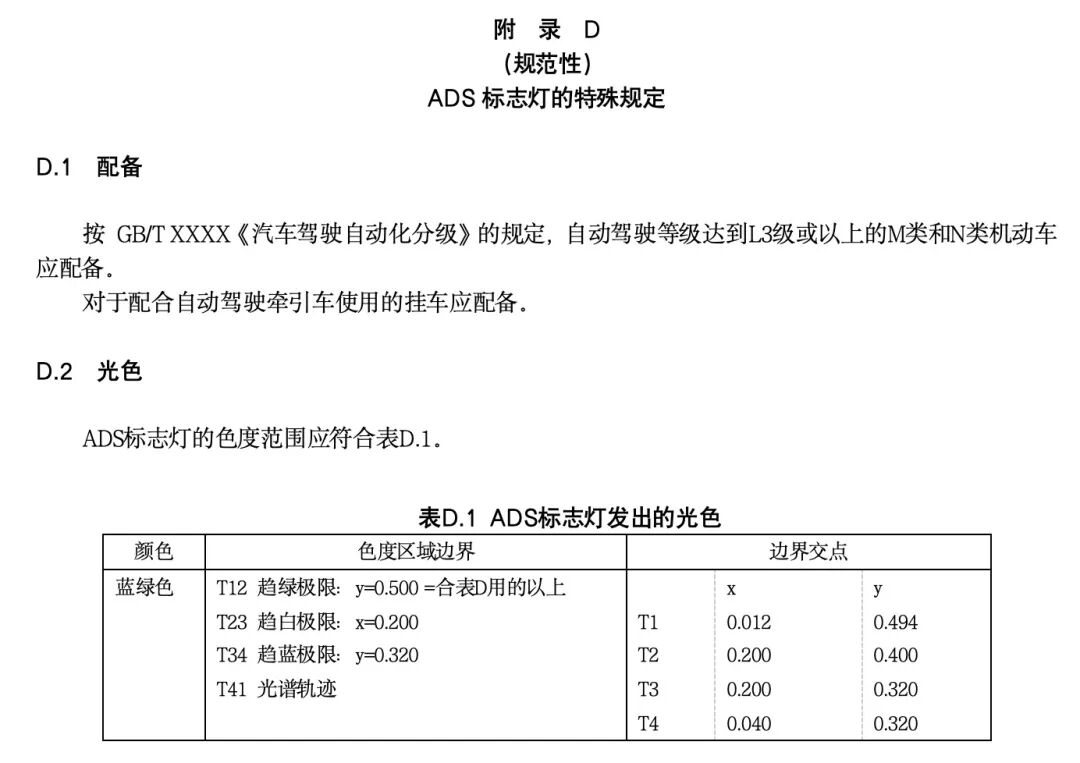
It is worth mentioning that in 2021, the Ministry of Industry and Information Technology (MIIT) released a draft for comments on 'Light Signaling Devices and Systems for Automobiles and Trailers,' which introduced a definition for the Autonomous Driving System (ADS) indicator light—a light indicating to other road users that the autonomous driving system is controlling the vehicle's operation. Appendix D of the draft specifically outlined the details for the ADS indicator light, designating it as an exclusive identifier for L3-level and above autonomous vehicles and detailing technical parameters such as light color, quantity, installation position, and visibility. However, in the final version of GB 5920-2024 'Light Signaling Devices and Systems for Automobiles and Trailers,' released in 2024, all clauses related to the ADS indicator light were entirely removed.
The Blue Light has faced considerable criticism online. The two primary criticisms are as follows, with the first one being particularly prominent: 'XX's Blue Light is really problematic; the brightness of the four lights is comparable to fog lights, and following behind is truly blinding.' 'XX has Blue Lights on both rearview mirrors; they are really small but also really dazzling.' 'Too bright; following behind a Blue Light at night is extremely dazzling.' 'Driving at night is dazzling, especially in the rain.' Many netizens commented under posts related to the Blue Light being banned by the police.
'I believe it is a positive move that the state is stepping in to regulate these issues,' said Zeng Qinglin. The emergence of the Blue Light stems from companies' desire to externalize their intelligent driving capabilities, with the original intention of informing passersby that 'the system is driving now,' serving as a well-intentioned form of communication. 'With the popularization of intelligent driving, the Blue Light has almost become a must-have for automakers; not having a Blue Light on your vehicle seems embarrassing,' Zeng Qinglin remarked.
In Zeng Qinglin's view, the current assisted driving capabilities in the industry vary widely. For models with strong intelligent driving capabilities and high safety limits, the Blue Light serves as an invisible brand promotion; however, for models with weak intelligent driving capabilities, it can sometimes become a 'roadblock,' indeed posing road safety risks. 'The introduction of national regulations will not only enhance road safety but also shift companies' focus from competing over the appearance of the Blue Light to improving genuine intelligent driving capabilities,' Zeng Qinglin stated.
However, some users believe that the Blue Light should be retained because it helps surrounding vehicles determine whether the vehicle ahead is using assisted driving, prompting them to maintain a safe distance. Although the Blue Light is currently banned, it does not mean a complete exit. With L3-level autonomous driving gradually approaching mass production, the future may see the reintroduction of standardized autonomous driving indicator lights under a more comprehensive regulatory framework. After all, compared to an outright ban, the industry more needed a clear and enforceable set of technical standards.
-
33,473 X9 Vehicles Recalled: Xpeng's Three Major Challenges
-
![]()
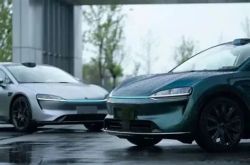
Initiation of Control over Access for Intelligent Driving's 'Little Blue Lights'
-
![]()
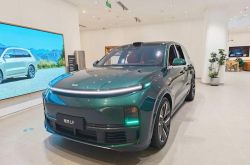
Is the Intelligent Driving Blue Light, a Source of Pride for Lixiang and AITO Owners, Facing a Ban?
-
![]()
Embarrassing Meta: Promises Made, Money Invested, but No 'Fruits' Yet
-
![]()
BMW Announces Thousands of Job Cuts via 'Voluntary Exit Scheme'
-
![]()
Official Announcement: Intelligent Driving Blue Light Banned Due to Safety Concerns; Automakers React Swiftly | Mirror Pro
-
Each Truck Can Cut Fuel Costs by 200,000 Yuan Annually! Why Are New Energy Vehicles Scarce in the Booming Electric Heavy Truck Market Led by CNHTC, Sany, and Dongfeng?
-
![]()
Kingsoft Office Triples Performance Amidst Trust Controversy