Farewell to the 'Little Blue Light': Advanced Driving Assistance Systems Still Require Standardization
 07/31 2026
 480
480
Produced by/Electric New Species
Author/Jichuan
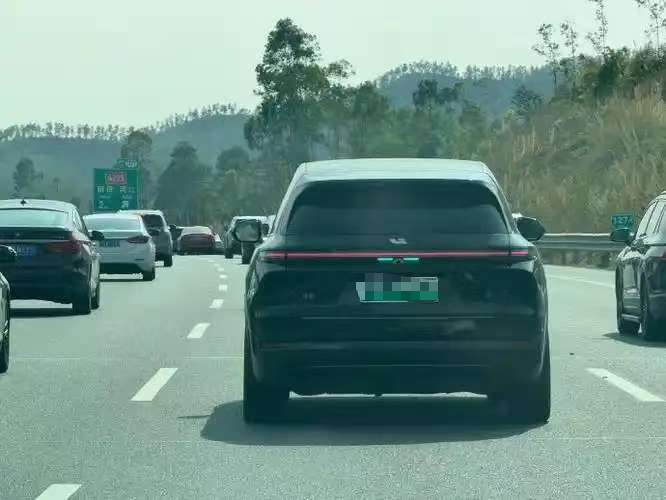
The most talked-about topic in the automotive industry lately is undoubtedly the impending prohibition of the 'intelligent driving Little Blue Light'.
On July 29, various media outlets reported that the 'Little Blue Light' used for intelligent driving might be banned, sparking widespread discussions among netizens. The topic quickly became a trending topic on Weibo, triggering heated debates among vehicle owners and industry experts.
That evening, the China Automotive Standardization Research Institute responded, noting that the current intelligent driving Little Blue Lights on the market suffer from issues of light misuse, posing significant risks to road safety and setting the tone for industry-wide discussion.
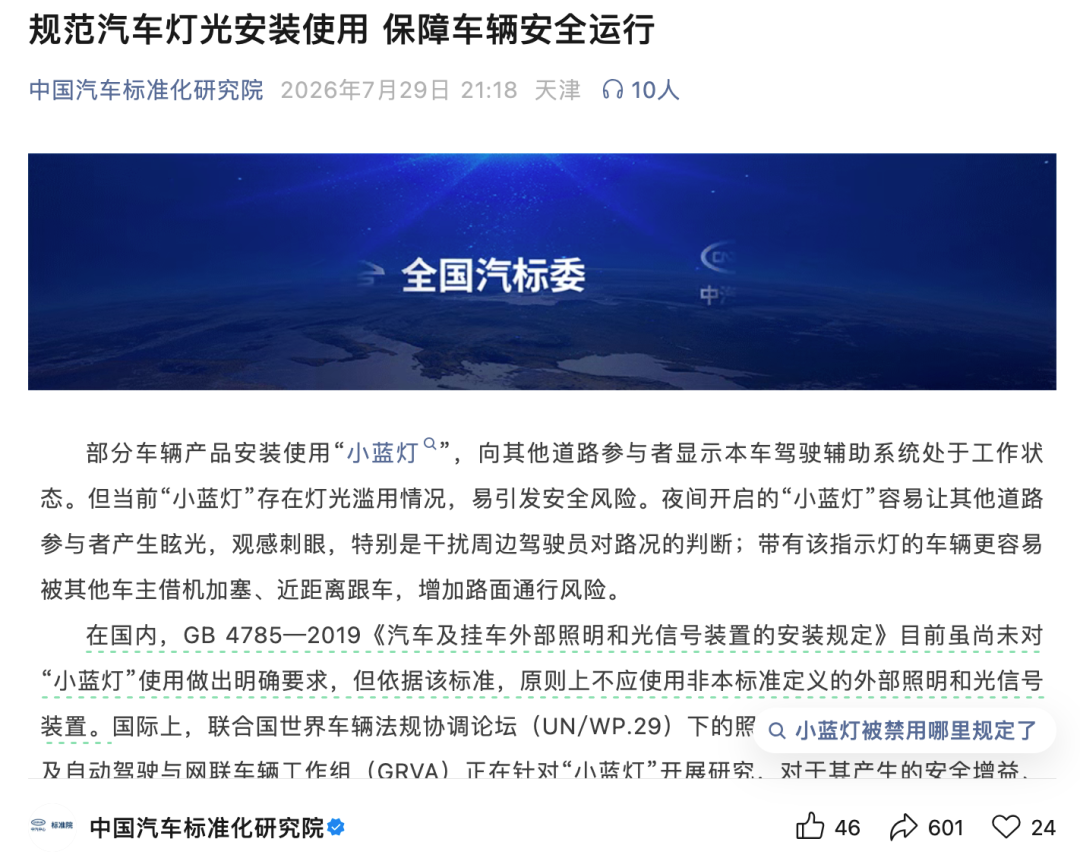
It is reported that in China, while GB 4785-2019 'Installation Requirements for External Lighting and Light Signaling Devices of Automobiles and Trailers' does not explicitly regulate the use of 'Little Blue Lights,' it states that external lighting and light signaling devices not defined by the standard should not, in principle, be used.
Once the news broke, automakers responded quickly. Geely stated, 'We are aware of the news and will strictly adhere to national regulations, awaiting further instructions from the government.' Li Auto executive Zhai Yuan lamented on social media, 'Cherish the 'Little Blue Light' while you still can.'
So, how did this Little Blue Light, once considered a hallmark of high-end intelligent driving systems, become the focus of criticism? On the surface, it is a matter of lighting compliance, but in reality, it is a necessary step to steer automakers away from marketing gimmicks and back to the core of driving safety.
01. A Light Without National Standard Support
Let's rewind to 2019. In December of that year, the current mandatory national standard GB 4785-2019 'Installation Requirements for External Lighting and Light Signaling Devices of Automobiles and Trailers' specified the light colors for different lamps, allowing only white, red, amber, and yellow for external signaling lights. Blue and bluish-green were not on the legally permitted list.
At that time, intelligent driving had not yet been widely adopted, and no one anticipated that automakers would later install blue indicator lights externally. The standard did not allocate a position for blue lights, nor did it explicitly prohibit their use, leaving a loophole.
The design concept of the intelligent driving Little Blue Light originated from a 2015 Mercedes-Benz concept car, aiming to indicate the vehicle's operational status to pedestrians through lighting. In China, the Ideal L9 first implemented mass production with this feature in 2022, followed by XPENG, NIO, Seres, BYD, and Xiaomi, which installed the indicator lights in various positions such as rearview mirrors and rear bumpers.
According to data from ZuoSi Auto Research, the installation volume of Little Blue Lights for advanced driving assistance in China reached 755,000 units in the first half of 2025, with an installation rate of 7.1%, surging by 1098% year-on-year.
However, throughout this period, the Little Blue Light lacked the backing of a mandatory national standard. In September 2021, the Ministry of Industry and Information Technology (MIIT) released a draft for comments, planning a bluish-green ADS symbol light for L3-level and above autonomous vehicles, detailing parameters such as light color, quantity, installation position, and brightness for day and night.
This should have been the starting point for the Little Blue Light's compliance, but the outcome surprised everyone. In September 2024, the formally released GB5920-2024 'Light Signaling Devices and Systems for Automobiles and Trailers' completely removed all clauses related to the ADS symbol light, with implementation starting on July 1, 2025. From draft to final version, the standard effectively blocked the compliance path for the Little Blue Light.
The reason for the clause removal was not detailed in official documents. However, an informed source confirmed to Economic Observer that new and modified vehicle models have already begun to comply with the relevant requirements in their declarations.
In other words, after three years, the Little Blue Light remained a product installed by automakers at their own discretion, unable to obtain formal legal status. Now, with tighter declaration controls, it has been barred from entry.
02. More Than Just 'Non-Compliant Color'
If it were merely a matter of color not being on the legally permitted list, the issue would not have trended on social media.
On the evening of July 29, the China Automotive Standardization Research Institute provided a more specific explanation: The current Little Blue Lights suffer from light misuse, posing safety risks. When activated at night, they can cause glare to other road users, appearing dazzling and interfering with nearby drivers' judgment of road conditions. Vehicles with these lights are also more likely to be cut off or followed closely by other drivers, increasing road traffic risks.
These two reasons correspond to real-life incidents on the road. Online complaints also focus on two points: excessive brightness and unreasonable installation positions. 'The brightness of the four lights is comparable to fog lights; following them is truly blinding.' 'The Little Blue Light on the rearview mirror is really small, but it's also really dazzling.'
Even NIO Vice President Ma Lin admitted, 'Some are brighter than the tail lights. Some make it dazzling for the following vehicle, posing safety hazards. These are definitely inappropriate. I didn't see any explicit (ban) regulations online.'
A more concealed risk involves cutting in and blocking. Some vehicle owners shared their experiences on social media: Vehicles with blue lights are often treated as 'test subjects' by other drivers, who deliberately follow closely or force their way in to test the reaction limits of the advanced driving assistance system.
Yijing Auto General Manager Zeng Qinglin posted that he had received an urgent notice and that his team would immediately act in accordance with national requirements.
He also pointed out the essence of the problem: 'For models with strong intelligent driving capabilities and high safety limits, the Little Blue Light serves as an invisible brand promotion. However, for models with weak intelligent driving capabilities, it sometimes becomes a 'roadblock,' indeed posing road safety risks.'
This actually uncovers an awkward underlying contradiction. Currently, most vehicles displaying the Little Blue Light on the road are equipped with L2-level advanced driving assistance, with the driver remaining the sole responsible party. However, the illuminated light signals to the outside world that 'this vehicle is in autonomous driving mode,' easily leading others to misjudge the attribution of rights and responsibilities.
03. The Ban on Lights, But the Problems Remain
The lights are banned, but the problems on the road persist.
Data recently released by Guo Shougang, Director of the First Department of Equipment Industry at the MIIT, shows that the penetration rate of L2-level combined driving assistance functions in passenger vehicles has reached 70.5% this year, while the penetration rate of navigation driving assistance (NOA) functions has reached 34.2%. This means that seven out of every ten new vehicles on the road are equipped with driving assistance functions.
After the ban on the Little Blue Light, how will these vehicles indicate to others that 'I am in driving assistance mode'? Currently, there is no answer.
The handling of already sold vehicles also remains unresolved. There is currently no official document requiring vehicle owners to forcibly remove or turn off the lights. The MIIT will discuss specific handling measures next. Some industry insiders analyze that automakers will likely resolve compliance issues through OTA upgrades.
However, things are not that simple. The production consistency supervision and inspection notice released by the MIIT in May this year clearly states that enterprises must not violate regulations by changing any vehicle technical parameters through OTA. If the Little Blue Light involves configurations declared in the product announcement, whether turning it off via OTA constitutes a 'violation of changing technical parameters' remains unclear.
Nevertheless, the ban on the Little Blue Light and Geely and BYD obtaining safety management system certifications on the same day point in the same direction.
On June 27, the MIIT released the mandatory national standard GB47955-2026 'Safety Requirements for Combined Driving Assistance Systems of Intelligent Connected Vehicles,' to be implemented on January 1, 2027. Models that fail to meet the standards will face a sales ban. Appendix E explicitly requires automakers to establish a combined driving assistance safety system assurance capability.
Geely, as one of the core drafting units, initiated system construction half a year in advance and obtained certification number 001 on July 20. BYD received its certification simultaneously. These two certificates cover the safety design, production, operation, service, and related management activities of combined driving assistance for intelligent connected vehicles, valid until July 27, 2029.
Meanwhile, the revision of GB4785 is underway. The National Standards Information Public Service Platform shows that the standard completed its review on April 28, 2026, with the review conclusion being 'revision.' The replacement project plan number 20262535-Q-339 is currently being drafted, with a project cycle of 16 months.
The main drafting units include the Shanghai Motor Vehicle Inspection Certification and Tech Research Institute, the China Automotive Technology and Research Center, Shenzhen Yinwang Intelligent Technology Co., Ltd., SAIC Volkswagen, and BYD.
Yinwang is a smart driving company under Huawei, and BYD is the champion in new energy vehicle sales. The fact that these two companies appear on the list of main drafting units for GB4785 for the first time means that leading smart driving enterprises are directly involved in formulating lighting standards. Based on the 16-month cycle, the new standard is expected to be officially released in the second half of 2027.
Summary
The Light Is Out, But Standards Are Still on the Way
The ban on the Little Blue Light is not due to unreasonable regulation but because the light has been operating without a clear path since the beginning.
Over the past three years, 750,000 vehicles have hit the road with a light lacking national standard status, with no regulations on brightness, position, or activation logic. Some find it dazzling, some use it as a target for testing, and some treat it as a visual symbol for brand promotion. The regulatory crackdown marks the end of a period of wild growth.
However, ending this period does not mean turning the page. With the penetration rate of L2 advanced driving assistance exceeding 70%, a large number of vehicles on the road are in a state of human-machine co-driving. How others can identify, judge, and maintain a safe distance from these vehicles are needs that will not disappear just because the light is turned off.
The revision of GB4785 is currently being drafted, and the new standard may be implemented in 16 months. Whether the ADS symbol light will return to regulations with a new identity depends on how the revision balances safety benefits and potential risks.
-
![]()
Lei Jun Disrupts the Market: Xiaomi Unveils N70/N90 Dual Models, Zeroing in on Two Leading Extended-Range Rivals
-
![]()
Sales Champion Leapmotor's Quest for Scale
-
![]()
SAIC-GM and SAIC Passenger Vehicles Announce Leadership Shifts on the Same Day: 'Technical Talents' Step Forward to Steer the Course
-
![]()
BMW's Turnaround Starts with the Easy Part
-
Tesla's Q2 Operating Profit Plummets, 'Cash-Guzzling' Expansion Drains Free Cash Flow
-
![]()
Volkswagen's Strategic Shifts: Cutting Back and Expanding
-
![]()
Unraveling the Decline of the Imported Car Market
-
![]()
Interpretation of the European + UK Automobile Market in the First Half of 2026: Electrification Surpasses Critical Point, Chinese Brands Experience Collective Growth in Sales