Huawei, Li Auto, XPENG, Xiaomi: After Scrutinizing Seven Papers, What Are 'World Models' and 'VLA' Really Competing For?
 08/12 2026
 351
351
Author | Benyi
Editor | Dexin
In the past year, terms like world models, VLA (Vision-Language-Action), and native multimodality have become buzzwords at new car launches and intelligent driving events. Public opinion has formed distinct camps: Huawei and NIO are seen as advocates of world models, while XPENG and Li Auto are viewed as champions of VLA.
However, at CVPR 2026 this year, a Chinese automaker presented an oral paper focusing precisely on world models. Its introduction acknowledged that, despite the lack of a unified academic definition for world models, their core capability is consistently recognized as the ability to predict the evolution of the physical environment.
Interestingly, this paper came from Li Auto—a company often associated with VLA in public discourse. The leading practitioners in this field have yet to clearly define its boundaries, yet the public opinion sphere has already drawn sharp lines for them.
Blaming this phenomenon solely on 'naming confusion' might be premature. More accurately, the boundaries between these technologies are not as clearly defined as public narratives suggest.
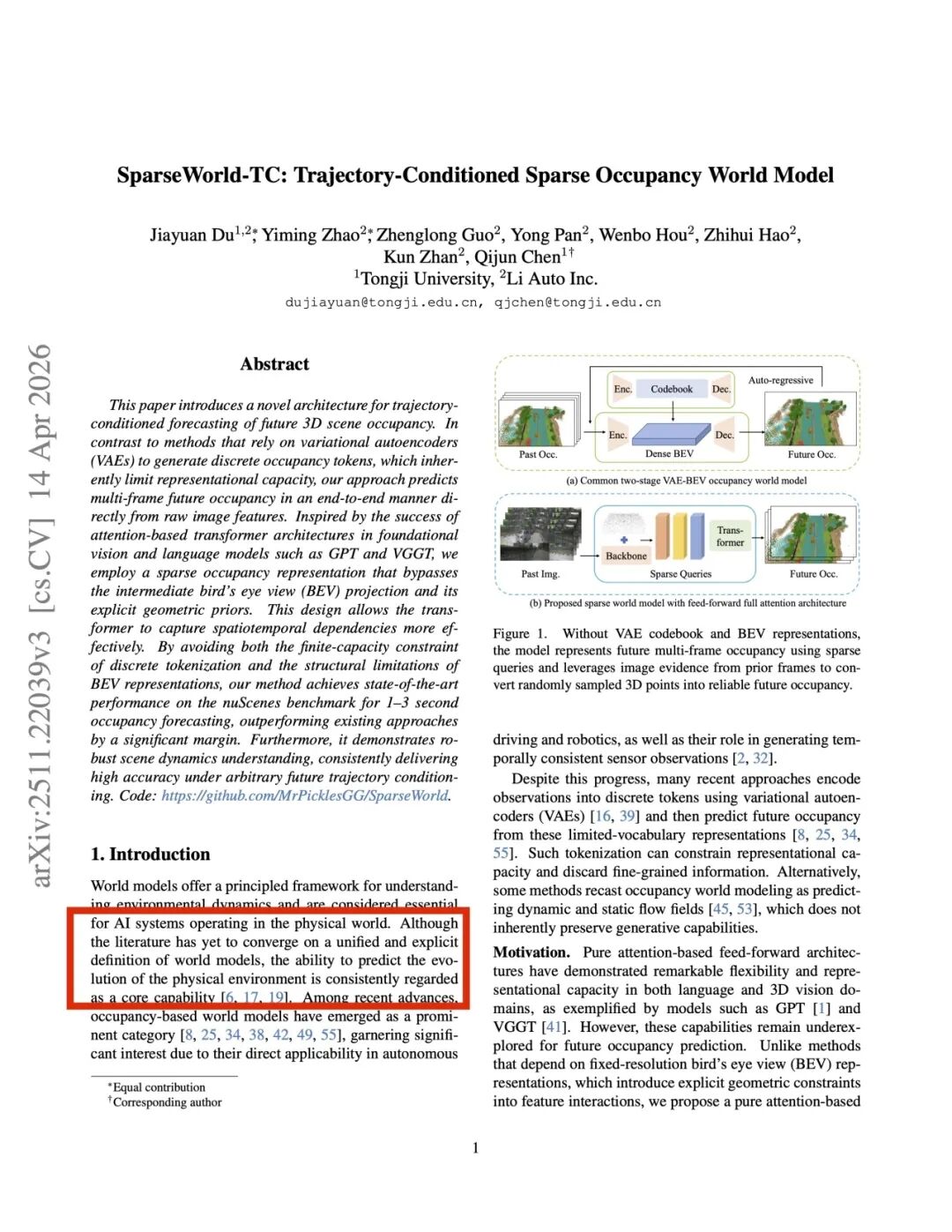
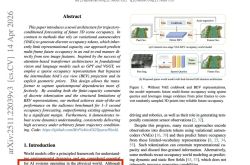
Image Source: Li Auto's SparseWorld-TC: Trajectory-Conditioned Sparse Occupancy World Model
1. A Company Advocating VLA Has Two Teams Working on World Models Internally
The situation at XPENG is even more intriguing. While externally promoting VLA uniformly, XPENG released five technical reports on arXiv in the first half of 2026, bearing signatures from four distinct teams: Predictive World Model (PWM), Generative World Model (GWM), AI Infrastructure (AI INFRA), and Foundation Model. The acknowledgments in X-Foresight also reveal that the work of the Generative World Model team on X-World serves as the foundation for pre-training its diffusion renderer.
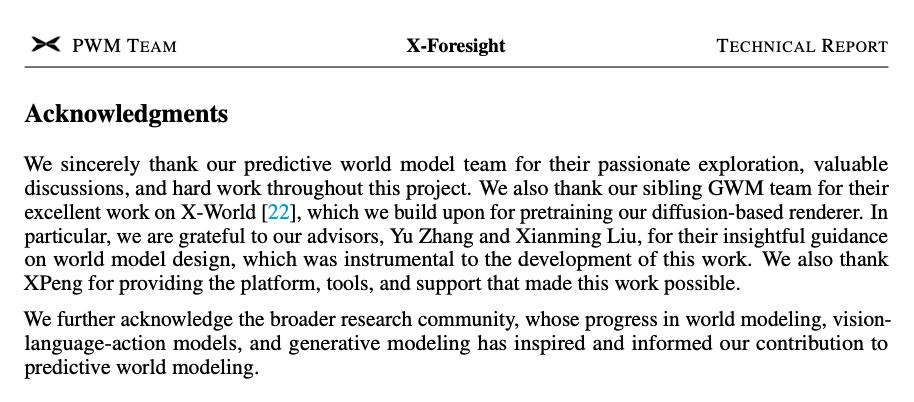 Image Source: XPENG's X-Foresight: A Joint Vision-Action Causal Forecasting Network via Predictive World Modeling
A company that externally promotes VLA has two teams working on world models internally—a clear indication that the reality is more nuanced than public labels suggest.
'Native multimodality,' initially intended to resolve naming confusion, has now itself branched into two distinct paths. Li Auto unifies language tokens and action tokens into a single discrete codebook, making no initial distinction between the two. XPENG, on the other hand, has designed a native multimodal tokenizer that integrates different modalities early in the information entry into the model.
Behind the same Chinese name lie two fundamentally different processing methods.
2. Mutual Citations in Papers, But Not Over Routes
Examining the papers published by several companies in 2026 reveals that academic/technical route clashes are far more lively than what is visible at launch events.
DriveLaW, a collaboration between Xiaomi Auto and Huazhong University of Science and Technology, directly references Epona and DriveVLA-W0 in its introduction, arguing that such methods train generation and planning separately, leaving a gap between visual imagination and action selection.
The signatory unit of DriveVLA-W0 is none other than Yinwang, which spun off from Huawei's Automotive BU.
DynVLA, a collaboration between Yinwang and the Institute of Automation, Chinese Academy of Sciences, criticizes visual chain-of-thought for incurring significant redundancy and computational overhead due to pixel-level generation, opting instead to represent the future with a 'dynamic chain-of-thought.'
Yet visual chain-of-thought is precisely the core proposition of XPENG's X-Mind.
XPENG did not hold back either. X-Mind argues that stringing world models before strategy models 'would bring unacceptable onboard latency'; hanging future image reconstruction at the network's end for auxiliary supervision 'makes it difficult for supervision signals to effectively backpropagate to the deep layers of the language model backbone, leading the model to learn shortcuts rather than true physical reasoning.'
This latter training approach bears a high resemblance to the training paradigm proposed by Huawei's DriveVLA-W0, which uses future image prediction to provide dense supervision.
Li Auto's SparseWorld-TC explicitly bypasses VAE discrete tokens and BEV intermediate representations, arguing that BEV's explicit geometric constraints limit the flexible interaction of spatiotemporal features. The 'abstract sketches' XPENG's X-Mind uses to preview the future are, at their core, based on BEV.
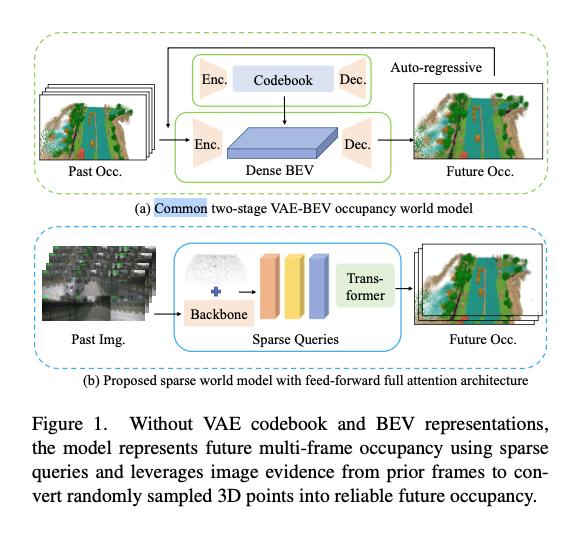
Image Source: Li Auto's SparseWorld-TC: Trajectory-Conditioned Sparse Occupancy World Model
Upon closer inspection, these four companies are criticizing each other's 'specific implementations' rather than truly negating the concept of 'predicting the future.' In other words, none claim that the other side is on the wrong path. X-Mind even states outright that integrating predictive world models into autonomous driving has become an industry consensus.
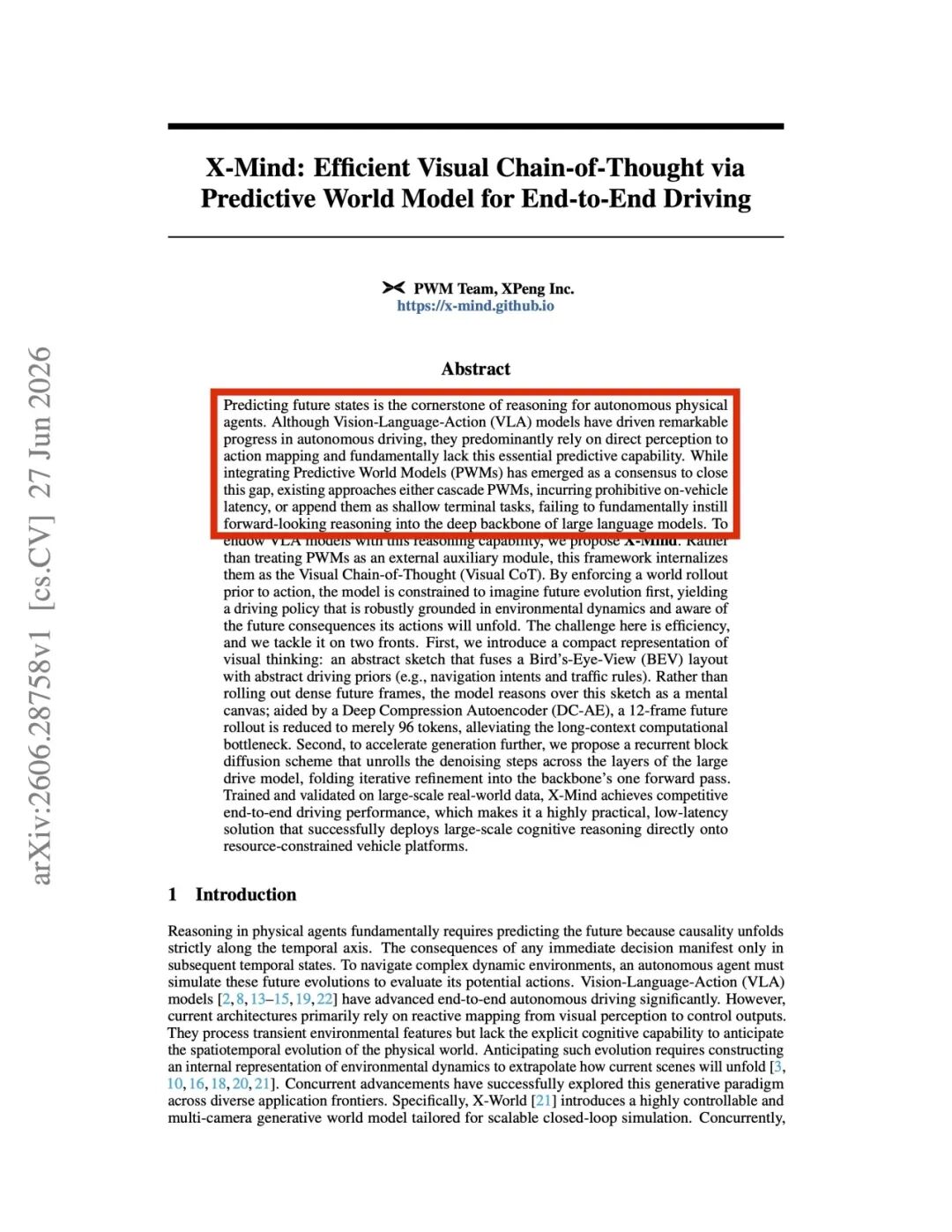
Image Source: XPENG's X-Mind: Efficient Visual Chain-of-Thought via Predictive World Model for End-to-End Driving
Thus, the question 'VLA or World Models?' may be misguided. The next round of competition in intelligent driving after end-to-end systems is not a binary opposition between A and B.
3. The Real Disagreement: How Much Detail for Previewing the Future?
When humans drive, they also 'think' through scenarios in their minds beforehand. Upon seeing a car ahead press against the lane line to the right, we quickly judge: If it merges over, should I slow down or yield? However, humans do not render these imagined scenes into 4K videos in their minds. That thought typically consists only of the car's outline, relative positions, and possible actions.
To make machines drive like humans, similar tasks must be performed. The key difference between humans and machines lies in how much detail should be retained in this generated 'thought.'
XPENG is betting on 'high abstraction.' X-Foresight's technical report argues that 'world representations should remain highly abstract; excessive visual details in the latent space dilute the model's structured world understanding capabilities.' X-Mind further compresses the next 12 frames into 96 tokens to express BEV layout, navigation intent, and traffic rules; realistic rendering is left to another module and does not directly participate in reasoning.
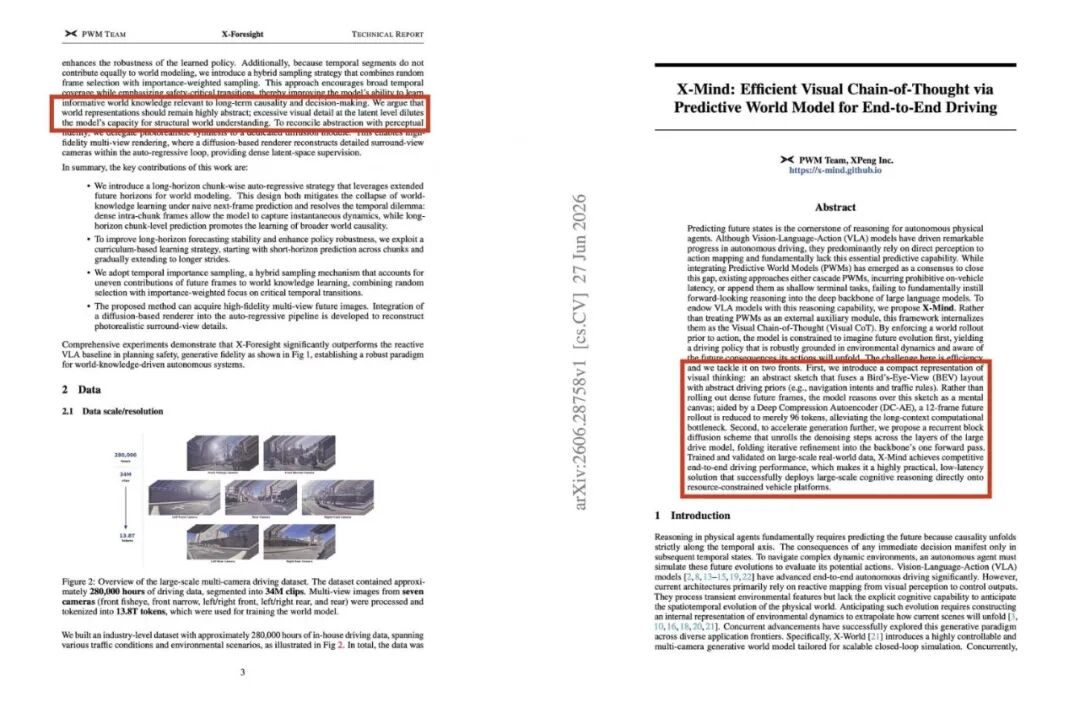
Image Source: XPENG's X-Foresight, X-Mind Technical Report
Xiaomi chooses the opposite direction. In its paper on 'DriveLaW,' the authors argue that existing approaches 'do not treat the generator's internal latent variables as planning states, leaving a gap between visual imagination and action selection.' Therefore, DriveLaW advocates that 'the internal representations learned by the video generator from massive driving videos have value in themselves, and the planner should directly use these representations to avoid disconnection between generation and planning.'
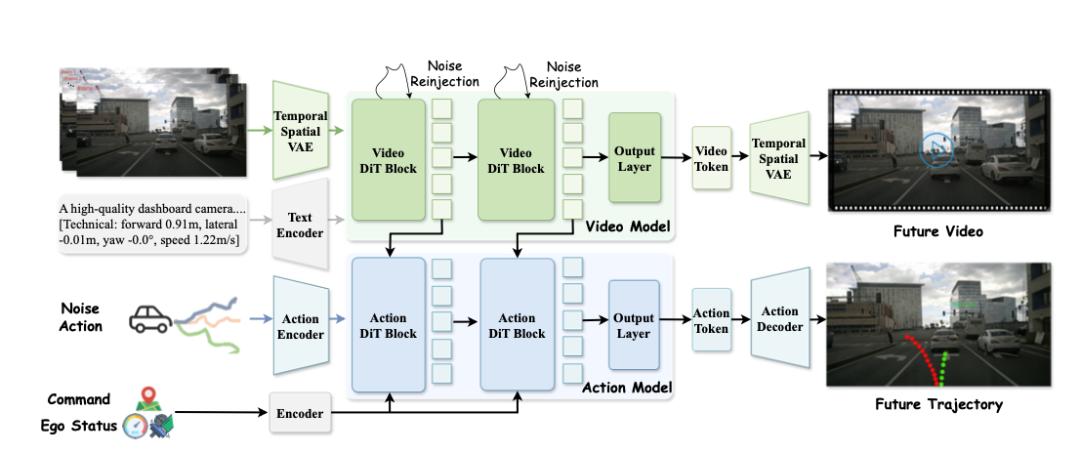
Image Source: Xiaomi's DriveLaW: Unifying Planning and Video Generation in a Latent Driving World
Li Auto falls in between. In his keynote speech at GTC 2026, Zhan Kun, the head of Li Auto's foundation models, explained clearly: 'Generating realistic future images directly would incur very high computational costs, so we choose to predict in latent space.' Li Auto calls this capability 'multimodal thinking,' meaning the model imagines the future in latent space rather than rendering realistic images.
Huawei's DynVLA compresses even further, using a specialized tokenizer to compress future evolution into a small set of discrete tokens and modeling the vehicle's dynamics and environmental dynamics separately.
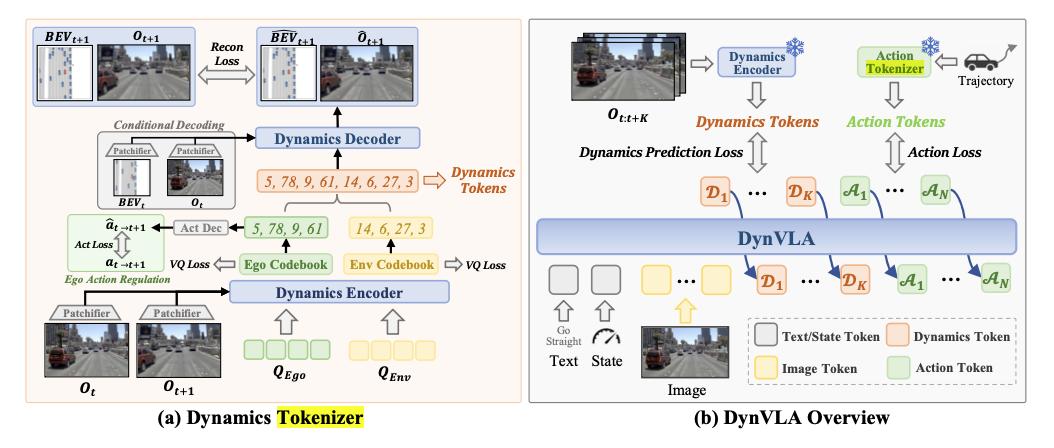
Image Source: Huawei's DynVLA: Learning World Dynamics for Action Reasoning in Autonomous Driving
When it comes to 'predicting the future,' these four companies offer four different answers. This divergence in technical paths may provide a clearer understanding of the theoretical foundations applied by leading companies in the next generation of intelligent driving technology architectures than the binary debate of 'VLA or World Models.'
Another point without a conclusive answer yet: XPENG uses BEV as the base for abstracting the world, while Li Auto considers BEV a limitation. Whether it is an effective geometric prior or a structural constraint hindering model learning may require more mass-production results to answer.
4. Before Routes Are Decided, All Are Stumbled by the Same Problem
Many users have encountered a type of issue after activating intelligent driving systems: The car can drive but takes the wrong route.
In April 2026, Fudan University, in collaboration with Tsinghua AIR, the Institute of Automation, Chinese Academy of Sciences, and Didi, conducted a set of experiments: Deleting the correct navigation information received by the end-to-end model or even replacing it with random steering commands resulted in almost no decline in overall planning performance, sometimes even slightly improving it.
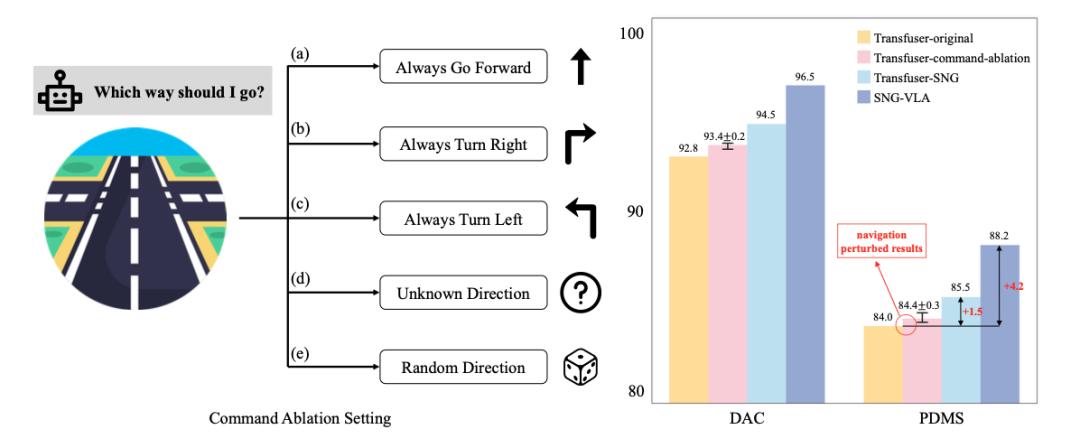
Image Source: Unveiling the Surprising Efficacy of Navigation Understanding in End-to-End Autonomous Driving
In at least the tested models, while navigation was integrated, it did not truly influence planning. The models relied more on the immediate road structure, camera footage, and common driving patterns from training data.
The reason is not complex. End-to-end models often receive only discrete commands like 'turn left, go straight, turn right.' Human drivers knowing they need to turn right hundreds of meters ahead will select the right lane early; the model, however, may still receive the command 'go straight' at that moment. During training, it sees humans changing lanes but may not know whether it is for overtaking or for a subsequent right turn.
The causal relationship between navigation and driving actions is broken.
This issue is frequently observed in practical tests by many media outlets.
A media outlet testing Horizon HSD in Tianjin encountered a complex intersection requiring going straight through the intersection first and then entering a central left-turn lane. HSD 1.6 had a probability of mistakenly entering the U-turn lane and going off course; V2.0 correctly navigated it twice under heavy rain conditions.
Another media outlet testing the IM LS8 equipped with Momenta's solution reported only three manual interventions over hundreds of kilometers, but two occurred during main-auxiliary road switches: the system failed to locate the intersection correctly and took the wrong route.
Our colleagues at Dasuanli also encountered a situation while test-driving Yuanrong Qixing's VLA version where the vehicle first changed lanes to the left, realized the route was incorrect, and then crossed two solid lines consecutively to return. A similar issue was recorded during a previous test drive of Li Auto's VLA.
In papers, companies argue over highly detailed technical questions like 'how to predict the world.' However, in practical tests of mass-produced intelligent driving products, these systems have been tripped up by the same navigation challenge one after another.
Yet, in the vast majority of technical architecture stories told by companies externally, this issue is hardly ever discussed head-on.
5. Beyond Models, Two Even More Challenging Problems Remain
The first problem is whether large language models (LLMs) can operate efficiently on vehicles.
Ren Shaoqing, head of intelligent driving at NIO, judges that, for the same computational load, Transformers require 8 to 70 times more memory bandwidth than CNNs, with the critical difference lying not just in computational power but in memory bandwidth. NIO's Shenji NX9031 offers a bandwidth exceeding 500 GB/s per chip.
Li Auto emphasizes in its Mach M100 chip paper that software-hardware collaboration must address not just computation but, more critically, how data is transferred in time and space. The M100's peak bandwidth is 273 GB/s, and it significantly reduces reliance on multi-level caches through a dataflow architecture.
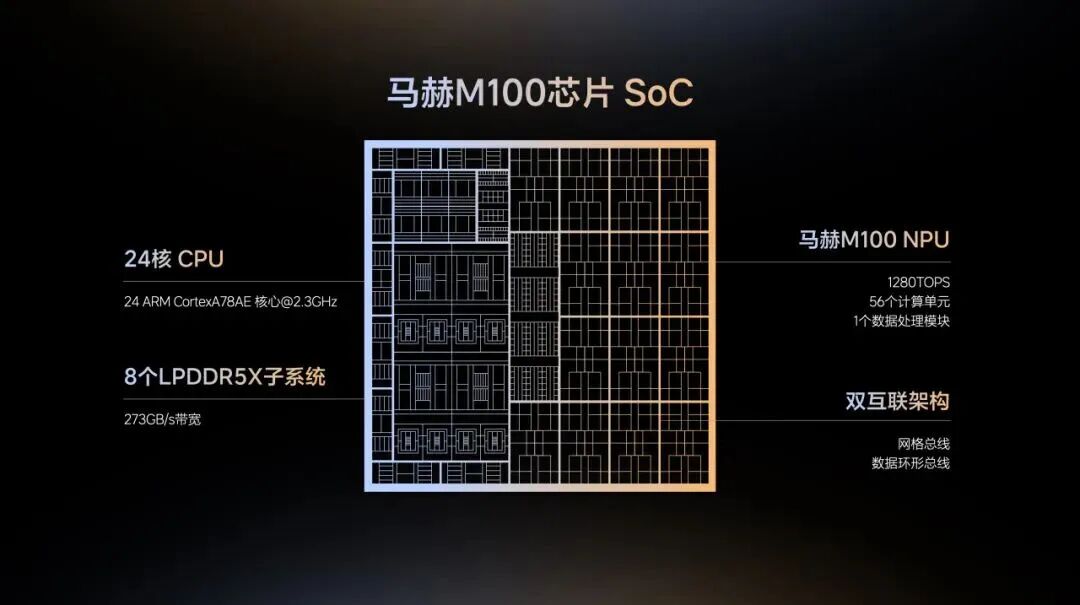
Image Source: Li Auto
These two figures cannot be simply used to judge chip strength, but they illustrate the same point: When large models are deployed in vehicles, the competition has shifted from 'how much can be computed' to 'whether data can be delivered to where it needs to go in a timely manner.'
Horizon offers a different answer. Among the 11 papers it had accepted at CVPR 2026, four focus on 3D reconstruction, three on robotic embodiment, two on perception, with one each on end-to-end planning and participating in world model evaluation; there are zero papers directly related to building world models or VLA.
The only end-to-end planning paper, ResAD, also does not let the model predict trajectories from scratch. Instead, it first uses a constant velocity model to calculate an inertial reference trajectory and then lets the model learn the deviation relative to it. While others are packing more capabilities into large models, Horizon hands over the parts that can be solved with physical formulas back to physics.
This aligns with what Su Qing, Vice President and Chief Architect at Horizon, said in a public speech late last year: 'My personal judgment is that there is a high probability that the next three years will be about extreme optimization of existing systems rather than a reconstruction of theoretical cores. So, don't get too excited; we're entering a phase of hard work again.'
Whether he is sober or conservative remains inconclusive for now. But at least, Horizon has made a technical choice that keeps its distance from industry buzzwords.
The second question is whether capabilities can be validated externally.
World models are pivotal in the narratives of numerous companies, serving as closed-loop simulation environments and engines for online reinforcement learning. At GTC, Zhan Kun bluntly stated, "The capabilities of the World Simulator fundamentally set the upper limit for reinforcement learning."
So, what is the current status of this upper limit?
At this year's CVPR, another oral presentation, WorldLens, was introduced as a benchmark specifically tailored to evaluate driving world models. The results it revealed are as follows: In closed-loop simulations, when a pre-trained planner navigates through the generated 'world,' the highest route completion rate achieved is 13.51%, with the lowest being 6.89%. Here, the route completion rate denotes the percentage of the preset route completed before termination due to collision, going off-road, or timeout. The open-loop performance of the same batch of models ranges from 71% to 79%, but drops significantly to between 4.8% and 10.6% under closed-loop conditions.
The paper's original statement reads: "All methods fail under closed-loop conditions."
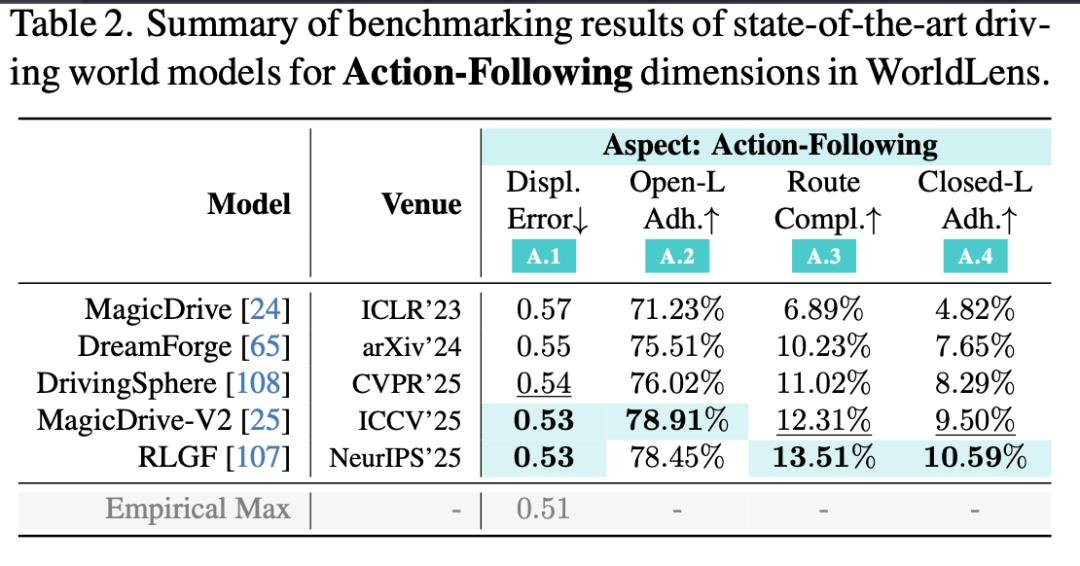
Image source: CVPR 2026 Paper WorldLens: Full-Spectrum Evaluations of Driving World Models in the Real World
However, it's important to note that WorldLens tested only open-source academic models and did not include any production-grade models from any company. Therefore, these results cannot be generalized to the mass-produced models of any automaker.
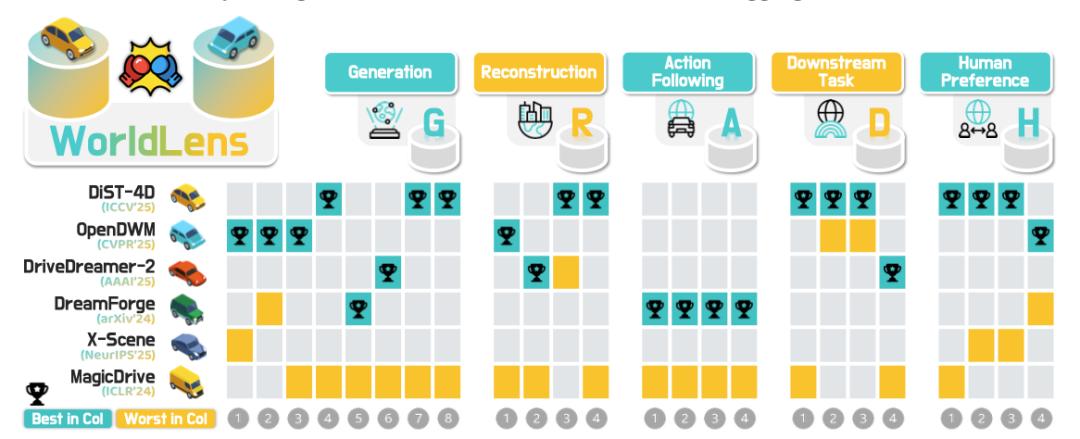
Nevertheless, a pertinent question arises: While companies tout world models as a crucial foundation for closed-loop simulation and reinforcement learning, no mass-produced models have submitted publicly available, horizontally comparable closed-loop evaluations. What the outside world observes are primarily each company's proprietary datasets and metrics.
Based on publicly available papers and research findings compiled by Dasuanli, Li Auto, Xiaomi, Huawei, and Horizon have utilized public benchmarks such as nuScenes and NAVSIM. The core results disclosed by XPeng, NIO, Momenta, Zoyu, and Yuanrong predominantly originate from self-built datasets or lack horizontally comparable public metrics. Xiaomi even explicitly notes that its results were achieved without post-training reinforcement learning or scorer post-processing.
Thus, from both theoretical and practical standpoints, the results of these benchmark tests do not indicate whose mass-production capabilities are superior. When companies employ different test sets and scoring methodologies, it becomes challenging for the outside world to assess the true significance of the lead announced during product launches.
This disparity is also evident in the case of Momenta.
In Chinese discourse, Momenta is often hailed as the 'pioneer of Physical AI.' However, in its IPO filing with the Hong Kong Stock Exchange, the term 'Physical AI' is absent, and 'world model' is mentioned only once, in reference to the 'under development' R7. The market-facing identity label, when presented in investor-facing legal documents, ultimately reduces to just an in-development project.
VI. The Solution to the Next Question May Not Lie in Algorithms Alone
When a media outlet tested XPeng's VLA 2.0 in Germany, it encountered a bicycle towing a small trailer. However, the test vehicle could only follow behind throughout the entire process without any intention to overtake. German road traffic regulations mandate that when a motor vehicle overtakes a cyclist in urban areas, the lateral safety distance must be no less than 1.5 meters.
The prevailing perception in China is that the more chaotic the road conditions and the more complex the dynamic interactions, the stronger the model's performance will be. Thus, if it can drive in Guangzhou, it should be able to drive in Munich. While the dynamic interactions in Munich are indeed less complex than in Guangzhou, compliance presents a different kind of challenge. The model must not only 'know how to drive' but also accurately comprehend local regulations and apply them to every action.
According to current plans, the EU's urban advanced driver-assistance systems regulation, UN R171 Series 02, is expected to come into effect by the end of 2026. XPeng aspires to be among the first to receive approval.
Over the past year, companies in the industry have expended considerable energy debating their chosen technical routes.
The answers gleaned from their papers indicate that the broad directions are converging, with differences lying in future representations, in-vehicle efficiency, and training methods. However, practical testing reveals that more specific issues such as navigation, public evaluations, and local compliance are far from being resolved.
VLA, world models, native multimodality... the terminology may keep evolving. Ultimately, what determines success is whether the vehicle can navigate the roads correctly.
References
The technical judgments in this article are primarily based on the following publicly available papers and materials. All papers can be retrieved in their original form on arXiv.
Li Auto
SparseWorld-TC: Trajectory-Conditioned Sparse Occupancy World Model
CVPR 2026 (Oral)|arXiv:2511.22039
https://arxiv.org/abs/2511.22039
M100: An Orchestrated Dataflow Architecture Powering General AI Computing
arXiv:2604.17862
https://arxiv.org/abs/2604.17862
Zhan Kun, 'MindVLA-o1: Unlocking the Omnipotent Paradigm,' NVIDIA GTC 2026 Keynote Speech, 2026-03-17
XPeng Motors
X-Foresight: A Joint Vision-Action Causal Forecasting Network via Predictive World Modeling
arXiv:2605.24892
https://arxiv.org/abs/2605.24892
X-Mind: Efficient Visual Chain-of-Thought via Predictive World Model for End-to-End Driving
arXiv:2606.28758
https://arxiv.org/abs/2606.28758
Xiaomi Auto
DriveLaW: Unifying Planning and Video Generation in a Latent Driving World
CVPR 2026|arXiv:2512.23421
https://arxiv.org/abs/2512.23421
Huawei (credited to Intelligent Vision, Noah's Ark Lab, etc.)
DriveVLA-W0: World Models Amplify Data Scaling Law in Autonomous Driving
ICLR 2026|arXiv:2510.12796
https://arxiv.org/abs/2510.12796
DynVLA: Learning World Dynamics for Action Reasoning in Autonomous Driving
ICML 2026|arXiv:2603.11041
https://arxiv.org/abs/2603.11041
Horizon Robotics
ResAD: Normalized Residual Trajectory Modeling for End-to-End Autonomous Driving
arXiv:2510.08562
https://arxiv.org/abs/2510.08562
Horizon Robotics CVPR 2026 Selected Papers Summary (11 papers by research direction)
https://www.horizon.auto/news/technology/439
Evaluation Benchmarks and Third-Party Research
WorldLens: Full-Spectrum Evaluations of Driving World Models in the Real World
CVPR 2026 (Oral)|arXiv:2512.10958
https://arxiv.org/abs/2512.10958
Unveiling the Surprising Efficacy of Navigation Understanding in End-to-End Autonomous Driving
Fudan University, Tsinghua University AIR, Institute of Automation, Chinese Academy of Sciences, Didi|arXiv:2604.12208
https://arxiv.org/abs/2604.12208
Epona: Autoregressive Diffusion World Model for Autonomous Driving
arXiv:2506.24113
https://arxiv.org/abs/2506.24113
(Cited as the target of criticism in Xiaomi's paper)
Other Public Materials
Momenta Global Limited Global Offering Documents, Hong Kong Stock Exchange, Stock Code 6880
Public Interview with NIO's Ren Shaoqing (statements related to memory bandwidth)
German Road Traffic Regulations (StVO) Article 5, Paragraph 4; UN R171 Series 02
-
![]()
Xiaomi's MiMo Stages a Two-Year Comeback to Top Global Inference Volume Rankings
-
Tech Titans' Offline Tussle for Desktop Dominance: The Office Agent Showdown
-
![]()
Full-Spec Power and BOSE Subwoofer: The REDMI K100 Pro Max Performance Review
-
![]()
Yuewen’s Unending Innovation: Navigating Content Industry Shifts
-
![]()
Huawei, Li Auto, XPENG, Xiaomi: After Scrutinizing Seven Papers, What Are 'World Models' and 'VLA' Really Competing For?
-
![]()
Proposed to Raise 955 Million Yuan through Private Placement! Huicheng Vacuum Boosts Localization of Ultra-Precision Optical Coating Equipment
-
![]()
Cash Flow Soars 13-Fold! What Major Strategic Move is Wuhan Five Square Optoelectronics Planning?
-
![]()
Leaked Design of vivo X500: Reverts to Circular Camera Module in Top-Left Corner, Pays Homage to Classic X90 Aesthetic