NIO’s Battery Swap Stations Transition to State-Owned Management
 08/14 2026
 541
541
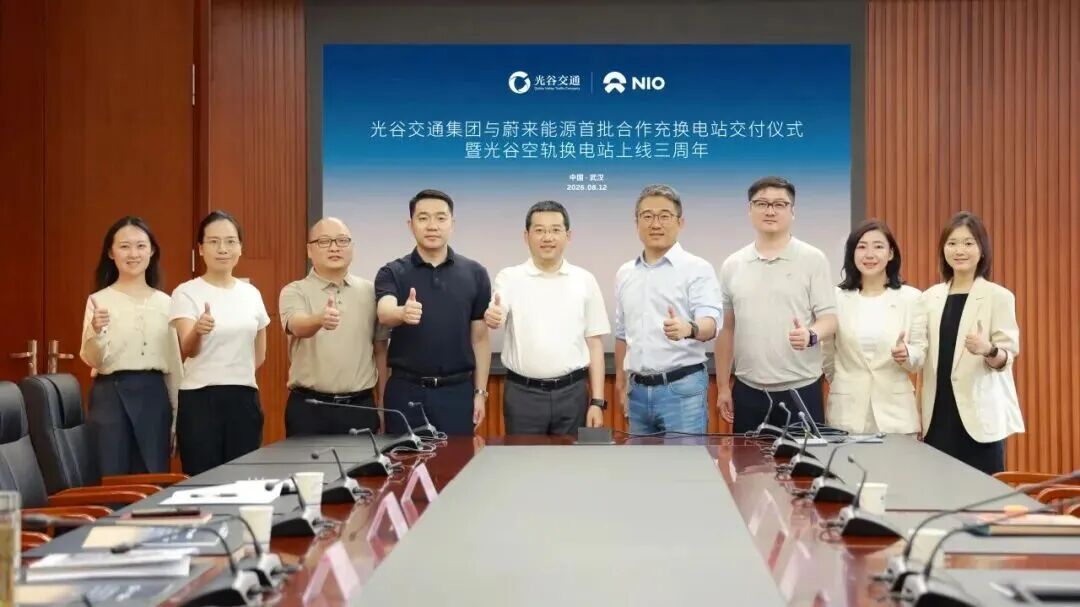
On August 12, NIO Power and Optics Valley Transportation Group celebrated the handover of the first batch of collaborative charging and battery swap stations in Wuhan, marking the official completion of the first 36 jointly constructed and operated facilities. Under this partnership, the state-owned asset partner retains ownership of the stations, while NIO provides professional operational services. Specifically, Optics Valley Transportation Group now holds the assets of these charging and battery swap stations, with NIO Power responsible for their day-to-day operations. Following the handover, all existing battery swap stations previously owned by NIO in Wuhan are now under state-owned management. The plan is to replicate this model across Hubei Province and other regions nationwide.
For NIO, integrating local state-owned assets into the management of charging and battery swap infrastructure represents a significant shift from its previous strategy, which relied heavily on self-financing for infrastructure development. Battery swap networks are inherently capital-intensive, with each station costing approximately 1.5 million yuan to construct and incurring substantial annual operation and maintenance expenses.
Over the past decade, NIO has invested over 20 billion yuan in the battery swap sector, relying solely on its own capital to fuel nationwide expansion. This self-funded approach has limited the pace and scope of its growth. The Wuhan project transcends mere station delivery; it signifies a deeper evolution of NIO’s battery swap business model, moving towards a model that separates asset ownership from professional operations. Under this joint construction framework, NIO’s per-station investment burden is reduced to roughly 40% of that required for a fully self-built station. This substantial reduction in capital investment pressure enables NIO to allocate more resources and energy towards technological innovation and operational efficiency enhancements, thereby fueling further infrastructure expansion.
NIO reported that as of August 12, it has established a nationwide network of 9,198 charging and battery swap stations, comprising 4,017 battery swap stations, 5,181 charging stations, and 29,875 charging piles. The cumulative number of battery swap services has surpassed 120 million, with total charging and battery swap services exceeding 200 million. In Hubei Province alone, NIO has constructed 288 charging and battery swap stations, including 145 battery swap stations, achieving comprehensive coverage with a station every 200 kilometers along the province’s “five vertical and four horizontal” highway network. Currently, NIO Power has forged collaborations with over 40 local state-owned asset platforms and financial institution partners across 25 provinces, municipalities, and regions, jointly building and operating more than 800 battery swap stations.
However, leading in network scale does not necessarily equate to full commercial viability for the battery swap model. With the rapid advancement of ultra-fast charging technology for new energy vehicles, battery swap stations must still prove their station utilization rates, asset returns, and cross-brand compatibility. While transferring some infrastructure assets to local state-owned entities helps alleviate NIO’s capital investment pressure, the long-term success of this approach hinges on operational efficiency and the scalability of the cooperation model.
Through the Wuhan handover, NIO is striving to expand its role to become a technology and network operator for battery swapping. Rather than merely focusing on increasing the number of stations, the market may find it more noteworthy whether this asset model can reduce expansion costs and enhance the sustainability of the charging and battery swap business. At the technological frontier, NIO is also actively promoting the standardization and compatibility of its energy replenishment network.
Just on August 9, NIO’s first fifth-generation battery swap station in the Hubei region commenced operations in Wuhan. This new station features a cutting-edge battery swap platform that supports a maximum wheelbase of 3.5 meters, accommodating all vehicle sizes from compact cars to large SUVs. It achieves full compatibility with all models from the NIO, LEAPMOTOR, and firefly brands.
As the deployment of battery swap stations and charging piles intensifies, the scale effects of the energy replenishment system are becoming increasingly evident. Broader station coverage and greater vehicle model compatibility enhance the user experience, encouraging more users to embrace NIO’s product ecosystem. This, in turn, fosters a virtuous cycle of growth characterized by “more models, denser stations, and better experiences.” NIO’s transformation also aligns with its broader industrial布局 (industrial layout) in Wuhan.
Earlier this year, in March, Wuhan Weineng Battery Asset Co., Ltd. signed an agreement with the East Lake High-Tech Development Zone to implement a new infrastructure project with a total investment of 9.8 billion yuan. This initiative aims to transform the concept of “vehicle-battery separation” into a practical driver for the city’s economic growth. From battery assetization to the state-ownership of the charging and battery swap network, NIO’s exploration in Wuhan is evolving from a single-enterprise endeavor into a systematic experiment in establishing a “new energy order.” As the asset and operational attributes of infrastructure gradually decouple, the true commercial viability of the battery swap model remains to be validated by time and the market.
-
![]()
Did Zhong Shanshan Make a Mistake?
-
![]()
Flash Charging and 'Celestial Eye': Standard Features in Qin MAX, Positioned to Challenge B-Class Sedans
-
![]()
Wey's Quandary: Can't Afford to Lose Blue Mountain, Yet V Series Struggles to Gain Ground
-
![]()
Google AI Sees Personnel Turmoil: Full-Stack as a Moat, but Also a Source of Conflict
-
![]()
Lenovo Group is Making Big Moves: Server Business Takes Off, AI Server Backlog Orders Reach 360 Billion Yuan!
-
![]()
WPS: A Future Plugin in the Making?
-
![]()
Zhang Xue Motorcycle Secures Sole Investment from Sequoia China, Valuation Soars to 6 Billion Yuan Post-Investment
-
![]()
Online Buzz: Alleged Leak of 'Little Blue Light' Rectification Blueprint