Japanese Automakers Encounter Their 'Nokia Moment': Faultless Yet Cast Aside by the Tide of Progress
 08/14 2026
 473
473
In the age of smartphones, the 'Nokia moment' epitomizes the fate of once-illustrious manufacturers who stubbornly adhere to the winning formulas of a bygone era. They respond sluggishly to technological shifts and, as the world evolves, swiftly plummet from their zenith, oblivious to their missteps.
Subsequently, this 'Nokia moment' has become a ubiquitous term in the business realm, depicting the scenario where established behemoths are upended by new paradigms, gradually eclipsed by the relentless march of time, and ultimately toppled by innovative products.
And now, it appears that Japanese automakers are teetering on the brink of their own 'Nokia moment'.
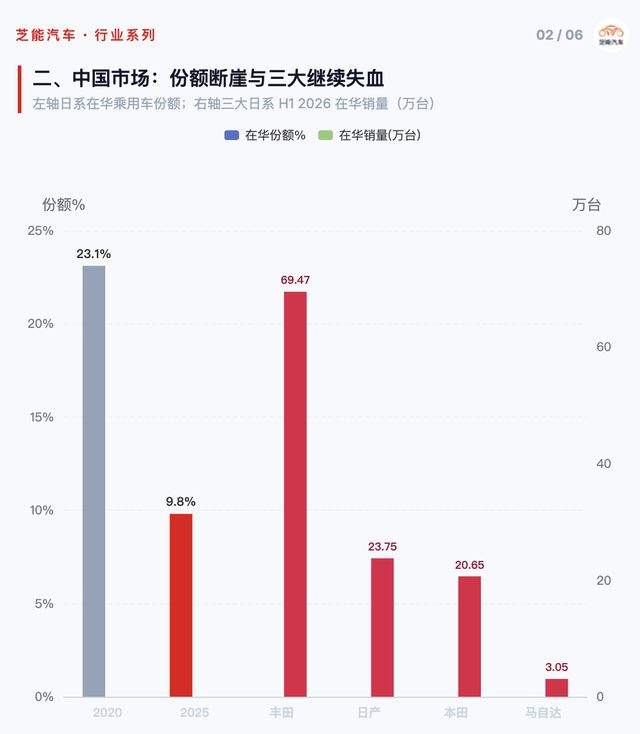
The golden age of Japanese automobiles dawned around 2008 and spanned over a decade. During this period, Japanese cars dominated global sales charts, with a commanding 30% market share in China that remained unparalleled by any other brand.
The 'Big Three' of Japanese automakers—Toyota, Honda, and Nissan—became household names, with numerous models in high demand. Price hikes and lengthy waiting times for delivery were commonplace, contingent on the additional amount paid and the duration one was willing to bide their time.
But all glories are ephemeral. Today, amidst the onslaught of China's burgeoning new energy vehicle sector, their performance is waning.
In the first half of 2026, Japanese cars' market share in China had dwindled to approximately 8%, a stark contrast to the previous 30%.
Virtually all major automakers are witnessing declines: Toyota's sales in China plummeted by 17.1%; Nissan's fell by 15%; and Honda's nosedived by 34.7%, marking 29 consecutive months of year-on-year decline.
If this is the plight of first-tier automakers, there's little need to delve into the struggles of second-tier ones like Mazda. As for other Japanese brands, they have already exited the Chinese market, including Mitsubishi, Suzuki, and Acura.
This trend is not confined to the Chinese market. Globally, in the first half of 2026, five out of Japan's seven major automakers reported sales declines.
Why are Japanese cars increasingly floundering? This can be traced back to the reasons for their erstwhile success. Japanese cars have long been renowned for their three core strengths: fuel efficiency, durability, and value retention.
However, the landscape has shifted. Plug-in hybrids now outperform Japanese gasoline cars in terms of fuel efficiency, while electric vehicles boast lower costs and eliminate the need for gasoline.
As for value retention, it is intrinsically linked to sales volume. High sales volumes foster value retention, whereas low sales volumes have the opposite effect. This is an immutable truth.
More crucially, the experience offered by new energy vehicles compared to gasoline cars is akin to the transition from feature phones to smartphones—utterly transformative. Yet, the electric vehicles produced by Japanese automakers during their transition still cling to the outdated gasoline car paradigm, failing to stay abreast of the times. It's reminiscent of how Nokia insisted that the Symbian system was also a smartphone system.
Consequently, Japanese cars have witnessed a precipitous decline in the Chinese market and are increasingly struggling on the global stage. Their former advantages have ceased to be advantageous, and their product competitiveness has been severely undermined.
As previously mentioned, in the face of trends, sometimes it's not because you did something wrong, but because you failed to adapt to the changing times. The same holds true for the automotive industry. With the advent of the new energy era, clinging to gasoline cars will result in being left behind by the relentless march of progress.
-
![]()
Did Zhong Shanshan Make a Mistake?
-
![]()
Flash Charging and 'Celestial Eye': Standard Features in Qin MAX, Positioned to Challenge B-Class Sedans
-
![]()
Wey's Quandary: Can't Afford to Lose Blue Mountain, Yet V Series Struggles to Gain Ground
-
![]()
Google AI Sees Personnel Turmoil: Full-Stack as a Moat, but Also a Source of Conflict
-
![]()
Lenovo Group is Making Big Moves: Server Business Takes Off, AI Server Backlog Orders Reach 360 Billion Yuan!
-
![]()
WPS: A Future Plugin in the Making?
-
![]()
Zhang Xue Motorcycle Secures Sole Investment from Sequoia China, Valuation Soars to 6 Billion Yuan Post-Investment
-
![]()
Online Buzz: Alleged Leak of 'Little Blue Light' Rectification Blueprint