State Cracks Down Hard on Quick-built Cars
 08/28 2026
 491
491
Introduction
Introduction
With a combination of proactive and defensive measures, the state is using a set of coordinated actions to make the transforming automotive industry more rational and avoid runaway risks, with the underlying logic being to return cars to their essence.
On August 27, 1955, the Guinness Book of World Records, a reliable record of 'world's bests,' was born. Since then, all claims to being 'number one' have had an authoritative basis.
'Reliability' is actually more important than being 'number one.'
Seventy-one years later, the Chinese automotive industry is objectively re-examining this statement. Also on August 27, the Ministry of Industry and Information Technology, the Ministry of Public Security, the Ministry of Ecology and Environment, and the State Administration for Market Regulation jointly issued a notice, deciding to launch a year-long nationwide special action to enhance production consistency and quality of road motor vehicle products from that day onward.
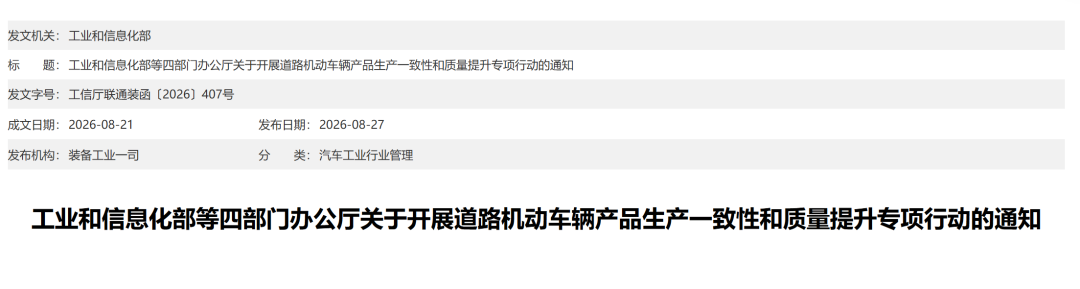
Although the notice does not mention the term 'quick-built cars' anywhere, it is clear to the discerning eye—this blade is aimed at 'unreliable, inconsistent, and unsafe' quick-built cars.
However, Automobile Commune is even more delighted to remind everyone that, in conjunction with another event two days prior, a deeper understanding can be gained—on August 25, the draft revision of the Road Traffic Safety Law was submitted to the Standing Committee of the National People's Congress for deliberation, adding for the first time a special chapter on 'Special Provisions for Autonomous Vehicles,' finally making it clear that 'the vehicle bears responsibility' to put a safety belt on the runaway technology.
With a combination of proactive and defensive measures, the state is using a set of coordinated actions to make the transforming automotive industry more rational and avoid runaway risks, with the underlying logic being to return cars to their essence.
We have heard too many rhetorical expressions about the 'transformation and metamorphosis of automobiles.' Admittedly, terms like 'second living room' and 'intelligent partner' are not wrong, but these are all derivative and secondary attributes; whereas 'reliable transportation' and 'an extension of the human body' are the essential and primary attributes.
Secondary attributes can enhance functional richness and boost commercial value, but not at the expense of primary attributes.
To draw an analogy—a person can be likened to a sharp blade for their bravery in battle or to a steadfast ox for their diligence, but human attributes are the primary ones, and they cannot be genuinely treated as mere tools or livestock.
No matter how cars are compared or extended, safety, reliability, and durability are essential demands that cannot be neglected.
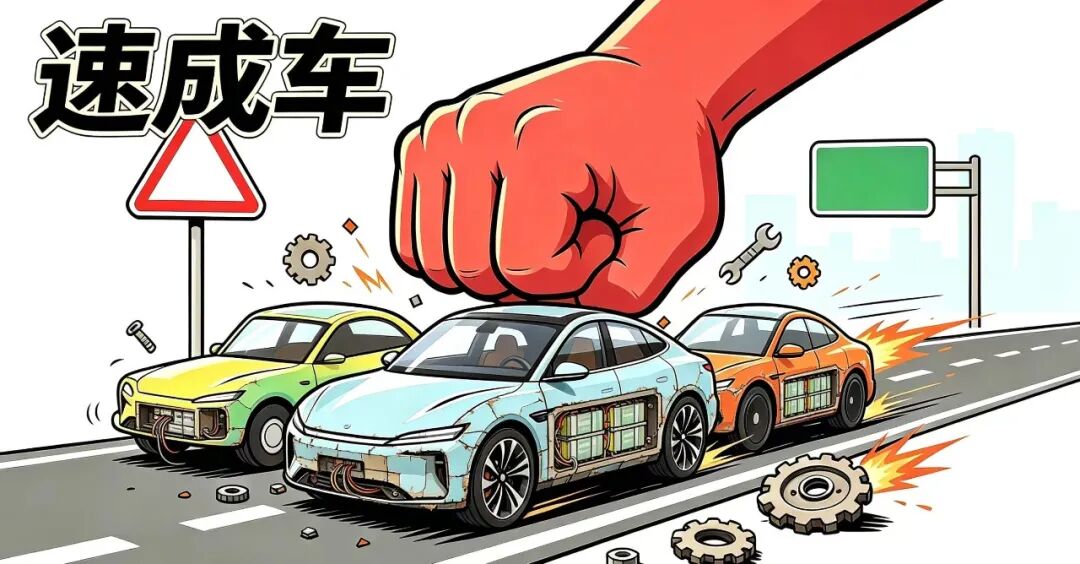
However, the essence of quick-built cars is precisely to harm the primary attributes in pursuit of rapidly and cheaply achieving secondary and derivative attributes, and then to cover up their deficiencies through exaggerated marketing, posing significant risks to the market and industry.
Just as the Guinness Book of World Records provides a reliable basis for 'world's bests,' Chinese automobiles have been racing ahead on the path of electrification and intelligent transformation for a long time. It is time to use reliability and safety to bring the rapidly spinning wheels back to the correct track.
01 The State Cracks Down Hard on Quick-built Cars
'Do you mean this special action is to restrict quick-built cars?' Xiao Xu, the company's financial officer, finally breathed a sigh of relief.
Her family was recently preparing to buy a car, but after visiting several 4S stores, she was nearly overwhelmed—'Hundreds of new models launched each year, three or four models hitting the market every day, the specification sheets are dizzying. This one claims to be a 'mobile living room,' that one claims to be the 'most understanding intelligent partner,' but which one is reliable? Which one is safe?'
Such confusion has spread across much of the market. Nowadays, with the accelerated iteration and updates of cars, certain 'quick-built cars' are muddling through, and the cars consumers buy have turned from 'mass-produced models' into 'prototypes'; consumers are overwhelmed by choices, and automakers are exhausted by the relentless iteration.
So, why is it said that the heavy blow of this special action is aimed at quick-built cars? First, clarify where the 'blow' is directed.
The notice explicitly proposes to focus on rectifying four types of issues: production consistency, reliability, durability, and testing and verification of new technologies. These terms may sound lofty, but when it comes to consumers' daily use of cars, they hit close to home.
Production consistency—simply put, the car you buy must be the same as the one filed in the Ministry of Industry and Information Technology's 'Announcement.'
It cannot be that the 'Announcement' states a '600-kilometer range,' but in reality, it barely reaches 400 kilometers; it cannot be that the submitted model for inspection is a 'deluxe version,' while the mass-produced models are all 'barebones.' This also involves the management of component suppliers by the automaker—procurement standards, incoming inspection, and quality management of component products. If any link fails, consumers are the ones who suffer in the end.
Reliability—the car must withstand use.
Have reliability tests and verifications been conducted for key systems and components? Can the production and manufacturing process standards ensure that the product does not malfunction? It is unacceptable for new cars to start making strange noises or displaying fault codes after three months, let alone leaving owners stranded on the road.
Durability—the car must withstand aging.
Are the designed service life and development cycle of new cars reasonable? Are the selection of body materials, corrosion prevention processes, and structural protections adequate? It is unacceptable for a car to start rusting or have suspension failures just three to five years after purchase.
Testing and verification of new technologies—this is the most critical point, and verification cannot be cut corners.
The notice specifically mentions: whether risk assessments for new product innovative designs, such as user habits, misoperation risks, and extreme usage scenarios, are sufficient, and whether marketing claims align with reality; whether new materials and structures pose risks such as product defects or fatigue failures; and whether testing and verification of combined driving assistance and autonomous driving functions are sufficient.
In plain language—do not treat consumers as guinea pigs, and do not hype up untested technologies and throw them onto the market.
Speaking of negative examples, there have been many cases of 'quick-built' models in the industry over the years.
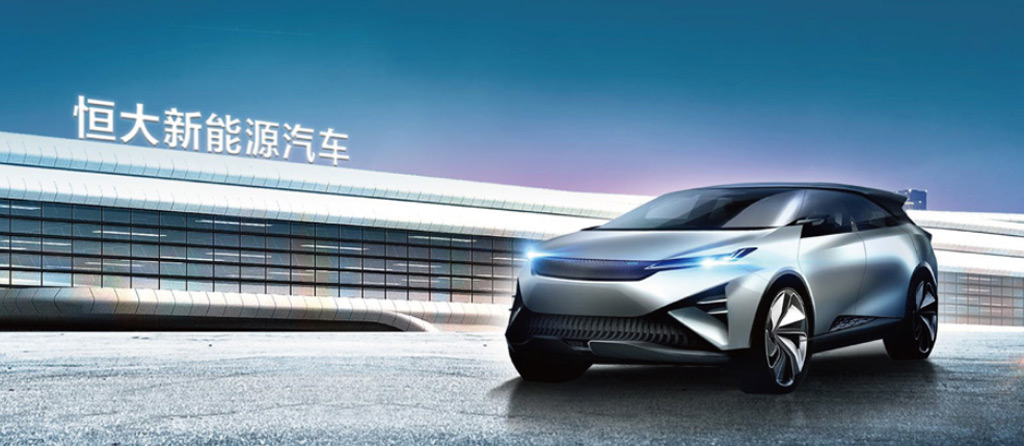
Evergrande Auto once launched nine Hengchi models at once, with a grand spectacle. But what was the result? Netizens' actual photos revealed that the show cars had no suspension or chassis structure—they were all empty shells.
All components were outsourced, and the company merely piled up supplier resources without understanding vehicle tuning or durability testing, let alone achieving basic supply chain control. The setup was vast, but beneath it was empty.
Dreame Auto followed the same trick (tào lù, a Chinese term meaning 'pattern' or 'modus operandi'). At the Beijing Auto Show, their concept car looked cool and stylish, but when the media tried to photograph the chassis, they were blocked. Later, netizens revealed the truth—the show car had no suspension or chassis structure, and all nine models were empty shells.
Each concept model cost about 3 million yuan, and most lacked complete driving capabilities or engineering prototypes for durability testing. While high-profilely promoting their self-developed intelligent chassis, they exhibited hollow show cars. How can consumers feel confident buying such cars?
Thus, some 'greenbelt warriors' and 'walking time bombs' have their origins in such practices.
Xin Guobin, the Vice Minister of the Ministry of Industry and Information Technology, has already pointed out the severity of the problem at a recent press conference of the State Council Information Office: irrational competition in the automotive industry remains prominent, with some 'aggressive' innovative designs being applied to vehicles without sufficient experimental verification, and there have been individual incidents of automotive product quality and autonomous driving safety that have drawn social attention.
The penalty measures for this special action are quite severe—for manufacturing enterprises with problems, joint punitive measures such as public notifications, suspension of relevant product 'Announcements' and compulsory product certification certificates, refusal to process relevant vehicle registration, and fines will be taken.
Moreover, the inspection method is 'surprise inspections,' without prior notice, going directly to the frontlines of vehicle manufacturing enterprises and inspection and testing institutions. The goal is to catch you off guard.
02 Returning Cars to Their Essence
After discussing 'what is being targeted,' we must discuss 'why it is being targeted.'
In recent years, there has been an extremely dangerous tendency in the Chinese automotive industry—treating the 'secondary attributes' of cars as 'primary attributes.'
Refrigerators, TVs, large sofas, voice-controlled large screens, AI large models in cars, full-scene voice interaction—are these things good?
Yes. They are value-added items that enhance the car's role as a 'second living room' and 'intelligent partner,' boosting commercial value and enriching the user experience. But the problem lies in treating these as the entirety.
A car must first and foremost be a car.
What is a car? It is a means of transportation that can steadily travel at 120 kilometers per hour on the highway for several hours; it is a mobile machine that meets safety standards for braking distance in rainy or snowy weather; it is a steel fortress that protects the occupants' lives in the event of a collision. Safety, reliability, and durability—these three words are the 'roots' of a car.
To achieve such reliability, safety, and durability, cars need to undergo extensive and rigorous testing during the DV (Design Verification) and PV (Production Verification) stages.
The problem with quick-built cars is precisely that—to rapidly pile up secondary attributes, the primary attributes are sacrificed. Development cycles are compressed from the normal four to five years to 12 to 18 months, testing and verification are cut corners, and durability tests are done once instead of twice.
Then, with flashy specification sheets and exaggerated marketing rhetoric, consumers' attention is diverted from 'is this car safe?' to 'can I sing karaoke in this car?'
This is putting the cart before the horse.
Returning cars to their essence is particularly important in the current fever of 'technological transformation' and also sustains the industry's long-term development.
This is why the addition of a special chapter on autonomous driving in the draft revision of the Road Traffic Safety Law two days ago is particularly significant.
On August 25, the draft revision added for the first time a special chapter on 'Special Provisions for Autonomous Vehicles,' clarifying the concepts of autonomous vehicles and assisted driving functions.
The draft stipulates that if a road traffic safety violation occurs when the autonomous driving function is activated, the automotive manufacturing or importing enterprise shall be held responsible. This is a reconstruction of the underlying logic, shifting from 'human full responsibility' to 'manufacturer responsibility in activated state.'
Why is this consistent with the special action in terms of underlying logic? Because both point to the same direction—emphasizing the essence of cars and clarifying responsibility lines.
In the past, when an incident occurred, consumers could never figure out whether it was a problem with the car or the driver. Automakers would simply shift the blame by saying 'the driver operated improperly.'
Now, things are different—under L2 assisted driving, the driver is fully responsible; under L3 autonomous driving in activated state, the automaker bears primary responsibility for system safety.
The two mandatory national standards previously issued by the Ministry of Industry and Information Technology have already clarified this liability logic—GB 47955-2026 applies to 'human driving with system assistance,' and GB 44721-2026 applies to 'system undertaking dynamic driving tasks.' This revision of the Road Traffic Safety Law elevates this logic from industry standards to national laws.
To draw an analogy. It used to be 'find the driver in case of an incident,' but now it has become 'find the automaker in activated state.' Consumers no longer need to worry—if an incident occurs when the car is driving itself, the automaker is responsible; if it occurs when a human is driving, the human is responsible. The boundaries are crystal clear.
This dual regulatory system of 'laws + standards' essentially forces automakers to return to the essential attributes of cars.
Do you like to hype intelligent driving? Fine, since you claim the car can drive itself, you must take responsibility if something goes wrong.
Do you like to pile on features? Fine, but only if safety, reliability, and durability—the primary attributes—are not compromised.
The special action addresses the issue of 'building good cars,' while the revision of the Road Traffic Safety Law addresses the issue of 'driving cars responsibly.' One manages the production end, and the other manages the usage end, working together towards the same goal—returning cars to their essence as 'reliable transportation.'
03 Will 'Hundreds of New Models a Year' Come to an End?
What changes will occur in the future Chinese automotive market after this set of coordinated actions?
First, the 'quick-built' model of launching hundreds of new models a year and three or four models a day will likely come to an end.
The notice explicitly requires enterprises to strengthen testing and verification of aggressive innovative designs in automotive products, fully assess safety risks, and prudently promote the application of new technologies in vehicles.
The four departments will increase inspection and sampling efforts for models and key components of enterprises with high levels of irrational competition and production consistency and quality safety risks.

What does this mean? It means that if you try to quickly produce a new model and throw it onto the market by cutting corners and skipping verification steps, you will find no door open. Testing and verification must be thorough, durability tests must be sufficient, and risk assessments must be comprehensive—all of which take time.
Second, the competitive logic among automakers will fundamentally shift.
In the past few years, competition in the industry has focused on 'who has fancier features'—you install a refrigerator, I install a washing machine; you have a large screen, I have an even larger one; you call yourself a 'mobile living room,' I call myself an 'intelligent third space.'
After the implementation of the Road Traffic Safety Law revision and the special action, competition will shift from 'who has fancier features' to 'whose system is safer and whose responsibility-taking ability is stronger.' Safety compliance will be a prerequisite for market launch, and clear responsibility will be a prerequisite for sales.
The days are over for 'quick-built players' who rely on piling on features, aggressive marketing, and cost-cutting. Conversely, enterprises that invest genuine effort in safety, reliability, and durability will reap institutional benefits.
Third, consumers' rights will be substantially protected.
In the past, consumers' biggest confusion when buying a car was 'not knowing if what they bought was a half-finished product'—the specifications looked good, the features were complete, but it never felt right when driving.
Now, things are different. Production consistency ensures that 'the goods match the description,' reliability ensures that 'it doesn't break down every few days,' durability ensures that 'it doesn't fall apart after three years,' and testing and verification of new technologies ensure that 'consumers are not treated as guinea pigs.'
More importantly, after the revision of the Road Traffic Safety Law, violations in the activated state of autonomous driving will be the responsibility of the automaker. Consumers buying intelligent driving cars finally have a clear legal basis. They no longer need to worry about bearing the blame themselves or being misled by various marketing rhetorics like 'L2+++' or 'quasi-L3.'
Fourth, the insurance system will undergo reconstruction.
Traditional auto insurance is based on the premise that 'the driver is the responsible party.' When the vehicle enters autonomous driving mode, this logic no longer holds.
In the future, two types of insurance will emerge—car owners will purchase 'non-activated state' insurance covering manual driving, while automakers will purchase 'autonomous driving product liability insurance' corresponding to activated risks.
Moreover, autonomous vehicles will record a large amount of driving data—mileage, scenario complexity, system takeover frequency, etc.—future insurance pricing will be more equitable: safer driving means lower costs, while higher risks mean higher costs.
Fifth, and most importantly—more people will have the ability and courage to own a car.
China currently has around 260 cars per thousand people, while developed countries have 500 to 800. There are still a large number of people who dare not drive, cannot drive, or are unable to drive.
Autonomous driving lowers the barrier to driving—elderly individuals, those with physical limitations, and people afraid of driving can now have the possibility of owning their own car. This is not about replacing existing stock but releasing new potential.
When autonomous driving frees up the driver's hands and time, cars are no longer just a 'means of transportation from point A to point B' but become mobile living rooms, offices, and lounges. Who wouldn't want that?
Looking back, the special action notice issued on August 27, combined with the road traffic law amendment draft on August 25, along with the two previously released mandatory national standards, form a complete institutional puzzle.
GB 47955-2026 and GB 44721-2026 address the access issue of 'whether technology can be used on the road'; the road traffic law amendment addresses the legal issue of 'who holds the rights and responsibilities after going on the road'; the special action addresses the regulatory issue of 'whether the car is well-made.' These three elements are interconnected and build upon each other.
This transformation from 'people driving cars' to 'cars driving themselves' ultimately points toward a more inclusive and equitable transportation society.
The first step on this path is to return cars to their essence—first, as a safe, reliable, and durable means of transportation, and only then can we talk about 'second living rooms' and 'intelligent companions.'
Those quick-success car giants who have gotten the order wrong should wake up.
Editor in charge: Shi Jie Editor: He Zengrong

THE END
-
![]()
In the first half of this year, Chinese automakers went on a rampage overseas again.
-
![]()
This Year’s Joint Venture Pure Electric Models Adopt a More Pragmatic Pricing Strategy
-
![]()
Li Auto’s Q2 Performance: A Striking V-Shaped Rebound, Regaining Momentum Against All Odds
-
![]()
Collective Struggles for New Energy Players: Li Xiang Acknowledges Pricing Challenges
-
![]()
State Cracks Down Hard on Quick-built Cars
-
![]()
September Sees Fierce Smartphone Market Competition: Will Foldable Phones Be Overshadowed?
-
![]()
Ideal's 'Revival'
-
![]()
AI Behemoth Spends $45 Billion Amassing Computing Power: A Battle Too Costly for Small Firms