Google Places Its Bets on Smart Glasses for the Future, While ByteDance Zeroes in on Doubao for the Present
 12/11 2025
 672
672

Both Google and ByteDance are on the hunt for AI-driven pathways, aiming to liberate users' hands and seize control over traffic entry points.
Written by | Zhao Weiwei, Blue Hole Business
By enabling hands-free operation and direct system control through voice commands, Google and ByteDance find themselves at the same AI crossroads—one with smart glasses and the other with mobile phones.
The smartphone industry has long been in need of disruptive innovation. The advent of Doubao Mobile Assistant has drawn attention with its exceptional versatility, though it has also sparked controversies surrounding privacy protection. Many apps, including WeChat and Taobao, have barred Doubao Mobile from logging in. Despite this, the Nubia M153, equipped with the assistant and priced at 3,499 yuan, has witnessed a robust market response post-launch, with some units even being resold at prices exceeding 10,000 yuan.
ByteDance's Doubao Mobile Assistant embodies disruptive innovation, while tech behemoth Google is quietly setting the rules for the smart glasses market. AI capabilities serve as the driving force behind both initiatives.
In the latest installment of The Android Show, Google has shifted its focus from a single flagship device to collaborating with partners like Samsung and XREAL to launch four device types tailored to different scenarios. The goal is to interconnect them using the Android XR operating system, which encompasses not only high-performance head-mounted displays but also lightweight AI and XR glasses. These products are slated to hit the market in 2026.
The Android XR operating system's standout feature is Google's core Gemini AI, while Doubao Mobile Assistant represents a strategic move by Doubao to leverage its large model capabilities to challenge Chinese mobile phone manufacturers. One is betting on the future, the other is reshaping the present. Google and ByteDance share a common objective: to find AI-driven pathways that liberate users' hands and dominate traffic entry points.
Google: Finding a Physical Form for Gemini
As a pioneer in smart glasses, Google has once again placed its bets on the future of smart device forms. At Google's latest Android Show, it unveiled four glasses devices:
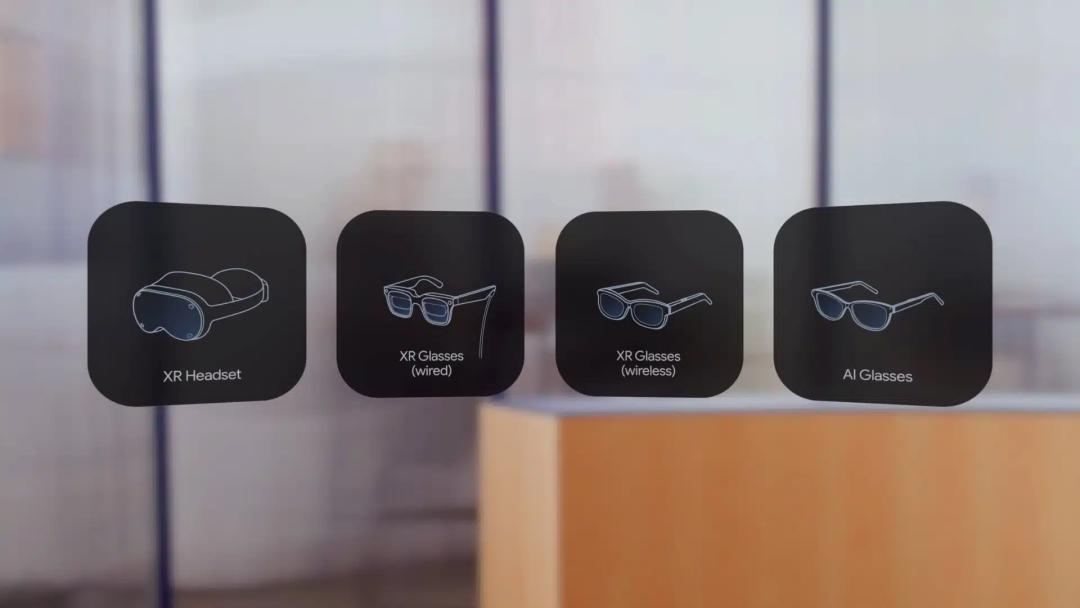
1. "Project Moohan," a rival to Apple's Vision Pro, seamlessly streams Windows PC screens to head-mounted displays, utilizes AI to generate lifelike user avatars for video calls, and combines Samsung's hardware prowess with Google's software expertise and Windows' productivity tools.
2. "Project Aura," a wired XR glasses collaboration with domestic player XREAL, runs complete Android XR applications. Resembling ordinary sunglasses, it allows users to work and entertain anytime, anywhere, striking a perfect balance between immersion and real-world awareness.
3. Wireless AI glasses, akin to Meta Ray-Ban, function as screenless audio glasses that can be worn all day. They rely on built-in speakers, microphones, and cameras to work seamlessly with the Gemini system.
4. Single-eye display AI glasses, set to launch in 2026, feature displays on the lenses that showcase basic visual information like music and navigation. In 2027, Google will unveil dual-eye XR glasses supporting mixed visual effects, seen as the ultimate prototype closest to the future vision by Google.
These four XR devices, spanning scenarios from high-performance head-mounted displays to lightweight gadgets, not only compete with Apple and Meta but also underscore Google's dominance over the XR ecosystem. Android is evolving beyond a mobile system to encompass computers, head-mounted devices, and glasses.
This expansion points to a growing Android ecosystem where users can seamlessly use familiar apps on XR devices, and developers can leverage familiar Android tools and architectures to create a wide array of display-based applications and experiences, vastly expanding the possibilities for future XR interactions.
"I'm incredibly excited about AI glasses—their design as personal assistants is outstanding. Can't wait to share more next year!" exclaimed Google's Android ecosystem president on social media.
The design as personal assistants reveals Google's core purpose in developing AI glasses and XR devices: to find a physical incarnation for Gemini.
As Google's current AI focus, Gemini seeks new growth avenues beyond mobile apps and web interfaces. AI glasses represent Google's most advantageous and accumulated domain. By integrating with glasses' cameras, microphones, and environmental sensors, Gemini enables real-time semantic understanding, scenario-based task processing, and natural interaction, elevating AI from an application to the system itself.
Recently, Google Gemini's rapid ascent has directly challenged OpenAI's dominance.
According to the latest data from market intelligence firm Sensor Tower, while ChatGPT remains the industry leader, accounting for 50% of global mobile downloads and 55% of global monthly active users, its growth momentum is waning. Gemini, posing the most direct threat, is rapidly closing the gap, surpassing ChatGPT in download growth, monthly active user growth, and user engagement time growth.
In August, Google's Nano Banana image generator achieved market success, further boosting Gemini's market share. On the third-party model performance ranking LM Arena, the Gemini 3 model has outperformed ChatGPT, and the Gemini AI app briefly topped the app store charts.
This prompted Sam Altman to declare an "orange alert" in October to accelerate ChatGPT's growth.
While the competition between Google and OpenAI is seen as the AI industry's focal point, Altman believes that in the long run, OpenAI's true rival is Apple. He contends that the device used to access AI is crucial, and current phones are ill-suited for AI applications. Hence, OpenAI is also recruiting talent from Apple for its hardware product development strategy.
AI hardware development is a time-consuming endeavor; the underlying operating system is paramount. Currently, Android remains the world's largest mobile operating system. Many global Gemini users rely on Android's built-in features rather than standalone Gemini apps, a significant advantage for Google in its competition with OpenAI.
As Google's Gemini breaks through the AI hype, AI glasses embodying Gemini will make their official debut next year, likely serving as a significant catalyst for Google to reach a $4 trillion market cap.
Doubao: Taking Over the Mobile Phone Realm?
While Google aims to extend the Android system to the XR realm, laying out AI entry points before your very eyes, Doubao Mobile Assistant's essence is to bring AI out of the dialog box and into the core of the mobile operating system.
Last week, Doubao Mobile Assistant sparked widespread online discussion as Nubia phones equipped with it could assist users in operating mobile apps via voice commands, such as booking tickets, shopping, and gaming. Its most outstanding feature is its full-scenario versatility, a major leap beyond previous AI assistants from major mobile phone manufacturers.
Doubao Mobile Assistant represents a new frontier in deeply integrating AI technology with mobile phone systems. Its core manifestation is automated operations based on recognizing and understanding screen content. After AI analysis in the cloud, instructions are sent back to the phone for automatic execution, significantly breaking through traditional API data calling methods and eliminating the need for individual APP permission requests.
However, just three days after its launch, Doubao Mobile Assistant faced controversies, including WeChat login restrictions. Subsequently, several adjustments were made, including but not limited to score manipulation, incentive manipulation, and restrictions in financial apps and gaming scenarios, to mitigate fairness and security controversies arising from AI-assisted cheating and sensitive operations.
Doubao Mobile Assistant sparked controversy because it encroached on the interests of other domestic tech giants, but the AI trend is unstoppable.
On December 9, Zhipu AI open-sourced its core AI Agent model, AutoGLM, effectively open-sourcing the underlying capabilities for creating "Doubao Mobile Assistant" to hardware manufacturers and developers. This enables them to build AI assistants that understand and operate screen content. In Zhipu's demonstrated scenarios, this model already supports over 50 products, including WeChat, Taobao, and Douyin.
As a CITIC Securities research report puts it, AI Agents for mobile phones are akin to autonomous driving for cars.
The report suggests that the collaboration between "Doubao and Nubia" can be likened to the successful case of "Huawei and Seres" in the automotive sector. Large model vendors are expected to provide mobile phone manufacturers with more powerful large model capabilities and ecological support, accelerating the launch of AI phone blockbusters that further optimize consumer experiences.
However, compared to the backlash from domestic APP giants facing threats, it's more noteworthy how other mobile phone manufacturers perceive Doubao Mobile Assistant. This represents a profound transformation of the mobile operating system, not just an app-layer external assistant. It points to a potential takeover of the mobile operating system itself.
As Doubao Mobile Assistant takes the lead and Zhipu AI continues to penetrate the AI phone realm, which mobile phone manufacturer will follow suit? The answer undoubtedly lies on a battlefield of competing interests and strategies. Entry points, traffic, and control rights are crucial, but more importantly, establishing standardized bottom lines and norms will become the next proposition for the AI phone industry.
Who Will Be the Future AI Entry Point?
AI phones represent a "new revolution on an old continent," while AI glasses are a "new continent being seized." The question remains: who will be the future AI entry point?
Google's strength lies in its ecosystem. Android remains the world's largest mobile operating system, holding over 70% market share. Among global smart device companies, only Apple and Google have truly built ecological capabilities. As XREAL founder Xu Chi said, Apple is not inclined towards open collaboration, making Google their only choice. Interconnectivity among different smart device forms will see third-party apps under the Android ecosystem explored in smart glasses.
This is also a key reason why Google is favored in the future smart glasses sector.
More importantly, with Gemini's support, iPhone users who install Gemini can gain a complete experience similar to Google's smart glasses. Although third-party apps may face Apple's restrictions, other Google products like Google Maps can remain compatible, significantly expanding Google's smart glasses user base.
Undoubtedly, Gemini is Google's biggest "ace" for future AI glasses.
Of course, the core pain point in the current XR industry is the lack of an application ecosystem. Becoming an AI entry point will take time, a problem not solvable overnight. Fortunately, Google is now building an Android operating system for the XR ecosystem, inviting developers to join this ecological game. It provides a relatively complete system and ecological platform, directly leveraging the existing Android app ecosystem and utilizing Google services and Gemini.
As Google puts it, developing for Android in the future means developing for Android XR.
While Google implants AI into glasses, ByteDance is embedding AI into the underlying system of smartphones. Compared to Google, Doubao Mobile Assistant may arrive sooner. It bypasses API restrictions, truly connecting closed apps. The phone screen remains, but the app operation interface is automated. Through extreme contextual understanding and execution, AI ultimately fulfills user demands.
It's an industry consensus that AI glasses cannot replace smartphones in the short term. However, as Google begins establishing rules and order in this new continent of glasses, a future where information appears before your eyes without needing to look down at a screen is no longer distant.
Whether it's Google or ByteDance, tech giants are forging a future beyond apps, where user intent becomes the sole operating system.
-
On the Eve of Its IPO, Avatr Finds Itself Embroiled in a 'Farce of Controversy and Belittlement'
-
![]()
Yutong Optics' Japanese Subsidiary Unveiled in Tokyo, Shifting Strategic Focus to Technology-Driven Growth
-
![]()
Half-Year Revenue Outstrips Last Year’s Total! Zhongrun Optics Forecasts 80.2% H1 Revenue Growth
-
![]()
Why Does AI Competition Start with Computing Power?
-
![]()
Apple AI Finally Makes Its Debut in China, Yet iPhone's 'AI Autonomy' Faces Uncertainty
-
![]()
Apple AI and QianWen Make Up Lessons: Alibaba Has Its Own 'Doubao Phone'
-
![]()
QianWen Joins Apple, Signal for Large Models to ‘Fade into the Background’
-
![]()
The ‘Anchor’ Strategy of Google Hidden Behind the Bleeding Financial Report