Has the Smart Glasses Era Truly Dawned? Here’s the Situation
 12/15 2025
 779
779
If you’ve recently strolled through major first-tier cities near subway entrances, you’ve likely noticed that smart glasses advertisements are ubiquitous on billboards.
Meanwhile, a surge of new smart glasses companies has emerged on various platforms in recent years, accompanied by a steady stream of financing news. Internet giants such as Kuake and Xiaomi are also diving into the smart glasses race, launching high-profile products.
Investors in the consumer electronics sector have begun frequently discussing what could be the next big thing after smartphones.
This year, a shared vision for future technology is taking shape.
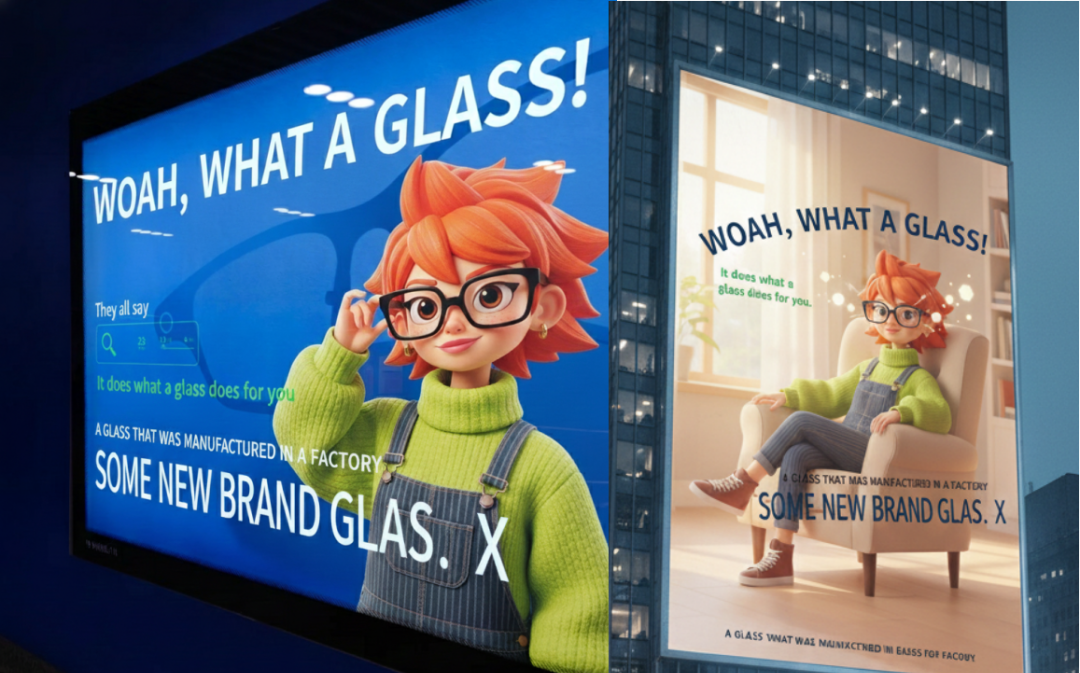
Advertisement Schematic for Smart Glasses from Leading Brands
Image Source: NanoBananaPro
However, this has also led to confusion among investors and consumers: What exactly makes these products, marketed as 'smart' and 'AI-enabled,' intelligent? Can their technological advancements truly usher in a new hardware era?
Or is this just another overhyped trend where the technology falls short of expectations?
Faced with a new and emerging trend—where definitions are still being debated, new players are entering the market, and rules have yet to be established—narratives often prove more compelling than facts.
But facts ultimately carry more weight than narratives. Therefore, this article aims to explore three key questions:
1. Why have smart glasses become a hot topic in 2025?
2. In this dynamic landscape, how can we define what truly constitutes smart glasses?
3. Where lies the breakthrough point for the next generation of computing gateways?
AI Gateway Anxiety: Which Path Should We Pursue?
The popularity of smart glasses stems from three underlying forces: AI gateway anxiety, the rise of spatial computing concepts, and capital's bet on the next smartphone-like revolution.
The rapid development of generative AI, exemplified by ChatGPT from 2023 to 2025, has created a new user demand:
“I want to access AI anytime, anywhere, without pulling out my phone every time.”
Smartphone interaction relies on users initiating actions: opening apps, inputting content, and tapping buttons. AI, however, is shifting toward proactive judgments—anticipating needs and automatically completing tasks based on the environment, context, and user behavior.
Given this technological shift, we need a device form that is more perceptive and less disruptive to daily life than smartphones.
Glasses, which stay within the field of vision, can be worn continuously, free up the hands, and synchronously perceive the real world, naturally emerge as the optimal gateway for the next generation of human-computer interaction.
On the other hand, devices like Vision Pro, Pico, and Quest have demonstrated the potential of spatial computing: computing doesn’t have to be confined to a small smartphone screen but can blend and interact with the real world.
While these devices currently appear bulky, with limited battery life and unsuitability for daily wear, they resemble early prototypes of the next generation, instilling the industry with optimism:
If Vision Pro can achieve such immersion and Pico can already perform basic spatial understanding, isn’t it just a matter of time before these capabilities are condensed into a glasses form?
Looking at the evolution of consumer electronics, since smartphones became mainstream, the industry has been searching for the next big thing. However, devices like smartwatches, earphones, and foldable screens have remained within the smartphone ecosystem, lacking independent gateway value.
The emergence of generative AI has intensified this anxiety: If AI is the most crucial technological capability of the future, what will be the most suitable carrier? Will it be smartphones or a new device form?
Capital is, therefore, keen on betting on smart glasses because they possess several attractive characteristics: a clearly defined yet unoccupied category; a natural fit with AI narratives; and an imaginative space akin to smartphones before the iPhone’s debut.
Thus, the phenomena we see today—advertisements, financing, and entrepreneurial waves—are not because the vision of smart glasses has already been realized but because the entire industry is vying for narrative control over the future gateway.
Smart Glasses in the Present: Caught in a 'Three-Nothings' Era
The chaos in the 2025 smart glasses market stems from the absence of a clear category definition.
In a mature consumer electronics category, no one would mistake a calculator for a pager or a basic early mobile phone (Xiaolingtong) for a smartphone. However, smart glasses find themselves in an awkward stage:
Currently, any device on the market with lenses, a screen, and Bluetooth connectivity labels itself as an 'AI' and 'smart' glasses product.
This chaos is not about industry ethics or standards but rather a typical characteristic of an industry in its infancy: no standards, no boundaries, and no anchors.
This chapter attempts to establish a smart glasses classification system not based on brands or price points but on core capabilities and technical architectures, enabling us to understand this early and chaotic market more accurately.
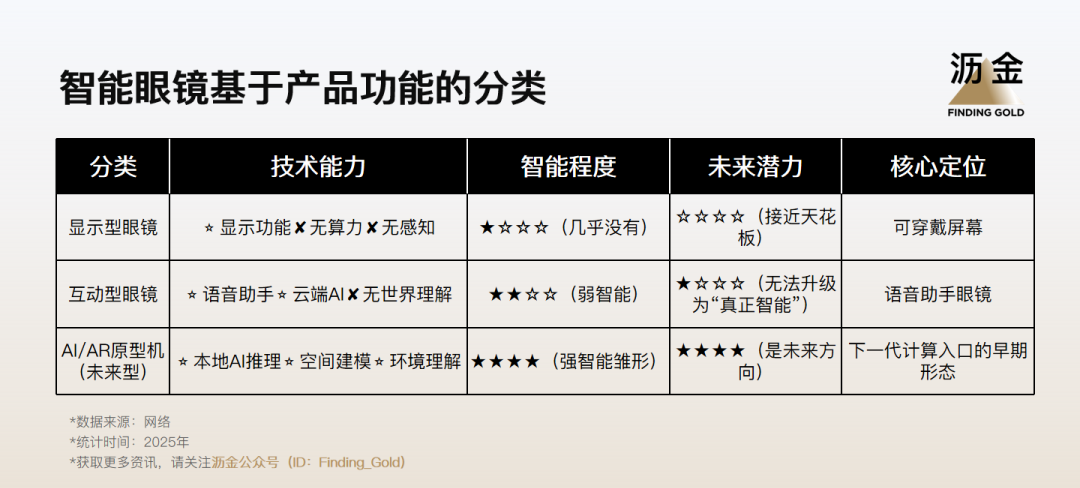
Currently, the market is flooded with 'display-type glasses,' which are also the most heavily marketed and numerous in terms of individual products.
Their essence is projectors placed on lenses, primarily used for watching videos and viewing notifications. They lack computing and spatial understanding capabilities. The so-called 'AI functions' rely solely on the large model computing power within smartphones.
Typical marketing scenarios include watching dramas on the subway or two people in the same space consuming different content.
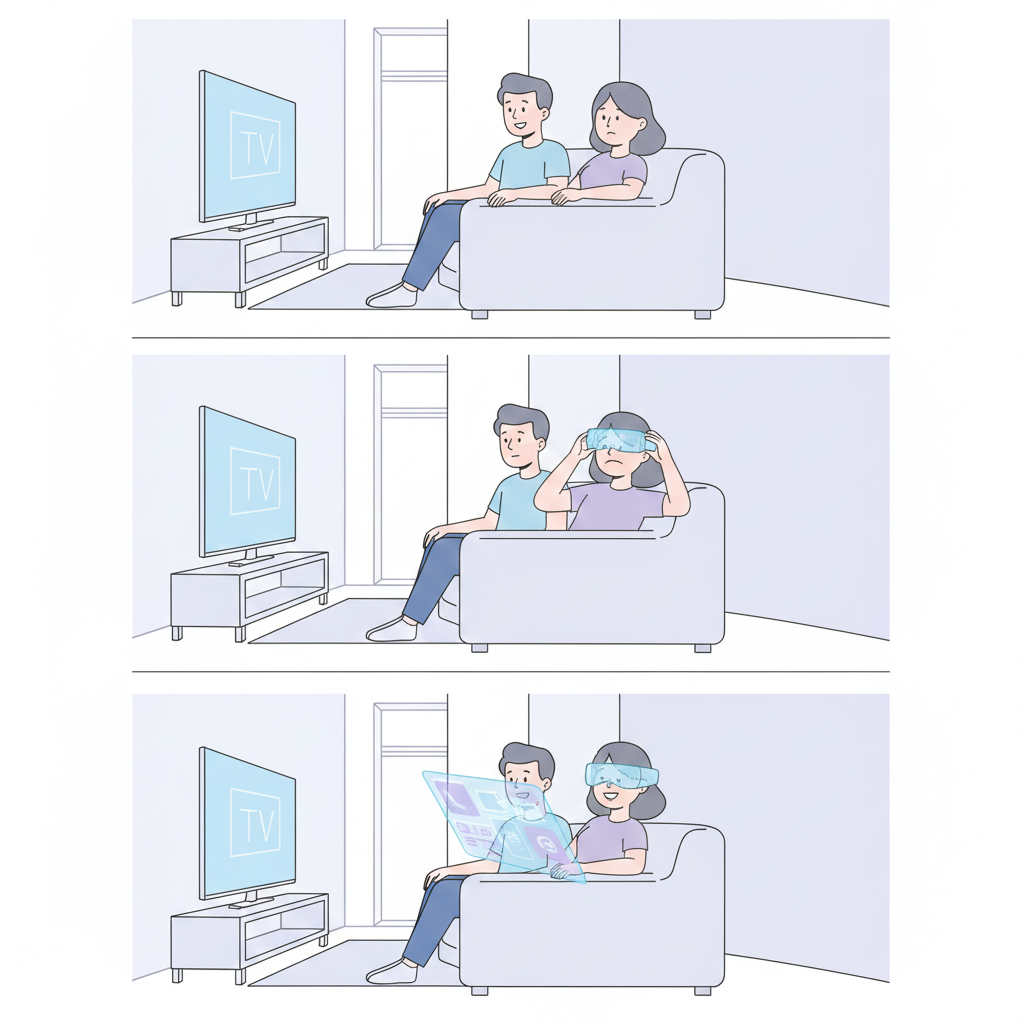
Marketing Scenarios for Display Glasses on the Market: Two Individuals Consuming Different Video Content in the Same Space
Image Source: NanoBananaPro
The proliferation of such products stems from their technological maturity, low barriers to entry, rapid commercialization potential, and the ability for contract manufacturers to create new brands with design changes.
However, problems arise when these more entertaining displays are packaged as smart glasses under the guise of AI. When advertisements repeatedly mention 'AI-assisted,' 'next-generation computing,' and 'smart interaction,' consumers struggle to understand that this has little to do with true intelligence.
Such products are one of the sources of current market chaos.
The second category consists of 'interactive glasses,' which exhibit some traces of intelligence but fall short of truly smart thresholds.
Compared to purely display-type glasses, these offer enhanced capabilities: basic voice assistants, cloud-based AI operation, gesture or head control, basic photography, and navigation.
However, they suffer from two flaws: limited or no local computing power, leading to high latency and instability; and a lack of world understanding, essentially remaining passive voice assistants waiting for instructions.
The third category represents what the industry and investors hope for: truly intelligent AI glasses in the so-called genuine sense.
Although no unified industry standard exists, insights from technical whitepapers by Apple, Meta, Google, Microsoft, and Qualcomm, along with mainstream AR/XR research, reveal that any device claiming to be 'AI smart glasses' must possess five foundational capabilities:
1. Local computing power (Local Compute/On-Device ML)
2. Spatial understanding capabilities (SLAM/Depth/Scene Understanding)
3. Real-time interaction (Low-Latency Interaction)
4. Long battery life and lightweight design (Ergonomics/Power Efficiency)
5. Always-available AI capabilities (Vision+LLM+Multimodal)
In plain language, intelligent AI glasses must be capable of seeing the world, understanding it, and sharing a real-world environment with you at all times.
Today, only XR devices like Vision Pro, Pico, and Quest come close to such capabilities. However, they remain experimental products in the journey toward the future rather than daily wearable items.
Based on this standard, no truly intelligent AI glasses exist on the market today. The entire industry is still in the exploratory phase of transitioning from prototypes to lightweight forms.
In summary, three fundamental reasons contribute to industry chaos.
Firstly, enticing narratives. Whether it's 'hands-free,' 'portable AI (AI always with you),' or 'next-generation gateway,' these concepts' futuristic appeal is strong enough to prompt manufacturers to hastily adopt corresponding labels.
Secondly, consumers lack benchmarks. For smartphones, consumers know what constitutes a mature product. However, for smart glasses, the absence of flagship products makes them susceptible to marketing influence.
Finally, although the technology is not yet mature, the market desperately needs stories. Capital, manufacturers, and entrepreneurs are all vying for the first-mover advantage in the post-smartphone era. Amidst this fervor, many companies resort to marketing gimmicks to compensate for technological shortcomings, using cloud computing to supplement local processing power and high-end displays to package intelligence.
As a result, products self-proclaimed as 'intelligent AI glasses' vary drastically in their core capabilities, resembling the difference between Xiaolingtong and smartphones—products from entirely different eras.
No Clear Vision of the Future: Hesitant to Make the Purchase
After addressing why the intelligent AI glasses market is both hot and chaotic, this section focuses on the future: How far are we from truly intelligent AI glasses?
To understand the future, we must examine two layers: hardware limitations and software bottlenecks, both of which constrain the birth of ideal products.
AI glasses must first possess two foundational capabilities: accurately understanding the surrounding environment and maintaining synchronization with user movements and gaze changes.
To achieve these, the device must incorporate multiple cameras, depth sensors, sustainable computing power, batteries, and cooling systems, all of which imply bulk and energy consumption.
The challenge lies in the fact that glasses' form factor restricts volume, while computing power and batteries are constrained by physical laws. You cannot cram smartphone-level computing power into a frame weighing just several tens of grams, nor can you expect tiny batteries to sustain continuous AI inference, let alone place hot chips against your face.
Therefore, true AI glasses must be as powerful as smartphones yet as lightweight as glasses—a combination still unattainable today.
This is why Vision Pro must be bulky, Pico remains a headset, and all lightweight glasses fail to deliver a genuine AI experience.
If hardware sets the upper limit, software determines whether the experience holds up. Even today's most advanced XR devices face a core software challenge: their world understanding speed always lags slightly behind humans.
When users quickly turn their heads, move, or interact with the environment, the device must re-identify the space, locate itself, and judge object relationships. Relying on SLAM technology, which processes images after seeing them, means the device is always reacting to past events. This lag causes minor drifts, positioning losses, and disjointed movements.
To transcend this technological boundary, software must not only recognize but also understand the environment; it must not only understand but also predict what will happen next.
Today's smart glasses merely passively follow user actions, processing what they see but always lagging. Future smart glasses must proactively understand the environment, infer the user's next move, and make the experience feel like a natural extension of the senses rather than a mechanical response.
The transition from passive reaction to proactive prediction represents the most crucial capability shift for AI in wearable devices. Only by surpassing this point can smart glasses truly enter the next generation. Given current technological levels, no manufacturer has achieved this yet.
Due to the unresolved hardware and software limitations, the entire industry stands at a crossroads. When 'technology is not yet mature' becomes an industry consensus, the path forward ceases to be a purely engineering problem and transforms into a strategic choice.
Today's smart glasses market is actually moving toward three distinct directions:
The 'prototype route,' which starts with complete capabilities and compresses toward lightweight forms; the 'evolutionary route,' which begins with wearable forms and gradually adds intelligence; and the 'opportunistic route,' which swiftly integrates existing technologies to meet specific scenarios. These routes lead to different futures.
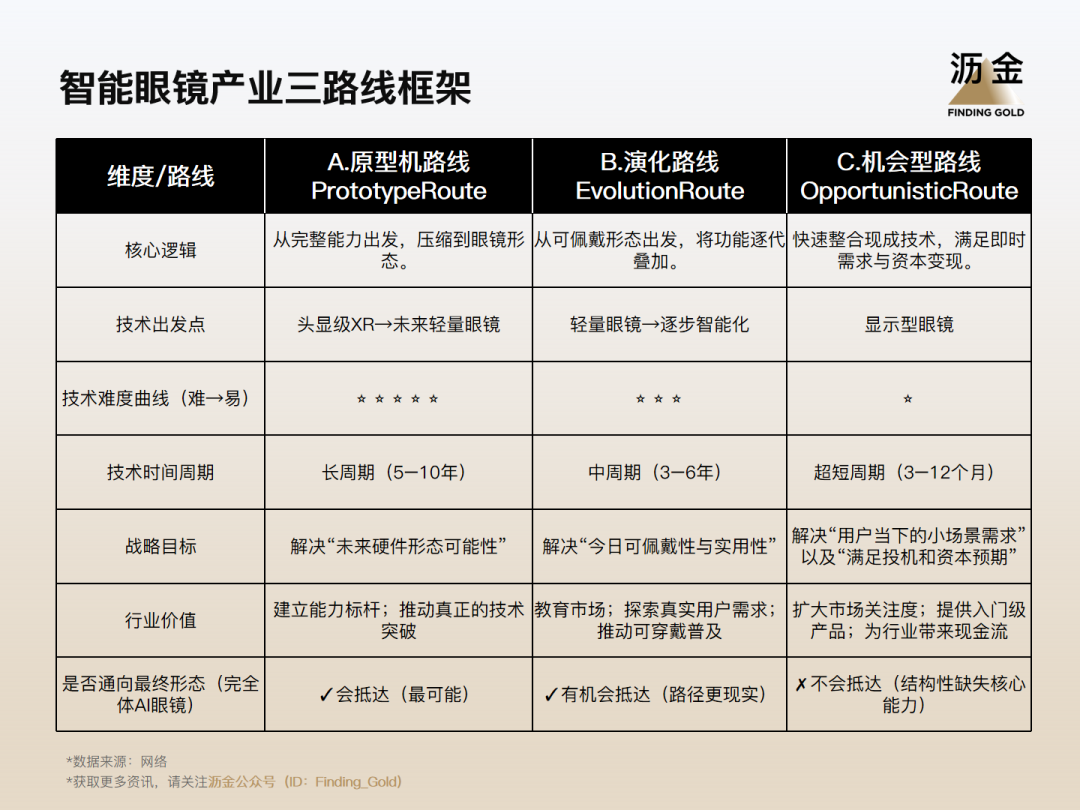
The core logic of the prototype route is to first construct the full set of capabilities potentially needed for future gateways: high computing power, multimodal sensors, spatial understanding, scene reconstruction, and real-time interaction. Such devices do not aim to meet 'daily wearability' requirements in their initial stages but prioritize verifying the complete form of the next-generation computing gateway.
Only after establishing the capability landscape can technology be iteratively compressed into a glasses form. The challenges are evident—bulky, expensive, and limited battery life—but it bears the responsibility of defining future boundaries. This route progresses from complexity to lightness, first proving the future and then approaching reality.
The evolutionary trajectory takes a distinct path. It doesn't commence with fully - fledged capabilities; instead, it starts from the very 'wearable glasses form', making swift iterative progress based on capabilities that can be realistically implemented. These include photography, live - streaming, voice assistants, real - time sharing, cloud - based inference, and lightweight spatial understanding. Each new generation expands its capabilities within real - world usage scenarios, striving to find a stable evolutionary path that balances 'lightweight' and 'intelligent'.
The advantage of this approach lies in its close connection to users' daily lives and its rapid iteration pace. It gradually accumulates intelligent capabilities within a wearable form. However, its upper limit is determined by hardware compression and the point at which local computing power can truly be achieved. It's more akin to a journey of 'evolving from glasses to intelligent devices' rather than 'compressing computers into glasses'.
The opportunistic approach currently boasts the largest number of participants and is the quickest to commercialize. It capitalizes on mature display technologies and controllable costs to integrate display capabilities, optical solutions, and basic interactions into a glasses form. This targets content consumption, private viewing, or single - scenario demands.
Such devices often boast excellent visuals, lightweight structures, and well - defined usage scenarios. But their intelligence mainly serves to enhance existing experiences rather than comprehend the world. Their significance lies in rapidly educating the market, lowering barriers for the category, and promoting the glasses form through functional products.
Although they are still far from achieving true intelligence, they play an indispensable role in the early stages of the industry.
The starting points, difficulty levels, and time frames of these three approaches vary. The prototype approach focuses on future possibilities; the evolutionary approach tackles the issue of wearability in the present; and the opportunistic approach meets immediate user needs while validating the market, quickly recovering cash flow, and fulfilling capital expectations in the early stages.
In a budding industry, these three paths are not mutually exclusive. Instead, they collectively form the early ecological foundation of smart glasses. The prototype path raises the technological ceiling; the evolutionary path drives growth in real - world usage scenarios; and the opportunistic path, with its relatively manageable product form, provides the commercial momentum required for the entire industry to sustain operations.
The future, fully - integrated smart AI glasses may not emerge solely from one path. Instead, they are more likely to result from the convergence of these paths when technology matures and market structures stabilize.
Lijin Review
The hype surrounding smart AI glasses is genuine, but the actual products are still on their way.
The smart glasses craze in 2025 is not a mere illusion; it is supported by very solid underlying trends of the times. AI is in urgent need of new interaction interfaces, spatial computing must find hardware forms that can be truly implemented, and the lifecycle of smartphones as the 'ultimate portable device' is entering its later stages.
However, these trends do not imply that current products have reached their final form. On the contrary, most of the 'smart glasses' currently available in the market are actually early exploratory works in the industry. Their main function is to educate the market and validate demand.
There is still a long technological evolution process ahead to achieve the ideal smart form. This includes compressing hardware to wearable sizes, stabilizing environmental understanding models, and integrating capabilities from different technological paths in later stages.
The true gateway has not yet appeared, and everything happening now is just the prologue.
-
On the Eve of Its IPO, Avatr Finds Itself Embroiled in a 'Farce of Controversy and Belittlement'
-
![]()
Yutong Optics' Japanese Subsidiary Unveiled in Tokyo, Shifting Strategic Focus to Technology-Driven Growth
-
![]()
Half-Year Revenue Outstrips Last Year’s Total! Zhongrun Optics Forecasts 80.2% H1 Revenue Growth
-
![]()
Why Does AI Competition Start with Computing Power?
-
![]()
Apple AI Finally Makes Its Debut in China, Yet iPhone's 'AI Autonomy' Faces Uncertainty
-
![]()
Apple AI and QianWen Make Up Lessons: Alibaba Has Its Own 'Doubao Phone'
-
![]()
QianWen Joins Apple, Signal for Large Models to ‘Fade into the Background’
-
![]()
The ‘Anchor’ Strategy of Google Hidden Behind the Bleeding Financial Report